Sunday, September 16, 2007

Pecfectability

When psychologists with 6 volt batteries and a stable of monkeys they didn't mind torturing figured out that there was classic "stimulus/ response" and that some rewards were better than others, we were all screwed. The psychologists might have claimed noble motives more than Nobel motives, but what they had discovered was why we gamble. Needless to say, the gambling palaces have since been the hungry beasts sucking from all the addiction scholars. Every time someone studies "what makes suckers into victims," the golden palaces read it and try to use the research to make more suckers into dependents. Let's face it: if you, Mr. Common Good Psychologist, find out that payouts at exactly 8.6% are associated with the most addicted gamblers, the casinos are going to change their slot machines and tables to offer a payout of 8.6%. If you think anything else will happen, then you are the sucker.

Today is Sunday, and Sunday is the Christian sabbath and the first day of the week. That seems fitting, to me. (Christians, by the way, are not let off the hook about the sabbath, but most of my co-religionists think they are -- if they even realize that Saturday is the 7th day.) The service today coincided with something I've been thinking about. From Collect to readings to sermon, the subject was forgiveness and sin. That's not the usual thing in my denomination. We're a more light hearted lot than the ranters. However, I've been thinking for a long time about a particular basic human desire and how it leads to the other addictions and mistakes.

The myth of perfectibility is one of the most important functional truths of our lives as individuals and our agglutinations as societies. Don't get me started about perfectibility and Original Sin. (Really: don't. I'm semi-pelagian. That will come up later, probably.) No, not that, but the binary concept of ultimate depravity vs. perfectibility goes through all recorded history, both western and otherwise. How bad are you? How much of that is inevitable? Is it possible to be better? What is better?

Should I break this into pieces?

Start with the obvious: the hope of amelioration is necessary for motion itself. If you don't think things are better over there than here, then you're not moving. If you don't think that you'll be better off with the pay than without it, you're not working. If you don't think that your bodily desires are better with a partner than without, you're not sacrificing for one. In other words, movement in all our senses is motivated by dissatisfaction and the hope of improvement. Additionally, parenting is all about better. It is largely what learning is about, as well. We waste time talking about unconscious things, though. The sort of better that is pathological is the sort that has as its end point the perfect.

You gamble because it's fun, but you keep gambling because there is enough regularity that you believe you can master the game and enough chance that you never can. You keep beating at Wikipedia because it seems like you have a real chance at a fair game and can make a perfect entity. The success of Wikipedia, in particular, is related to this hope of perfecti
on. Why would the author of the article on the Death Cap mushroom write it on Wikipedia? Is it that this kind of above-journalism and below-specialist prose has no journalistic home in a contemporary Life Magazine? Is it because print encyclopedias would never allow such a contributor who was not a professional myconologist? Perhaps both of those things are true. Perhaps, also, it is true that we have more competent writers alive today than ever in the past, that we lack journals and paper enough for all the good writing. However, there is something else involved. The print encyclopedias are a rigged game, in most people's minds. They demand superbly qualified writers and then demand that they write at a superficial level. The person who is a true expert on fungi is not going to be strained, except negatively, by trying to write a general, "I Am Joe's Bad Shroom" article. At the same time, the people who have a skill for gathering up a hundred details and writing a compact narrative will have no access to the print editions. Furthermore, the author may think that the print piece is requiring an artificiality: the permanent record.

You see, what Wikipedia actually offers its authors is a double hook: instantaneous gratification and the mirage of perfectibility. First, it lets the person get "in print" instantly. Like the slot machine, there is the sound of spinning wheels, the flash of lights, the aroma of a chair cushion that is well worn and deeply imbued, and then a "ping" as the article appears. However, it also provides the intellectually defensible position that there is no permanent truth and that, therefore, it is more reliable and useful to the world to offer up an article that is cont
inually in revision and perpetually sliding toward perfection than it is to write a draft, mail it off to the encyclopedia, and then see it in print three years later.

Wikipedia is thus a very Catholic form of perfection. It is the gamer's encyclopedia. Like a video game, it promises infinitely growing mastery and infinitely nearing perfection. Plato suggests the basis of his belief in the singular god in Timaeus, where he gets it from, of all things, the number line and the great Lambda. The thing is, his perfection -- his god -- is an infinite zero. It is the wholly self-contained perfection that never moves, never does anything. It is all being and no existence, because existence is inherently imperfect. When you get nearer to perfection by following along an eternal scale, you repeat Plato's regression to zero, and your only consolation is that you know that you'll never get there without winking out of existence.

You can aim for perfection of the "prevenient grace" sort, where the perfect finds you and overwashes your imperfections, or you can go for the work-for-it grace, where grace just tells you you really should start cleaning up your act. This distinction, tied as it is to the concept of total depravity of mankind, is reflected in the sorts of habitual vs. conscious attempts at perfectibility that hook people. On the one hand, you can desire the whole person makeover of a new screen identity -- this time one with friends and good looks and body image -- or by becoming king of the discussion board or top posted feeb at Slashdot. You can take up the challenge of really, really, really, really knowing your omphalos, or you can feel the perfection coming on you as you eat another lettuce leaf instead of french fry. Diets are a form of perfectibility, and so are meditation courses. There is the perfection of enlightenment and the perfection of education, the perfection of rebirth and the perfection of mastery. However, what is critical, what is vital, what is most hidden and yet most central to all forms of human perfectibility in existence is that they must not work.

Remember: gamblers give the casino their all because they get random rewards, because there must be the appearance of an even game and yet the impossibility of ever getting a even break. Wikipedia has generated "wikiholics," just as Slashdot did before it (slashdotters, of course). These things follow on late from the unlamented CB radio, which rests in an empty tomb of its own. CB was the first to give us all "handles" and fun rendezvous with hookers and outsized personalities that bore no connection to our own. It offered up that new you with a simple investment long before the www came along. None of this can work, though.

Think for a moment. Really, do. What would happen if the implied promise were made good upon? If you could win at blackjack with a simple guide, there would be no more games. If you can have a perfect Wikipedia article, then all of those people eager to be just like you will have to be shooed away. If you can have a new life with your screen name, then everyone else must, too. If you can be the life of the party and the honored and beloved hero, then there won't be any admiring crowds, because they'll be the heroes, too.

If you hit the perfect, you wink out of existence and join Plato's infinitely regressive zero.

This kind of perfectibility is both unworthy of the effort and an addiction that will drain, rather than fulfill you. On the other hand, there is sufficiency, activity, and power in grace because, as I said above, it is the perfect reaching out to you, not your trying to become the perfect. Essence is possible. Essential salvation is real. It is not, however, to be found by your mastery of a technique, nor, alone, your actions.

Sunday, September 09, 2007

Concusion of the foregone

It's one thing to rant and rave about kids today, shaking one's cane furiously as the children make splatters of dog feces running after their whiffle balls in the yard and tearing up the daisies and... Anyway, it's easy to yell at all of you for using computers as surrogates for hope, but there is a time to put one's vitriol where one's hands are.

Therefore, it is with great pleasure that I announce:


and encourage every other Second Lifer, every Wikipedian, every Thing2er, every Slashdotter, every "social" engineer of every sort and stripe to follow my lead.

I may continue to post to this blog, as it is at least an honest monolog, with neither the pretense or desire of audience or input, but I'm going on strike. It won't make a difference to anyone but myself, but it isn't designed to make a difference to anyone but myself. Why?

First, because the others aren't real. They're all segments of an inchworm, all phantoms of personae, all poorly scripted hauntings. Second, because those who are motivated to type online for psychological need or social deficit are not going to follow the call of anyone. They can't. Even though they are not getting actual calories from the simulated foodstuff of websites, they are getting their hunger pangs blunted (and no other alternative is as easy). Third, because, while it can happen to me, it can't happen to them. They're too self-aware to get disgusted. Fourth, because, if it were possible to persuade anyone of anything by this means, it wouldn't need to be quit. Fifth, because I am the only one in the room when I'm typing.

Why, then, bother to tell you about it? What good is it to announce a strike to people who aren't reading, won't care, and can't follow Norma Rae out the door in any case? Well, I can hope that you, individually, are better than all those other people. Yes, I mean you. While the other clowns who read this blog are hopeless cases, there is some small chance that you can see that striking is a way to remind the network that it is made of actual people who are presenting only a single profile, and you may also see that striking will enable you to feel, and possibly make up for, the pains that you have been palliating with this dope.

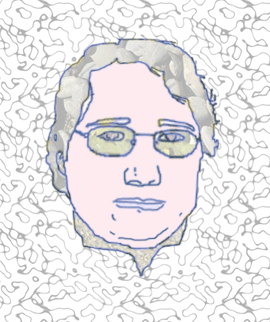
Don't let me down. Copy the image above (released free, no copyright) to every web endeavor you are expected upon. Do not answer questions. Do not make demands. This is not about trying to get something from the boss: this is about simply declaring independence and the third dimension.

Saturday, September 08, 2007

Hey, Bebby, let's fornicate with our second bodies...


I want to thank everyone who responded with the correct Spanish for "quiet is healthy." I should have entitled the last post "Senex est habilis." Regardless, I have to respond to one of the most common queries I get on this blog. "Hey, The," my readers write, "tell us more about your sex life." At the risk of overloading the web and being the first person to ever talk about sex on the Internet, I will offer the following prurient and scarifying tale of lust and sweat.

I dated a student of mine, once. Ok, I had a student once. I should say that, first. Then I should say that I had a female student. Then I can reveal that I dated her, once, when she was no longer in my class. You see, I was five and twenty, and she was in the bloom of physical perfectibility at nineteen or twenty. I understand that the massive gap in ages makes my confession shocking, and that we had no chaperon makes it all the more alluring. This is what comes of letting your daughters attend a secular college. What makes it even worse is that she had known me prior to becoming my student. She had even been, she said, a "fan" of mine! I mean a fan of me, particularly, and not our future-gay singer, future married drummer.

Obviously, the lady had troubles.

Anyway, she thought I was witty, intelligent, and cool. I thought she was unbearably cute, lively, interesting, and with a compelling, but worrying, back story. (Her father was not the nicest person in the world. Something about having been in Laos in 1967 in action, even though, of course the US was not in Laos then, but maybe that was just a coincidence.)

We had one date. We had exactly one date.

There was no break up, because there was nothing to break. The chemistry could not have been worse for dating, and in the post-mortem I think I figured out why I felt so bad. Why she felt bad is instantly understandable: I'm not worth any woman's time and biological resources. I am desperate, though, so why wasn't I heartbroken?

The thing is, you see, I felt like only part of a person (and that's no good, no matter how you slice me). Witty, cool, and intelligent trapped me. I had always presented that face, and now it was the basis of her attraction. As long as I was around her, I couldn't like bad art, couldn't be wrong, couldn't enjoy stupid music, couldn't watch dumb movies, couldn't praise sports on television, couldn't be bland. A single, consciously inflated but genuine, part of myself was going to have to mask the rest of me. It was wretched. It wasn't the pressure. I was a teacher, and a popular one, so I was accustomed being engaging and smart for hours at a stretch. I couldn't have fooled her into thinking that I was admirable if I didn't have some admirable or shiny bit in my corpus.

Rather, I was not satisfied with this much sacrifice of freedom. The freedom I needed was the freedom to be who I am, in whole and various, rather than the freedom to do some particular thing.

Self-determination may be overrated, but when it comes to the making, handling, distribution, and consumption of love, I find that it's somewhat critical. I also find that the amount of time one spends with another person in the postures of love, the more of the designed self gets eroded, and the nearer the core gets to exposed. This is why being selected by a partner for an attribute is absolute doom. Unless the lover pulls back the layers and likes each one, or at least most of them, there is no hope whatever. If you try to become the attributes that the lover likes, you'll go mad. In fact, you pretty much are mad. It is delusional and mentally ill, as well as dishonest, to try to become the projected image.

No sugar that night, then.

That's not the issue, though. I'm not really writing this blog entry about my date or passing on my words of wisdom to the lovelorn or love handled or short horned. What I'm actually writing about is the fact that screen names and screen identities are self-projections. They are what we think of as the diamond inside us, when we hold the cutting knife. They are also the bit we wish were inside. Either way (self-selection or fantasy), they are projections of attributes or aspects onto a screen. Like all projections, they are two-dimensional, and social websites are these screens. They allow lateral movement, but they never allow stacking meanings, contradictions of action, paradox, frustration and aspiration. They never allow hope. They have no history. They are a continually dragged out "now," where, interestingly, the moment is ineluctably pre-defined by the attributes contained in the screen name. In a sense, the screen name is the moment.

They have the ability to seem like social life in exactly the same way that television can persuade the gullible that soap opera characters are real. (This, incidentally, is not a small amount. Don't you dare laugh at the woman in the line at the grocery store getting Soap Opera Digest and expressing audible fears about Monica's baby. You are no more clever than her.)

Suppose you do the wish self, the conquering hero(ine) self. If you chose your online self when you were thirteen and looking to get chicksman ("Chicks, man"), then you gave yourself the name Cooldude (because we all know that chicks like the cool dudes), and that is your present moment. For the rest of your time with that name, you are thirteen. Or you're Catherine de Lily, the impetuous belle for now, and now forever. For the rest of the time online, you are Cooldude or Lady Catherine, and all the scribble and dribble you did at that age, suffering as you were from testosterone poisoning or green sickness, is your present moment.

Suppose, instead, you take the shining gem star of your heart and do that. Stampman15 and Birdergirl3 have singular interests. They can't have mortgages to meet. They can't lose jobs that they do not admit to having. They cannot be swamped by PTA meetings or have to rush to arrange a relative's funeral or decide, most of all, that stamp collecting is fey and birding is too expensive. No: they're locked down. That neglected corner of the user's soul that needed watering is now claiming the whole pot.

Above, I argued that avatars are inherently psychotic. This is what I meant. It isn't your avatar that is psychotic, and it isn't that psychotics create avatars, but rather that you have gone out to date the entire universe of computers with a tenth of a personality. More, you have decided to stay there. You can be glamorous and say that you are an actor stuck in a role, but that's wrong. You are a liar stuck in a lie. You have decided on the role yourself, written it, and now cannot change the script. Even if you could change the script, though, and even if you could correct the lie, you would only have the binary choices of one or the other or the other or the other. You are in a two-dimensional society. You are flat. You must be forever operating as a pair of ragged claws surfing across the surface of prattling seas.

Is that how you want to spend your free time? Is that personality? Is that a second life? Is that life at all?

Give me a rocket or a big red switch.

Saturday, September 01, 2007

Silences est saludas?


I can't speak Spanish. I don't even know if it's true, but I saw a movie that was pretty bad, and it featured a professor explaining, in a Latin American History class, that in the midst of the disappearances of Chile, there was, coincidentally, a public health campaign to cut down on noise pollution. Thus, just as people were being killed for free speech, there were signs up saying, "Silence is health."

Now, for myself, I'm given to inner debate, or ... You know, that's not true. I just wrote a lie. I have almost no inner debate. Like most middle aged men, I'm over arguing with myself. In fact, what stands between me and contentment is inner judgment, not inner debate. It's as if there is a court room with a judge, no jury, and no lawyers -- just edict after edict and evaluation after evaluation. It is a tyranny of the self, in its way, because the internal dictator has been chained to the internal criminal -- the petty potentate (ugh, I'm so sorry for that alliteration, but this is the kind of thing I'm talking about) is handcuffed to his most impotent and inept critic. They don't argue. It is simply the actions of the fool and the condemnations of the censor, groaning away, and each has the power to make the other miserable, while neither has the capability of making the other better.

I'm rather sick of words. I'm sick of them in two ways, and one of these ways is prophetic, or at least bellwether.

First, I'm sick of my own words, as you should be sick of yours, if you have any sense of shame at all. Every day, every place I go, I feel as if all the words I have uttered, the lies, jokes, stories, witticisms, ill graced vitriol, preparatory patter, stuttering interjections, curses at misfortunes, comparisons between things, evaluations of history, valuations of artworks, deep readings, shallow readings, eunuch pleasantries, lustful compliments, disjointed non-sequiturs, sing alongs with the car radio, growlings at editorials, strings of words that must follow, choices of words that make fresh points, and all the rest of the symbolic junk are there. It's all there, all the time. It's all there, everywhere. It's all there, getting in front of my eyes, filling my ears, crawling on my cheek. Words, everywhen. Words, like a cloud of gnats that cannot be swatted.

Silence would be health indeed, and you should agree with me, because every time I see you, I see the swarm around your head, too, you know. All of those words are history for both of us, and they're the flood. If you concentrate on floating, you're sure to sink, I was told when I was tossed in the swimming pool.

The other way that I'm sick of words is the Internet. You know me, though: I'm always going on about symbolic abstractions of rhetorical constructs of semiotic deferrals! Oh, that's me, alright, in a nutshell.

Well, see, you do know me, but you know this me, which is nothing but a system of words. I know you, too, the same way. People on the Internet are not people at all. They are no more than constructions of rhetoric. They're symbol streams. If I am LordViper on Wikipedia, then I have not only fashioned a self, but I have ... and this is important, so do please pay attention... destroyed a self at the same time. The Litgeek cannot speak of himself, if he's LordViper. The past, hopes, insecurities, desires, balls and brains of the Litgeek must be omitted in LordViper's discourse. LordViper may get to have things that the Litgeek lacks (a criminal record, for instance), but he loses massive amounts, and therefore Litgeek cannot be himself as LordViper. Those who meet LordViper don't know Litgeek. They will never know him. They only know a selection of propositions -- the truth of which are self-verified and meaningful only as they are enacted rhetorically -- that are projections of a rhetorical "I."

Well, I'm sick of it. First, most of these authors suck as fictional biographers. Second, the rhetoric is uniform. Third, I like people, and therefore I like e-people in inverse proportion to their rhetorical sutures. They are all very fundamentally sick.

No, I don't mean they're all neurotics who need "avatars" to be whole. Who cares about that, anyway? No. I mean that the avatars are sick. Because they cannot have pasts, futures, and aspiration, they cannot be whole. They are fractures of personality. As such, no matter the "real people" back there, hanging around e-people is a day trip to the asylum. Since they are only words, silence is health.

Sunday, April 08, 2007

De-Nominations

I was driving by the local community college, bar, and grill, and my eyes were taken to their extremely large, highly animated electronic sign announcing, in letters large enough for Godzilla to have written in kindergarten, QUICKBOOKS. They're going to teach students how to master Quickbooks. They're also going to teach them accelerated Excel. Those boys in the software world have always been good at names. From Eudora being named for a short story in the engineers' college textbooks (but which they didn't read) to software makers calling themselves Richochet (gun games) , Black Isle, and Oblivion (role playing games), they've been experts at the art of naming, if not branding.

So, if the Quickbooks is another example like Eudora, where the people behind the name were only half-informed, what is the secrete exegesis of it? Well, there is, of course, the problem that no book is quick. It sure isn't quick to write one. If it's quick to read one, it probably isn't a book, after all, but a pamphlet. Then again, it is, I suppose, a relative term. A week spent reading War and Peace is quick, while a week spent reading Hop on Pop may not be (three links, there: you absolutely have to click on "on" and "Pop" to understand).

"Quick" also means "alive," though. You may "cut me to the quick," if you work for Diebold (or Die Hardest). I can end up exposing the quick, when I bite my fingernails. Can I have a living book? Can I have a book that is perceptive, organic, dynamic, or one that grows? If I have one that grows, can it mature, dodder, and die ("Growth for its own sake is the ideology of the cancer cell," Edward Abbey said, but it was reiterated and expanded by F. Kaid Benfield et al.)? If so, I suppose that's Wikipedia, which is well on its way to droooling down its shirt and mourning the fact that it doesn't get around anymore.

Speaking of names and their selling power, though, perhaps no title has been as successful in drawing in readers who have no business there than that masterpiece of Egyptian and Tibetan branding, the Book of the Dead. What, you ask, do I mean the Necronomicon? Why yes, I do. Next to "The Necropolis" (very 3-D one), it has to be the biggest branding success in history. Along with "The Catacombs" and other terms that had to walk through a hundred penny novels before being redefined, "Book of the Dead" is a great example for "QuickBooks" to aspire to.

You see, I got tricked into reading the Egyptian one. It's about preparing corpses. I've also been to my share of necropoli. They're graveyards. I've even been in catacombs. They're graveyards.

So, let's suppose, instead, a new type of Quick Book -- a book for living. What would such a thing say? "Eat, sleep, reproduce (optional), cease?" Would it say, "Know yourself, for time is running out?" Would it say, "Serve, and know that service is freedom?" Would it say, "Abide?" Would it even say, "Worship your creator, for that is your purpose?" If you're of the atheistical and Beatles bent, would yours say, "Life is what happens to you while you're making other plans" or "All you need is love" or "The love you take is equal to the love you make?" I must say, if any of those were to be the case, even the authentically Orthodox one, I would be quite disappointed. Nor would I read a quickbook that said, "Close up thy Byron, open thy Goethe" (and, implicitly, "go do something passionate").

Thing is, life doesn't seem to need a book, as it happens without its own willingness and continues against any superimpositions like will. You might be tempted, then, to say, "Forget your quick books: living needs no guide." Well, Mr. Smartypants, the dead don't need no stinking book, neither. They're going to go right on being dead without anyone painting on their coffin lids. They can't see the pictures of beetles (or Beatles) and be inspired to hop up.

My long time reader will recognize that there is some barb coming, some moral, and it's going to be corny. My attentive reader, if I had one, would look at the calendar. Yes, I admit it. It's going to be cheap.

Ready?

Ok. After I went by the commie college and bar & grill, I hooked onto a state highway (this was in pursuit of my mandatory feast for the day, which was a triple burger du fromage (link takes you directly to the direct thing that sent me to the restroom for hours after)), I saw a number of churches. I collect what I call "populist expressions of admonitory or exhortative religious sentiment" (sorry about the Southern slang, there), so I pay attention to marquees. I noticed, though, that the various churches, which are usually in competition with one another on these matters (and the best is an AME Church nearby, where the pastor has very literate and nice sayings) were in accord. Most had "He Lives" up.

The coincidence was nearly too much. First, QuickBooks, then "He Lives" various places. Naturally, I thought instantly of the old (1988) John Carpenter film, "They Live," which, I was told, had been misread by some of our Southern scholars as "they live" (with the second word an adjective rather than verb). It was a natural jump, especially since that movie is all about signs, too, and it features instructions for profitable living reduced to simple imperatives.

However, I thought that the proper meaning of "He Lives" was a great contrast with this absurd mental drift of mine. In fact, the two concepts exist like a metaphor. Metaphor, acorrding to my understanding, is the distance between the actual words and the implicit or virtual words used. The tension between them is the message of the metaphor, and metaphor is, in fact, the only way that the infinite is apprehensible. We see the shadowplay that Plato talked about, and we do not guess the forms outside. Instead, the real forms and their shadows differ from one another, and the difference is the apprehension of the real.

Sorry.

Ok, let's go back to something concrete: He Lives. This is the meaning. He Lives, and the way that He lives is eternal and not a process. It is organic, and yet it is essential. It is infinite, and yet it is perceptible. It is always the same, and yet it is each person's individual and particular salvation. The single sacrifice and passion takes away the "sins of the world" not as a series of particularized children on Santa's naughty list, but as a single forever event, an event that is always in the present because outside of time, and always particularized in the subsuming of all mankind into one suffering, rebellious, and misguided thing. The Quick Book is merely to be, not to live as a series of events or a line through time or a track through the waters, but to be a whole statement at all times. Mind you, there is nothing you can do to achieve this. You're already doing it. All you can do is be aware of it, to know what you say, and to mean, and you mean because He Lives eternally.

Monday, March 26, 2007

Nemesis

Have I mentioned to you folks before that I have an enemy? I can't recall now. I do, though. It's a person I despise. The worst student I've ever had, with some brains but nearly pathetic laziness, total unreliability, and an ability to do the wrong thing at the wrong time that is peerless keeps following me around. Or perhaps I follow him around (it's a male). Everywhere I go, it's the same giant already there or right on my heels. The giant isn't Nemesis (male) and doesn't seem to be persecuting me for any particular crime, except making him what he is. Obviously, I'm talking about William Wilson.

Anyway, today is springtime for William Wilson and recrimination. It's a morning full of haze, in which no one can wake with a full spring in the step, and the air feels like a humidifier stuck on full, already warm at six AM. The Tarheels lost in the round of eight last night, thanks to my wearing unlucky boxer shorts. (All yellow underwear is unlucky and should be worn only when no matter of consequence is uncertain.) Coach Williams was very upset, and so was I. It's a bad time, I suppose to go "off meds and out of therapy," as one State Department official said of a Department of Defense fellow. "Night entangled trees" give way to thick fleshed flowers making a dim mosaic through the fog of a day just getting a running start on becoming a blister.

Could the same air, the same flowers, the same dim dawn, be a florid melange of scents and delirium, if things were better? I'm not sure even Walt Whitman could have enjoyed these overbred southern mornings.

At any rate, William Wilson (the bad one) has dictated to me. It is in a fog that we meet, after all, and in the fog that shots could be fired, but, of course, they never are. Instead, there are two who go in and two who come out. I have always had a kind of out-of-sync S.A.D. Most people get bummed in winter and cheer in summer, but I get bummed in Spring and Fall. As the hazes and blooms appear and vanish, I get out of sorts, physically and emotionally, and my doppleganger nears me, pistol drawn. Poe's fog (I'm referring to a story here, you know? I have been throughout... does no one click on links?) is assumed to be the result of psychology. It's supposed to be confusion. I don't think so. I think it's a fog made of mist. Also note that it thickens by rivers and schools, which is another piece of verisimilitude, because I think William Wilson hangs out by the schoolhouse most of the time.

September is usually pleasant. April is not. September's massacre of vegetation always seems to me to be a scourging. The world sheds its display and recants its boasts. The trees drop their lies and pretenses and go back to being trunks and limbs. Bushes stop all the deception and trickery and leave the bees alone. The only unpleasant part is the lawns of the great middle class (from $18,000 to $950,000 per year in income) dying. They go brown and tan in a truly hideous scrofula of vegetation in Autumn, but the fault lies not with the season but with the lies of the people who sacrificed six months of ugliness for three months of constant care and green ground for hiding animal defecation. Autumn merely shows them the truth and strips away their braggadocio.


Spring, though, has the activity of a shout, the truth value of an orgy. Every lifeform begins to sacrifice for display. The world becomes an amorous bachelor or hopeless maiden at a singles bar, going into debt to look nice. Animal and vegetable alike put on their hairdos and hope that the rain doesn't wash them out. They go for broke with their credit cards and arrive at destitute, and all for the chance at a chance at releasing their pent up sex.

"Birds build -- but not I build" is the most bitterly rending line in all of poetry. At times, I could pray with the poet for rain, but virtually never can I understand how he can find a growth that appeases the pain of Spring. Instead, I go back into the fog and haze of an intemperate morning and conclude that the real problem with William Wilson is that he's a lousy shot.

Wednesday, March 14, 2007

Oh, yeah? Well, make me!

Lucinda Williams is a good singer and songwriter, and her records are interesting. Her new record, "West," is more matured than "Car Wheels on a Gravel Road." The latter had seemed almost to deliver several times what the performer intended, to need just a little more cooking before being taken out of the oven. On "West," the songs deliver what they promise. When they promise raunchiness, they deliver it.

On the song, "Come on!" she complains about a lover or a man or a something -- the object of her complaint is identified only as "You." You know how bad You is. You do most of the good and bad things in the world. Well, You "are so self-involved/ You're in some kind of fawg," according to Ms. Williams. If you think that's bad, though, she is quite clear about one point, "You didn't even make me/ Come on!" She makes that observation 38 times -- roughly once every six seconds -- and it seems to be important for that. How could you!

Ok, so let's except the usual language games -- You know -- "didn't make me" vs. "didn't make me come on" vs. "didn't make me, come on!" Let's call a spade a spade and a flower a flower and a bloom a bloom. What gets me is not the amateurishness of the reference but the verb of it.

You didn't make her? Could you perhaps have persuaded her? I know I would prefer to persuade my lover to come on or, at most, urge her to do. I could show her how it would be in her best interests. I could lead her to. I might, if lucky, have her come on unbidden. It could even be her idea once in a while. I wouldn't even mind if she didn't make me come on, too.

It isn't Lucinda Williams being smutty that makes this phrase curious, either. Rather, we have it in everyday (locker room) speech. Boys and girls, boys and boys, girls and girls, girls and boys, all speak of making someone. I believe in making love, as that suggests a collaborative building project; it is the making of creating. I do not believe in making a person experience joy, as that suggests being outside of the event. It is the making of coercion, of manipulation, of control. It's curious that we have this idiom. It seems to mean that, deep down, we see love as a thing we are within, even in sexual congress, but that the culmination of sexual pleasure is inflicted or controlled.

Teri Garr, in "Tootsie," does a parody of the "liberated woman" by saying that she is in charge of her own orgasms. Well, that's cute. However, the humor that we can derive from laughing at that parody depends entirely upon either being mean spirited or understanding that she is pretending that orgasms are her possession, or at least her voluntary actions, like lies. The people who laughed at that line (if they weren't just laughing because there was a cue to laugh and the idea of an empowered woman made them want to laugh) were aware that it was silly to think of orgasms in such a silly way. Are these people laughing because someone has to "make" you?

I would recommend, here and now, a campaign against the controlling "make" ever being used in connection with arousal or fulfillment. You do not make me whole. You do not make me love you. You do not make me get into a state of exaggerated arousal. We make love. We make pleasure, as two people constructing a thing, not as master and slave, victim and controller.

Well, at least that's how I feel. I hope I haven't made you mad.

Sunday, March 11, 2007

Dealing with Doubts

"Once granted the first step, I can see that everything else follows -- Tower of Babel, Babylonian captivity, Incarnation, Church, bishops, incense, everything -- but what I couldn't see, and what I can't see now, is why did it all begin?" -- Mr. Pendergrast, in Evelyn Waugh's Decline and Fall

Of course the answers to "why" are everywhere and anywhere. Mr. Pendergrast is a fool, as most characters in Waugh's novels are, with only the novelist not one. Waugh is reassuring in that way. Unlike other satirists, he gives us a nice us and them, and I say this not to belittle him in any way. It's a good thing to occasionally find some satire where the bad guys are stupid and the author isn't one of them and where the reader gets a chance to share the joke with the author, rather than being the butt of it. It's the sort of satire that has necessarily gone out of vogue.
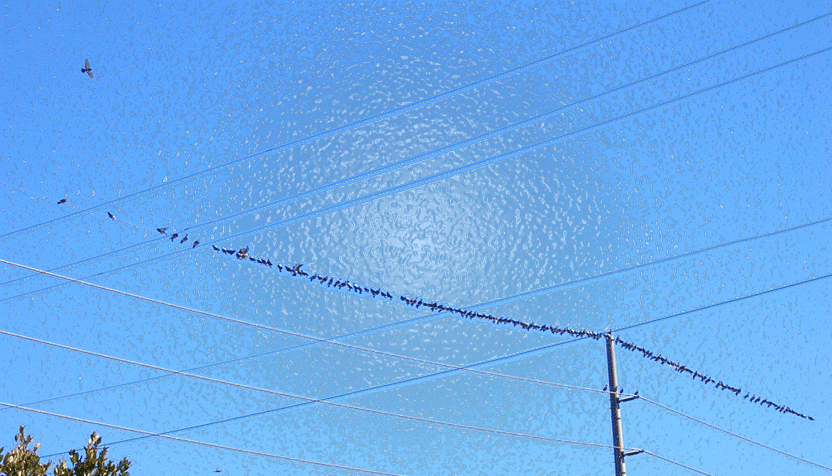
(Pretty picture, isn't it? I took it. It's the sky in the year 2000.)

I'm reminded of... Oh, heck, that would be cheating.

No, I've changed my mind. I'm reminded of Job's answer from God: put on your big boots, when you ask questions like that. I'm reminded of a lot of other answers, too. The world exists to explain itself. 42. It exists to ask itself why. I like God's answer to Job better. God tells Job that he is part of the creation, that he is a character, not the narrator. Like Mr. Pendergrast, he is a fool, and only the creator of the world gets to be free of the taint of ignorance. Man might bite the apple from the Knowledge of Good from Evil, but that's not the same thing as the apple of planting the garden.

Knowing good from evil is a deadly knowledge, for it means participation in good and evil. Before such knowledge, there is no evil. After such knowledge, evil is within you. Once there is evil, there is decay and death. What, then, is the stem of knowing why? What is it to know why a world is created, except participation in creation and therefore in negation. In other words, if Job could know why he was born, he could know fully how he could be not made.

I don't want to be gnomic, or a hippie, but to know something is to enclose it, to have it both in its positive and negative. To know a hamburger is to know the state before eating it, during eating it, and after eating it. (I say this because a hamburger is not an object, but a food, and a food is only eaten.) To know good and evil means knowing both the good and the evil, having them both within one's mind, having the action of obedience to God and disobedience to God. (Thus, picking the apple and eating the apple made the swallowing of the apple irrelevant. Once they had done the first bit, they knew good and evil. Note that they knew it without the expulsion from Eden. Evil has nothing to do with punishment or even suffering.)

So, Mr. Pendergrast wants to know why the universe was created. He doesn't want to know why it is the way it is -- figures that all makes sense once it gets created -- but what could make the creator go to the trouble. Other people have puzzled that one, too. Plato figures that God would be far too contented to move. The Stoics need randomness. Even pure empiricists need a something of unknown quality to trigger a boom. Well, don't look to me to answer the question, because I have only the vaguest guesses.

What does occur to me, though, is that the character can never know her own non-iteration. A piece of the machine can never see the machine it is in. It cannot hold within its mind the lack of a system. I cannot see beyond my horizon, for my horizon always moves with me.

I just saw Stranger than Fiction, and I rather enjoyed it. It was a bauble, but it was a very pleasant and well constructed one in all respects, and I even tolerated that dreadful comic in the starring role. However, the person inside the grid never knows who drew the lines.

You can't know your narrator. You can't know your genre. You can't know why the world was created. You can't trust any answer you get about these things. I would argue that you cannot even be sure if you were to get knowledge through revelation. The process of understanding what you were told would transmute the message into something comprehensible, and comprehensible means cut to measure to fit the world you inhabit.

The moral of this story? Well, it could be awfully nihilistic or irresponsible, but I don't think it should be. One thing clear is that we are creative creatures, narrators, tellers of all sorts. Furthermore, we are molested day and night by responsibility for the stories we tell and over the creatures we make. Do they fit well with the stories of others? Do they mesh with the stories that made us? Do they fit with what we can tell of the grand story? Nothing can allay that worry, and nothing should.

We have no knowledge of telling and not telling. To suggest that that gives us an excuse to just live our lives without regard for the shape of the story is logically inconsistent. We could only "go about our business" if we knew that such was part of the story, and the fact is that we don't. We don't know either way, and therefore we cannot take comfort in our ignorance. It wouldn't even be a question, except that we keep telling stories ourselves. We are compulsive. This is not a good or bad thing, but simply the function of us as characters. We are compulsive in fretting, and this, too, is neither good nor bad. We do go about our business when we anxiously look to the skies and wonder whether or not we're starring in the play because by doing that we reflexively tell a story.

Monday, November 27, 2006

The Dog and the Mangers

The following post will cover a few subjects, but it was inspired by driving to lunch and seeing that a particular town is going to have a "Christmas Pride Parade." The county seat has a sled and Santa already up, in lights, and I fully expect a nativity scene soon. It's that kind of town. Christmas Pride, presumably, is the antithesis of the "War on Christmas." Either that, or it is an artillery shell fired at the enemies of Christmas, whoever they are supposed to be. No doubt they are the "liberal secularists," as O'Reilly has them, who oppose big displays of the Ten Commandments. (Note: I am a "card carrying member" of the ACLU.)


The thing is, Christmas, like the Ten Commandments, is an invention. I'm not talking about the concepts behind these things. The Nativity is real, but we haven't the foggiest idea when it occurred. (The shepherds were up in the hills with their flocks, so winter doesn't make a lot of sense.) The Star of Bethlehem would have been visible for a while, if not over a wide area. However, the Nativity is most emphatically not Christmas, and no one has said so. In fact, Christmas is the Christ Mass -- the church service dedicated to the birth of Jesus. Given that no one by the third century knew when Jesus was born, exactly, Roman Christians set the feast of Jesus at the same time as the Saturnalia. That allowed syncretism that could keep Christians from the executioner, on the one hand, and damnation for idolatry, on the other. Christmas is a church service, not a date, not the nativity. I hope I'm not the first person to point out to you that, when the Protestant Reformation occurred, many of the more radical protestants rejected Christmas. The first two generations of protestants were Bible scholars, knew that the nativity's date was uncertain, and wanted nothing to do with the idea that Jesus would be celebrated for a birth date coinciding with pagan rituals. The Puritans made Christmas celebrations illegal in England. (A good article on the ban is here.)

Charles Dickens recreated Christmas with that book of a man forging chains in life and blessing a crippled boy. That was a bold bit of public relations. After that, America began making a visual Christmas, a Christmas of a particular sort. Just as with Thanksgiving's Puritan holiday getting foisted on the rest of the nation (founded earlier by different folks), a particularly northeastern form of Christmas...with snow and sleds and candy canes -- all products of New England -- became the universal and unequivocal Christmas. German immigrants bring their fader Christmas and Santa with Black Peter (who gets dropped as not fit for marketing). That gets sold on television and in film, so all of us wish for a "White Christmas," even in Arizona.

Christmas, in the form of a sled full of presents, is purely a merchandizing invention, a marketing construct. I am not saying that it is corporate America tricking us into celebrating Talk Like A Pirate Day. No. It's just that this Christmas is an accidental agglutination of commercially successful details -- each having been chosen by the marketplace, each being top seller. When a southern city defiantly puts up a sled, fake snow, elves, and the like, it is defying secular liberals on behalf of a commercial image, not the Christ Mass, and not the Nativity. They claim to be defending "Christmas," but that Christmas is not the christological moment of the Incarnation of God as man.

Surely, surely, surely everyone knows that the "washing machine sized" monument of the decalogue that Judge Roy Moore was fighting for was not chiselled by Moses or the finger of God. In fact, it came from Hollywood. No joke. The "Ten Commandments" came from the marketing of The Ten Commandments via the Fraternal Order of Eagles. The FOE put these things up around the country, and one of them fell into the clutches of a fundamentalist judge. From there, all wrath broke out. Those who mobilized for the display of the Ten Commandments were, in fact, rallying around a marketing freebie.

What's interesting about these two causes is that they are both fights about wrappers rather than contents. The box, rather than the gift, is what is important. It isn't the celebration of the incarnation of Christ that we're fighting over, but whether or not someone says "Merry Christmas" (and how often does "merry" come up in other phrases in contemporary American?) or "Happy holidays." In other words, they are about outward display of washing machine blocks of granite and greetings, not about Christianity and adherence to the rules of Mosaic law.

I'm tempted to agree with Umberto Eco, whose Travels in Hyper Reality suggested that Americans like the recreation more than they do the real thing, that the replica of Graceland is better than Graceland because it has been edited and had its reality heightened and tweaked. However, there is a more philosophical and religious crisis at stake here. Our preference for simulacra might pump money into the Hard Rock Cafe, but it won't get us screaming at one another on the nightly news.

Instead, I think that the Protestant Reformation, the thing that made us most at war with Christmas, has made us most desperate for "Merry Christmas" and mangers and Christmas Pride. Protestantism's emphasis on the individual's role in interpreting scripture and choosing one's denomination, and the congregational churches' emphasis on lack of authority in structure, has led Christians into greater isolation from one another and no visible mark of their faith. Jesus said that we need no external marks, that we should concentrate on the cleanliness of the soul, not the washing of the hands. However, that leaves people nervous for some reason.

The ichthus display on car trunks is a sign (the "fish symbol"). It says, "I am a Christian." Why? It is the same reason as the Christmas Pride and the decalogue-as-rock: it is a way of shouting out one's Christianity, of screaming one's identity, or one aspect of one's identity, at the top of one's lungs. I do not know why, but it's clear that the people involved feel like their identities are threatened, feel like they are sliding into oblivion and irrelevance, and they are striking back with poor aim and no introspection.

My feeling is that people telling the world so loudly that they are Christian do not mean that they are Christian. After all, the people they are shouting at are Christians as well. The people they are shouting at are not enemies or ashamed of the incarnation of Christ, either. Instead, they are following the dancing shells of ideology and guessing that the pea (the self) is under this particular walnut half. I'm afraid that they're wrong, but I'm also afraid that we cannot convince them of that. Instead, we can try to reassure them and hope to help them discover what it is that is truly making them afraid.

Saturday, November 25, 2006

Why We Fight


"And if I fight with a loved one, Lord,
Won't you please make me the winner?" -- Loudon Wainwright III, "Thanksgiving."


Each holiday has its cliches, and each has remora comedians and commentators pointing them out for the younger and less observant of us. Some of the time, they crack wise, sometimes wisely, sometimes morosely. However, the winks and grins come from pain deep enough for trauma. The people out there in the audience have had some pretty bad times at the holidays. What is it about Thanksgiving and family fights, though? Every year, those people called family come together to eat and fight. One of them mentions a past grievance or a present political preference or notice an article of clothing, and suddenly the grown-ups table becomes more emotional and louder than the children's table. Boom, boom, shriek, glower/ We will not stay another hour.

So, how do we get there? We get there by becoming adults. The kinds of fights we have can not take place when we're young. We have arguments of unknown etiology and pessimistic prognosis solely because we have gotten over those old competitions and resentments of youth. Furthermore, we fight inerrantly about the bones of our maturity. This is not as much of a paradox as it seems.

Suppose you grew up bitter at the taste of the bridle. You would go on to assert independence and figure out how to tolerate authority by becoming the authority or by dropping out of the power structure. It would be one of the keys to becoming an adult, for you, to be your own person. Suppose instead that you grew up aggravated and depressed by distant parents. If that were the case, you would survive the burden by becoming self-sufficient or the center of jollity. Sibling rivalry is too various to discuss -- the sisters' vanity battle, the brothers' pounding on each other or tricking each other into trouble -- whatever it is, it will throw one of the biggest obstacles to life at you, and you will have to handle it and neutralize it as you become an adult. You can, as ever, win by fighting or by swallowing the opposition. Whatever your strategy, it will have been crafted very specifically to meet very specific needs.

At the feast, our strategies, all developed like receptors to the antigens of our family, are at the fore, on the skin, in the stare, quavering in the voice, firing the nostrils. We have allergies to our family. Additionally, Thanksgiving is a collection of adults who are not in charge. Being in charge is not merely a long-sought privilege of maturity, but is also the licensing condition for coping with the past. The most placid family get togethers are the ones where each adult is given a task. The delegation of authority leaves each member of the family Executive Vice President of this or that, and that is why the best pacifier to the family fight is having children. When you have kids to manage and control access to, you are guaranteed maturity, guaranteed to be in charge. If, however, you have not or not yet swum upstream, spawned, and survived, or if the children are with the ex-, or just absent, then you are not in charge. You are idle and dependent, and only your personality stands between you and the others.

Oops.

So, there you are, faced with those burdens and your compensations. If any, and I mean ane ne, of your strategies were anti- the parent/sibling, then very soon you will prove your personal growth by demonstrating how little you care about what that person did. You will attack, in other words, without knowing about it. That's why it will be impossible not to mention how your parents paid her way as an "artist," and why his snort of derision at The Nutcracker at the local theater is surely meant to be an insult to your years as an artist.

Call upon the divine for a victory, because to win the fight to prove to yourself that you closed the holes those people called family made in you is to win an all important battle. Winning means autonomy. It means being whole. It is a fight for a self that you are having, and the fight proves that you have already lost, that some part of you, even if that is the memory of wrongs long done, is owned by someone else.

Wednesday, November 15, 2006

Don't Blame Me: I Voted on a Diebold Machine


That's one of my new bumpersticker ideas. I have others. My favorite other one, in terms of million dollar ideas, is "Said Yes to Drugs." I figure that it might be funny to slap that on dad's car, except that they might get confused and think that it was Rush Limbaugh at the wheel. My personal favorite, not in terms of the millions I could have made, is "I'd Rather Be Sleeping."

At any rate, the slogan is true enough, above. We have a number of I'm an X and I Vote ("I Hear Voices, and I Vote"), per a previous blog post, but we also have a cliche of "Don't Blame Me, I Voted Budweiser Frogs" and others of that ilk. It began as a demonstration of dissent, but it then got to be a joke in its own right -- first a rueful one and then a forgetful one.

"Democracy is the theory that the common man knows what he wants and deserves to get it good and hard." -- H. L. Mencken

See, the problem these days is that we didn't vote Kodos, didn't vote Kerry, surely didn't vote Gore. Nor did we vote Bush, of course. What we voted was Diebold. We all know that Diebold machines can be hacked, if we've been paying any attention to computers or the news. From Finnish hackers to Princeton professors, anyone can hack a Diebold. HBO showed a documentary about BlackBox Voting called "Hacking Democracy" the night of the election rather than the night before. Ok, so clever computer scientists like the chimpanzee can hack the voting machines, but so what? Can't corrupt county bosses do the same with paper ballots and manual machines? Well, yes, but there is a much greater insecurity now than there used to be when Sheriff Cletus had his hand on your hand on the lever: Diebold machines are centrally produced, distributed, and collected up, and all the data must go upstream to a single point.

In other words, it's hard to manipulate a vote to change a state wide election, when it's paper or mechanical. It's hard to manipulate a vote to change the county commissioner, when it's centrally controlled. Given the fact that Walden O'Dell, CEO of Diebold, raised more than $100,000.00 for George W. Bush, that he vowed to "do anything (he) could" to give Bush Ohio in 2004, and the fact that all the votes have to go upstream to a counting system (which can be hacked) from memory cards that each have executable files on them (which can be hacked) and that altering either program shows no intruders, we have a pretty dark horizon out there.

But The Geogre, you say, the Democrats won! Why are you bitching? I'm bitching because we may have won in spite of the voting machines. I'm bitching because, so far, every time there has been a recount where receipts are measured against recorded totals, Democrats have gained votes. I'm bitching because George Allen quit before a recount, when it's possible that the recount would not have made him look very good. I'm bitching because the vote is centralized in the hands of commercial vendors, and it's possible for a single corrupt person to swing a nation or a state wherever he wishes. I don't mean O'Dell, either. I mean an "unaffiliated group" somewhere, like the people who "served with John Kerry in Vietnam" (meaning that they served in Vietnam, not that they were in the Navy, that they were on the lines, or that they were on the boat with him) who just knew that he didn't deserve his medals.

When Sheriff Cletus coerces me, I know who it is. When a faceless freak with a Palm Pilot can knock me out of the booth and waft his employer into office, I get upset. The strong arm on my hand is bad, but the thumb on the scale is worse. I'm free to vote on the Diebold, but I'm not free to have the vote go through. It's rather like a videogame vote: it makes me feel happy, but it doesn't actually accomplish anything. You can play Halo all you want, but you're not Jack Bauer, and you can go vote with your Diebold all you want, but you're not participating in democracy, not unless we decentralize the process.

Anarchy in voting is bad, but it's better than a commercial vendor. For profit voting? Think about what we have invisibly and silently chosen: turning voting over to competition for profit. Should anyone be encouraged to go cheaper, faster, and with the highest margins when we're talking about voting? Why, exactly, can the government not manufacture voting machines? Why, exactly, can we not have non-profits make them? What is it about voting that makes the most profitable (and therefore those with the greatest ability to advertise, to organize junkets, to sweet talk, to man the phone banks) the BEST for us? What is it about intellectual property rights that makes you think, "Yeah, I want someone to own the methods of my voting, the display and storage of the data, and the access point to it?"

This is insane.

Republicans should be as outraged as Democrats. Everyone should be stopping well short of merely wondering if O'Dell is cheating and ask whether free market profits are proper, whether proprietary encoding is proper, and whether or not we need to have a Democracy Incorporated deciding how many votes to count, if not where they go.

Sunday, November 12, 2006

What's Wrong with This Picture?

"You beat your pate, and fancy wit will come;
Knock as you please, there's nobody at home." -- Alexander Pope
No, not that picture, but the picture we get when we look into the prophetic pool of the academy. It's a prophetic pool because it certainly isn't a mirror. Instead, we look into academe to find out what will be, in two senses. First, the fads and foolery of the colleges will soon enough be on satirical television shows and then the streets of America. Second, the theoretical and research results there will get into the heads of millions of people and then shape the actual practice of the knowledge implicated industries (which is most of them now). At the same time, everyone thinks that the pool lies, that it's wrong. So, what is wrong with academia, other than me, I mean?

The first problem is the one that anyone who thinks for a moment will realize: it is a fortune-telling mirror, and so it shows what is not but what will be. Therefore, it is always false. It is always not what "we" think. Therefore, whether it says "God Is Dead" in 1965 (yes, that's the link to the original that got everyone from the Southern Baptist Convention to Bernie Taupin talking) or "The margin is the center" (no link, but it's Jacques Lacan or Shaka Khan or the Wrath of Madeline Kahn), it's altogether nonsensical, outrageous, and a waste of tax payer dollars. Needless to say, people will soon enough find these suggestions and researches shaping their public discourses, both in positive and negative incarnations.

The related problem to that is that these things seem to be a danger to the youth of Athens. Let's brew up that hemlock tea, because our nice, clean cut freshmen are coming home as promiscuous whores and liberals! The fact is, of course, that universities don't make children liberal, or whores. College simply exposes people to other ideas, ideas not found at the dinner table, and that's something that shows them that father might not have known best. What they do then is anyone's guess. The more tightly repressed they had been at home, the more kinetic energy they have built up and the more they will bound out of the box in a different direction. Lost virginity and no thunderbolt of pregnancy? Hey, this is fun! Neighbor on the hall smokes dope and doesn't rob liquor stores? Kewel! We all know this dynamic, and it includes ideas and ideology. Novelty is dangerous.

Where did this come from? Well, the biggest villain in this blog essay is going to be publish or perish and its devouring effect on knowledge. The hero is going to be curiosity and patience. Ok, the heroes are going to be curiosity and patience.
  1. When you have to publish on anything and everything, you have to be new. In science, this leads to an article on every result in your huge experiment. You want to find out if insulin-like growth factor-I and insulin-like growth factor binding protein-3 administered concommitantly will reduce insulin resistance in patience with metabolic syndrome. That's going to take years. At each step (in vitro results, in vivo results, phase I-III trials), you publish a paper. Instead of a coherent result, you deliver a dozen results. Sure, someone might take a piece of your research and work from it, but they know that you're on a big mission. In humanities, though, and in social sciences, you have to be different damn it. You have to avoid the competition, because everyone has the same laboratory you do (they all have brains and grad students and libraries), so you'd better go off, man. You'd better not write on Shakespeare and the meaning of the plays, on in-groups and how they police themselves, the Battle of Midway and why it succeeded for the US. Those are so done, and the journals aren't interested in repeating old truths in new ways or putting old wine in a new skin.
  2. When you work with patience and curiosity, you may come up with some really wild stuff that will take an age to find application. Sure, Gregor Mendel was ignored, but so was Gerard Manley Hopkins.
Here's the deal, though, what does novelty do to us? What, in the humanities, is going to be the problem?

The chief problem is that flight into a private garden. When you have to be alone, when you have to own the field, when you have to eliminate competition by eliminating intercourse, you will not only avoid the basic stuff that readers and students want ("whatzit mean, prof?"), but, curiously, that we push meaning off to our garden and pretend to answer the central needs by making them our own.
"No one undergoes a stronger struggle than the man who tries to subdue himself." -- Thomas à Kempis, Imitation of Christ *, 3, iii.
Look, it was always the case that people avoided competing with the greats of their fields. We can all sing "Shine on/ Shine on, Harold Bloom/ Up there at Yale" for his The Anxiety of Influence and its confession. Sure, you have to say that T. S. Eliot was emotionally constipated, if you want to write poetry after him. You have to say that Wayne C. Booth is gullible about the determinacy of texts, if you want to write in the next generation of critics. We all know that. I'm not going to waste your time pointing it out (except that I did... I'm sooooo po-mo). No, rather, it's that we have changed our priority.

In literature and history, and in art-history and even law, people have been infected with the fever of "theory." Theory is unavoidable, etc. We all have a theory, etc. We are all practitioners of ideology, etc. You bet. Who would argue from that old trench? Feminism to lesbian feminism to body feminism to brain science feminism to psychoanalytic feminism to third wave, to fourth wave, etc. Marxism goes to a sort of mass psychology, cultural history (sort of), Foucault's psychological Marixm, post-Hegelian Marxisms, etc. That's all ok with me. Linguistics primers falling into the wrong hands leads to post-structuralism of a sort. Cultural anthropology leads to structuralism leads to an aesthetic structuralism, which leads to anti-structuralist reading "against" the structure, which can go into more of that post-structuralism thing or reader response or cultural aesthetics and reception aesthetics, etc. Let's all give a shout out to our peeps in the theorizing room. They're all groovy to me. I love them all and extend my blessing upon the whole gibbering crowd.

What gets me, and what ties me back to the subject, tangentially, is that the way we are getting to feed the furnace of publication. Instead of the old game of writing about Richard O. Cambridge instead of Alexander Pope and Scribleriad rather than Dunciad, but that's old news and respectable as it adds to the world of knowledge. It used to be that we would select a subject and then seek out an approach that would be useful for it. What's happening now is that we are starting with a theory and looking for a text that it works with. We start off as a post-feminist post-structuralist modernist and then try to find a poet(ess) that will make the theory work. The result of that is that we get articles on the most minor, the most alien, works possible.

So?

Well,
"...the Brain, in its natural position and State of Serenity, disposeth its Owner to pass his Life in the common Forms, without any Thought of subduing Multitudes to his own Power, his Reasons, or his Visions...." --A Tale of a Tub

when you first find your dry cleaner poet because he fits your post-Hegelian paradigm, you cut out one of the most important tests of a theory. Each theory proposes a conclusion inductively or deductively about a set, and it can be validated only by reference to an outside theory (bad article on the subject, but I'm lazy). You have to take any closed system of propositions and compare it to a different closed system to verify it. If you start with a conjecture ("people from Lyon are liars") and then go find a person to fit it, you haven't demonstrated anything about the conjecture.

You see the importance? I hope so.

If we are verifying our own theories by seeking confirming examples, then we are expressing no form of curiosity at all. We are beginning from a position of knowledge and faith, not inquiry. We were interested only so long as we were reading the theory. Once convinced of it, we are ready to go on and prove it. Furthermore, the fact that we go find the subject that proves our theory shows no patience, either. We are guaranteed results.

So, if this is true, we are no longer going to be producing a controversy that will permeate culture, because the ideas won't be able to multiply or sink in. After all, they were only energized by being bulked from within their own claims. We are left, then, with the troubling image in the still waters of the academic pool, but the ugly picture is not any longer the future. The widening of minds is no longer explosive and destabilizing curiosity that will send students home with a wide view, but rather the image of competition, of blind proof, of stating one's faith and demanding that only the confirming examples exist. Even George Bush could publish in a world like that.

Sunday, October 29, 2006

A Really Immature Femme?

This is a movie review of a film you've never seen. Don't worry: it's absolutely not important that I'm right about the movie. If I am or I am not will make no difference to whether or not you should see it, and the only way you can see it is by going to a dimly flourescently lit video store or belonging to Netflix. The film du femme is "A Real Young Girl" ("Une Vraie Jeune Fille") written and directed by Catherine Breillat.

So, why write about a suppressed and virtually unknown French film? Well, imagine the most unrealistically gynephobic voice from The Vagina Monologues and imagine that voice got over the class consciousness and was given a 16 mm film camera and a cast and crew. Also imagine that, instead of being a poor or bourgeoise woman of the usual sort, she went to the Sorbonne around 1971 and got a head full of ecrit feminine and, amazingly, believed it. Astonishing, stretching credulity, I know, but you have to imagine the combination of "writing is done by the vulva" with "I hate my vagina" and keep all the narcissism that leads to a one-woman show. You then have to put all of that into the amazingly cold and treacherous medium of film and ... wait until you hear this ... expect people to think the result is deeply real.

The star of the film is a very, very beautiful young lady whose other films are confined to pornography of the lighter sort. All the men show their penises, and pretty much all of the women show their mons veneris, while our heroine is inserted, opened, and given metonymic close ups. Remember: this is feminism. This is truth. Essentially, our heroine loves disgusting things because she disgusts herself, even as she desires the disgusting things that disgust her, and she is compelled to sitting wrong way on the potty, denying would-be lesbian lovers, and rejecting the boys she finds arousing because of her disgust, while she has to look longingly at her father's inappropriate genital display because it's disgusting. She's a filthy whore, her mother tells her, and so she feels ashamed and desirous of shame and being violated by men who simply don't give a f....

Haven't we heard this story before, and didn't we find it unconvincing? Didn't it seem like hyperbole already? What's worse is that this compulsion to document is doubly complicit. On the one hand, the author (of the "novel," Breillat, when there might be six pages of dialog in the whole movie...but dialog isn't something she's interested in, as that involves other people) is inflicting her vision on an actress and some actors, so, if she's out to tell her personal story of shame and nymphomania, she's making someone else go through it. On the other hand, the moment you film a woman's vagina being dressed in earthworms, you have committed pornography. If there is supposed to be some healing process back there, some way that the director is getting over her bad upbringing and shame by pictorializing it, then she's picking a medium in which she must, by the very nature of it, do exactly as she complains: expose her genitalia to express her revulsion of it, become a pornographer to complain about pornography. It's chowderheaded in the extreme, or else it's smugly recidivous. This is pornography from Andrea Dworkin, psychotherapy from Mark Foley, a reformation of manners from Heidi Fleiss.

If you, personally, do not get along with your naughty bits, that's a matter for the couch. Filming it and enacting it means that you have some hope or some doom to seek. Later on, Breillat would continue her pornography as protest with Romance (which is even duller and more disconnected from its own medium than A Real Young Girl is, as its central conceit is that a woman is only interested in a man who is gay/impotent with her, while she goes about getting raped and accosted and whipped in sadomasochism and provides us with exceptionally leaden monologs about her vagina), and there a baby and the timely death of its father would prove to cure the problems.

I know I'm doing nothing to get you interested in these films, and I'm not trying to. Instead, I'm thinking about the powerful mystery of sex. It is a powerful mystery, because we make it one. Give a person enough time, and he or she will become convinced that accidents of birth explain everything, that the root of all problems is some thing that can't quite be examined. Usually, it's parents. This is a good ticket for a while, but being a boy (when you wish you could cry at movies) or a girl (when you wish you could just charge through life without a care) will show up at some point. Being small/large, top heavy/top light, ugly/beautiful, dark/fair will explain most of your problems, if you're left alone for long enough.

The fact is that your genitals have very little to do with anything. They serve their function, or they don't, but most of the time, even if you're Wilt Chamberlain, or Agrippina the Younger, they're just minding their business and waiting for the next overfull bladder. Oh, there are all sorts of potent chemicals given off by them, and they do tend to "flash and yearn," as John Berryman said in "Dreamsong 14" (read it at the Poetry Foundation). They flash when near an object, suitable or not, and yearn for use, but they don't do a lot else. Men are lucky, in that theirs are usually in view, but then that means that they get obsessed with cyllinders and sizes and such. Women need a step ladder and a mirror and seem to be inhabited by a cranky stranger, and that can lead to all of this mystification and worry and hatred directed at a not much at all.

Sex (not gender, which is appropriately complained of by everyone...even the chick magnet and party girl) is elusive enough and mercurial enough and deeply seated enough to act as a great locus of problems. Why not, after all?

The problem is that you only have a 1:2 choice, and every single thing you suffer from, being male or female, is something that around half the population suffers from. You're not the first one. You're not the proper spokesperson. It's normal. It's normally difficult, normally unsatisfactory, normally obvious and normally obscure. If you let it get to the point where you think your personality, much less your writing, criticism, and speech, are determined by this one extrusion or recession of embryology, I can only draw one conclusion: you're bored. You obviously need a real enemy or friend.

Given how many victims of violence there are, how many starving, how many tortured, how many disappeared, how many discriminated against, how many fattened, how many derided, how many bullied, how many kicked out of home, how many preyed upon by bankers, how many shipped out of the country, how many jobless, how many addicted, how many leading anonymous lives, how many abused in elder care, what the hell are you doing worrying about how much you hate your pee-pee?

Monday, October 23, 2006

Cliff's Edge Notes for the below post


The blog entry below this one is dense. I wrote it all at one throw, in a stream of consciousness, and like a lot of bad stream of consciousness writing, it required that you have read the same books as I at the same time and understood them the same way. Well, that might work for some people, but I'm nobody and have ambition to one day be nothing. No clove cigarette from my lips, beret on my shaggy head, no chaps on my broad thighs, no New York acclaim is mine. Therefore, I'll try to be less opaque.

I. Why I failed to communicate:
Well, the big thing is that the first paragraph is comprehensible enough, but then I have two paragraphs of etudes on 18th century philosophers and poets whom I hardly identify and do not explain. I then go to a fully frenzied rant about conservatives. That's normal enough, but no one's reading by that point.

II. The schoolboy philosophy
1. John Locke
Locke's empiricism begins with the senses. He maintains that we are made of our experiences, made by them, and not by an inherent essence. We are not born to be a king or a pauper, but we are made into a king or pauper by our experiences. Furthermore, we know nothing without perception. Percept leads to concept -- the inward shape of the outward sense -- through synthesis and distinction in the human mind. Now, what's important is that you not put a Nehru jacket on him: he is not B. F. Skinner in a periwig. He's closer to Arthur Koestler than that. Locke does not see us as wholly without innate qualities, and he believes that we have a sixth-ish sense, the sense of commonality, the common sense. It is this that allows us to combine disparate sensations into types, to form generalizations, to make predictions. This is coupled with judgment or wit, which allows us to distinguish individuals and to analyze complexes into their components. Remember this common sense.
2. Shaftesbury (the not-Zimri one) and the Killer B.
Shaftesbury had suggested that there is a different innate sense, a sort of common sense of morality. There is, he thought, an inward sense of the right. This (we mustn't call it a moral sense yet, historically, but it was in all but name) sense told us what is right and good, and it responded to that which is harmonious. According to Shaftesbury, we are all inherently inclined toward goodness. Now, we go awry, of course, but, left alone, we would be good if we could. In opposition to this was Bernard de Mandeville, whose "The Grumbling Hive" and "Fable of the Bees," suggested that, in fact, we're much more beastly than that. We are, at heart, selfish, and this selfishness does not result in anarchy. Instead, greedy, carnal, miserly, spendthrift, and rapacious individuals generate a social good by their very vices, that they employ people, that they generate surplus wealth that must flush out into a generalized economy. That's a cheap version of Mandeville, who is really quite nuanced, but it's not unfair. Mandeville saw humans beneficial in aggregate, not in individuals.
3. Hutcheson
Francis Hutcheson was going to save Shaftesburian optimism (the sort of optimism even Pope wouldn't have endorsed) by reiterating and systemizing the sense of goodness Shaftesbury had posited in a Lockean system. He's the one who argues that the moral sense is a sense as natural as the sense of commonality in Locke. He suggests something akin to a pleasure sense, a sense of fitness and beauty inherent in the human mind. This allows us to have a universal sense of beauty and a universal sense of morality.

III. The screed about Conservative "Thinkers"
I was pissed off that my edition of Hutcheson came from The Liberty Fund, Inc. The problem is that there are mutliple funds and institutes like this that are interested in bolstering the "heritage" of conservativism. They do this by appealing to the 18th century in England almost without fail. However, they either don't read all of it or they pretend that they're unaware of the debates that the "heroes" of conservativism were engaged in. They seem to have read passages of Locke, but ignore the fact that he was trying to overthrow absolute monarchism. They have headlines from Shaftesbury and Hutcheson, but no awareness of Mandeville or Hobbes. They especially like to cut out paper dolls from Adam Smith, but never understand his Theory of Moral Sentiments or even the introduction to Wealth of Nations.

IV. The quick summary of the blog post below
There exists a trend in America where right wing groups have decided that they need "intellectuals." Therefore, they have these groups who have read excerpts from the 18th century and publish them for everyone. The members of these groups then get rolled out on dollies whenever conservatives need "intellectuals." They're not intellectuals, or not intellectually honest, because they have a clip-art view of 18th century political philosophy. By stopping the clock at various points to grab one tired Scotsman or another by his collar and hauling him out to say something, they're missing the entire context of 18th century Insular philosophy, which was a dialog of empiricism trying to deal with its glaring epistemological shortcoming (i.e. "How can we be only our experiences and yet not be plants spinning about in phototropism?). Each of philosopher tried to spackle over the dent at the bottom of the system, and their opponents were no better at system building than they were, but the very imperfection and mortal stature of the philosophers kept them going at it.

Conservatives these days don't have intellectuals, because their practical system is antithetical to everything the empiricists would have endorsed, and their quoted fathers, Locke and Hutcheson and Shaftesbury, would have had Barry Goldwater brought to the Old Bailey, while they would have had W. Bush committed to a private asylum. All the same, conservatives fool themselves and apply small dabs of ointment to their intellectual consciences by saying, 'Oh, yes, what we're doing is firmly rooted in the best part of intellectual history.' What they're doing is, in fact, global rape, but they convince themselves of the lie and then expect the gullible and the long gummed to believe it, too.

Sunday, October 22, 2006

The Clown of Unknowing

I was listening to my favorite show just a bit ago, "Music for Lava Lamps." Before it could be replaced by "Mambos for the Gormless," I tried to relax and float amongst the astrals, but to know a veil. I'm far too riddled with guilt and riddles to enjoy the echo of thoughts on the vastness of my tiny skull, so, instead, I read a bit of Dorothy Parker and some Francis Hutcheson. One of them was a lot more pleasing to me than the other, I can tell you, and even though it was a story she had failed to finish. My danged fool lava lamp was looking more like a poop lamp than a lava lamp, and I understood why one fool damned himself by putting his on a stove top. It's supposed to be a lamp, and lamps are supposed to be hot.

So, there is Hutcheson, next big thing of 1725, trying to save poor Shaftesbury (the good one, not the Zimri one) from a grumbling hive of killer B's. Bernard (the killer bee) had said that everything was selfishness, and Shaftesbury had talked about an inward goodness that generates a sense of morality, and Hutcheson tried to ... really... just replicate Locke. (He's a major philosopher why?) Locke's empiricism has needed five senses and an inward common sense. I.e. it had specified a sense innate in the human (even tabula rasa) that synthesized and distinguished impulses. This common sense was necessary to save us from being vegetables turning toward the sun. Hutcheson just says that there is an innate common sense of morality that takes actions of beauty and rightness and synthesizes and distinguishes them. Big deal. To my knowledge, Mandeville never returned fire, but it would have been amazingly easy to do so. Even as Hutcheson's "greatest good for the greatest number" (it's his phrase, y'all) turns into Utilitarianism (and you thought it was their phrase), Mandeville's cynical retort is always lodged just beneath the flesh. Let's say that that inward sense of morality and common good is not a sense but a need. Let's say that it is the need for either getting goods or the need for simple company. Let's suppose that humans are naturally social. I mean that they're naturally social. (We know, as clever citizens of the future, that humans are.) Mr. Hutcheson, meet situational ethics, which will knife you the moment no one is looking.

I was hoping for more. It's not that I thought I was going to get very much more from Hutcheson, and his aesthetics are great for swinging the hinge on Samuel Johnson's more out-of-depth Rambles, but it was rather sad all the same. What's worse is that the edition I got was published by some highly suspicious group. It's published by (and I say this to my great remorse) The Liberty Fund, Inc. of that mecca of metropolitain thought, Indianapolis, Indiana. Oh sadness! Finally, 18th century philosophers reprinted, with decent introductions by real philosophy types, and done by a Liberty Fund, a fund, no doubt, dedicated to the proposition that all men are created equal and that all governments are created in Hell. Oh, my! How does the introduction begin? With a quotation of the Commonwealth of Virginia declaration of rights. What is the spirit of the introduction? Francis Hutcheson is important for American independence. All of that is true, but all of it is worrisome.

I don't worry that they stop the clock in 1765. I worry that they excerpt the clock. Bernard de Mandeville is much closer to David Stockman and Ronald Reagan's philosophy than Shaftesbury (the good one) is. John Locke would take one look at Alfred W. Newman, the current Prednisent of the US, and shriek. Heck, the entire ship load of 18th century philosophers would stand, mouths agape, staring in disbelief at Goldwatery conservativism. They never once thought of their "liberty" as the defense of the rich against obligation. They never once thought of freedom as being the tax cheat's rally cry for his survivalist time share in Montanna. Furthermore, they were men always in dialog with one another. The certainty of each brings out the skeptic in the other. Because the "John Locke Society" (click on that only if you have taken your dramamine) and Liberty Funds of this world present only the selected highlights of the thought they think instrumental, they leave out what that thought was thinking about. They leave out the earlier positive statements that their demurrals refer to, the earlier provocations that their assertions seek to stabilize. They also cut out all those nasty clarifications and challenges that would make these versions of empiricism look naive.

You want to read Locke? Do. Read Swift, too, though. You want to read Essay on Man? Do. Read also Caleb Williams.

I'm a long way from Music for Lava Lamps, I'm afraid, but this is why I couldn't space out. There are people out there who swing dead philosophers like truncheons, who know not one end from the other but who nevertheless shove them forward whenever their absurdity and illiteracy is pointed out. Those people, then, are exalted as intellectuals by the manifestly anti-intellectual "conservative movement." "Oh," they say, "you should read George F. Will! He's an intellectual!" No. He's just another craven egoist.

Conservativism as it exists in the United States is all about selfishness. It might reach as far and climb as high as being vaguely eugenicist, but it's generally the life of the market, and the market is about a profit now, not about an investment. The only miracle is that these people managed to ever plan anything, given how much instant return they demand, and they only planned in the sense that they kept repeating themselves for lack of anything new to say. Conservativism isn't about "values," except as they allow the conservatives to beat up on others and define themselves as Not Them. (Do we really need the rogue's gallery of GOP congress golems caught with their pants down this year alone? Do we really need to name all the ones divorcing multiple times, leaving dying wives, and sleeping with same sex partners of various ages?) It isn't about Christianity, except that it gets them elected (as Bush makes fun of fundamentalists while claiming to be one and the GOP national convention arranged the rostrums to look like Calvary, which would shock a devout person with its hubris). It isn't about the market, except that it is about profit. (Can we find one who hasn't enriched himself with shady deals?)

Conservativism is about denying the common sense, the moral sense, the universal sense of the beautiful. It is about appetite and cancerous expansion. It is voracious, anti-moral, and as thoughtful and intellectual as a reflex.

How can I mellow out? How can I rest and listen to Sigur Ros noodle meaninglessly in authentic New Norse Gibberish? I was better off reading Dorothy Parker, I think. She only had the horrors of Warren G. Harding's illegitimate daughter and the profundity of Calvin Coolidge to complain about. While she never seemed to go see a good play, at least there were plays to go see that hadn't yet been subverted to glorifying the greatest dunces of her age. In her day, the conservatives at least had the good sense to wear top hats and spats, so the poor people weren't so duped as they are now.

My stupid lava lamp still looks like a stool. Everything kind of does these days.