When I was fourteen years old, I was visiting in south Georgia. I had been given $5 and allowed to spend it any way I wanted, so long as I spent it. (This is what people did before there were gift cards.)
I went to the only store in walking distance, Boney's Drug Store, and looked through the spinners. I had attempted, previously, to read comic books, but the effort left me cold. There was far too little story. The whole issue could be summarized in four sentences, I found. (I didn't know that I was demanding. I was officially Slow. My IQ scores said so.)
I saw this (and this is the only photo I could find of it, folks, so sorry if it ain't pretty):
At fourteen, there was one thing that attracted me to the book. It was, of course, the fact that at that time (1975-6), there was a famous band with the same name. The fact that I could lay my head along the edge of the paper and imagine that I could see the woman with the dice hat's breasts had nothing to do with it. I bought the book, and I read the book.
Well!
The book hit me straight off with "Adalbert Stifter," with "Carl Jung," much praise of "Nietzsche," much more praise of "Wagner," and, at fourteen, I pronounced those names naively and sought the works of each. The book also told me of "Immanuel Kant." I could not find any books by Wagner, fortunately, but I found and read The Portable Nietzsche. It would have been more fruitful had I gotten Stifter or Hoffman. I then got Critique of Pure Reason. I read these books. I really did.
This was the gateway book, you see. It was the book that set the course, that made anything but Philosophy or literature impossible for me.
In the years that have passed, I have defended Steppenwolf from its many critics. I read Kierkegaard's Either/Or and there found (in the A volume), a short passage where he speaks of a "magic theater for madmen only where every dream will come true," and I saw that Hesse was copping existentialism. That had always been my view anyway.
So strongly did I defend this book that I never re-read it, and I have now assigned it for another to read. It looks like this now:
I should have left well enough alone. I re-read The Lord of the Rings not that many years ago, and I had been unable to ignore the homoeroticism and the palpable aristocracy of the book, the belief in Good Blood, as I had every time before. I can still endorse the books, still say that it takes a peevish reader to object for these reasons, but I could not ignore the reasons. That was a warning that the things of totemic power when a teen might prove less worthy in middle age.
I know that Steppenwolf was written in 1920. I know that Hesse can't know about the Nazis. I know that when he's in love with Wagner, it's a sign of how in love with Wagner a certain intellectual was. I know that the neo-eastern esotericism of Hesse isn't so very wildly different from the cultism of the theosophists or the Nazi interest in India. I know that we can ignore some of this as innocent in impulse and guilty only in act. The same impulse can go harmlessly toward the existential or awfully toward the nasty selfishness of Nietzschean Darwinism. (Oh no! No, you do not get to deny it. You can say that Hitler misunderstood Nietzsche, and Hitler obviously did, but there is no way to deny that Nietzsche's triumph of the will is not rooted in a battle of the greater over the lesser selves, who are to be dispensed with, that it has in it a knife and blood in the gutter.)
Still, if I can forgive all of the really smelly cabbage of the book, I'm having a hard time with the didacticism. I even know how it can be excused as the inverse of Kierkegaard's method. K. would tell in fiction a thing and then explain it in philosophy, while Hesse seems to have this tedious "treatise on everything my book will teach" before there is any fiction. Still, some balls! Some ego. Some isolation!
The reason the idol is wooden and hollow, I think, isn't even the style, the historical awareness, or my loss, but the fact that the young can conceive of the self as a project and as a pure project, with Society as an enemy, and, later on, one realizes that society is pretty wretched, but one is always in it. Pee in the water all you want, but you're still in the stream.
1. No one will get it. 2. The ones who get it won't care, but since there won't be any, that's not a real danger.
I have developed my manifesto. Manifestos are important, as I argued before. Whenever one's art, whether it's painting the house multiple colors or making a unique lawn watering scheme or a tree fort for the children or a decorating scheme for the kitchen or writing an essay that borrows from journalism and academic style, fails to get the response one wishes, the natural and inevitable response is to write a manifesto.
Mine is not for a movement, though. It's just mine. I have decided that my own position, in the post-Sputnik age, the Watergate and Apollo age, is rebel humanism. The right wing frequently... well, the left, right, top, bottom, and every other wing, plus guard, plus side... tells the audience what its greatest fear and weakness is by campaigning most vigorously against a phantom menace. In the case of the so-called Christian fundamentalists (who seem to miss the fundamentals and behave in ways far from Christian morality), they have had a full on war against "seccalurhummanisss." Secular humanists, they say, are everywhere, are plotting, are organizing, and are effective. It is difficult, therefore, for anyone to even understand the word "humanism" properly (hence my link).
Me? I know the empiricism. I know of the physics. I have no problem sharing the facts and statements of our age. Indeed, I am on a computer. However, I, and perhaps others, have rebelled against the proscribing of the horizon by scientism, the belief that what is known is what is knowable, that what is perceptible is what is knowable, that what is inferrential is more reliable than what is deductive, that reason is sufficient. Mine is not merely anti-Rationalism, although I found that and took to it, but I was rebelliously humanist before I found those people, I think. Nope. I know what the theses are, but I have no reason to suspect they are a limitation.
If we would know why Pentheus lies in pieces, we must ask how he behaved.
If we would know why Gulliver is in the stables, we should ask where he's been.
We can listen to Jung, or Bakhtin, or nearly anyone, but they have the human as the "shadow," the "mad," the "beast," and all sorts of other pejorative names. If it's us, then why all the names, except that we are, again, trying to suggest that it's not really part of us, that it's the manure of humanity, the vestigial tail, an atavism? If a person decides, "I will allow myself to be really alive next weekend," then the effort will fail. It's a stupid idea.
The truth is that "You are here" is at the center of all maps, and we, as the cartographers, can never escape our human-centrism. We can never escape the limits of being created things (take your sense of the word -- be an atheist, and it's still true), historical things, accumulations and chemicals. Nor, surprisingly, is that depressing. It is only doom and gloom if you wish to set up a new, ephemeral idol in the niche formerly occupied by the chunk of wood.
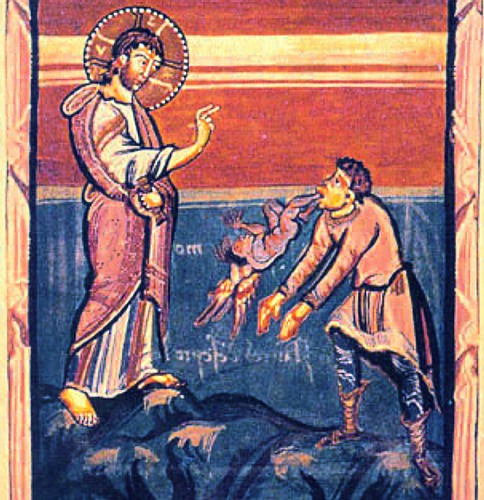
The story of the man possessed by Legion in the New Testament is utterly striking. Whether you have read the Gospels or not, the story is absolutely shocking for how little it resembles what you think you know about the world. It's short, so here it is in the NSRV (new standard revised version) form (Luke 8: 27 ff):
As he stepped out on land, a man of the city who had demons met him. For a long time he had worn no clothes, and he did not live in a house but in the tombs. 28 When he saw Jesus, he fell down before him and shouted at the top of his voice, "What have you to do with me, Jesus, Son of the Most High God? I beg you, do not torment me"-- 29 for Jesus had commanded the unclean spirit to come out of the man. (For many times it had seized him; he was kept under guard and bound with chains and shackles, but he would break the bonds and be driven by the demon into the wilds.) 30 Jesus then asked him, "What is your name?" He said, "Legion"; for many demons had entered him. 31 They begged him not to order them to go back into the abyss. 32 Now there on the hillside a large herd of swine was feeding; and the demons begged Jesus to let them enter these. So he gave them permission. 33 Then the demons came out of the man and entered the swine, and the herd rushed down the steep bank into the lake and was drowned. 34 When the swineherds saw what had happened, they ran off and told it in the city and in the country. 35 Then people came out to see what had happened, and when they came to Jesus, they found the man from whom the demons had gone sitting at the feet of Jesus, clothed and in his right mind. And they were afraid. 36 Those who had seen it told them how the one who had been possessed by demons had been healed. 37 Then all the people of the surrounding country of the Gerasenes asked Jesus to leave them; for they were seized with great fear. So he got into the boat and returned. 38 The man from whom the demons had gone begged that he might be with him; but Jesus sent him away, saying, 39 "Return to your home, and declare how much God has done for you." So he went away, proclaiming throughout the city how much Jesus had done for him.
I hope that wasn't too long. The story is told by Mark and Matthew as well, and although there are variances in Matthew, the story is basically the same. Do you notice anything missing in this account?
Come on, folks! You've been watching your horror movies. You've seen your television shows, like "Supernatural." Where is the war? This is the only actual dialog between Jesus and a demon in the Bible, and the demons aren't hollering defiance and war. They are not vowing revenge. What else is missing? Here is a man possessed by many, many demons -- enough to take out a herd of swine -- and he can break chains, so you'd figure that he could do some serious damage to the village, right?
This is strange.
If you want a Left Behind "Rapture Ranger" going to war with your Christian soldiers and counting on the Mighty Fortress that is our Lord, then this story is frustrating in every possible way. The demons manifest their evil by making their victim hurt himself. They show that they are demonic by being remorseful and despairing. They do not fight Christ. Instead, their first reaction is to ask if He has come to give them their torment in advance, because they know that the torment is coming. In other words, they are fully conscious of their guilt, and they are fully conscious of the fact that they not only will lose the struggle, but that they should lose the struggle.
What do they do when Jesus sends them into the swine? The compel the swine to drown themselves.
"Legion" is despair. The man with these demons suffers exactly as a person would who has the more malignant form of the disease depression.
This tells us enormous amounts about "demons," and despair. An animal, a pig, that held human despair would charge off a cliff. It could not endure the suffering. A man, imbued with reason, would instead harm himself. His elevation above the animal means a greater capacity for suffering because of consciousness, because of futurity, responsibility, and morality.
If you wish to see the story of the possession as a metaphor, as many no doubt do, then, just as other "demons" were epilepsy, this "demon" is our Scriptural evidence of depression. The man possessed by Legion is the patron saint, more or less, of those who suffer despair. The disease, when it comes from disease and not events, is like a herd of maledicting spirits: each voice speaks ill of every event, or even every lack of event. Each night is spent with a foreign, invading spirit turning the resting mind to whatever thought is most ill to the sleeper, and every morning sun is cast over by the clouding demon that calls it too hot or too late or too early, and the ledger is kept by demons that only know debits against the account.
The man who dwelt among the tombs was afflicted by the army of evil despair, and so there was not one thing to remove. Had his friends told him that the day was fine, the next spirit would have said, "Yes, but I have accomplished nothing in it." Had a loved one pointed to all that he did, the next voice would have said, "But it is too late to do any good for anyone." Like poisonous mercury, it would fracture and reassemble with one effect but as many bodies as necessary.
I only saw this meaning in the story this week. You may not think the story illustrates despair, but you cannot evade the despair of the demons. Frozen monks speculating on spiritual warfare are finely metaphorical, but this is Gospel, and we do well to consider it first, and those people who have a vested interest in war metaphors in their religion need to find some justification for it. Jesus won that fight already, but we can lose it all with violence, civil war, hate, and despair.
"We are born crying, live complaining, and die disappointed." -- Thomas Fuller. Fuller's statement is one of my favorite aphorisms. It's one of those great efforts at summing up the human experience in terms vague enough that no one can disagree and pointed enough that no one can repeat the statement without being in the author's own mood. In fact, Fuller's statement suffered reiteration in the 1980's as, "Life sucks, and then you die." That, however, misses the power and nuance, and so I offer up the following:
For immediate release Order to printing press for vinyl bumper sticker run Distribution: all truck stops and Affiliated convenience shops:
"Life sucks, and then you die, and you never got what you asked for on your birthday."
Well, be that as it may, there are umbrellas people walk around with -- little devices they have that offer shade and dry, where they can believe that what is inside in aspiration is outside in reality, where they can know that the other people -- the very ones most often known as "Them" -- are exactly the same. It's a vital piece of equipment in a post-imperial age. When you are a member of a group that reaps the benefits of the whirlwind of trade, when the colossus of your state plants its boots on the peoples of the world, when you are secure and know what it means to be a proud member of your national group, then you are most in need of reassurance, most nervous, most afraid, most jealous, most impoverished, most a twitch, and sun struck.
Speaking of which, I have some bad news and some good news about the near future for you all. First, the bad news: 1. Someone is writing, right now, a Twitter novel.That person is writing a novel where Twitter is a character or setting or metaphor or theme, and the magic of Twitter will be the motivation behind the largely bankrupt author, if not the complete thoughts. The good-bad news: 2. That novel will fail on artistic and commercial grounds and will not last. Samuel Johnson famously showed himself a blockhead who allowed his personal distaste for an author to overshadow an appreciation for what was in a book on more than one occasion. One was dismissing Gulliver's Travels as just requiring imagining big people and little people. The other was saying, "Nothing odd will do long. Tristram Shandy did not last." However, there was, perhaps, a deeper truth in his crankiness. No one could, after all, really imitate Sterne -- even Sterne. The structural complexity of Gulliver's Travels is far less spectacular than A Tale of a Tub, even if the satire is sharper and more philosophically interesting and developed from a position of simple defiance. Thus, any person who attempts to celebrate the lightning's flash and write an ode to it while it is yet splitting the sky is ... well ... a fool. Don't worry, though: I have no praise for the Tweeties. I have no interest in explaining why, in particular, your great Twitter novel is going to flop, or why your deep fantasy novel about Wikipedia is an abortion, or why your novel comprised of faux Facebook pages is a wreck in ruin. If you don't understand why already, then I place my muddy mitt on your head and give you my nicotinic blessings. Instead, in my fey way (Fey Wray?), I want to wander around the subject of why people, despite never being inclined to read anyone else's celebration of new sensations, still think to themselves, "You know what? This... this right here... this is great! This is the new Woodstock, or Eden. I need to write about it, sing about it, paint it, sculpt it, and bore the stuff out of everyone talking about it, and then I must convert them."
Answer the following question: When more than ten people gather together, they will behave: A) Like apes in a small cage B) Like ladies and gentlemen C) Like a community D) Like people on an elevator: striving to get away from one another as quickly as possible. When more than a thousand people gather together, they will behave: A) Like a small town B) Like a club that needs to black ball members C) Like a tribe at war D) Like independent individuals cooperating as little as possible.
That, friends, will explain all. If, to the first question, you answered A or D, then you are probably incorrect, depending on case. Presume that the people "are gathered." Some thing has provided an access point for convergence. The greater the power the individuals have over the access and collection, the less coercively they will behave.
Right now, the mania is Twitter. I say "right now," but I could, of course, be out of touch. After all, Marx argued that any superstructural artifact is ideologically meaningful only so long as it is not reified and objective. (What? You're surprised to find Grundrisse here?) In other words, by the time someone can say, "Hey, there is a great music scene in Athens/ Austin/ Chapel Hill/ Seattle," the scene is dead. It was active only so long as it was so puzzling that no one had a name for it. The moment it has a name, it has borders, and when it has borders, it has a place in the cultural lexicon. The Twits are a little different, but I'll come back to that.
See, when people gather and begin to subvert or play -- and play is subversive by its nature -- and when people gather together and cooperate (and cooperation is subversive, because it is also offering up a goal that is in miniature or distinction or separation from the ideological), they get a big rush. The thing is happening, and, while it is happening the people stumble along. As soon as they stop stumbling, as soon as they meet a threat, they have to defensively come up with a name for what they're doing. They have to have a "vision" that the threat is not.
While a thing is underway, the activity attracts society. However, there is an irreducible Bozo percentage (sometimes including the Zoso percentage, which is made up of people who believe that they're on a vision trip). Marx never discussed this, and neither did Freud, but there is a percentage of humanity that is a dick. Sometimes these are participants who fail, sometimes "outsiders" who want the energy for their own, sometimes "enemies" who oppose what they believe to be the ideology served by the activity. It doesn't matter. They are attracted to joy as surely as a flea is attracted to blood.
The music scene gets flooded with immigrants "just like REM/ Windbreakers/ Superchunk/ Pearl Jam." Trolls show up at the Usenet group. They then show up in web forums, as soon as they're invented. "Jimy issogay" articles appear at Wikipedia. SecondLife gets filled with porn. The various user-generated dictionaries fill up with private, elementary school physical impossibilities and slander. YouTube gets evil troll raters and "memes" of derision. The original activity, whatever it was, might attempt to fight back by adopting power or regimentation -- both of which being the white flag of defeat. When it's all over, the corpse in the grave, the grave paved over by a super highway, Hollywood will make a movie about the hot new scene.
Twitter is Citizen's Band Radio, in other words. CB was Ham radio. In each case, these were "fun" and "addictive," and the remarkable thing was that "everyone is nice." There were no evil people there, and "experts were shocked" that humanity was nice. CB radio was, for me at fifteen, what Twitter is now. "It allows the People to be free," the mantra went. "Look at the oppressed expressing themselves," the voices said. Ubi sunt?
The difference between a music scene, an art scene, a film project, or a theater project and Twitter or Wikipedia or CB Radio is not in what makes us go. We go because something contra-ideological is taking place. The difference is in the precondition of the technology. CB needed the radio, and Wikipedia and Twitter demand the servers. Each has a ticket price and a location, and therefore each attracts the inevitable irreducible dick percentage that will make it unpleasant and force the community into staleness, and each also has a magnet for the equivalent of that Hollywood movie. Each dangles a lure for investors, states, power trippers, and owners of thought, claimants of benefit. (Listen to Jimbo Wales take credit for Wikipedia some time. The Twitterers haven't done that, yet. Give them time: venality is a disease.)
We will jump at Twitter, and the next thing, because ideology is one of those rooms in a horror movie where the ceiling and floor move toward each other, crushing us.
"Positive ideals are becoming a curse, for they can seldom be achieved without someone being killed, maimed or interned." -- E. M. Forster
With apologies to the delicate Mr. Forster, it seems that positive ideals are all the world these days, but one should in no way believe that for being "positive" that they are designed to add, to supplement, or to achieve progress. They are, instead, ideals of certainty, ideals of propulsion. They are creeds, banners, slogans.
On my desk, I have a photo, framed, that I got from despair.com. I recommend the site, and I will link you directly to the place, so you can buy your own. It says, "It's best to avoid standing directly between an ambitious jerk and his goals." That's a motto, for me. The people who come in see it, smile or laugh, and share a sympathetic nod, even the ambitious jerks whose paths I am avoiding. This is not merely because, "Satire is a sort of glass wherein beholders do generally discover every body's face but their own," as Swift wrote in A Tale of a Tub, but because, in this case, the satire and the satirist seem to apply generally to the folly of the world.
You see, if you look about your work place, you will notice a great many jerks, ambitious and otherwise ("otherwise" includes bitter, vindictive, small minded, guarding, shredding, and oblivious), but you will notice one central thing about them: there are those who cause reactions and those who react. The ones who make everyone else react and compensate are the asses. (I do not mean that in the vulgar Usonian corruption of "arse," either. I mean it the way a dictionary would mean it.)
Back in the 1980's (beginning in the 1970's, I suppose), business manuals and business schools began advising, training, praising, and paying people to become "Leaders." Dingleberries of all flavors began reading Musashi and fancying themselves Samurai. They taught themselves the "art of the kill" and looked for "Human Resources" and "assets" and other mil.net junk. They sought, in short, to be not testosterone infused -- all of my feminist friends with their analyses of the homosociality of the corporation have valid observations, and all of the feminist analyses of the boardroom's hostility to the female are accurate, if historically bounded -- but asses.
The Scythians were set in flight by the braying of an ass, according to Roman historians congratulating themselves on defeating Mithridates.
An ass is excellent at going the direction it is already heading. It is not so good at adapting to circumstances, however, but the ass is not particularly interested in those circumstances in the first place. Alternately saturnine and sullen, so long as its actions are unhindered, the ass goes forward or kicks back.
Look at your workplace, I say, and you will see that you are reacting to a jerk. The person you spend all of your time trying to make up for, trying to compensate for, trying to mitigate, is almost certainly an ass. If you are not doing so, then you are an ass. If you feel that things are pretty much in good shape, except that people won't do what you tell them to do or want them to do, then you are an ass. The ass has a direction.
In the political sphere, we are in a pathetic place right now. We have a technocrat President. The last Democratic Party ass we had as president was Lyndon Johnson. Bill Clinton was something else. He was a negotiator, a mediator. I'll get to these people. In some ways, they're the worst of the barnyard. The technocrats are extremely competent. Competency is the new loyalty, one D.C. insider quipped (reversing a satire of W. Bush, who substituted personal loyalty over knowing how to do one's job). He is also a great orator, of course, but he's not an ass. His opponents, though, are filled with "positive ideals." They're positive that an ideal world will have "no government" and a strong military, and pure state's rights, with the federal military giving them Predator drones to shoot brown-skinned immigrants, positive that the ideal society will be "free" with more prisons and dissent will be "free" and arrests for communists will be a matter of course, along with phone tapping. Their positive ideals make no sense whatever, but that's because they're ideals. They're not real and not designed to be real, or even in contact with reality.
So, what do you do, if you're not an ass, and you are deafened by the braying?
I don't know. Why would you think I would? I put a sign on my desk that I purchased on the Internet, so obviously, I haven't a clue.
I can tell you some things that don't work, though.
One of them is to believe that the ass is really a dog. If you believe that the animal is expressing reasonable demands that simply need to be heard, decoded as cries for help, and addressed in a meaningful way, then you are going to get your head stove in or staved in. I know a person like that. He keeps attempting to mitigate. By avoiding all anger, especially his own, he believes that it can be averaged. This is how he was raised, no doubt. "All of us are equal, and all are alike," the dictum goes, "and no one is bad."
That's true, but people do bad things, and people resist improvement, and, while you are getting your catcher's mask and the rubber bullets and the sticky foam, they're gnawing at your leg or burning down your farm. This is a high price to pay for the "virtue" of not being positive, yourself, of not being aggressive.
This deluded person is not the negotiator. He is, instead, so passionately afraid of the jerk, the ass, that he is refusing to admit that he, too, is a beast, that there are beastly qualities. The negotiator, on the other hand, knows full well what an ass is. He's a jerk of a different stripe, because he's an advertiser, a pitch man, a confidence man. He is running numbers while he's counting change and talking about the weather. If he's complimenting your shoes, he's wondering how to convince you to make yourself naked. He wants to use Aikido on you. Your own impulses will be channeled gently so that your jerks become his impulses. If they can't, then they render you neutral.
The negotiator is a jerk with a smirk.
My method is more common, more defeated. I take Pascal's advice and try to tend my garden. I cannot, though, because the asses are tromping up and down the halls and trying to bellow at me. Therefore, I opt for a separate peace. Each time, I look at their positive ideals and try to negotiate harm reduction. My day is spent in a constant calculus of injury prevention, seeking the grand prize of inertia against all of these unbalanced forces.
My method does not work. It requires constant worry. It also means reaching inside for every resource: aggression, resentment, satire, isolation, and positive ideals of my own. I have to rummage through the entire quiver for whichever tool, whichever prick, will turn the beast aside that is at my door. Most of the time, though, I try to stand off to the ass's side.
Asses have lousy peripheral vision, what with the blinkers and all.
Such as me are the worst. We are worse than the people who lay down grease, trying to figure out the best trajectory for the kicking noise box to go when it begins its charge. We keep suing for peace on terms of our own, keep ditching our allies. We do so either because we are exhausted or because we are wise, because we are clever or because we believe it is not worth the bother to try to grab the reins, because we're missing fingers from those squared teeth already or because we're Scythian savages who want to ride the plains unhindered, but we do so. We strand our friends. We leave the creature to hoof up and trample down everyone else's garden, so long as our precious carrots bloom.
An ass cannot get a good head of steam up, unless timid or grizzled people like me duck out of the hall. The positive "reformers" who want to "take our country back" (from whom they do not know, exactly, except that they are sure that once it was theirs and now it is not, and they feel the loss, even if they cannot measure it) need the freshmen in Congress who want to be unnoticed, the veterans who want to calculate that these groups come and go, the compliant reporters who feel that the crazy sells and the fact checking bores (and takes up time). The office jerk cannot make everyone react unless "everyone" decides that hindering that creature's momentum is certain to be an effort without allies and, in so doing, assures the next victim that blocking the beast will be done alone.
As for positive ideals, there is one: Isaiah 11:8: And the sucking child shall play on the hole of the asp, and the weaned child shall put his hand on the cockatrice' den.
An ass or an asp. Either way, it would be the New Jerusalem.
If you see the newly released-to-DVD "Defendor" and do not recognize that you are watching a pure adaptation of Don Quixote, then it is not your fault, nor the film makers.
Let me exonerate the film maker, first. Peter Stebbings wrote and directed the movie, and that's a pretty good sign that he had something on his mind. When one encounters a film with a writer/director, it usually means that there is something literary or otherwise hermeneutic going on. Some surfeit of signification is going to be either on or behind the frame. In this case, the adaptation is lovingly crafted and detailed. The film shows the sort of obsession to Cervantes and brief, synecdoctal allusion that only a man in love and meditation could come up with.
"Defendor" is note for note, beat for beat, refrain for refrain, Don Quixote. Perhaps other directors went mad chasing the mad don, but Stebbings managed to capture him complete in his audience interaction, if not his social significance.
You see, the problem with Don Quixote is that he refuses to be actually heroic. He loses his fights. He refuses to be a voice of virtue, too. His notions of virtue are based on hyperbole Romance conventions. He is nuts. His side kick is the hero, but he refuses to be heroic, even in his anti-heroism. The villains are villainous, but not special. The audience is required to laugh at the ... this is hard ... are you prepared? ... disjunction between the real and the language. What's funny about Don Quixote is the perception of reality held by the player(s) and the author and the audience. The three different voices (and they are at odds with each other) change places in levels of seriousness and virtue, but they always present a gap, and that gap is ridiculous and satirical. In Don Quixote, we are sometimes satirized, as readers, for reading junk, sometimes satirized for letting the world be messy, sometimes satirized for being a mob, sometimes satirized for overlooking peasant wisdom, sometimes satirized for trusting in titles, sometimes satirized for our use of wealth, sometimes satirized for not trusting more. There isn't one message involved, but a dozen.
"Defendor," believe it or not, manages most of that. Arthur, our "Defen-don," is retarded, and that is the greatest difference, and the most troubling problem, with the adaptation. (More about that later.) Other than that, he is a man who has taken his comic books and comic book movies seriously. This is a film that gets to parody film's own excess, and in film's own language, but with a character that gets to be Cervantes's narrator. He loses his fights. His "hooker with a heart of gold" doesn't have a heart of gold at all, but she doesn't have a bad heart, either. She smokes crack, but, in the film, it's called "Bling." Bling is not simply a random substitution, either, but a clever comment on what fills the wound. She's normal, and that means unrepentant. Defendor's villains are villains, but they're not super villains. His arch-enemy, like the wizard that Don Quixote chases, is an amalgam of lost hopes and disappointments that points at a real arch-villain.
We, the audience, are put through the same knots of emotional response with "Defendor" that we are with Don Quixote. More to the point, we have to laugh mainly at ourselves. We have to recognize that we ignore the construction workers holding the sign saying, "Slow" (as if a label or badge pointing at themselves). We have to recognize that Captain Industry is, indeed, an arch villain who is destroying mothers, even if there are more immediate villains, like the bad dry cleaning store owner who knows he is bad. We have to admit that we built castles in the air out of wishes and castles in Spain out of denial.
The film's Sancho Panza is a man who, like the book's Sancho, knows what he is: he is decent. He reaches out and takes in Arthur Poppington ("Defendor"), and he receives no island for his efforts (except the island universe of a small house with a family in it). His normal world and normal life is a deviation from Don Quixote, as is Defendor's retardation. This film's theme is more concerned with the subject of virtue and vice (in the law enforcement meaning, as well as the theological meaning) than Cervantes's was. Our Sancho tells his updated idol that there is no need for illusion, no need for delusion, that ordinary heroism is sufficient. This Sancho does not follow: he rescues, and he counterposes a separate world, a genuine separate peace.
This message gets rejected, at a critically important moment. Rejecting ordinary heroism means rejecting ordinary methods of heroism as well (including ordinary preparation), and Defendor must have his illusion to define him, as the Don must have his madness. However, because Defendor is compromised by retardation rather than delusion, some of the power of the message is lost, and a good bit of the moral sting is lessened. There is too much of an opportunity for an audience to say, "He couldn't help it: he was retarded."
I applaud the film. It is amazing. Except for the fact that some audiences could excuse themselves from being better by saying that Defendor was compelled, "Defendor" is a vital movie.
Here is where it goes all pear shaped, though: why didn't you see this movie at the theater? It stars Woody Harrelson and has other well known character actors.
Well, it would have come out near the time that "Kick Ass" was coming out, I suppose. "Defendor" is Sony, and "Kick Ass" is Lionsgate, and I will allow the people who think about Hollywood things to think about those things. "Hollywood" is not a place: it is a business model, and I, personally, do not care for it.
"Kick Ass" is a juvenile wish fulfillment movie, and, as such, it is designed to compete for the acne creme and Twinkie audience. "Defendor" is art house. This Venn diagram shows no overlap at all. I understand that the marketeers have no concept other than Pez dispenser tie-ins and clothing lines for toddlers, and "Defendor" seemed to have its own clothing line built in (just as "Don Quixote" would), but that's not, I think, the reason.
I suspect that the reason is that you, the audience, are being calculated again. You are intelligent, but your intelligence does not show up in the counterweight of their scales. They believe that 100 intelligent people per 1,000 is not good business. More to the point, they do not understand Don Quixote and are certain that you do not, either.
You can be forgiven for not understanding Don Quixote. You've probably never read it, at 800+ pages, and you've almost certainly never seen it. Filming a novel is iffy. Filming a novel and capturing its aesthetic or aesthetic action is rare indeed. Worse still, there are "movies" of Don Quixote that stand between you and the novel.
First, we have the attempts at recreation of the novel. Recapturing and recreating the novel, of filming it, are valuable. However, filming all of it would be the sort of project that Eric von Stroheim and Abel Gance would have to have teamed up on. Additionally, there would be no way at all to capture the narrator in a film. Finally, the disjunctions that created an entire genre (the mock-heroic) would be absent, as the audience would simply see an old man being whooped upon by mean people. Nevertheless, there are attempts at such recreations. People have seen them.
I have no bad words for these films. If you know the novel, the films are nice.
Secondly and more destructively, though, we have the appropriation of the novel's aesthetic by The Man of LaMancha. That musical and film has utterly obliterated the novel. We cannot even see or hear the don for its dreamer dreaming the impossible dream. From a mad fanboy, the don has gone to hippie dreamer on a quest for self-actualization. Try to imagine making fun of him, and see how far you get.
I have greater admiration for "Defendor" than you may imagine because the writer/director had to fight against preconceptions and a miasma of appropriation to retake the don. That he did so by actually adapting Don Quixote instead of filming it is even more to be admired.
Just because you don't see a post, that doesn't mean one isn't here. It just means one isn't published.
Just because you can't see yourself, that doesn't mean that you're invisible. It means that your face is too swollen to allow eye movement.
Just because you don't hear any news, that doesn't mean that you have peace of mind. It means that you are unaware of what your enemies are doing.
Just because you found a way into the mirror, that doesn't mean wonder awaits you. It might mean that the reflection meeting the object will result in complete negation.
Just because you're not guilty, that doesn't mean that you're innocent. Many people are blameless and entirely worthless, both.
Just because you have to pay an income tax, that doesn't mean that you are taxed then. You were taxed anyway, and always farther away from the point of your daily needs, the more affluent you are.
Just because you cannot hold down a job or complete a sentence or maintain a regional dialect for more than a few weeks at a time, that doesn't mean that you're not a "star of the Republican Party." There is a good chance that you are, in fact, a star of the Republican Party, and, with three colleges to get an associate's degree, superior to a law professor when it comes to the U.S. constitution, superior to Ph.D.'s in climate science when it comes to global warming, superior to Nobel Prize winners in economics when it comes to taxation, and far ahead of people getting the daily nuclear threat briefing and non-proliferation reports when it comes to nuclear weapons policy.
Just because people tell you that you're a lumpen monster, that doesn't mean that you're not entitled to run the joint. If your name is Caliban, Prospero's books might have made you, but that doesn't mean that you have to listen to him.
Just because you're sore between all of your hinged parts, that doesn't mean that you've done something wrong. Debauchutantes are the new entertainers on all levels of society, and they're widely admired.
I was just standing there, pooling water in the sink to hold hair that I mowed from my face, and the BBC WorldService was going into its segment "The Interview," and they were going to repeat a segment I'd already heard, with the mayor of Jerusalem. I had just gotten back from fetching a biscuit, and I had considered blogging a thoroughly mopey observation about the differences between dogs and their vertical but shabby and stunned and melancholically prideful owners on the morning walk, and I was contrasting these and my own mood to the day.
You see, it's Palm Sunday. This is the day when the followers of Jesus got what the literal minded expected. This is the day when Jesus conformed to their expectations -- the expectations people like Nir Barkat would have -- of being King of Israel and Judah. Christians, who know the whole cycle, are in a strange moment of prolepsis and memory, and this has been one of the most intriguing parts of worship for me: we are to celebrate occasions as if they are isolated from what follows and yet as if they are fully in communication with what follows. We celebrate triumph today, and we know, at the same time, what follows.
Anyway, I thought about how, in comparison with something unimportant to the first generation of Christians, like birth days, the date of Palm Sunday is very carefully recorded. The timing of Holy Week is quite precise. We can be sure that this is the same week of the year, even though we have no guess about something like Christmas. The reason is that it occurred during Passover.
That led me to an observation that someone else must have made. Passover must have been an extremely major holiday for Israel and Judah at the time of Christ. If all of the early Christians knew it exactly, and if it was the centerpoint of the year, then it was not simply some holiday or holy day. That led me to thinking that a nation like pre-diaspora Israel must have taken the liberation from Egypt as something like a point of national foundation day (Fourth of July) plus a holy day plus a day of the Law.
The way that I work, I began to think -- largely because of the dramatic increase in hate speech and hate groups in the USA this year -- of what freedom from slavery, what emancipation, would mean for a people. Juneteenth was once a major celebration, we're told, but it has faded out almost entirely. (Yeah, it's on the web, but so are Norse fertility rites, and notice that the first thing is, "What is this?") The Emancipation Proclamation, I hope everyone knows, did not "free the slaves." It freed slaves in Confederate territory. I.e. it freed slaves beyond the reach of the proclamation itself, and it did not free slaves in the Union. It would take later action for there to be real emancipation -- hence Juneteenth.
I thought, "Gee, people ought to have a Passover-style celebration," but then I stopped.
I stopped for two reasons. First, there is nothing divine involved. A nation that ceases to do evil is not actually doing good. When a nation ceases to be legally wicked, it's a pretty piss-poor party we'll throw. Also, the deliverance was judicial and legislative and contentious. The second reason, though, is the question of who would celebrate? All descendants of formerly enslaved persons should celebrate, of course, but do those descendants know who they are? Our histories are vague. Our ancestries are treated, in the U.S., as quaint matters for D.A.R. and cotillion manque dames. Skin color has nothing to do with it, of course, and both "white" and "black" people can find enslaved ancestors and enslaving ancestors, if they have ancestry going back far in the continental United States. (Many of the people now sprouting neo-Confederate tufts of gray are curiously newly arrived, in that respect. They talk of how nice slavery was, and yet they don't seem to want to be enslaved, themselves. I, on the other hand, have the ancestral taint, and I see nothing in it to boast of or expiate on the individual basis.)
Finally, I wondered about celebrating Passover in Egypt. Our situation is quite different. It may be historically unique. We are a society that is striving to integrate and redress. This is peculiar, and it is worthy of celebration. It is perhaps worth shouting about that we did not pass over, that we folded in, that we admitted to membership and admitted to ourselves.
Certain phrases are false if they're true and true if they're false.
We know this from the old liar's paradox. I can give it to you in the Cretin version, but I'd rather give you a cretinous version of it: "Everything I say is a lie." You see, if the statement is true, then it's false, but, if it's false, then it's true. These are not, I would argue, paradox at all, because they do not seem to be true.
"Literal reading of the Bible" is a self destructing phrase. No one, no matter how stupid, and I mean that, reads the Bible literally. Any person who took the Bible literally would have to be Roman Catholic, to start with, due to "Take, eat, this is my body given for you," and then he or she would have to be a Catholic from before the 2nd Vatican Council. Additionally, though, such a person would read the Revelation of St. John and expect exactly what it says, a dragon with ten heads, for example, and would never, ever say that that "represents" something like the E.U. Such a person would also think that the builders of the ancient Temple in Jerusalem were incompetent, as Nehemiah said they "built with a sword in one hand and a trowel in the other." That person would also think that David was not a king of Judah and Israel, but, in fact, a sheep, since the Lord was his shepherd.
No one, least of all the people who talk most raucously about how they want a "literal interpretation of the Bible," reads the Bible literally.
"Government spending" is a self-destructing phrase. I was polled recently and asked how much of a voting issue it was for me to "stop government spending."
Government spending? Which government? I presume the U.S. government is intended, but which level of it? Is it important for me that my city stop spending funds? Of course I am supposed to assume that the phrase refers solely and exclusively to the federal government, but if I am "against government spending," I can only make the phrase have meaning by thinking in an analogy to a human being. If I am against my child's spending, it is because I want my child to save for college. Is that what I want, then? I want the U.S. federal government to build up a bank balance?
In reality, I am against spending on the Strategic Defense Initiative. This anti-ballistic missile treaty defying program has sucked out $3,000,000,000,000.00 of our tax money to protect us from the Soviet Union's intercontinental ballistic missiles. It doesn't work. It can't work. It can't work for that, at any rate. No American citizen's health is improved by it, and no American citizen's poverty is relieved, and no American citizen's drug habit is reduced, and no city's infrastructure is bolstered, and no wetlands are protected, and no rail systems are built with it, and no broadband is laid, and no smartgrid is built. It sits there sucking, and no one seems to question it. However, the people "against government spending" will not be up in arms about it. No. They'll be furious about Welfare -- the thing that accounts for less than 0.01 of our domestic spending. They'll be furious about museum funding. The phrase "government spending" is not "government" or "spending," but "domestic spending on the poor and needy and culture and cultural products not your own."
"Taxes" is not self-destructive as much as it is empty political calories. It's a symbolic link, in Internet terminology. When you click on that verbal icon, it redirects you to another concept. Instead of taking you to "taxation," it takes you to "individual income tax." The people out there with signs and turning purple with rage are all about "taxes," but they do not mean taxation: they mean the income tax, and that is the only form of taxation they mean.
"Public health" is a self-destructive phrase. I know that I am more likely to use it than the people I've been railing at, but it's a phrase that takes itself apart. Health is individual, not public, and public is necessarily unhealthy.
Recently, the governor of the state I am in justified continuing banning alcohol sales on Sunday only on the grounds of public health. I watched youngsters try to argue for or against his position. Inevitably, they all argued for his position, but they found themselves, being under twenty-one, arguing his logic rather than his position. They argued that the public is healthier without alcohol than with, and therefore alcohol sales should be prohibited at all times. (In fact, my own view is that the ban on Sunday sales is a bit of left over religious bigotry. I suspect that it was originally aimed at Catholics, not sobriety.) The reason that this governor felt no compunction in making such a weak and stupid argument was because he had "public health" to hide behind. A phrase without meaning, a phrase that disassembles in the mind, is a phrase that can hide an elephant.
Unlike the serious-minded, personally affecting post below, which took a long time to write, I have one that practically writes itself, except for finding the time. My next topic and theme is The Laziest Generation (it's yours).
I've been asked to keep the forgiving, reflective, "we're all sinners" tone out and to go for the throat, and I'll try. I must say, though, that BBC deciding to run "Super Power Season" has certainly been a major help in pulling out the knife and putting away the bandages. Every time some "Internet entrepreneur" comes on to say, "Like, we have to look at things from the perspective that things themselves ask for," I want to grab a garrote.
Back as soon as I can find the time. It shouldn't be long.
[Note: I had originally written this in pieces, and the results were uneven. You can read them, below, in "De, Da, Dum."] I work at a place where there are rumors that a statement of faith is coming. It's not so remarkable. Many, many, many parochial and non-parochial institutions have things like that. Heck, entirely secular places have these statements of belief that employees have to sign, but they're called "statements of principle" or "memos of understanding." It got me thinking, though, about why a group that has given absolutely all credible evidence of belief in behavior needed to be sent through a signed confession.
There's a lot of it about.
Does anyone here remember the hubbub of the flag pin in the presidential elections last year? It was all about wearing a pin showing the U.S. flag. Only patriots wore them, and anyone who didn't wear one was no patriot. Oh, my European readers will not believe anything so trivial really happened, but it was an encouraging improvement. Before that, there was a furore about the "Pledge of Allegiance." Back in the late 80's and early 90's, politicians vied with one another to say it loudest. They also made sure to sing the national anthem, or bits of it. (The fact that this came from Lee Atwater is not surprising, really.) When they were all singing and pledging and swooping their arms over their hearts with greater and greater passion and stage tears at the mention of soldiers, it prompted me to think that the ministers of Lilliput, who had to dance on a high wire to get elected, were chosen on a more rational basis than conservative politicians in the U.S., because the public was more entertained by a high wire walker than these old white men trying to look grave without looking dead. The flag pin, in comparison, didn't bite down.
The idea was that by his pin shall ye know him. By his pledge shall he be known. FoxNews has been convicted of passing along an e-mail slander about candidate Obama in 2007-8 that claimed that he "refused to say the pledge of allegiance." This is part of the portfolio they were building of proof that he was secretly a foreign agent.
Think about that. Do you not wonder now why no one ever made Robert Hanssen say the pledge?
You see, the thing about all such pledges and tokens is that they represent a search for a set of magical words, a set of words that, if spoken by the unbeliever, will cause the cursed tongue to burst into flames. They therefore represent a wish rather than a tool. They testify to the desire of the affected group, not the social coherence of it. A group can be entirely uniform in belief, completely loyal, entirely certain, and yet it can reach for the formula of the loyalty oath, the pledge, the confession of principles that all "real members" must sign or say or sing or dance (really, in some societies it's a dance). Indeed, the groups that employ these devices frequently are quite homogeneous.
In each case, the invocation of the magic is a demonstration that the group feels like it is impure, is fearful that it is infiltrated, is nervous that its ideas or ideology haven't strength enough to survive a test (whether the test is foreign trade, education, free speech, open assembly, or discussion varies group to group and place to place).
When the Republican Party goes after a Purity Pledge, swearing to pure Ronald Reagan, they not only grant Reagan the apotheosis that Christian fundamentalists within the party really ought to object to, but they also seem to say that they are afraid that these principles are not capable of surviving in their party without such oaths. Particularly, the device is aimed at "accountability." A politician who "passes" the purity test (with its connotations of sexual inexperience being simply another troubling aspect, given that this is a party most dogged by closeted politicians and hidden pedophiles currently) can then be "held to account" when he or she casts a vote that presumably violates the pledge or test later. What's implied is that the pure principle cannot survive the jarring of practicality or negotiation. What is actually stated is that the demand is for inflexibility and "pure" or nothing. It is an ideology that exists in and emerges from the framework of war.
If a religious institution makes its priests swear to agree to the dictates of dogma, it is presumably because the institution is in a struggle not among, but against all other religious organizations. If it has them swear to be religious, then it is at war with non-religion or with Satan. If it has them swear to be exactly in the model and mode of a particularized list of things and thoughts, then it is at war with conceptual interchange and fearful of that enemy. Oaths, in other words, create and announce their own enemies. If a political group has its members swear to the founding idea of the party, then it is against the opposing position. If it has its members go to a list of particular points, then it is against discussion and modulation and negotiation (against, in other words, civil exchange). No harm comes to a society if people are at war with evil, or Satan. Considerable harm comes if a society is in civil war. Considerable harm comes to a group if it is in intramural war.
(not my photo)
The purity pledge, the idea of cleanness, ends up slashing the throats of those who devise such tests. The institutions, whether they're church affiliated colleges or businesses or political parties, that institute oaths and pledges for purity are stipulating a "not them" as the definition of "a good one of us." This is, first of all, an identity built on opposition, which is guaranteed to be absurd or tragic. Secondly, though, it means that the person who devises the oath is subject to the same examination by the next test giver. "Are you Baptist enough, friend," the test giver asks the test maker. "I see that you ask them to swear that the Bible is the inerrant Word of God, but you do not make everyone swear that it is the inerrant literal Word of God." In turn, that reformer is challenged, later, by another who can say, "I love the oath that you have devised, but you did not have the statement of principle say anything about how we all affirm the sanctity of unborn life, and we certainly don't want any baby killers around!"
Once an instrument of purity, or Puritainism, is in place, "purity" goes on indefinitely. Our friends the Menonites are pure. To them, the most fundamentalist protestant churches are hopelessly corrupted by man. Each element of a defining principle can become exaggerated to become an identity, and then a test question, and all in an effort to sort out the good from the bad on the assumption that the bad cannot speak lies and the good will never hesitate to swear.
"Auto de fe" is the original of what we now know as the "auto da fe." Originally, it was an act of faith. If you were sorry for your sins, you would show it in an act of faith. No one would tell you to, and no one would tell you how. The confessor would simply watch to see if you did something that showed that your faith was back so that he could be sure that you weren't paying lip service to the oaths. You see, the old church folk actually knew that people could be forsworn, that bad people had no problem swearing that they were good, that people without conscience would gladly swear to whatever was convenient. The auto de fe was not a test imposed by anyone, but rather a sign manifested by the will of the person.
Well, we all know what happened. Once the institutionalized fears came in, once the Roman Catholic Church became convinced that its ideas might not stand up in free interchange, they adopted tests of faith. Then came hunts for heretics. Then came increasingly elaborate tests to prove that a person was or was not serving Satan or Martin Luther. Then come the Inquisitors. After a person was tortured, that person would sign or say a grand confession in public, and this was the auto da fe. What had been a sign from the person became a testing outcome for assessment.
It's sad, amazingly sad, to see tests come in like this -- attempted tests of the soul, of the heart, of the mind, as if some combination of syllables could be an ascultation of the inward self. It's sad, deeply sad, to see Christian schools, particularly protestant ones, adopting, increasingly, oaths, as if unbelievers will not sign or that they will somehow demonstrate their non-belief. It tells us that the groups at the helm are afraid that their faith is not strong, that their ideas cannot survive free exchange, that they believe that prosecution of their members is better than construction of their ideology. What's more, it tells us that they are, in their fear, willing to forgo looking at a person's expression of faith in favor of demanding a formulaic satisfaction of a ritual.
If the Republicans want to be a party again, they need to have dissent, debate, and discussion, and not purity. If protestant churches want to triumph, they need to have faith -- faith in the power of Christ, power in the Word that conquered the world -- faith in life's diversity and the glory of God who creates not in one type, one model, or one mold, but in endless variety.
While we're waiting for the thing on the purity tests, let me meander a moment.
In 2002, just as the Bush administration began to secretly torture people and employ "black sites" for prisons, and as, at the same time, the Pentagon sought permission from the Justice Department to begin to torture at Guantanamo Bay, and as it became very clear that such things were happening and that they were going to try to start an unprovoked war against Iraq, the mood in New York City's hedonistic areas was tense. Down in the Bowery, the stenciled motto I saw spray painted over and over, though, was "Pray for Pills."
Hardy-har-har, most people thought.
"This is no time for juvenile puns," my friend said, more or less. She was right.
I was fascinated by the secondary meaning, though, and the irony. I was interested in how the graffiti painter's attitude was unclear and unstable. The message itself was disposable -- a taunt typical of the punks (this was the Bowery, after all), where one attempts to puncture all sanctimony, including sanctity, and no good reason is necessary. The vehicle of the taunt, though... that was interesting. And then there is the question of exactly how much of a taunt it is, and who is being taunted. Pray for "pills" gives us "peace/pills" in tension and interchange: that is interesting.
The old "generation gap" of the 1960's, which was the most tiresome trope in journalism, theoretically went away when the Baby Boom became the journalist. (The term was nothing more than a way of saying that children occupy different horizons of expectations from the parents, which must inevitably be true, even if the generation is 1310-1330 AD.) It was tiresome for triteness, but it was noisome for taking itself seriously. "Help! I don't understand my teenager" is the subject of a never ending fascination of publishers, but the fools had the gall to present this one as if it were a once in eternity phenomenon.
The fact that the delinquent teens would make babies that would result in a second boom that would have a gap was presumed minor, and when the day came it was greeted as a marketing opportunity. The boomlet was my generation. The echo boom was the punks. (And they got to express their exasperation with "generation gaps" and "togetherness" and the pomposity of changing the world by using their only available tool: withering irony instead of manifestos. A great expression of the rage here.) After America stopped talking about "generation gaps," it adopted Douglas Couplan's foolish "generation integer" stuff, and all of that was marketing. Pepsi and Doritos and Budweiser sought out the characteristics of the generation to sell it product, not to communicate with it or educate it or reconcile it. In fact, the "generation integer" transition to marketing meant that firms wanted to exaggerate differences between parent and child so as to innovate product lines. There was money in making a generation gap, and it was annoying to both the marketing directors and the youngsters when the elders refused to play along and were early adopters.
Imagine, then, my surprise at encountering a silent generation gap when it comes to pills and peace. The graffitist is young, without a doubt, and her or his writing shows it. "Pray for pills" can put "pill" in a linguistic interchange with "peace" and suggest either that the author wishes nothing, nationally, but only a personal high obtained from dope, or that national peace and medication are related, if not causal, or that pills will be the savior that we pray to and for. In any resolution of this irony, the author betrays the idea that the pill is greater than the individual will. In fact, for the author, it's assumed. If the author is being satirical, instead of merely ironic, the point to the satire is aimed precisely at the substitution of "pill" for "will" or "God" as the agent by which hope may be sought in time of distress.
I had the misery of being a good bit ahead of the nation in questioning what is now an accepted trope ("medicalization of mood"). Back in 1991, before Prozac Nation's self-indulgent and unenlightening novel made investigative and timid pieces possible, and before those lead to more thoroughly investigative and enlightening pieces, I held out the question, and anyone who is honest keeps it as a question, of whether the human brain's manifestations of mood (chemical production) are synonymous with its causes of mood? If not, is preventing the manifestation of mood tantamount to a treatment of the cause?
Suppose that substance Q is in the brain of people at rest. Does it make placid feelings? If a person is too tranquil, and we prevent the production of Q, are we treating the somnolence, or are we preventing the expression of the disease state? Either way, are we not effectively ceasing to ask anymore about the cause and therefore leaving it to heal, worsen, or remain without medical intervention?
In fact, are we not preventing any awareness of it? By effectively disrupting the evidence of cause, by putting a lid on the box, are we not preventing, quite effectively, any access to the box's contents? Obviously, the manic whose mania is suppressed is unlikely to think about the cause of the mania, but, additionally, are we not also making it difficult or impossible to even ask what the reason is, if symptoms are interrupted so fully as to have no access point?
To put it another way, isn't it identical to invading Iraq? It looks like there's a problem, but asking whether the problem is the man or the system or the neighborhood or the objectives of the man is time consuming. If you're a "CEO-president," you're impatient with long explanations. Besides, you decide that your oath of office is not to the Constitution of the United States, as every other president's had been, but "to keep Americans safe," and so you want to fix the problem. Therefore, you decide that, although you don't know the causes, you don't care. You know the symptom, and you have a weapon. Once you invade, you invade, but you are then there, and now you have to figure out the things you considered time consuming before invading, or else you have to just plain stay there, without an exit strategy.
I say that I had the misery of it, because I paid the price in ridicule for questioning the wisdom of doctors without being one. After all, the pharmacology could not be susceptible to logic. Logic must not be applied in these cases, for the market knows best.
Now, though, what I thought is thought by many, but most of the many have gone to conclusions. They are for or against medicating mood. They are certain that it's good or bad. I am still not. For me, it's still a question. I do not know whether medicating psychological, rather than psychiatric, complaints is wise or not. I suspect that it is done too frequently. I am sure that it is done unsafely, but the central question of cause is still open for me. The brain is far too complex for my analysis, and the mind is vaster still.
What is curious, though, is what all the commercials for Zoloft, Alli, and Viagra have done to one generation of Americans and what they haven't done to another. These commercials, and the doctors who are victims of the cutty sarks and firm featured suits the commercials send to their offices, have created a whole generation that has grown up with a complete assumption that pills are more powerful than will. You see, a previous generation believed that "no pill can make me do something" or feared that "any pill that changes my mood has raped my soul." This attitude toward medication that affected the mind was profound. There was a baseline hatred and fear of the concept that any pill could make a person, could force a person, could interfere with the most intimate, inward self. Therefore, the person believed that such medications could always secretly be fought, secret-agent-tied-to-a-chair style (the character of Morpheus in "Matrix"), or that any thing that did this was going to shatter the person and make suicide or mercy killing the only virtuous act.
I grew up sickly. I was in the hospital a good portion of my life before adolescence, and I had been subjected to narcotics before I saw the drug fear films of the 1970's. I was afraid of "smack" and "H" and "horse" and the rest for their ability to instantly transform the polite human into the depraved slave, but I didn't know that I had, in fact, been on those drugs in their polite forms on several occasions. When I realized that what the world was afraid of was the same thing, the idea that a drug could be fought off or that it would break the self was impossible to hold in the mind. I was well aware that they could be "fought off" and that, even when they were not, they never touched the inward self.
Attitudes we see now toward depression, bipolar, erectile dysfunction, mania, PMDD, fibromyalgia, etc. are all reflective of this underlying question. The people who speak aloud of their mood and mood affecting disorders are of the generation or paradigm that accepts the pill as above the individual will. Those of us who are, either by birth or marketing or suffering, also, though, accept that the pill is temporary, that it is not, in fact, a breaking of the self or fixing of the self (the honorable obverse of the pill as psychic pollutant, as psychological rapist). This is why we can come up with taunting, teasing, slogans like "pray for pills." The very same joke is no joke to some large segment of America. Those of the other mental generation hear all of these things with shame and shock. For them, each one is an admission of weakness, of lack of integrity. The need for the pill should be countered with a muscularity, a fight, for any pill is a loss of virginal honor.
You know, I thought the last one was wonderful. I thought it was going to get me an invitation to the editorial board of The Dial. I braced for the impact of dozens... nay, hundreds... of learned letters about the ongoing Romanticism of lyric poetry.
Anyway, them's the breaks of the cookie crumble.
I am working on something much less fun in tone, much less lively in style, but much more socially useful. It's a discussion of why purity pledges continue to be demanded, despite always having been disasters for those proposing them. However, there is writing it, and then there is linking it, and then there is coloring it in.
I have written before about how, once we announce that we are offended and that we must be appeased, we have achieved the ultimate power, because the power to take offense exists independently of anyone giving offense. When our goal is harmony, instead of peace, then the most offended and most displeased person has power over the whole of the group.
Consider the United States Senate today. Its paralysis over the "notification to filibuster" is not only troubling because it says that the least happy have power to stop all things without having any necessary reasons or programs. The Republicans have not actually had any ideas for reforming health care. Their idea has been, pretty much, to stop malpractice law suits. That, needless to say, has nothing to do with health insurance. However, they feel perfectly justified in stopping all efforts at extending insurance, even efforts that they had once sponsored, under threat of filibuster, because they are not in charge.
Harmony and unison are not identical, and peace and harmony are not the same thing. Having all sides agree is not only not necessary, it is not beneficial. Having all sides cooperate is desirable, but they never will until they understand that they must honor an overriding rule that is above their individual good.
It's like pluralism. Pluralism is not relativism. Pluralism and inclusiveness is not the same thing as indiscriminate inclusion. Pluralism is a positive ideology, and it has within itself a principle of exclusion. "We allow in all groups, so long as they accept the idea of including all groups that are themselves open to inclusion" is the philosophy of pluralism. Democracy is not merely "the people vote," but rather "the people always vote to determine their government." Therefore, a democracy cannot vote to get rid of the democracy, and any vote to abolish the democracy is not democratic.
I feel like I have to point these things out, because too few people seem to know them. I feel that I need to state them rather than finesse them out philosophically because they are both axiomatic and elementary. One could take the time to work through examples and reason quietly over days and weeks to make the propositions likely, but these are, in fact, a priori within the concepts themselves. My only stretching is extending to the idea of consensual behavior. It isn't axiomatic or elementary, but I have come to believe that it is likewise inescapable that consensus means agreement when all sides understand that they cannot have their way. I.e. consensual politics, consensual corporations, consensual kindergartens, consensual communes, and consensual online editing communities are all possible only when each person gives up striving for her or his pure vision. "Consensual" is therefore an antonym to "pure" or "revolutionary" or "orthodox." The orthodox, pure, and revolutionary exist only with the application of unequal power.
I needed to do that quickly, and with none of my verbal playground stunts, because I want to talk about the auto de fe, the auto da fe, and how stupid people get when they're stressed out.
A number of conservative organizations are embracing purity tests, oaths, and other declarations these days. It has long been a feature of the conservative impulse, incidentally, as the very idea of 'return to glory days' means that one has the mindset that there is a largely invisible but inherent threat in the present, and 'return America/England/Australia/Canada/Sweden to its glory days' means that one believes that the present citizenry may be contaminated with beliefs that destroy the greater good. When this is combined with religious principles, the desire for a declaration is oddly unchanged. Many organizations associated with the Southern Baptist Church are now moving toward oaths, and this is merely the latest step in a curious evolution for a church that was once known as "the Independents" and criticized for having no unity at all. However, the way the oaths come in and the way they are organized is quite like the conservative "purity test." Instead of "creeping socialism" or division over Ronald Reagan, the presumption is that Satan is working inside those who will not sign or swear, as inward doubt is a mark of an absence of perseverance of the saints and grace (I suppose). Additionally, the institutions in question (mainly colleges) believe that they are "mission" oriented and therefore must convert, and conversions can only be performed by those who are "called" to be missionaries.
We need not dwell very long on the effectiveness of these instruments. It is self-evident that they do not work. They are like a net designed to keep the very large and the very small, while the middle sized get away. They succeed in keeping only the feckless and the fools, while the conscientious and convicted flee, and this is true whether they are applied in religion, in politics, or in culture.
What I think is worth talking about is why they do not work, and yet why people keep reaching for them, year after year, making the same historical mistakes, the same psychological mistakes, and the same cultural disgraces.
Does anyone here remember the hubbub of the flag pin in the presidential elections last year? It was all about wearing a pin showing the U.S. flag. Only patriots wore them, and anyone who didn't wear one was no patriot. Before that, there was a furore about the "Pledge of Allegiance." Back in the late 80's and early 90's, politicians vied with one another to say it loudest. They also made sure to sing the national anthem, or bits of it. It prompted me to think that the ministers of Lilliput, who had to dance on a high wire to get elected, were chosen on a more rational basis than conservative politicians in the U.S., because the public was more entertained by a high wire walker than these old white men trying to sing or look grave without looking dead.
Well, the thing about all such pledges is that they allow the certain to seek out a set of magical words, a set of words that, if spoken by the unbeliever, will cause the cursed tongue to burst into flames. They therefore represent a wish rather than a tool. They testify to the desire of the affected group, not the social coherence of it. A group can be entirely uniform in belief, completely loyal, entirely certain, and yet it can reach for the formula of the loyalty oath, the pledge, the confession of principles that all "real members" must sign or say or sing or dance (really, in some societies it's a dance). In each case, the invocation of the magic is a demonstration that the group feels like it is impure, is fearful that it is infiltrated, is nervous that its ideas or ideology haven't strength enough to survive a test (whether the test is foreign trade, education, free speech, open assembly, or discussion varies group to group and place to place).
When the Republican Party goes after a Purity Pledge, swearing to pure Ronald Reagan, they not only grant Reagan the apotheosis that Christian fundamentalists within the party really ought to object to, but they also seem to say that they are afraid that these principles are not capable of surviving in their party without such oaths. Particularly, the device is aimed at "accountability." A politician who "passes" the purity test (with its connotations of sexual inexperience being simply another troubling aspect, given that this is a party most dogged by closeted politicians and hidden pedophiles currently) can then be "held to account" when he or she casts a vote that presumably violates the pledge or test later. What's implied is that the pure principle cannot survive the jarring of practicality or negotiation. What is actually stated is that the demand is for inflexibility and "pure" or nothing.
It is this latter principle that ends up slashing the throats of those who devise such tests. The institutions, whether they're church affiliated colleges or businesses or political parties, that institute oaths and pledges for purity are stipulating a "not them" as the definition of "a good one of us." This is, first of all, an identity built on opposition, which is guaranteed to be absurd or tragic. Secondly, though, it means that the person who devises the oath is subject to the same examination by the next test giver. "Are you Baptist enough, friend," the test giver asks the test maker. "I see that you ask them to swear that the Bible is the inerrant Word of God, but you do not make everyone swear that it is the inerrant literal Word of God." In turn, that reformer is challenged, later, by another who can say, "I love the oath that you have devised, but you did not have the statement of principle say anything about how we all affirm the sanctity of unborn life, and we certainly don't want any baby killers around!"
Once an instrument of purity, or Puritainism, is in place, "purity" goes on indefinitely. Our friends the Menonites are pure. To them, the most fundamentalist protestant churches are hopelessly corrupted by man. Each element of a defining principle can become exaggerated to become an identity, and then a test question, and all in an effort to sort out the good from the bad on the assumption that the bad cannot speak lies and the good will never hesitate to swear.
"Auto de fe" is the original of what we now know as the "auto da fe." Originally, it was an act of faith. If you were sorry for your sins, you would show it in an act of faith. No one would tell you to, and no one would tell you how. The confessor would simply watch to see if you did something that showed that your faith was back so that he could be sure that you weren't paying lip service to the oaths. You see, the old church folk actually knew that people could be forsworn, that bad people had no problem swearing that they were good, that people without conscience would gladly swear to whatever was convenient. The auot de fe was not a test imposed by anyone, but rather a sign manifested by the will of the person.
Well, we all know what happened. Once the institutionalized fears came in, once the Roman Catholic Church became convinced that its ideas might not stand up in free interchange, they adopted tests of faith. Then came hunts for heretics. Then came increasingly elaborate tests to prove that a person was or was not serving Satan or Martin Luther. Then come the Inquisitors. After a person was tortured, that person would sign or say a grand confession in public, and this was the auto da fe. What had been a sign from the person became a testing outcome for assessment.
It's sad, amazingly sad, to see tests come in like this -- tests of the soul, of the heart, of the mind. It's sad, deeply sad, to see Christian schools, particularly protestant ones, adopting, increasingly, oaths, as if unbelievers will not sign or that they will somehow demonstrate their non-belief. It tells us that the groups at the helm are afraid that their faith is not strong, that their ideas cannot survive free exchange, that they believe that prosecution is better than construction. What's more, it tells us that they are, in their fear, willing to forgo looking at a person's expression of faith in favor of demanding a formulaic satisfaction of a ritual.
If the Republicans want to be a party again, they need to have dissent, debate, and discussion, and not purity. If protestant churches want to triumph, they need to have faith -- faith in the power of Christ, power in the Word that conquered the world -- faith in life's diversity and the glory of God who creates not in one type, one model, or one mold, but in endless variety.