[Note: I've started blogging at Daily Kos. Sometimes my "diaries" get attention. This one got none. It's either because it was inappropriate material or because it's a bit, um, advanced, or because I did it on the day of the supposed Rapture, and that was everyone's topic.]
If you are an intellectual and you feel free of anxiety, then I would like to know why. So far as I can tell, there is nothing but guilt for the moral intellectual in the United States.
I have a moral question that few will want to ponder and that none will be able to answer, I think. I sure as shootin' can't answer it. I feel like I did well to find a question that will ruin your day. Before I get to it, though, I need to make clear that what I am about to outline might be prophetic. It is possible that what I am talking about is the future rather than the present, and it could be the past for some sensitive souls. I cannot say, because in the United States at the present time it is not possible to discuss moral questions. The Internet has given us each a soap box and a funnel, but that just means a whole mass of barbaric yolps -- not discussion. I can prove that, too, if it's necessary for me to prove what we all know.
Before getting to the question ("Oh, do not ask what is it/ Let us go and make our visit") – and I promise not to play a coquette's or a writer's game with the point – I need to establish my usage of the term “moral.” I know that even the word is rejected by a good many people on the left, while, like toilet paper, it is used without respect to remove stains by "values" politicians on the right. For me, the word “moral” denotes a set of values that the individual believes to transcend the individual, the social, and the temporal. Thus, moral is what we believe to be good and evil, not right and wrong. It is right to stop at a stop sign, but it is good to feed a starving dog. The ethical and civic virtues depend upon context, while the moral ones do not.
Speak of morality and alienate our audiences, provoke arguments, invite lazy, retarded retreats into familiar lean-to's of belief, and it is received wisdom worthy of Flaubert's Dictionary that anyone who says the word is a fundamentalist trying to impose an antiquated scold's bridle on us or or a relativist trying to attack whatever is most dear. Speak of morality and make the gorge, discomfort, or disinterest rise.
It occurs to me that if this received opinion is correct, it is more of a reason to have the discussion than to avoid it.
[A digression follows. Therefore, imagine a lithograph of a nun wearing a cowboy hat on a prayer mat, while a cactus, needles capped by spent shell casings, stands sinister and an Oath Keeper with “Thor” tattooed on his knuckles smiles beatifically to the dexter.]
A result of the taboo on 'morality' for the left and middle of society has been the “religious illiteracy” that Mr. Prothero has documented so well. Another result is that we forfeit the discussion to those who will have it. Taboo creates fetish, after all. The more we make the Good unspeakable, the more sexy it becomes to those who wish us ill. We empower religion, especially, for the right, at the very same time that we surrender our voice and thus ensure that bigots are the only ones in the agora. The result is that most people think that “morality” is synonymous with religion. It isn't. Morality can be derived from religion. It most often is derived from religion. However, depending on definitions, all that is required for morality is a belief that some things are just right or wrong, no matter what, that the good and bad can be irreducible. Argue that passing on one's genes is the right thing because of fitness, that utilitarianism determines the right, that living and non-living matter are the same and that Nature's laws are right, that societies are systems and that the system's health is the greatest good – anything except “it depends on context” or “it is all up to the individual,” and you have argued a moral position, because you have argued that the good and bad extend beyond the individual's desires or the group's demands.
Basically, if it can make you uncomfortable, it may be morality.
Just because we disagree is no reason to be silent. If we are so afraid of having to clarify our assumptions, so nervous about trusting the other person to be calm, that we avoid the subject or claim that there is no truth but the temporary or relative, we end up giving the floor to the fundamentalists, the radicals, and the violent. This leaves us unable to call out their frauds. It makes us mute when we wish to converse and persuade the inexperienced to turn from the visions of fearful glory and martial virtue.
[End of digression. Onto the business of why you should feel horrible. Therefore, imagine that there is a photograph of Cicero with congestion and living Claritin Clear.]
Modernism. "Our virtues are fathered by unnatural vices," Robinson Jeffers said. Well, that's probably poop, but Modernism was certainly fathered that way.
I will abridge any long description of the rise of Modernism and only say that we in the Northern hemisphere of the Earth have, as our defining moment of the twentieth century, World War II. Before that, though, we had World War I. According to the Modernists themselves, who wouldn't shut up about it in their manifestos, they had no choice but do something drastic because of World War I. Rationalism had failed completely. Hegel's assurances, Arnold's assurances, science's confidences, that Progress was coming, that Civilization would lead us forward, had been gassed, died, bloated, and its corpse had exploded in No-Man's Land. Intellectuals after World War I got 1) sad, 2) cynical, and then 3) angry. They produced both the most original and skeptical thought of the century with one of their Cerebus heads and the birth of new vehemence and violence and mis-Utopianism with the other. They either questioned everything, including the unity of the self, in ever-spiraling questions of consciousness and mysticism, wondering if there was communication, or they had to devise a New Order that would not make such mistakes. Communism and Fascism both came from intellectuals rejecting the morality and civilization that “lead” to World War I. Then again, another set gave us the retreating movements. Revved up Theosophism, neo-Rosicrucianism, and tons of neo-nativist societies “discovering” the antiquity of their national tribes and paganism (the Geatish society, the Thule, the Golden Dawn) all retreated from reason in one direction, while others moved toward the hero cult or the truth of machines. Intellectuals were frenzied, desperate.
Well, golly. If that thesis is true, then what did World War II do?
Anyone?
It should have really, really set the world alight, right?
Well, no... and yes, maybe. It was a “good war.” For French, English, American, and even Italian intellectuals, World War II has a nicely drawn contour. Only after the bomb was moral philosophy awakened from its sleep. At that point, there was a searching into responsibility and the value of man as an animal. In France and Italy, the identity and culpability of the collaborator, the heroism and epistemology of the resistance (Sartre, most famously), the meaning of being a by-stander... these nagged and dogged, and some of the absurdism and nihilism and existentialist individualism of the 1950's and 1960's that we celebrate in America and the U.K. may mark a flight into private worlds where social morality no longer applies. However, other than a few moral philosophers like Niebuhr, who kept going on and on about sin, American and English thinkers fretted about tenure and q not q. Modernist skepticism stayed en vogue during the Cold War, because the Cold War kept raising questions about whether humans could be trusted to organize their own sock drawers.
[Since, by now, you're convinced that I'm never going to talk about us and why we should feel bad, here would be a truly diverting cartoon from the first run of “The Phantom,” where the hero instructs the natives on how to use an American revolver.]
I'm a coward, and I was doused in a mixed up form of Augustinianism early on in life, and so I have a big bucket of guilt on me from the start. I read famous philosophers hoping to find someone smarter than I who has gotten the answer. Like calls to like, they say, and so I have noticed that I am attracted, deeply, to those intellectuals who found themselves guilty of being near a crime in commission. So it is that I have been interested in how German intellectuals dealt with being the inter-war generation. One thing I see, over and over again, is that they grapple with the subject of guilt and responsibility of the individual as a component of the whole.
Now that question can't be answered directly. No one can say, directly, what our responsibility is for being near the crime. In fact, I would say that it's a problem that has been asked by many generations, from John Locke trying to figure out his responsibility for being in the regicide generation to us[here be footnotes], but philosophical discomfort is very useful, and the evasions help us. Thus, one of my favorite contemporary philosophers is Odo Marquard.
Dr. Marquard seems to have had the misfortune of receiving his Ph.D. during the “bad” time. Thus, he received his training from those philosophers whose names we do not pronounce. Is that his fault? His consciousness as a philosopher and professional was shaped by the post-war experience, which itself was dominated by the multi-year tribunal. Thus, in Abschied vom Prinzipiellen (Farewell to Matters of Principle [holy cow! they want $98 for it? Sheesh! it's really good, but $98?) we get my favorite contemporary philosophical essay, “Burdened and Disemburdened 18th Century Man and the Flight into Unindictability.” It's clear that the heavy question of guilt of mankind in the question of theodicy and the tribunal of philosophical questions of evil that Dr. Marquard discusses on the surface of his essay is a window into to a a question that is both wider than his historical moment and more deeply affecting than mere words.
The way he sees it, we humans could not say (Leibniz) that God created evil, and so we said that man did it. Well, if man made evil, then man can fix evil, and man is responsible. We, then, are on trial.
If humans created evil, then humans must answer to the tribunal, and the weight of this burden is such that we struggled to invent our social sciences to “presume not God to scan” and make “the proper study of mankind... man,” but we have been forced now to admit defeat. The world wars, the bomb, the germ warfare, the human experimentation, the eugenics... obviously, we have failed in fixing man. What, then, do psychologists, anthropologists, doctors, and others who went to fix evil do? They sweated. Thus, under swarms of qualifications, excuses, and demands that we look at our instruments and navels, we would give anything to not have to fix the problems of evil deeds. Indeed.
[I'm getting to the point now. Here is where we can collectively conjugate the verb “squirm”: I squirm, you squirm, we squirm.]
Aside from praising, awarding, and forgetting Arthur Koestler, we have known quite clearly that, as a democracy, and as a republican democracy, we could never suffer such monstrosities as Stalin or Hitler. Our lesson from World War II was about the individual. Could the individual who was president be insane? Could the “finger on the button” become Jack D. Ripper? Otherwise, we had little guilt and denied even that, especially when we hushed up questions about Hiroshima. The A-bomb is too horrible to visualize, and so we either turn it into an apocalypse (always with survivors) or fall back on Captain America. We need him now, we'd say.
In a democracy, if an administration violates our moral sense, we must vote against that administration and all who stand with it. We must ourselves stand for office. If our image of ourselves as Gary Cooper married to Donna Reed is under threat, we change things.
Here is my moral problem, then. We did that.
George W. Bush used torture and made torture legal. He decided, without legal authority other than usurpation, that the Geneva Conventions did not apply. He ordered that the Uniform Code of Military Justice not apply. His people began to spy on citizens. They decided to reinvent the dungeon in Bagram and Guantanamo Bay. They decided that there were people who needed to commit no crime to be detained and have no trial to be guilty.
We voted. We stood for election, too. We voted for Barrack Obama because he said that he would end every one of those immoral (not merely illegal and unconstitutional) practices. However, he has not, and he will not. Bradley Manning is just one example of an immoral act taken by President Obama. The man has not been found guilty of anything, and yet he has been pronounced guilty and treated with Guantanamo styled tactics, which themselves are immoral and unconstitutional and illegal internationally. The crime he is charged with is barely a crime, and he hasn't been put on trial, much less convicted. Nevertheless, psychological torture takes place and then, on the grounds of psychological instability, restraints.
The shooting of Osama bin Laden is probably also immoral. Do not get me wrong: from a political point of view, bin Laden could not have been captured. Bin Laden as a prisoner would have been a toxin too great for any state body. However, shooting an unarmed man is either moral or immoral. It cannot change just because the person in question is really nasty. That we have sacrificed morality for political practicality is understandable, but it is not acceptable. Further, we find that he was shot because the mission that “got” him was part of a standing program called “Kill or Capture.” That it has a name tells us that it is routine. That it is routine tells us of the erosion of morality like the seabed beneath our feet. It is normal to preferentially kill, but, if necessary, capture persons.
So, folks, what is our guilt? We voted. We voted the way that should have accomplished the moral ends. The vote did not achieve it. How obligated are we now to do more? How obligated are we now to agitate?
If torture does not violate your moral sense, then look at the structure of our economy. Our economy is absurdly immoral at the moment and shows every sign of increasing its barbarism, and this adds to the immoral treatment of prisoners, the immoral distribution of wealth, the immoral abrogation of rights. We voted against it. We have shouted against it. We have even stood outside banks and protested against it. Is that enough? Do we sleep at night? Do we have guilt, complicity, or just despair?
Are we unindictable -- social engineers who simply need to analyze our own methods again, or are we all doubling our Zoloft? Why are our philosophers not writing exclusively about evil, responsibility, and value? How can we, of all times, be silent now?
It's true that we "did what we could." Or is it true? Would we indemnify another citizen of another nation who did as we have, or would we damn? How, then, do we deal?

Monday, May 23, 2011

Tuesday, May 17, 2011
Unmoved
"...my interest in most things lies in the nominal rather than the phenomenal aspect. Some fine day I intend to try to get to the bottom of WHAT'S GOING ON HERE -- the real world here, rather than the world of seeming. Are we all liars and humbugs and if so, why not?" -- Myles na gCopaleen
If the average person exists, then the average person in the United States has a smudge where the meaning of “paradox” should be. Of the persons who know the word without its -ical handmaiden (“It's paradoxical that so many people know the adjective and so few the noun”), the Liar's Paradox and Zeno's Paradox must be the only occupants of the set. Oh, “set of all sets” and other strangers wave from beyond the margins at certain professions, but Zeno's paradox of motion far outweighs the argument he made that there is no pain, and Cretans lie (aren't Cretins the only ones fooled by the Boolean trap, or do we hold out for prepubertal viewers of "Star Trek" like me, too?).
For me, Zeno's paradox has been something of a haunting presence. I have never been satisfied with the answers that I have gotten to it, except the answer of my senses (those flying turtles hurt). Furthermore, I am haunted by the fact that we have somehow managed to go about our business, playing Math and Physics for centuries without getting a good answer to the paradox. Not only that, but I am molested, every time I consider this, with just how pleasant the people are who believe that they have solved the 'problem.'
My reader is an above average reader in every way, and so my reader already knows all there is to know about the paradox itself.
[Above Average Reader Of Note: Yeah, but we want to hear you say it, so we can make fun of how much you get wrong, later.]
Well, Zeno was slaloming in between the pillars and posts of his porch, wondering when the Romans would come make it all intramural, and I'm told he was ranting about how much Parminedes bothered him. Parminedes's paradox of time and motion, he said, was stubborn. “The way I heard it,” he told his students, “Usain Bolt and Rafael, the teenaged mutant ninja turtle, were going to have a race. Because it was unfair on the face of things for Usain Bolt to race a fictional character, he decided to give the turtle a fifty yard head start. However, when the race began, Usain Bolt discovered that he could not win, because he was unable to pass the turtle.” “This is because the turtle is a poorly conceived cartoon character, isn't it,” one of Zeno's students asked. “No,” Zeno replied, “but because Bolt, to pass the turtle, had to cross half the distance between himself and it. He then had to make up half the remaining distance. After that, he had to make up the very slight half distance remaining, but only to discover that there was as much distance to go. He crossed half of that, but then there was half again remaining. Of this half, he crossed half, and then saw that he could only cross half of the remainder. This would go on, as it turned out, forever, or for as long as there were divisions and numbers, and Bolt simply could not pass the turtle.”

[Aaron: That's not how we heard it.]
I know. That's why I told it differently. The point is that “time and motion are both illusions,” like Parminedes said, except, of course, that they're not, no matter what you've heard to the contrary.
Aristotle said that the problem with Zeno's paradox is that he presupposes and infinite amount of space to cross, but not an infinite amount of time to do it in. If we segmented time just as infinitely as movement, then the turtle would be in the soup. Something or other to do with the definition of time or the definition of motion or something. I usually agree with Aristotle – which is to say that I usually understand Aristotle – but in this case I'm still left with that “infinite division” thing. Worse than him, though, mathematicians have told me that Zeno's paradox is not only not a paradox, it isn't even a problem. While all of us were sliding off our seats drunk at a wedding reception after-party, a mathematician told me that I was just confused because I hadn't realized that some infinities are larger than others. The infinity of fractions is larger than the infinity of whole numbers, sez him, but they are contained within the whole numbers, and so we were just playing a game with sets... or something... or one infinity overtook or ate the other. I thought it was drink talking until a sober mathematician (speaking of poorly conceived fictional characters!) attempted to tell me something very similar.
Ever since I received those explanations, I have used them as a test of soul, as a Procrustean bed. If Aristotle has it right, then you, Madam, are clearly meant for a physicist. If, on the other hand, new groom Bill's cousin the mathematics professor had it, then, Sir, you may be fit for any number of jobs, but you are no humanist. Both results are, of course, to your credit and health. You will, I have no doubt, sleep better at night, and your horror scope indicates that you will be able to accomplish deeds surprising and proficient.
[Aaron: Yes, very amusing, in a 19th century Gentleman's Magazine sort of way, but not a humanist? Exaggeration is one thing, but insult is another!]
I mean it, every word. Well, I mean the words I mean, but not the words that are meant in jest or gesture (watch carefully). However, the people who agree with Aristurtle or the math folk are not humanity centered, not placing the human reality at its proper position -- which is the center of all possible perception. This is not egoism, nor species egotism, but rather knowing one's place and recognizing that it's a great deal better than it might be otherwise. Let me explain.
[Aaron: And now he's asking permission? Where's my pouch of Red Man?]
The new groom whose wedding we were dunking till drunk went on to get a Ph.D. in electrical engineering. I would like to say that he's one of my life's friends. However, his doctorate was in analog signals, and this was in the middle of the 1990's. “I thought the point is that everything is, uh, digital,” I said to him one day, “so why analog signals?” “Because,” he answered, “at the high end, digital signals begin to act like analog.” I thought about this for a few moments, made no progress, and then went on to worry about chain marks in bibliography class or some other important problem. I still needed, after all, to distinguish between late 17th century usages of “lampoon,” “burlesque,” “satire,” and “parody.”
I was so ignorant then!

Sometimes a fact will wedge in the soil of the mind, and layers of information, passion, misdirection, reconnection, and agitation will eventually force it back up. The process is not vegetative. People have been speaking of ideas “growing” in the mind since at least Charlemagne, and probably ideas do grow, send out rhizomes, cross-pollinate, and need pruning, but facts do not. Facts are like colored glass beads to the magpie mind. They go into the nest. In the course of the seasons of straw, hatchlings, and matings, the bead will turn up again in a new context where it will – by itself still only a bead – become part of a new mosaic. So it was with the fact that digital becomes analog analogy for me.
Right now, I have iTunes playing in the background. It is playing a song recorded by The Ventures in monoaural in the 1960's that was converted to stereo, pressed onto an album, converted to a digital CD, purchased by me (I buy CD's, and not because I'm old and bewildered, either), and then converted to the super-magic iTunes format, and now it is playing. I am enjoying it, too, in case you were wondering. However, the way those lovely surf guitar sounds were made and recorded was analog.
In analog recording...
[Aaron: Sheesh! Now you're going to explain analog? Plug it in and go.]
...voltage went to a microphone beneath the strings and one in front of the amplifier, and an electromagnet recorded increasing and decreasing voltage continuously that was then recorded, continuously up and down on magnetic film. [I know! 'To learn more about analog recording, consult your local library.'] The vinyl record was a cut groove that continuously reflected the pushing of a stylus in response to voltage increases. The digital, on the other hand, is based on sampling. A computer is told to capture sound levels and take an exact picture of all voltage levels on all microphones and to write this data down. It will do this a number of times a second. It might do it sixteen times a second (low quality) or thirty-two times a second (standard) or one hundred and twenty-eight times a second. Regardless of how many times a second the computer is taking a 'snapshot,' it is still taking a “sample,” which is an audio record of all values, at discrete moments.
You can see now what I did not see, I am sure. The super high end samples will begin to act as if they were continuous. Bright man, my friend Bill.
[...And yet you want to connect this to Zeno's paradox by …]
Quiet you! I do not. I may not be as clever as Bill, but I'm not as clumsy as that.
You see, the digital music that I am listening to right now, which, incidentally, is Pink Floyd, is tricking me. [Pink Floyd? I thought the air smelled a little sweet!] It is playing back thirty-two separate clips of music per second, and I am too sluggish of thought to hear the silences between them. [Yep. That's what happens.] This is because I am a man – sufficient reason to be miserable, as the Greek said. However, if it were slower in its clips, would I still perceive the music? Think about watching television with your dog. Your poor dog never liked your old analog television set, because it emitted a high pitched whine and because he couldn't see a picture. That is because there wasn't a picture. Only a third of the screen was lit up at a time,and the third rolled from bottom to top, and not that quickly, either. If you took a picture of a television screen, all that you saw, in the old days, as a third of the screen. Well, that's what your poor dog saw when you tapped the glass and said, “Look, Rufus! Another doggie!”
A movie is twenty-four frames per second of pictures showing in sequence. A cartoon is a sequence of drawings flipped past the eye. There is nothing continuous in any of these three things. The old television, the movie, the cartoon: all of them were discrete objects that we insisted we experienced as continuous, as analog. Digital music is therefore no surprise.
They call the human blur/blend illusion the Phi phenomenon. Phenomenologically speaking, one can see where this is going – which is around and around, like a fly in a Coca-Cola bottle on Wittgenstein's lectern.
[I really must object! That's neither funny nor necessary.]
They laughed at Heidelberg.

[Yeah, but not at Heisenberg. No one could tell where the punchline was.]
There is always the possibility that Zeno's was 'right,' as it were, or that Parminedes was, and that we don't move, that motion is a phenomenon, a Phi phenomenon. Perhaps analog is digital, and, if we were to look at that “continuous” electrical charge going up and down in a microphone line, it would be made up of greater and lesser infinities of incremental measurements. It's just that there sure seems to be a difference. It sure feels different. Actual movement, with persistent objects, really seems to have some distinction against representations presented sequentially, no matter how rapidly.
If, though, you have enough of a humanist in you to think, as I do, that there is something about the world, about living, that is different, and even superior, to super-rapid sequence, then we're right back at Zeno's question: Where is it? If the digital acts like analog when chopped finely enough and the analog can be chopped into digital, where is the whole number?
You see, the answer to Zeno's paradox that does not require phantasms of infinity or time is to declare that there is an indivisible unit of space. If you deny infinity itself, then Zeno has to stop cutting the space in half. If you say that “there is no more distance,” then Usain Bolt finally gets to the finish line and the autograph seekers. The alternative is to say that a mystic Something Happens whereby the infinities surpass one another in a glibly invisible and imperceptible leapfrog as we move in whole numbers, unmindful of the limitless fractions we toss by. In either case, the skeptic (or Eleatic) has the right to ask you, “Ok, Buck, so tell me where it is.”
It is to avoid that question that everyone else seeks purely logical, non-mystical answers, no matter how much they hurt the brain.
I don't have a bead on the answer. As I said, Zeno's paradox keeps giving me the bad touch when I least want it. I was wondering, though, the other day, that we are so happy to ask no questions about another impossibility. We mumble and mutter along every day with circles and other oddities and their attendant irrational numbers. Pi, like movement, lodges like a pretzel in our windpipes. It just won't go away, even though it is generally a simple expression. What's more, like running around in a circle, it is infuriatingly rooted in the real! We know that the circumference of a circle is pi multiplied by the squared radius. That means that we get pi always from every danged circle. If circles are actual (real, existing), then so is pi. Well, that's simply intolerable.
Is pi proof that there has to be an irrational or a-rational or suprarational answer to the question of divisibility of space, time, and motion? I'm not that juvenile. Pi floats out there, infinitely, and waves at us from beyond our capacity to limit and define, just as motion does, just as the difference between the infinitely divided and the continuous does. All of these weave from the margins of our minds, producing a garland of phenomena and rational limit. They humble us. They insist that we are products of reality and consequently can never judge it entirely.
Monday, May 09, 2011
Witter and Fritter
I don't know what qualifications there are for the job of "public intellectual." I don't know where one applies, and I'm not interested in filling the position. I do know that other people have commented in the past that the United States does not have any public intellectuals. I rather think, the way the term is applied in other countries, we have too many of them and therefore, in effect, have none. In other countries, intellectuals and knowledge workers who use their expertise in their own fields to analyze and offer solutions to public problems or public cultural phenomena are public intellectuals.
My favorite public intellectual is Umberto Eco. A professor of linguistics and medieval history who is undaunted in analyzing the press, social decline, and the phenomenon of semantic and social power is a hero, even if he's wrong. Jean-Paul Sartre was one. In fact, we can find them in Europe. In the United States, we read Sartre and Eco and Artaud and Robertson Davies, and we go and do likewise, or we long to go and do likewise. In the past, we couldn't, because publishers were necessary accomplices, and they were convinced that brainy stuff don't sell. Indeed, it is unlikely that the public would ever buy a book by an intellectual. If someone were to write about science, that might be alright, and if someone were to write "inspirational," then that sells (like Praying Hands sculptures and naughty "angels"), but they could not imagine giving a chance for an intellectual linking theology, organized religion, and a critique.

At any rate, the publisher has disappeared. More specifically, the publisher has "de-rezzed." Their image has broken into a trillion pixels, their inventory into a terraflop of bytes, and their editors -- long ago fired as unnecessary fussbudgets -- have become budgetary fustian of ages past. Now, therefore, the public intellectual is any intellectual who dares, and Americans are known for their daring.
In fact, one need only go to the parent of this blog -- blogspot -- to find genuine intellectuals offering good and sound advice on public matters. If one wishes to go to WordPress instead, then there are intellectuals there, too. If one goes to a "community" site like DailyKos, then there are intellectuals there as well. In fact, there are hundreds of intellectuals, and I mean the term genuinely, who are writing well, speaking truly, and offering sincere advice.
Therefore there are no public intellectuals in the United States.

We, like depression, are legion. We speak with a thousand voices in a hundred ears. We are myriad spirits attempting to possess a single body. No one pays us any attention unless we do something to achieve spectacle or unless some microcardial politician whose stirp goes to Tail Gunner Joe decides to investigate us.
So, why do we not speak? We do. We talk all the time. Why do you not hear us? You do. You hear us through a filter, probably, as our ideas show up in reaction shots on politicians' faces or in phrases that candidates use or in ideas that politicians reject as frankly absurd. We lack the powerhouse of e-mail forwards that move conspiracy theories from place to place, and we will never get the television.
For myself, I worry that the public intellectuals of the United States, by being so varied, various, free and ignored, have no way to develop an idea. There is no point in having them, if they can't actually use their minds to mature ideas. It's wonderful when a journalistic intellectual says something and each lonely garret responds, but it would be so much better if the conversation took that thesis, debated, refined, and made it practical and pragmatic without the need for walls or pay or paywalls.
My favorite public intellectual is Umberto Eco. A professor of linguistics and medieval history who is undaunted in analyzing the press, social decline, and the phenomenon of semantic and social power is a hero, even if he's wrong. Jean-Paul Sartre was one. In fact, we can find them in Europe. In the United States, we read Sartre and Eco and Artaud and Robertson Davies, and we go and do likewise, or we long to go and do likewise. In the past, we couldn't, because publishers were necessary accomplices, and they were convinced that brainy stuff don't sell. Indeed, it is unlikely that the public would ever buy a book by an intellectual. If someone were to write about science, that might be alright, and if someone were to write "inspirational," then that sells (like Praying Hands sculptures and naughty "angels"), but they could not imagine giving a chance for an intellectual linking theology, organized religion, and a critique.

At any rate, the publisher has disappeared. More specifically, the publisher has "de-rezzed." Their image has broken into a trillion pixels, their inventory into a terraflop of bytes, and their editors -- long ago fired as unnecessary fussbudgets -- have become budgetary fustian of ages past. Now, therefore, the public intellectual is any intellectual who dares, and Americans are known for their daring.
In fact, one need only go to the parent of this blog -- blogspot -- to find genuine intellectuals offering good and sound advice on public matters. If one wishes to go to WordPress instead, then there are intellectuals there, too. If one goes to a "community" site like DailyKos, then there are intellectuals there as well. In fact, there are hundreds of intellectuals, and I mean the term genuinely, who are writing well, speaking truly, and offering sincere advice.
Therefore there are no public intellectuals in the United States.

We, like depression, are legion. We speak with a thousand voices in a hundred ears. We are myriad spirits attempting to possess a single body. No one pays us any attention unless we do something to achieve spectacle or unless some microcardial politician whose stirp goes to Tail Gunner Joe decides to investigate us.
So, why do we not speak? We do. We talk all the time. Why do you not hear us? You do. You hear us through a filter, probably, as our ideas show up in reaction shots on politicians' faces or in phrases that candidates use or in ideas that politicians reject as frankly absurd. We lack the powerhouse of e-mail forwards that move conspiracy theories from place to place, and we will never get the television.
For myself, I worry that the public intellectuals of the United States, by being so varied, various, free and ignored, have no way to develop an idea. There is no point in having them, if they can't actually use their minds to mature ideas. It's wonderful when a journalistic intellectual says something and each lonely garret responds, but it would be so much better if the conversation took that thesis, debated, refined, and made it practical and pragmatic without the need for walls or pay or paywalls.
Monday, May 02, 2011
Haunted Words 3: Earn
The frayed knot between morality and social activism has never been so thoroughly worn as by the evolution of the word “earn.” If other market-driven terms are zombies, then this one is like the unfaithful servants of Odysseus, punished with a corpse tied to its back. It pollutes our conscience most, ennervates our outrage, and dazzles us most often with a false sense that gilt is glory. I loathe the word “earn,” because I cannot mean it. I abhor it because I can neither intend nor rehabilitate it, and the places where it goes wrong are so varied that I think the word was always a sin.

Ðæs wæs gud cynninga! The bard who said so used litotes, and English and German speakers were known for it. Litotes's understatement is not the sarcasm of children or the poor mouthing of southern college football coaches. Instead, it creates a gap in the auditor's mind. If I list all of Roosevelt's accomplishments and say, “That was a good president,” the listener objects that I have set too low a value on the deeds. She then must supply her own value, and the litotes engages her, like a burlesque dancer using layered lingerie, to supply with imagination what frustration provokes.

Earning is supposed to be a function of justice, isn't it? In one context, we use it like “deserve.” We say that the scholar earned his degree, the villain his downfall, the meek heroine her prince. In each case, we are declaring the outcome fit and just. However, we use the same word for money and contracts. This is the meaning that shows up in fool phrases like “earn your keep” or “earn your daily bread.” The implication of the first is that its object is kept, and the second implies that some people out there are eating improperly. We further use “earn” simply as a way of saying “suffered for.” I am going to have a beer tonight, because I've earned it, I might say, but what I mean is that my suffering justifies a drunk. Finally, we use it as “met a contract.” In this last way, for example, the consultants earn their pay, even though they tell us nothing and give us less. We cannot begrudge them their payment, because we agreed upon it in advance.
The quadruple conflation would be reason enough to study the word “earn” and demand that a person use something more precise, but what is insidious is that mixing the meanings has brought us to an immoral and immobile state. We who have concern for justice, who have empathy, who worry about fairness, find our throats robbed of their voice, our hands of their gestures, as the grimly smug rich man says, “Hey! I earned my money! Why should my money go to some lazy Welfare queen who won't get off her bon-bon eating ass and earn a living?”

That bastard lie depends on confusion. It takes one meaning of 'earn' (contract) and claims it must be another (fairness), while the Other who suffers and breaks the cliche (earn one's bread) is guilty of another (not deserving 'earn'). These two lies are raised to the power of a third: "my money." We can argue the provenance of money, and I would recall Christ's words that the money's owner's name is on it (U.S. Federal Reserve), but that's not the lie. The lie is that "my money" encodes the belief that the money is the speaker's before and after any contract, that it is fully his, like a foot, a testicle, or a daughter's uterus. What do we say to a creed of malice and ignorance like that?
Persons who translate labor into money, money into value, goods into money, and justice into contracts are operating with an axiomatic handicap. Their assumptions are immoral, or at least amoral.
Morality depends upon a scale or register of values above the human and natural. Whether one calls this religious in the sense of revelation or simply transcendental deduction, the moral is atemporal and trans-social for the adherent. Where ethics answers with “It depends,” morality argues “It never does.” To do this, to perform the magic of reaching beyond a moment, a person, a group, a moral set has to have obligations and references that are outside of the individual's scope in every sense. Ethics tells a person, “Look around: you must consider your actions in light of others.” Morals tells a person, “You must consider your actions in light of others and values whose virtues may be beyond your needs or vision.” Both demand getting beyond the self, and the moral demands getting beyond the powers that be, too.
The sort of person who uses “earn” in every day discourse likes to “earn what” she “has.” She will tell you that she worked for everything she has. When she says this to you, she is conferring justice on its acquisition. The “earn” may be true empirically, in that she was paid a contracted amount and she did not steal more, but she has moved the earning of a salary to the justice of the salary and then taken the salary to the possessions and glazed them all with the same sticky wet juice of satisfaction.
The “earn” person is passing sentence. “Earn” in this context is purely a value judgment, and it is always employed as a law that is higher than fairness. Even though “earn” is supposed to equal “justice,” the people who speak the word most often will insist in one breath that “Life ain't fair, go cry to Mama,” and, in the other, “You've got to earn everything you get.” In other words, “earn” replaces “fair.” In their ethical scheme, the value judgment of “earn” is paramount. They will not complain at the unfairness of CEO pay versus worker pay, but they will complain that the poor person “hasn't earned” a free breakfast. Further, they will demand policy changes to address this last point, while they accept the first condition as the way of the world. In other words, unfairness is just, and not earning is unjust.
What seems clear to me is that “earn” is a self based system. It is immoral because, as a value judgment, it is self-applied. It has no value in consensus. As a conveyor of “justice,” it has lost its only ability to carry that meaning, and yet people continue to twist that concept into their usage so as to pronounce themselves, and only ever themselves, worthy of their present circumstances and others unworthy.
In toil, the man who is fifty-five years old, arthritic, and working on a framing crew in South Florida without health insurance is working much, much harder than I am. In toil, I am working much, much harder than a stock analyst. In toil, the thirty year old stock analyst is working harder than a teen pop sensation. However, the last is paid the most, the first the least (maybe; I might make less). I have suffered the rich man's contumely day after day, and the analyst has not. The groundskeeper has had that same contumely and imagined others. What have we laborers earned more of?
The word “earn” means nothing that its speakers intend, I think. Worse, when we speak it or allow it to be spoken, we enter into a world where we are implying a compelling justice beyond fairness, and yet tainting it with money and suffering. On that basis, we allow ourselves to be lied to and neutralized by the rich, who can always point to their stacks of gold and say, “You go ahead and make money the old fashioned way. Look: I still earned it.”
Wednesday, April 27, 2011
A Message for the Goon Squad
[I know when one of my posts is less than great -- mainly because I hit "post." I know when one is far less, too. Also, just from the years, I know when I stumble across my nuts, blind squirrel that I am, and so I share this letter, occasioned by anger at hearing a rather indulgent interview on BBC World Service's "Strand" program.]
An open letter to the novelist of the recent Pulitzer prize win.
Dear Madam, I understand many things about your story, but one thing is missing.
It is true that love is like the thing that cures one of its diseases, mercury (who the Greeks called Hermes), in that it moves with speed, splits, rejoins, and cannot be touched directly. Also like mercury, love is poisonous if taken too deeply, and, like the element, love compounds readily.
We have no power over who loves us, cannot fling love like a brick or fire it like a dart or spitball at the objects we would desire, and our desires and loves are themselves frequently jarring with one another. Married couples of deep mind find that they cannot imagine a world without one another and cannot bear to think of a romantic touch from the other, while the febrile teen's desires overwhelm reason and wisdom alike, and would make him or her suffer any consequence for the chance to join sex. Love itself, though, flickers, jolts, smites, ebbs, flares, and generally frustrates, if it shows up at all.
I understand, quite well, why the fundamental injustice of humanity, a pain as great as our first sin – in fact a mirror of our sin so that we may feel what we have done to God's divine providence by that unrequiting sin – would make a person flee. Closing down the receptors to love is sensible. Cauterizing the wound is a normal reaction for the disaffected, although it rarely works. Diversion is another normal reaction, where we decide that, if we cannot command love that has full meaning, we will take the half love that is under command, whether it is from collecting dolls or imagination or payment.

What I do not understand, though, is why, with all of the possible reactions to being unable to make the desired love, you chose to fall in love with yourself!
Admiring the work of one's hands is a secret joy that any author should be allowed. There is a shame in gazing with dew in one's eyes at the marvel of one's own invention, but it is a shame possessed as a shared secret and each forgives the next without a word. The thing of art may be a joy, yes. Galatea is lovely indeed; Pygmalion is not.

In the fullness of time, I have seen pornography. The voyage of adolescence compelled it, and the liberty of adulthood made it possible. I noted that each item, every year, sought to be more shocking than the one before. Pornographers thereby chug into absurdity long before they peter out of imagination, and that is why pornography, as opposed to sex, is an assault and battery that only a very young man can endure. As time matured, I put away all such clownish efforts of the pornographers to make me feel dirty and sneaky and criminally triumphant.
However, when you go on interviews and explain that your novel was a mere onion skin's chuff of your genius, that it was your craft, that you worked without inspiration from any but approved, monumentalist, classic culture, that contemporary history meant nothing to you, that, most importantly, your novel was a way for you to uncover, to discover, to mine, to produce your own psyche, I have a real pornographic feeling.
Worse yet, I finally feel quite, quite dirty.
Sunday, April 24, 2011
A Frayed Knot
Over the past interval, I have nearly come to log in several times. I nearly wrote, for the first time, honestly, directly, and in my own voice about what was happening in my life -- which is to say that I almost did what blogs generally do -- but the long weekend has allowed me enough hours of self-delusion and numb that I believe I can pretend to be otherly wise for a moment. Besides, it's Easter.
John Arbuthnot pointed out, long ago, that "The law is a bottomless pit." When John Bull and Louis Baboon got into an endless lawsuit over the estate of the dead Lord Stutt, it went on and on and on, and the only ones who seemed to enjoy it and profit from it were the lawyers! Arbuthnot planted the idea that perhaps the lawyers had no interest in seeing the suit ended, so long as the two or three parties had money. Never mind that the "lawyers" did get wealthy and the "suit" proved intractable, there was always someone in the courtroom cheering for one more stratagem, one more push.

As a member of a church (an actual member, not just an attendee), I get e-mail from my local church. As a person who has bought things from the National Cathedral in Washington DC, I get e-mail from them. As a person who, before drinking coffee reads three or four news blogs and listens to the BBC World Service, I hear about the headline grabbers. This morning, two of the four agreed, one jarred enormously. The Dean of the National Cathedral's message was that on Easter we Christians awaken to a world where death has been vanquished, where He Is Risen, and yet our world today seems more like a Good Friday sort of world, where all is lost, and our hopes have died. He pointed out that the women who went to the tomb were expecting nothing and found the news, and then they found their risen Lord gradually. He urged us to know, not see, the risen Christ, to find the hope in our living rather than to wait for the world to change.
It was pretty good for being brief. My priest's message was to think of Mary Magdalene. The disciples, seeing the tomb empty, just up and left her there, and she was left crying by the open tomb. It was to her that the angels appeared and Jesus appeared first. He diverted his point from there to talk about all of us in the world overwhelmed with worldly concerns like the disciples, where I would have stopped to consider the value of the mourning and lamentation, of waiting, and the reward to the suffering exemplified in the mystery. The news folk had nothing much to say on the subject of religion this morning, although Kos had some good stuff prior from people of faith in the progressive movement about how integral faith is to the left's mission (not merely the usual, glaring truth -- that the right's mission is horrifically anti-Christian). The Pope's message to the world today was prayer, diplomacy, and comfort. Again, all is as it should be, in my view: those of us who are Christians are so because of this day. This is the meaning of our lives. The rising of Christ from the dead is both a blazing and glorious triumph and a quiet, secret thing found by the humble. It is always useless for us to impose our reason on God's movements.
The head of the Scottish Catholic Church, though, said that Christianity in the UK is under assault from "aggressive secularists." The BBC World Service then did their "Facebook question of the day" about it, inviting and reading aloud the comments of inane dribblers and scribblers and emotives. Such a thing! I don't want to telegraph my punches, but for a few months, now, BBC News Hour has had these "question of the day" follies. They try to get as many trolls and trite-o-bytes as possible on Facebook -- a medium conducive to both -- and then read samples aloud, the samples chosen to be "representative" of polar points of view.
So, Christianity under attack in the UK by "aggressive secularists." In the United States, Bill O'Reilley has gotten boffo ratings with his adaptation of the "War on Christmas," and Stephen Colbert parodied and satirized that with a spoof "war on Easter." Now, figuring that the two audiences share zero members, Fox's Sean Hannity has declared that there is a "War on Easter." It's in Australia. It's a fake. Of course the "war on Christmas" was back this year, just like last year and the year before and the year before. In Texas, the "discrimination" and "prejudice" against Christians in academia is so pronounced, obvious, and damaging that a legislator has bill to outlaw discrimination against religious academics (who teach Creationism in the Biology Department of a university). I know how Mother Jones responded to the bill, but I also know how others responded: "So, is there discrimination against Christians in academia? Here to discuss it is Nass T. Sneerz to explain that all religious people are deluded rapists and child molestors, and Winky Blinkyeye, to show how everyone is going to Hell who doesn't vote Republican."
Meanwhile, the right wing plays the religious like an over-wound autoharp. Every strike they make generates a heck of a lot of noise, but nothing anyone would call music. People speak of "the religious right," but there is no such thing.

From the German Peasant's War (Zwickau Prophets)
The "right" in religion are the churches resisting change, and those would be the Orthodox, the Catholic churches, and then, in descending order, the Reformation churches -- each of those state churches (- of England, - of Sweden, - of Denmark, etc.), and then Presbyterians, then Methodists, etc. The point is that the groups now called "religious right" are radical liberals, in religion. What they are is the right wing playing at religious.
There is no such thing in America as the "religious left," mainly because such a thing is a tautology. From the Methodists who worked at prison reform, the Crittentons who worked at prostitution prevention and helping women, the adoption services, the orphanages, the soup and aid shelters, the religious houses of Christianity have been providing charity and pushing for more charitable legal conditions. Who has pushed against the death penalty but the religious? Who has pushed for environmentalism? Who is still the first port of call for the indigent?
The point is that it is remarkable when someone to the far right can call on Christianity, much less claim to own it. What has happened to fray the knot between progressivism and religion?
It starts with the fact that the religious who have powered the social gospel of Christ in U.S. and U.K. politics have done so with a full embrace of free will. It may be simply chance, and it may not, but the ones who have done the most have been ones who have emphasized the free will of the poor to choose between sin and virtue, and therefore have felt the need to educate but not to compel. Thus, they've believed in being light handed with the religious message, in allowing choice. Even though now every single missionary is presumed to be a child molester or an amputating conquistador, missionaries by and large seem to be liked by the villages they've gone to, and they, by and large, go without guns, without power. It's true that they offer the riches of education, but cultural contact is cultural contact, and it is better in such a peaceful and persuasive way than the usual way (bulldozers, corporations spraying pesticides, etc.). However, the anecdotal evidence is shameful and damning, and progressives are the sorts to feel very bad about these things.
Secondly, of course, and mostly, we have a free market political world.
We have a "free press," in that the government does not overtly control it, but we have a free market press, meaning that it is for-pay. Since the mechanism of the free-market press is advertising, and advertisers will only pay if they believe their message is reaching many people, the news device must ensure high numbers of readers or viewers. Furthermore, the people must have a way of proving these numbers. On television, the infamous and malignant Nielsen group, while radio depends on the utterly bizarre Arbitron book that no one can read. Web sites and international radio have a stranger argument with their people. How many people are listening to the BBC World Service, for example? Since they can't advertise, it may not matter, but what if they can advertise on their website? What if they can, and their story directs listeners there? Oh, websites use sitemeter and other things, and cookies and other pestilences, none of which your news website wants to put there, mind you.
Eventually, the news service that is sober and serious decides that it will cheat the market. "No, heavens," they say, "we will never run Brangelina baby bump stories!" "However," they confess, "we might take one pop culture outrage an hour and then put something up on our web page so that we can generate traffic and know how many people we have." For a long time, network news fell into a race to put on the trashiest story at a particular spot to grab eyeballs. (Get the viewer at the start, and she will stay.) Once they started competing at all spots with cable, they began running trashy throughout the newscast. The cable companies started competing with each other, racing to who could have the most spurious drama.
The answer to that should be public radio. Public radio went to ground, afraid of conservative budget cuts, then more afraid, then getting cut anyway, then more afraid, and then getting cut anyway, so it was neutralized as soon as it got an audience.
The answer to that should be the Internet. No problem!
The problem, of course, is that all of us, here, like me, are like seeing the Running of the Bulls. The crowd could include Shakespeare, Bacon, and Mozart, but you'd never know: too many bodies, too much screaming. So we got some settling into blog sites and magazines. As soon as any of them developed an audience, though, it needed servers, and then it needed money, and then it found a miraculous buyer. (Look at the history of Salon.com for an example. It got bought, then bought again. At first, it was alternative and serious. Then people like Tracy Flory began writing hyperventilated headlines and cute stories and ... junk ... but the new owners liked that. It got hits. Trick headlines get hits, and hits are numbers, and numbers sell.) Huffington Post began as a news aggregator and then was kept afloat by nip-slips and visible panty lines. These got clicks, and clicks got numbers, and numbers got money.
I'm not off topic. You see, the BBC World Service covered that crazy bishop's comments for the same reason he made them: they wanted attention. They wanted outrage, sensation, and alarm. The debate is null, of course, because it's rigged. No one knows his terms, has an honest approach, and all are affective and arguing from anecdote and impressions, but that's also why it's just a glorious thing to say. Pure emotion.
For decades, "Christian" has been whoever makes TV. TV has been seeking the loudest voice. If there is a protest outside of an abortion center or an execution, and three hold up a sign saying, "Pray. Find Another Way," while one is screaming, throwing things and explaining how murdering the murderers is God's will, which will be on TV? Thus, "Christian" is the craziest person in the room every time, and religious people who want also to be famous will be as provocative as possible, if only to get the pulpit.
Is there discrimination against Christianity in academia? You bet. It's petty, unfocused, and mean spirited -- mostly petulant. Is it job discrimination? I doubt it. Are there "aggressive secularists?" If there are, television and newspapers and magazines and websites will go looking for them. They will be given every possible opportunity to seem bigger than they are.
There is no war on Christmas, no war on Easter, no war on Christianity, except that we who keep harboring war metaphors instead of metaphors of love and life make it so.
John Arbuthnot pointed out, long ago, that "The law is a bottomless pit." When John Bull and Louis Baboon got into an endless lawsuit over the estate of the dead Lord Stutt, it went on and on and on, and the only ones who seemed to enjoy it and profit from it were the lawyers! Arbuthnot planted the idea that perhaps the lawyers had no interest in seeing the suit ended, so long as the two or three parties had money. Never mind that the "lawyers" did get wealthy and the "suit" proved intractable, there was always someone in the courtroom cheering for one more stratagem, one more push.

As a member of a church (an actual member, not just an attendee), I get e-mail from my local church. As a person who has bought things from the National Cathedral in Washington DC, I get e-mail from them. As a person who, before drinking coffee reads three or four news blogs and listens to the BBC World Service, I hear about the headline grabbers. This morning, two of the four agreed, one jarred enormously. The Dean of the National Cathedral's message was that on Easter we Christians awaken to a world where death has been vanquished, where He Is Risen, and yet our world today seems more like a Good Friday sort of world, where all is lost, and our hopes have died. He pointed out that the women who went to the tomb were expecting nothing and found the news, and then they found their risen Lord gradually. He urged us to know, not see, the risen Christ, to find the hope in our living rather than to wait for the world to change.
It was pretty good for being brief. My priest's message was to think of Mary Magdalene. The disciples, seeing the tomb empty, just up and left her there, and she was left crying by the open tomb. It was to her that the angels appeared and Jesus appeared first. He diverted his point from there to talk about all of us in the world overwhelmed with worldly concerns like the disciples, where I would have stopped to consider the value of the mourning and lamentation, of waiting, and the reward to the suffering exemplified in the mystery. The news folk had nothing much to say on the subject of religion this morning, although Kos had some good stuff prior from people of faith in the progressive movement about how integral faith is to the left's mission (not merely the usual, glaring truth -- that the right's mission is horrifically anti-Christian). The Pope's message to the world today was prayer, diplomacy, and comfort. Again, all is as it should be, in my view: those of us who are Christians are so because of this day. This is the meaning of our lives. The rising of Christ from the dead is both a blazing and glorious triumph and a quiet, secret thing found by the humble. It is always useless for us to impose our reason on God's movements.
The head of the Scottish Catholic Church, though, said that Christianity in the UK is under assault from "aggressive secularists." The BBC World Service then did their "Facebook question of the day" about it, inviting and reading aloud the comments of inane dribblers and scribblers and emotives. Such a thing! I don't want to telegraph my punches, but for a few months, now, BBC News Hour has had these "question of the day" follies. They try to get as many trolls and trite-o-bytes as possible on Facebook -- a medium conducive to both -- and then read samples aloud, the samples chosen to be "representative" of polar points of view.
So, Christianity under attack in the UK by "aggressive secularists." In the United States, Bill O'Reilley has gotten boffo ratings with his adaptation of the "War on Christmas," and Stephen Colbert parodied and satirized that with a spoof "war on Easter." Now, figuring that the two audiences share zero members, Fox's Sean Hannity has declared that there is a "War on Easter." It's in Australia. It's a fake. Of course the "war on Christmas" was back this year, just like last year and the year before and the year before. In Texas, the "discrimination" and "prejudice" against Christians in academia is so pronounced, obvious, and damaging that a legislator has bill to outlaw discrimination against religious academics (who teach Creationism in the Biology Department of a university). I know how Mother Jones responded to the bill, but I also know how others responded: "So, is there discrimination against Christians in academia? Here to discuss it is Nass T. Sneerz to explain that all religious people are deluded rapists and child molestors, and Winky Blinkyeye, to show how everyone is going to Hell who doesn't vote Republican."
Meanwhile, the right wing plays the religious like an over-wound autoharp. Every strike they make generates a heck of a lot of noise, but nothing anyone would call music. People speak of "the religious right," but there is no such thing.
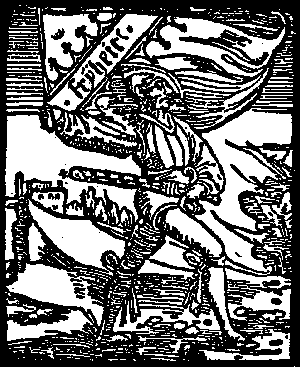
From the German Peasant's War (Zwickau Prophets)
The "right" in religion are the churches resisting change, and those would be the Orthodox, the Catholic churches, and then, in descending order, the Reformation churches -- each of those state churches (- of England, - of Sweden, - of Denmark, etc.), and then Presbyterians, then Methodists, etc. The point is that the groups now called "religious right" are radical liberals, in religion. What they are is the right wing playing at religious.
There is no such thing in America as the "religious left," mainly because such a thing is a tautology. From the Methodists who worked at prison reform, the Crittentons who worked at prostitution prevention and helping women, the adoption services, the orphanages, the soup and aid shelters, the religious houses of Christianity have been providing charity and pushing for more charitable legal conditions. Who has pushed against the death penalty but the religious? Who has pushed for environmentalism? Who is still the first port of call for the indigent?
The point is that it is remarkable when someone to the far right can call on Christianity, much less claim to own it. What has happened to fray the knot between progressivism and religion?
It starts with the fact that the religious who have powered the social gospel of Christ in U.S. and U.K. politics have done so with a full embrace of free will. It may be simply chance, and it may not, but the ones who have done the most have been ones who have emphasized the free will of the poor to choose between sin and virtue, and therefore have felt the need to educate but not to compel. Thus, they've believed in being light handed with the religious message, in
 allowing choice. Even though now every single missionary is presumed to be a child molester or an amputating conquistador, missionaries by and large seem to be liked by the villages they've gone to, and they, by and large, go without guns, without power. It's true that they offer the riches of education, but cultural contact is cultural contact, and it is better in such a peaceful and persuasive way than the usual way (bulldozers, corporations spraying pesticides, etc.). However, the anecdotal evidence is shameful and damning, and progressives are the sorts to feel very bad about these things.
Secondly, of course, and mostly, we have a free market political world.
We have a "free press," in that the government does not overtly control it, but we have a free market press, meaning that it is for-pay. Since the mechanism of the free-market press is advertising, and advertisers will only pay if they believe their message is reaching many people, the news device must ensure high numbers of readers or viewers. Furthermore, the people must have a way of proving these numbers. On television, the infamous and malignant Nielsen group, while radio depends on the utterly bizarre Arbitron book that no one can read. Web sites and international radio have a stranger argument with their people. How many people are listening to the BBC World Service, for example? Since they can't advertise, it may not matter, but what if they can advertise on their website? What if they can, and their story directs listeners there? Oh, websites use sitemeter and other things, and cookies and other pestilences, none of which your news website wants to put there, mind you.
Eventually, the news service that is sober and serious decides that it will cheat the market. "No, heavens," they say, "we will never run Brangelina baby bump stories!" "However," they confess, "we might take one pop culture outrage an hour and then put something up on our web page so that we can generate traffic and know how many people we have." For a long time, network news fell into a race to put on the trashiest story at a particular spot to grab eyeballs. (Get the viewer at the start, and she will stay.) Once they started competing at all spots with cable, they began running trashy throughout the newscast. The cable companies started competing with each other, racing to who could have the most spurious drama.
The answer to that should be public radio. Public radio went to ground, afraid of conservative budget cuts, then more afraid, then getting cut anyway, then more afraid, and then getting cut anyway, so it was neutralized as soon as it got an audience.
The answer to that should be the Internet. No problem!
The problem, of course, is that all of us, here, like me, are like seeing the Running of the Bulls. The crowd could include Shakespeare, Bacon, and Mozart, but you'd never know: too many bodies, too much screaming. So we got some settling into blog sites and magazines. As soon as any of them developed an audience, though, it needed servers, and then it needed money, and then it found a miraculous buyer. (Look at the history of Salon.com for an example. It got bought, then bought again. At first, it was alternative and serious. Then people like Tracy Flory began writing hyperventilated headlines and cute stories and ... junk ... but the new owners liked that. It got hits. Trick headlines get hits, and hits are numbers, and numbers sell.) Huffington Post began as a news aggregator and then was kept afloat by nip-slips and visible panty lines. These got clicks, and clicks got numbers, and numbers got money.
I'm not off topic. You see, the BBC World Service covered that crazy bishop's comments for the same reason he made them: they wanted attention. They wanted outrage, sensation, and alarm. The debate is null, of course, because it's rigged. No one knows his terms, has an honest approach, and all are affective and arguing from anecdote and impressions, but that's also why it's just a glorious thing to say. Pure emotion.
For decades, "Christian" has been whoever makes TV. TV has been seeking the loudest voice. If there is a protest outside of an abortion center or an execution, and three hold up a sign saying, "Pray. Find Another Way," while one is screaming, throwing things and explaining how murdering the murderers is God's will, which will be on TV? Thus, "Christian" is the craziest person in the room every time, and religious people who want also to be famous will be as provocative as possible, if only to get the pulpit.
Is there discrimination against Christianity in academia? You bet. It's petty, unfocused, and mean spirited -- mostly petulant. Is it job discrimination? I doubt it. Are there "aggressive secularists?" If there are, television and newspapers and magazines and websites will go looking for them. They will be given every possible opportunity to seem bigger than they are.
There is no war on Christmas, no war on Easter, no war on Christianity, except that we who keep harboring war metaphors instead of metaphors of love and life make it so.
Saturday, April 09, 2011
Paradox day
Everyone's going to have a party!
April is the crowded month, breeding sinners from quick wombs, mixing memorials and desire. And so it's the month of birthdays and anniversaries for half the northern hemisphere. The rest have just gone or are planning for theirs. So it is that we with our flesh give our last piece of respect to the seasons of the earth.
Lord knows that tanning beds, bronzers, and plastic will allow summer to bow to our whims, spring to last to our convenience and with our hygienic standards. Winter will only show up as spasm of snow, freeze, and storm, as we unhinge the climate and worry that doing anything else might "cost jobs." And a Snooki is upset that there will be a tax on tanning beds. (No one should tan her snooki to start with.)

(Manasse Block Tannery in Berkely, CA, doing it the organic way)
On my participation in that great involuntary parade of reflection or ejection, I was morose. I know that's a big surprise -- me being morose, I mean, not that I would think of birthdays and anniversaries of all sorts as being a choice between dejected spirits or ejection of spirits -- but I was just numbly so. You see, I had gotten served by a deputy the day before. That's right: In America debts will not go away, it seems. In the past, I moved so often that the "hide and hope to die" strategy worked on both me and the creditor. On me, it helped confirm my self image. On them, it just worked, as they were eager to sell the debt to a collection agency anyway and keep the real economy going. (The real economy, despite what you may have heard, is not manufacturing. It's financing. The real economy of the U.S. is purely usury. There is nothing else at all. We do not make stuff. We make money. We make it up in the sense that everything is devised now for the interest rate and the default and the sale of debt. It employs armies and creates fictional fortunes.)
So, I was morose rather than surly. (My father gets surly.)
My funk was taking the form of a flummery. The distillate of regret, doom, and new fear were all tinctures strained through the mesh of old fear. This all made me sort of unresponsive in the main, and it lead to oddly reflective moments of paradox.
First, I was waiting for a meeting to begin, and I said, "I can't stand w..." and then realized that what I meant was, "I can't stand." It was not "waiting," but the standing.

See applicable copyright
Then I wanted to tell someone that I was, "Not feeling very happy" and corrected it to "Not feeling." This is, of course, a form of the joke that Tom Lehrer made, "Good evening, Ladies and Gentlemen. I'm very happy to be." I, however, was looking at something else. I was realizing that the meaning was implied in less than the word.
Later on, that evening, as I went off to dream of someone giving me a rose (really! I know it means I'd died, but I hadn't, so up yours, Freud!), I said to myself, "I don't care how depressed I am."
Suddenly, I realized that I had stumbled on a brand new paradox. Really.
Remember (should I say "really" again, just to prove that I don't edit my posts? really, I don't) Bertrand "Stinky Pants" Russell's fit in his hubristic Summa Mathematica? I'm sure you do. It is "the set of all sets." If you want to be bored to the point that you dribble your own flummery, you can read about it here. See, the set of all sets must have, as a member, itself. If it does include itself, though, then it is not a set of all sets. It's a Klein bottle problem.

Copyright to original author
In a way, it's a reiteration of the liar's paradox, but with math. (If it's a lie, it's true, but if it's true, it's a lie.) The question hinges on a Boolean condition, like "living/dead" or "on/off" and "inside/outside." If I say, "I don't care how depressed I am," though, I am doing the same thing. First, I'm obviously lying. Second, any statement I make about my indifference must be a lie. If I were indifferent, I would not care that I cared. If I were indifferent, I would not note that I did not care. If I were indifferent, I would have no position on caring or not caring, no position on happiness or sadness at or of a situation.
Therefore, let no one say, "I don't care" anymore. Henceforth let all such clauses be banished. If they wish to communicate disinterest, they may do so by looking away, walking off, or starting a separate conversation.
Or do we manage, in conversation, to do what we cannot in physics? Do we manage to be outside and inside at the same time? Are binary oppositions false when it comes to the psyche?
I don't care. I just thought I'd share, in case you did.
April is the crowded month, breeding sinners from quick wombs, mixing memorials and desire. And so it's the month of birthdays and anniversaries for half the northern hemisphere. The rest have just gone or are planning for theirs. So it is that we with our flesh give our last piece of respect to the seasons of the earth.
Lord knows that tanning beds, bronzers, and plastic will allow summer to bow to our whims, spring to last to our convenience and with our hygienic standards. Winter will only show up as spasm of snow, freeze, and storm, as we unhinge the climate and worry that doing anything else might "cost jobs." And a Snooki is upset that there will be a tax on tanning beds. (No one should tan her snooki to start with.)

(Manasse Block Tannery in Berkely, CA, doing it the organic way)
So, I was morose rather than surly. (My father gets surly.)
My funk was taking the form of a flummery. The distillate of regret, doom, and new fear were all tinctures strained through the mesh of old fear. This all made me sort of unresponsive in the main, and it lead to oddly reflective moments of paradox.
First, I was waiting for a meeting to begin, and I said, "I can't stand w..." and then realized that what I meant was, "I can't stand." It was not "waiting," but the standing.
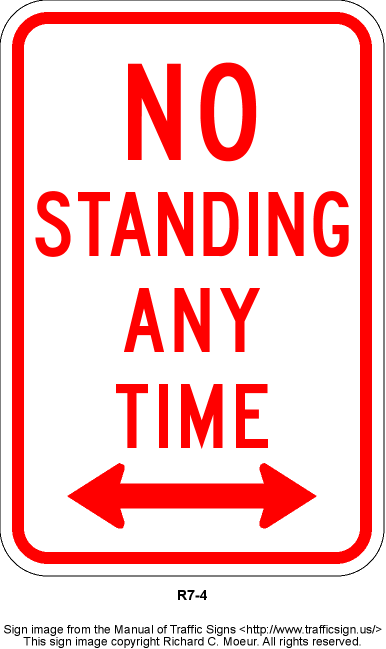
See applicable copyright
Then I wanted to tell someone that I was, "Not feeling very happy" and corrected it to "Not feeling." This is, of course, a form of the joke that Tom Lehrer made, "Good evening, Ladies and Gentlemen. I'm very happy to be." I, however, was looking at something else. I was realizing that the meaning was implied in less than the word.
Later on, that evening, as I went off to dream of someone giving me a rose (really! I know it means I'd died, but I hadn't, so up yours, Freud!), I said to myself, "I don't care how depressed I am."
Suddenly, I realized that I had stumbled on a brand new paradox. Really.
Remember (should I say "really" again, just to prove that I don't edit my posts? really, I don't) Bertrand "Stinky Pants" Russell's fit in his hubristic Summa Mathematica? I'm sure you do. It is "the set of all sets." If you want to be bored to the point that you dribble your own flummery, you can read about it here. See, the set of all sets must have, as a member, itself. If it does include itself, though, then it is not a set of all sets. It's a Klein bottle problem.
Copyright to original author
In a way, it's a reiteration of the liar's paradox, but with math. (If it's a lie, it's true, but if it's true, it's a lie.) The question hinges on a Boolean condition, like "living/dead" or "on/off" and "inside/outside." If I say, "I don't care how depressed I am," though, I am doing the same thing. First, I'm obviously lying. Second, any statement I make about my indifference must be a lie. If I were indifferent, I would not care that I cared. If I were indifferent, I would not note that I did not care. If I were indifferent, I would have no position on caring or not caring, no position on happiness or sadness at or of a situation.
Therefore, let no one say, "I don't care" anymore. Henceforth let all such clauses be banished. If they wish to communicate disinterest, they may do so by looking away, walking off, or starting a separate conversation.
Or do we manage, in conversation, to do what we cannot in physics? Do we manage to be outside and inside at the same time? Are binary oppositions false when it comes to the psyche?
I don't care. I just thought I'd share, in case you did.
Sunday, March 27, 2011
PAIN is GAIN
Post forthcoming, but I realized that I could empty out the ruck sack of "earn" in one utterly depleted phrase: "No pain, no gain."
 "It hurt while I got it, and the amount of pain is the amount of deserving to the acquisition" is one of the full statements of "earning" in the United States. Therefore, the woman who can eat all she wants and never lose a curve or gain a lump has not earned her figure, but the woman who frets at the gym and diet counter has, and the man who lifts barbells has earned his muscles more than the man whose body is simply large and hung with muscles.
This grand, well thought out principle leads us to wonderful conclusions. From this basis, we gather that all things difficult are deserved more than those easy, including torture. The information obtained by torture is better than that obtained by discourse because it had so much pain and danger in it. The sport that involves least protective gear, highest speeds, and most violence is the most "athletic." The artwork that looks like a daubed hand of a five year old had made it but is comprised of chiseled granite and diamond over a space of a mile is praiseworthy. Why, just look how much sweat went into it.
It also leads to the Lexis driver going across three spaces in the parking lot. It cost a lot of money to buy that car, and therefore that car has more rights than others. It hurt. It's worth.
Go on, Johnny, and push at that weight stack, and remember that there is no gain without pain, and pain is a sign of being deserving, except, of course, in some cases.
The principle that durance is the measure of justice in acquisition is absurd, of course, but that's how we clowns think and act. The actual standard that we perverted to get here is the principle of sacrifice. Sacrifice cannot be equated with pain, nor with unpleasantness, nor money. I dare say that the gym rat is choosing that pain and has some pleasure in it. Sacrifice would be duty without compensation. That would create worthiness, alright, but we don't see it anymore.

No, we stick to 'if it feels bad, it must be special,' and then we lie. After all, the person who cleans out septic systems has a more unpleasant job than the man who writes advertising. The woman or man who works in the weather on a framing crew has a more unpleasant and painful job than the one who works in an accounting house. The one who pulls weeds, sprays pesticides, and gets a face full of chemicals so that others may have lawns in insane weather endures far more than the people with the lawn who lead teams of engineers. In each case, though, we say that the richer person has "earned it." The poorer person, who will pay more in taxes, will not complain about government services, but we will hear unendingly from some of those others about how "their" "hard earned" money is being taken. It was earned, after all, because they endured for it.
The gamblin' man is rich, and the workin' man is poor, as Woody Guthrie said, but today we actually pretend that they earned the same.
 "It hurt while I got it, and the amount of pain is the amount of deserving to the acquisition" is one of the full statements of "earning" in the United States. Therefore, the woman who can eat all she wants and never lose a curve or gain a lump has not earned her figure, but the woman who frets at the gym and diet counter has, and the man who lifts barbells has earned his muscles more than the man whose body is simply large and hung with muscles.
This grand, well thought out principle leads us to wonderful conclusions. From this basis, we gather that all things difficult are deserved more than those easy, including torture. The information obtained by torture is better than that obtained by discourse because it had so much pain and danger in it. The sport that involves least protective gear, highest speeds, and most violence is the most "athletic." The artwork that looks like a daubed hand of a five year old had made it but is comprised of chiseled granite and diamond over a space of a mile is praiseworthy. Why, just look how much sweat went into it.
It also leads to the Lexis driver going across three spaces in the parking lot. It cost a lot of money to buy that car, and therefore that car has more rights than others. It hurt. It's worth.
Go on, Johnny, and push at that weight stack, and remember that there is no gain without pain, and pain is a sign of being deserving, except, of course, in some cases.
The principle that durance is the measure of justice in acquisition is absurd, of course, but that's how we clowns think and act. The actual standard that we perverted to get here is the principle of sacrifice. Sacrifice cannot be equated with pain, nor with unpleasantness, nor money. I dare say that the gym rat is choosing that pain and has some pleasure in it. Sacrifice would be duty without compensation. That would create worthiness, alright, but we don't see it anymore.

No, we stick to 'if it feels bad, it must be special,' and then we lie. After all, the person who cleans out septic systems has a more unpleasant job than the man who writes advertising. The woman or man who works in the weather on a framing crew has a more unpleasant and painful job than the one who works in an accounting house. The one who pulls weeds, sprays pesticides, and gets a face full of chemicals so that others may have lawns in insane weather endures far more than the people with the lawn who lead teams of engineers. In each case, though, we say that the richer person has "earned it." The poorer person, who will pay more in taxes, will not complain about government services, but we will hear unendingly from some of those others about how "their" "hard earned" money is being taken. It was earned, after all, because they endured for it.
The gamblin' man is rich, and the workin' man is poor, as Woody Guthrie said, but today we actually pretend that they earned the same.
Sunday, March 20, 2011
Haunted Words 2: "Consumer"
Oh, yes, the consumer. Isn't the consumer horrible? It is a plague, like a tent caterpillar, eating up the substance of its own host. The consumer is Moloch, devouring the children of the nation and purifying the economy of its waste thereby. The consumer consumes, leaving nothing.
 Gobble, gobble.
This word, "consumer," is of a more recent vintage than other haunted words. Unlike "labor," it does not go back into the pre-history of language. In fact, you can see its usage history here, if you'd like (great site). When we see the word's base, "consume," prior to the 20th century, it is always with "destroy" implied, and "waste" actually denoted. It was in the 1970's that the word got into the collective Business head. (This time, I do not plan to attack business schools.) I can remember, as a child, people objecting to the term. "How dare you call me a consumer," people said.
They don't say that anymore.
 Nor do I wish to act as if we need to run for our aluminum foil deflector beanies. No. My point is merely to discuss the term itself, what corpse it carries with it into our mouths and minds, and the effect of speaking and thinking such defilement on us may be. (Photo at right shows, incidentally, and I mean incidentally, some of the difficulties we should have had already. Go to its source and read that essay, if you'd like.)
Conceiving of the consumer, inventing the consumer as an abstracted force in economic transactions, performs the same moral deferral that "labor" does. A crime against your neighbor would be punished by the neighbor, by the state, and by your conscience, but an action against "labor" is "necessary" by "laws" of "the market." In other words, each of these forces that is cited as a compulsion is an abstraction derived inferentially from repeated observations of actual exchanges of goods. An historian, essentially, observes how exchanges have gone, analyzes and infers common principles, and these descriptions are presumed to be predictive of future exchanges. From this scientific basis, we get such concepts -- all linguistic shorthand for massive assumption and deduction -- as "labor, production, material, consumer," and then we act according to "laws of the market" that are not laws. They are habits of humans. Humans are only partly predictable.
I would never cost my neighbor his job, but I can feel morally absolved by "market forces" and laws, even though these forces and laws are people en masse. The moral action on my part has been absolved by numbers, not by a real force. (I'm trying to avoid being obvious or obscure. What I mean is that "the market" does not let me off the hook. The "market" does not exist. It is simply a description of a mass of people and a set of assumptions about their behavior. The morality of actions remains, whether there is a market present or not. You still fired people.)
If a side effect of abstractions like "labor" and "consumer" and "manager" is to create a false sense of laws and forces that will absorb the impact of moral actions, then it is because each word carries extra freight. None of these words is innocent. None is actually a pure economics term. Each one has something strapped to its back. In the case of "labor," it is "uneducated, obdurate, obstreperous." With "manager," it is "executive, brain, judgment." What is it with "consumer?" What does using the word "consumer" do to our moral acts after it has given us a giant marshmallow to absorb the good and evil of them?
 Ah, Bosch. The Garden of Earthly Delights
A "consumer" is a glutton. Gluttony is, of course, a sin. It is a sin in nearly every faith on earth. It is a sin in non-faiths, too. In Christianity, gluttony includes eating too much and simply wasting substance. In Buddhism, it is attachment. In Hiduism, the same. In Islam, the same as Christianity, and in Judaism, it is forbidden. In contemporary culture, gluttony means fat, and fat is bad, but, then again, it is alright if it is in the name of being a consumer, because over consumption is wealth.
A consumer creates nothing. A consumer is an end point for culture. A consumer is a toilet, a garbage can, and a dump. It is an efficient absorber. Now, we all know and accept the truth that no consumer consumes completely, that there is waste, but when we accept the term "consumer," we accept the inherent quality of the big bad wolf who 'ate them all up.' We also accept the fact that being a consumer is being sinful, that consumers are making demands, that consumers are baby birds screeching, mouths open and eyes closed, for more, more, more.
From Thorstein Verblein's thesis in The Theory of the Leisure Class, we have moved on considerably. For him, the leisure class was a form of actual class structure. Since those days, our productive model has inverted. Luxury has become increasingly cheap, and staple goods have become increasingly dear. There is no question that an iPod/Pad is a luxury good, that a 4G phone is a luxury, and yet those are cheap in real dollars, while housing has moved up in real dollars of income for average income. This is because leisure and luxury do not constitute class any longer, but basics do.
When a company makes its product and its managers make decisions (for the dumb hands and feet and mouths that are incapable of 'executive' function), it considers "the consumer." It wants to know how to appeal to the consumer, not how to serve the consumer, how to be known to the consumer, not pleasing to people, how to offer perceived value per unit to the consumer, rather than quality goods for long use, and they want to build brand loyalty among consumers rather than consistent products. By considering this creature -- this vaccuous, voracious and wicked thing called "the consumer" -- as a target for psychological analysis, focus group study, predictive statistics and the like, the company is treating people with contempt, ignoring their product, and focusing on an amoral universe that must be immoral.
Why must a society ordered around labor, management, and consumers be immoral? It must be because the one using the term is included in the term. The problem with the analysis is that same as the morality: there is no way to remove the observer. The producer is a consumer. The manager is labor. The consumer is a producer. The company that has scorn for consumers and works hard to psych them out is being targeted by a supplier, and the executive goes home to be targeted by a luxury maker or a staple maker, and the whole country turns into a game of liar's poker where no one can win the stakes.
Then again, some people just prefer to steal.
 Gobble, gobble.
This word, "consumer," is of a more recent vintage than other haunted words. Unlike "labor," it does not go back into the pre-history of language. In fact, you can see its usage history here, if you'd like (great site). When we see the word's base, "consume," prior to the 20th century, it is always with "destroy" implied, and "waste" actually denoted. It was in the 1970's that the word got into the collective Business head. (This time, I do not plan to attack business schools.) I can remember, as a child, people objecting to the term. "How dare you call me a consumer," people said.
They don't say that anymore.
 Nor do I wish to act as if we need to run for our aluminum foil deflector beanies. No. My point is merely to discuss the term itself, what corpse it carries with it into our mouths and minds, and the effect of speaking and thinking such defilement on us may be. (Photo at right shows, incidentally, and I mean incidentally, some of the difficulties we should have had already. Go to its source and read that essay, if you'd like.)
Conceiving of the consumer, inventing the consumer as an abstracted force in economic transactions, performs the same moral deferral that "labor" does. A crime against your neighbor would be punished by the neighbor, by the state, and by your conscience, but an action against "labor" is "necessary" by "laws" of "the market." In other words, each of these forces that is cited as a compulsion is an abstraction derived inferentially from repeated observations of actual exchanges of goods. An historian, essentially, observes how exchanges have gone, analyzes and infers common principles, and these descriptions are presumed to be predictive of future exchanges. From this scientific basis, we get such concepts -- all linguistic shorthand for massive assumption and deduction -- as "labor, production, material, consumer," and then we act according to "laws of the market" that are not laws. They are habits of humans. Humans are only partly predictable.
I would never cost my neighbor his job, but I can feel morally absolved by "market forces" and laws, even though these forces and laws are people en masse. The moral action on my part has been absolved by numbers, not by a real force. (I'm trying to avoid being obvious or obscure. What I mean is that "the market" does not let me off the hook. The "market" does not exist. It is simply a description of a mass of people and a set of assumptions about their behavior. The morality of actions remains, whether there is a market present or not. You still fired people.)
If a side effect of abstractions like "labor" and "consumer" and "manager" is to create a false sense of laws and forces that will absorb the impact of moral actions, then it is because each word carries extra freight. None of these words is innocent. None is actually a pure economics term. Each one has something strapped to its back. In the case of "labor," it is "uneducated, obdurate, obstreperous." With "manager," it is "executive, brain, judgment." What is it with "consumer?" What does using the word "consumer" do to our moral acts after it has given us a giant marshmallow to absorb the good and evil of them?
 Ah, Bosch. The Garden of Earthly Delights
A "consumer" is a glutton. Gluttony is, of course, a sin. It is a sin in nearly every faith on earth. It is a sin in non-faiths, too. In Christianity, gluttony includes eating too much and simply wasting substance. In Buddhism, it is attachment. In Hiduism, the same. In Islam, the same as Christianity, and in Judaism, it is forbidden. In contemporary culture, gluttony means fat, and fat is bad, but, then again, it is alright if it is in the name of being a consumer, because over consumption is wealth.
A consumer creates nothing. A consumer is an end point for culture. A consumer is a toilet, a garbage can, and a dump. It is an efficient absorber. Now, we all know and accept the truth that no consumer consumes completely, that there is waste, but when we accept the term "consumer," we accept the inherent quality of the big bad wolf who 'ate them all up.' We also accept the fact that being a consumer is being sinful, that consumers are making demands, that consumers are baby birds screeching, mouths open and eyes closed, for more, more, more.
From Thorstein Verblein's thesis in The Theory of the Leisure Class, we have moved on considerably. For him, the leisure class was a form of actual class structure. Since those days, our productive model has inverted. Luxury has become increasingly cheap, and staple goods have become increasingly dear. There is no question that an iPod/Pad is a luxury good, that a 4G phone is a luxury, and yet those are cheap in real dollars, while housing has moved up in real dollars of income for average income. This is because leisure and luxury do not constitute class any longer, but basics do.
When a company makes its product and its managers make decisions (for the dumb hands and feet and mouths that are incapable of 'executive' function), it considers "the consumer." It wants to know how to appeal to the consumer, not how to serve the consumer, how to be known to the consumer, not pleasing to people, how to offer perceived value per unit to the consumer, rather than quality goods for long use, and they want to build brand loyalty among consumers rather than consistent products. By considering this creature -- this vaccuous, voracious and wicked thing called "the consumer" -- as a target for psychological analysis, focus group study, predictive statistics and the like, the company is treating people with contempt, ignoring their product, and focusing on an amoral universe that must be immoral.
Why must a society ordered around labor, management, and consumers be immoral? It must be because the one using the term is included in the term. The problem with the analysis is that same as the morality: there is no way to remove the observer. The producer is a consumer. The manager is labor. The consumer is a producer. The company that has scorn for consumers and works hard to psych them out is being targeted by a supplier, and the executive goes home to be targeted by a luxury maker or a staple maker, and the whole country turns into a game of liar's poker where no one can win the stakes.
Then again, some people just prefer to steal.
Sunday, March 13, 2011
Haunted Words 1: "Labor"
Apparently, there is a loophole in Genesis 3:19 that lay silent in grievous oblivion for centuries. Where God told Adam,
it appears that modern business schools have made the discovery that only some people are sweaty dust. Other people are management material.

This distinction between management and labor is antique and an antique, a revenant or malingerer. We have had laborers, and the class of 'labor,' as long as there have been corners, and hence corner offices, but for us it probably dates to a difference bred of widespread illiteracy and innumeracy, as well as legally defined class and college being unavailable. Even in those days, the difference between the labor and the management was education, not nature. Today, though, the difference is nothing but the distinction. I will return to this.
Let me pretend for a minute that I have a business reader, that somewhere and some time such a coincidence occurs. That person, trained in business, learned in business, is hardly going to learn anything from me. After all, I don't know anything about business, not having read the same things nor been to the same places. However, I do know from experience certain things about my own behavior. I know why I dropped a local medical supply company for my mother. I did it because the moron who came out to install things did "elder talk" to my mother. He was patronizing, lying, and infuriating. I know why I have paid more for a guitar at one shop than another. I know it was because the bored teenager on the floor at the inexpensive place wanted to shove a heavy metal shreddddder experience in my face, and the more expensive shop actually asked me what I wanted. I know that a local pizza place does not get my business because the teenagers who man the phones are unmotivated and unhappy.
The lowest paid person is the person who is in contact with me, and the person mistreated the most, disposed of most often, least trained, least respected, least cared for by the company is the person who is the only face of the establishment for me.
I am sure that the guitar shop manager had an MBA. I'm sure the pizza shack owner manager had a great business plan. I know the corporation had a clever way of allocating profits. However, each of them treated workers as "labor costs," and the workers knew where they stood and acted accordingly. Shat upon, they shat back.
In the modern Business School, we study business. Business, you know. Not trade, nor psychology, nor accounting, but "business." Think about that, as it may be the first time anyone has asked you to do so. What is "business" divorced from all of the other things? What is "management" divorced from the things managed? What are the things, after all? Are they people or objects?
As it turns out, Business people study how to get inventory, generate profit, manage brands, diversify, and invest. They learn, in short, about a series of abstracted operations that come from case studies. In all of these, they are eager to turn the humans involved into abstract forces that can be predicted, either with game theory or statistical correlation. From these inductions, they come to names, and from the names they come to laws, and from the laws they generate book sales. The people involved are all learning about managing a "business," but none of them are learning about humans who are working, using, disposing of, or depending upon.
(This last point is a critical flaw: I might study how to make shavers, but the premise of "business" is the free market. No one thus trained has studied what to do if her product is a staple good, like electricity, or food. As a consequence, in order to justify market behaviors, people who wish to apply Business to utilities, pharmaceuticals, and agriculture must adopt libertarian lies.)
So, let's suppose that some case study eventually shows, ten years or so after B-School fiends have been monkeying with life, that workers who are shat on shit back and that customers see the lowest paid person. That makes no dent in the idea that there is "labor" and that "labor" is a "cost" (that's how it was taught in B-school!). Instead, "managers" react by creating "customer service scripts" and "decision trees" for people dealing with customers or -- dream of dreams -- getting sophisticated A.I. to man the phones. It's better than training the workers or treating them like they're part of the company.
The truth, of course, is that there is no such thing as labor, or there is nothing except labor. The company is the labor. Business school talks about the product as if it is already always existing. It teaches as if raw materials need no extraction or refining. It teaches as if the product comes in ex nihilo, like words in a text book, as a "widget," and there is a big box on the flow chart for "making it" that acts as a drain on the real business -- the part You the MBA have been trained for -- which is all that stuff about allocating units and game theory. Of course, there is no company without the product, and there is no difference between the person working to advertise and the person working to make. The "executive" (naming themselves as if they were brains!) is a laborer.
Finally, when companies or organizations decide that they need to make more "profits," they seek to reduce "costs." "Costs" include materials and "labor." Since B-school fools have propagated in themselves the lie that there is a difference between themselves and 'labor,' because they think that there is such a thing as 'labor' distinct from 'executive,' they see labor as that same square on the flow chart, and it's a square that costs. Why, just look at how much "we" pay "it" in benefits (what is it that "we" made, again? and how did they come to be "it," anyway?)!
When college is available to all, thanks to community colleges, and when literacy is at a high, and when the Americans with Disabilities Act is ensuring that there are no disabilities making people settle for demeaning positions, the only thing between the "unskilled" and "executive" class is education, and education can be obtained. It's true that we are not alike intelligent, but it's also true that not very many "executives" are brains -- either in or out of college. However, they still speak as if they are one thing and "labor" is another.
This has consequences. Because "labor" is over there, and "labor costs" should be reduced, while top executive pay is an "incentive," when cuts come along, the axe falls with gravity down the chart. No man thinks, "You know, I'm not worth much. I should lose my job." No woman says, "I think my division could get by with half its budget." No. The top says, "Cut 10%," and the next executive says, "Cut 10%," and the next group says to the lower ones, "Cut 10%." The command falls and falls until there is no one in charge -- the workers. The workers get fired, the work gets left not done, and the business goes along with more executives and no product.
Let no person, ever, accept this word. There is no "labor" in a post-industrial nation. We are ALL labor or capitalists, and you are definitely not a capitalist. The capitalists are very few in number, very low in value, and very worthy of our hate. The rest of us are laborers lying to ourselves and committing suicide.
"By the sweat of your brow shall you eat bread until you return to the ground, for out of it you were taken; you are dust, and to dust you shall return" (NRSV),
it appears that modern business schools have made the discovery that only some people are sweaty dust. Other people are management material.
This distinction between management and labor is antique and an antique, a revenant or malingerer. We have had laborers, and the class of 'labor,' as long as there have been corners, and hence corner offices, but for us it probably dates to a difference bred of widespread illiteracy and innumeracy, as well as legally defined class and college being unavailable. Even in those days, the difference between the labor and the management was education, not nature. Today, though, the difference is nothing but the distinction. I will return to this.
Let me pretend for a minute that I have a business reader, that somewhere and some time such a coincidence occurs. That person, trained in business, learned in business, is hardly going to learn anything from me. After all, I don't know anything about business, not having read the same things nor been to the same places. However, I do know from experience certain things about my own behavior. I know why I dropped a local medical supply company for my mother. I did it because the moron who came out to install things did "elder talk" to my mother. He was patronizing, lying, and infuriating. I know why I have paid more for a guitar at one shop than another. I know it was because the bored teenager on the floor at the inexpensive place wanted to shove a heavy metal shreddddder experience in my face, and the more expensive shop actually asked me what I wanted. I know that a local pizza place does not get my business because the teenagers who man the phones are unmotivated and unhappy.
The lowest paid person is the person who is in contact with me, and the person mistreated the most, disposed of most often, least trained, least respected, least cared for by the company is the person who is the only face of the establishment for me.
I am sure that the guitar shop manager had an MBA. I'm sure the pizza shack owner manager had a great business plan. I know the corporation had a clever way of allocating profits. However, each of them treated workers as "labor costs," and the workers knew where they stood and acted accordingly. Shat upon, they shat back.
In the modern Business School, we study business. Business, you know. Not trade, nor psychology, nor accounting, but "business." Think about that, as it may be the first time anyone has asked you to do so. What is "business" divorced from all of the other things? What is "management" divorced from the things managed? What are the things, after all? Are they people or objects?
As it turns out, Business people study how to get inventory, generate profit, manage brands, diversify, and invest. They learn, in short, about a series of abstracted operations that come from case studies. In all of these, they are eager to turn the humans involved into abstract forces that can be predicted, either with game theory or statistical correlation. From these inductions, they come to names, and from the names they come to laws, and from the laws they generate book sales. The people involved are all learning about managing a "business," but none of them are learning about humans who are working, using, disposing of, or depending upon.
(This last point is a critical flaw: I might study how to make shavers, but the premise of "business" is the free market. No one thus trained has studied what to do if her product is a staple good, like electricity, or food. As a consequence, in order to justify market behaviors, people who wish to apply Business to utilities, pharmaceuticals, and agriculture must adopt libertarian lies.)
So, let's suppose that some case study eventually shows, ten years or so after B-School fiends have been monkeying with life, that workers who are shat on shit back and that customers see the lowest paid person. That makes no dent in the idea that there is "labor" and that "labor" is a "cost" (that's how it was taught in B-school!). Instead, "managers" react by creating "customer service scripts" and "decision trees" for people dealing with customers or -- dream of dreams -- getting sophisticated A.I. to man the phones. It's better than training the workers or treating them like they're part of the company.
The truth, of course, is that there is no such thing as labor, or there is nothing except labor. The company is the labor. Business school talks about the product as if it is already always existing. It teaches as if raw materials need no extraction or refining. It teaches as if the product comes in ex nihilo, like words in a text book, as a "widget," and there is a big box on the flow chart for "making it" that acts as a drain on the real business -- the part You the MBA have been trained for -- which is all that stuff about allocating units and game theory. Of course, there is no company without the product, and there is no difference between the person working to advertise and the person working to make. The "executive" (naming themselves as if they were brains!) is a laborer.
Finally, when companies or organizations decide that they need to make more "profits," they seek to reduce "costs." "Costs" include materials and "labor." Since B-school fools have propagated in themselves the lie that there is a difference between themselves and 'labor,' because they think that there is such a thing as 'labor' distinct from 'executive,' they see labor as that same square on the flow chart, and it's a square that costs. Why, just look at how much "we" pay "it" in benefits (what is it that "we" made, again? and how did they come to be "it," anyway?)!
When college is available to all, thanks to community colleges, and when literacy is at a high, and when the Americans with Disabilities Act is ensuring that there are no disabilities making people settle for demeaning positions, the only thing between the "unskilled" and "executive" class is education, and education can be obtained. It's true that we are not alike intelligent, but it's also true that not very many "executives" are brains -- either in or out of college. However, they still speak as if they are one thing and "labor" is another.
This has consequences. Because "labor" is over there, and "labor costs" should be reduced, while top executive pay is an "incentive," when cuts come along, the axe falls with gravity down the chart. No man thinks, "You know, I'm not worth much. I should lose my job." No woman says, "I think my division could get by with half its budget." No. The top says, "Cut 10%," and the next executive says, "Cut 10%," and the next group says to the lower ones, "Cut 10%." The command falls and falls until there is no one in charge -- the workers. The workers get fired, the work gets left not done, and the business goes along with more executives and no product.
Let no person, ever, accept this word. There is no "labor" in a post-industrial nation. We are ALL labor or capitalists, and you are definitely not a capitalist. The capitalists are very few in number, very low in value, and very worthy of our hate. The rest of us are laborers lying to ourselves and committing suicide.
Subscribe to:
Posts (Atom)