Showing posts with label Polemic. Show all posts

Saturday, January 24, 2015

Falling from Small Heights

"Man is, and was always, a block-head and dullard; much readier to feel and digest, than to think and consider." -- Thomas Carlyle, Sartor Resartus
As part of an "assessment instrument," I've been reading sample essays from Oh-ficially scored sources. See, our students read four very short arguments responding to a common prompt and then write their own argument about which is the best case. We free ourselves of subjectivity by using nationally certified sources. Our old essays are now too well known by the students, and we need new ones for the exit assessments anyway, so that means reading this year's samples. The old set responded to "As people rely more and more on technology, their capacity for problem solving and creativity will surely diminish." The responses were quite different from one another in approach, and the best was different from the middle one in thought as well as expression.

This year, all the prompts are business related. The best one, for our purposes, was, "For the leadership of the future, it is imperative that children be trained in the values of cooperation rather than competition." The responses, graded by the Official services from six to one, all agree with the prompt, and the differences between them are differences of compliance with written English. The "six" has complex sentences, and the "one" has sentence fragments.

They are all dumb. In fact, the "six" would have gotten only a B from me, because even it had the "Leaders will need to be encouraged in their school" object/subject number confusion (unless all "leaders" go to the same school). Not one of the responses was analytical. Not one questioned the dichotomy of the prompt. Heck, the "five" essay began with one of those, "The dictionary defines competition as..." gambits that is only supposed to be used if a person intends to redefine a term.

Consider this my answer, and my protest to the stupids that this Official voice wanted to offer people going to its test prep site.
 
"Skepticism (is) the virtuous mean between two vices: absolute knowledge and absolute ignorance." -- Odo Marquard, "Skeptics: A Speech of Thanks," in In Defense of the Accidental


"Competition" and "cooperation" are actions incomplete in their own. They both require objects, company, friends and enemies. One competes or cooperates with. These are neither values that can be taught in the abstract, nor are they transactions that can be consistently enforced without teaching a social setting that mandates the activity.

The submerged assumption in the writing prompt is that "MBA culture" has harmed America. Well, that's hard to argue, but it's also important to follow. "CEO America" looks at quarterly profits, does not know or care what the core business is, and is pleased to fire all of the labor force and eliminate all the goods being made by the company, because those are debts. The resulting "profit" will increase the stock price, which will increase the CEO compensation, and the trading of the stock will increase the company value, which will increase its price on being bought, which will ensure the board a good package on the merger. Thus, all of those making decisions will make enormous profits. The things being made will cease, but. . . that's not the business of the CEO. The CEO and board's duty is to shareholders, not to "consumers" or "labor."

Obviously, the effects of stock traded corporations are evil. Obviously, CEO's are bad for business and bad for the larger economy. Obviously, market funds are bad for the nation. Even their positive effect on stimulating start-ups is cancelled by their decapitation of those same businesses when they begin to produce, and especially when they manufacture. The specific evil is a system we have developed of captial pitted against commodities. When capital moves and "innovates" and "is made" without any relationship commodities, then there is a separate industry of "wealth workers" who set themselves in opposition to those who work in everything else, because their fundamental task is to shake capital free from any attachment to any person. (If you don't think we are post-capitalist in this manner, I'll see you in comments.)

By nature, humans are cooperative. By nature, humans are competitive. By nature, humans compete against themselves preferentially over other people, and we do not need studies to establish this.

Look around you at lunch. How many people are playing Candy Crush or played Tetris? How many people are playing video games solo? When they play in networks, do they play against one another, or do they play with each other in teams? In general, people play against fixed goals and against their own performances, seeking to be perfect at things. It is why they go to the gym and shoot hoops or lift weights.

At work, how often are you asked for help? How often do you ask for help? The point is that people are competitive, but not hostile, and they are cooperative, but not sycophantic. Indeed, we do need to battle the damage done by the naive assumption that "capitalism" is Darwinism and the even deeper lie that Darwin's "survival of the fittest" meant survival of the biggest, toughest, or strongest -- "fitness" means toward the environment, and strong, mean, nasty critters are not very adaptable. We have to fight the fascist theme that "America" is about individuals fighting it out without any help against one another for a triumph.

More, though, we need to understand that we are under assault by a post-capitalist economic theory that is disloyal, immoral, and corrosive of all values and value.

Thursday, December 25, 2014

Why You Think the Internet Stinks Now

I have been active on the Internet since 1990. In those days, we had Usenet at the university and moderated private bulletin board systems (FidoNet) for amateur fun. This makes me four Internet generations ago, if we assume that an Internet generation is about five years, rather than twenty-five.

Indulge with me in nostalgia. Before the FCC decided to sell bandwidth to the .com top level domain, the Internet was a place of low or no graphics, where users were almost exclusively .edu accounts (with a few .sys, .mil, and .gov), and most accounts were a first initial and last name (mine being misspelled by the IT people at my U, so I had anonymity even then). HTML sites were usually navigated by Lynx or one of the other text-only Unix based clients. Since the entire endeavor was text on slow dial up connections or fast connections on computers with monochrome displays, it was an empire of words subordinated to either a group's activity (e.g. rec.bicycle) or a group's academic research. University and government workers created massive amounts of free information, and the early HTML systems were ways to link information infinitely. People spoke of beginning with an interesting note in the newspaper, clicking on an odd term, following to a strange fact, seeing a strange name, and spending hours “surfing” from site to site, but all of this was via reading.

When America Online and CompuServe opened their closed systems to the Internet, everything changed. There were floods of new users who reflected average America. While many snobs thought that “killed” the Internet, it was, instead, the underlying decision to commercialize the Internet, combined with hypertext, that turned the Internet into today's creature of clicks and “eyeballs.

By 1996, and certainly by 2001, most “Internet” users only knew the world wide web, not Usenet, not discussion. The world wide web itself “was” a series of commercially profitable sites, with the last of the .edu created purchased (e.g. Bartleby.com, created by Columbia University library to make all of its Columbia UP reference works available for free, was sold, then resold) or forgotten. University server sites providing information became gradually invisible to average users because they went unadvertised, and “the web” was no longer a place where persons “surfed” on an adventure of information. Certainly by the time the "tech bubble" burst, each website invested in keeping visitors on sites, in sites, and preventing outside linkages. Websites became more pictographic, with an increase in sensationalism, as the same pressures that turned superabundant newspapers in 1900 into the Yellow Press created increasingly narrow and vertical forms of discourse (“vertical” refers to information that is recursive and closed, in this case). What had been peer groups in conversation became interest groups engaged in a tailored retail experience. 


“Friendster” and “MySpace” were non-profit simulacra of the older Internet. They succeeded, to the degree they did, by offering like-minded cultures and subcultures. (There have been other simulations since, including Reddit.) However, when their host/software companies offered stock, they were purchased by media corporations that, as early as 1998, had been imagining an Internet/cable vehicle whereby visitors would be captive, ordering television shows, movies, books, radio, and the rest on an a la carte basis by the Internet. '

Neither the websites nor the delivery technologies were in place for such visions to be realized. (This vision, and its failure, was paradoxically critical to the collapse of Enron. The Amazon Kindle/Fire is getting very close to its realization today, according to critics. If they can "own the pipeline" and the store and the production, then the consumer choice is finally completely eliminated -- or "business uncertainty is minimized," if you prefer.)

 I'm no Electronic Frontier Foundation warrior or GNU freak. I haven't the money to be the first or the skills to be the second. I did join Wikipedia in 2003, though. My frustrations with it were that it was not dedicated to a common project of construction as much as it was a "community." My criticisms of capital in technology are not propelled by idealism or ideology. They are directed solely at an analysis of the deterioration of academic freedom and investigation because of a capitalized web.

One thing I've noticed is that a genuine analysis of technology cannot be found under the title of "technology" writing. For about ten years, I noticed that the writing about computer technology, in particular, fell into one of two camps. Either a new device or program was the Swiss Army Knife of Heaven -- able to turn every student into a buddha and genius -- or the next device or program will free the Fenris wolf and extinguish the sun for once and all. "Tech" writers are either reviewers or advocates. Sometimes, even worse, they're salesmen.

Look, capitalized websites serve capital. I get it. That's just and right. But non-capitalized websites are now all but invisible, especially since Facebook learned from MyFace's failure and AOL's persistence and began to fold in a whole universe of outside websites into its "you're still on Facebook" experience. Regular people are beginning, just beginning, to realize one of the more cynical web "memes": If you're not paying for the product, then you are the product.

All of the commercial Internet is riding on public infrastructure. Ask AT&T how it feels about cable companies getting access to "their" infrastructure. Well, how should we feel, then, about commercialized Internet services working against the public's interests or the nation's constitution? EU investigators found out that a person who creates a Facebook account and immediately deletes it generations twenty thousand pages of data that Facebook does not delete. That, after all, is their data.

Windows 8.1 is roping all its users into Xbox Live accounts and beaming geo-location to Microsoft. Apple does that with iTunes. This is without even talking about a smart phone. Any person who owns such a thing is foolish, in my opinion (as a phone, it's a phone, but as a computer, is it equal to a laptop? as an mp3 player is it equal to even a Walkman? doesn't it offer imitations of a dozen functions but at inferior performance, and all with the solitary advantage of fitting in a pocket?). I'm sure you have already read that the new iPhone made news for not including a backdoor into user encrypted data for NSA and FBI. 

Going onto Google is a losing proposition. It geolocates the browser. After a few searches, Google begins to tailor results to "customize the web experience." It predicts the sorts of results this user wants. It discounts, for example, "old" web pages -- so if you're looking for a news story from 2004, you won't find it, because Google simply doesn't want that to show up, because "normal people" don't search for old information. A few more searches, and the results are "customized more." 

Google's search is used by Bing, by the way. Facebook will tailor search results and "help" the user extensively as well. 

Doesn't that scare you? Don't you see why that's the end of the world?

The limitations are being made, in the case of Amazon, Facebook, and others, on the basis of likely purchases, not what one wishes. In the case of Google, it's made on the basis of what you have been interested in before. In other words, these merchants are making decisions about the sorts of questions you can ask, and answers you can get, on the basis of likely sales, likely happiness, not answers, not knowledge, not growth.

As an academic, I have to have open searches, because the Internet has consumed the library. Once that library has then become a public library with card catalogs assembled by advertisers, whole floors of the stacks go missing. The only answer to it is yet more capital outlays in the form of JSTOR and EBSCO subscription services. 

Meanwhile, the Facebooking of conversation has pushed conversation into interest groups, where like meet like, the agreed hear from the confirmed. That is guaranteed to be sterile or frenetic.

Thursday, May 08, 2014

"9/11 Changed Everything," indeed.

To begin to write for the third time on this subject, I would need to go to the ends of the subject. As with each previous time, the real occasion for writing is obscure, as it should be, if there is going to be any use to it. Way back in 2001 and 2002, the fools who had to have something to say as they closed their thirty minute tours of news would quote governmental press releases and talking points fallen from Dick Cheney's desk and say, "It's no exaggeration to say that 9/11 has changed everything." I didn't believe them. I vaguely remember a floating head on a screen waxing poetic and summoning all the atmospheric Murrow he could (but only managing Brokaw) and saying that we would be telling our children about the event that defined their world. It was Pearl Harbor. . . or not quite that, but it was like it.

The news readers going basso profundis was inconceivable comedy to me. Even looking back, the most I can come up with by way of how I felt is a paraphrase of Lincoln, who said that, if the United States were ever to die, it would be by suicide, not conquest. 

Then again Lincoln embarrassingly underestimated the thanatopsic urge. So did I.

Oh, historians of the time in question have said that Cofer Black and the Spook Patrol began giving W. Bush daily briefings with unfiltered intelligence -- that is, with no analysts involved, no hierarchies of threats, no assessments of feasibility or reliability, just every single hateful and violent threat made by the whole world -- and this every morning before the Ovaltine. It scared Bush senseless, and he said "Yes" to every request. This is how the USA PATRIOT ACT went from controversial to routine -- even boring. The same scary people with scary reports kept working on their haunted house routine, because Obama began saying his job was, "Keeping Americans safe" in 2009. The man who campaigned on civil liberties began devouring them at a pace that his predecessor would not have imagined.


Assassinations? Secret detentions? Suspension of habeas corpus? Phone taps on a national scale (i.e. a small nation of people, not every person in this nation)? "Why object, if you have nothing to hide" uttered as a legitimation, when it had last appeared in satire or dystopian cliche? All of this has come to be a portion of the invisible architecture of American reality -- a base condition for living for most citizens. W. H. Auden's "The Unknown Citizen" is unteachable now, both because its commentary has been bunted in front of home plate and, more, because its world of a state with an indexed population of statistics is now so far beneath the N.S.A.'s capabilities and the ostensible goals of "total informational awareness" as to seem boring.

September the eleventh thrust a cup of hemlock into national hands. Our leaders presented as a chalice, and all drank. 

I do not mean, though, that losing "the American way" or civil liberties was the death of America. Instead, I mean that, frighteningly, the vapid people were right: we changed everything on the day, soul first.

In 2011, the little people who live inside of the television asked, "What have we learned from 9/11?" We learned nothing, of course. We learned nothing because there was nothing to learn from a billionaire attacking centers of international capitalism. We learned nothing because 9/11 handed its victims suffering rather than pain, and suffering neither teaches nor presents norms. Most of all, though, we learned nothing because to learn we must first recognize our world and ourselves.

September the eleventh was suffering for those of us in New York City. I feel confident that it was for those in the affected wing of the Pentagon and for the families of the lost in Pennsylvania as well. No one can learn from suffering, only  from pain, but suffering is less focused. Rarely is suffering for a particular reason, or even for a passion. Even more rarely is suffering for a passion or reason that carries with it a moral value or heuristic principle. Instead, people may grow while suffering, but they grow by having empathy or understanding (of humanity, of self, of family) increase. 

Most of us would rather attend a seminar.


Among our problems with 9/11 is just simple recognition. "We" don't do much introspection of the moral sort. For a nation of self-help patrons and "Face the Press in Review This Week" organizers, we love to look at the individual self and the weekly events, but not much from a decade or a community.

 Why there is a new government,
and why the parties are disenfranchised
The Republican Party has variations on "self" in its definitions. It's the party of "self-reliance," of "individual liberty," of "personal responsibility," and it performs a fan dance with libertarianism. (Well, it used to. Since 2012, it has been more of a peep show, where the primaries are all access libertarian and the general elections put on a flag G-string.) The Democratic Party is the party of good governance, of community building, of ensuring welfare and commonweal. Most of its definitions feature "community" and "common" in them.

September the eleventh made both parties aliens to the United States. Unlike the United Kingdom and numerous European nations, the U.S. has no "government" distinct from its politicians. We do have a civil service, but it is weak and without an identity of its own. It is certainly not operating contrary to the political system. There could be no American "Yes, Minister" the way there was an American "House of Cards," because our civil servants have less and less job security and are beholden to political appointees who face the spoils system. Thus, most talk of "the government" Americans do has been faulty from nearly the day of Andrew Jackson. It has certainly been faulty since the 1980's. However, since 2001, we have begun to grow a government, complete with self-protection and ideology separate from the political EVEN AS the traditional civil service has been put under more political control than ever before.

This government of 9/11 begins and ends with a fiat: It is the job of government to keep the citizens safe from "evildoers"/ "those who wish us harm" (the difference is one of dialect, not language). You heard Bush say that his job was keeping Americans safe countless times. You may have even heard Cheney and others lie and claim that Bush was a good president because there were no terrorist attacks on Americans during his presidency. If you have been listening, you have also heard President Obama define his job this way, and probably as often as his predecessor. 
 
The problem is that, well, keeping citizens safe from harm is simply not one of the duties of the presidency. The president of the United States is the head of the executive branch. He is the chief cop and the chief enforcer of laws. In war, she is the coordinator of the armed forces ("commander in chief"). There is no warrior king, priest king ("decider"), or even "CEO president" function to the job. Armed forces keep us safe from foreign powers, and police keep us safe from those on our soil if they have broken a criminal law. Secret services stop agents of enemy and foreign powers. Quick: what part of the government is the Secret Service a portion of?

We all want to be safe, of course. However, we also all want to be asked how we are kept safe, if we are a democracy. A critical difference between democracy and fascism is that we do not believe that a Great Man (or woman) might, with will or strength, achieve what the people, with consent, do every day. A critical difference between democracy and the Soviet is that we do not believe that the Party or state leadership can, with critical efficiencies or expert policy, achieve what we do in our stumbling consensual manner.

Never mind my idealism, though. The parties are aliens to the government of the United States because this government dedicated to keeping Americans safe has a new question to ask. It is no longer concerned with the individual's happiness or the group's welfare, as both are irrelevant. Instead, it asks, over and over again, "Who are you? What is the identity of the citizen?"

Define for yourself the goal of N.S.A. and other agencies dedicated to defeating foreign agents in an era when "agent" no longer means what it once did. Whereas once an agent was a person not only acting in the interests of a foreign entity but acting at the behest of that foreign entity, an agent now does not need the alien entity's knowledge, much less involvement. This is because the agent is no longer of a foreign power, but a foreign ideology. Furthermore, that ideology is not named. It isn't "the Communist Party": it's "terror" or "wishing us harm."

Even though we in the United States do not have an official religion or official ideology, we have a shifting net of enemy ideologies that are largely identified solely by the willingness of anyone propounding them to, coincidentally or consequentially, advocate violence against the U.S. military, U.S. citizens, U.S. territory, or U.S. assets. Think back to 1978 for a moment and remember the anti-nuclear protests held throughout Europe. It was a weapon that made plain the fact that some of Europe would be a battlefield in a coming war between the U.S. and U.S.S.R., and the people living on that battlefield were less than pleased. Some of them were infiltrated by Soviet agitators. Some of them were violent. Most of them were neither. Were that today, would N.S.A. label "Belgian" or "Social Democrat" as enemy ideologies? Under the philosophy that demands that all believers in a religion or religious sect are "enemy" today, it might. This is a consequence of 9/11 and defining the goal of government as "protecting Americans." Once that becomes the goal, violence is the only qualification for enemy status.
 
Imagine that you are floating in the ocean. Now, so long as you float, you will be rescued. However, a line is tied to you and attached to everyone you know. For reasons unclear to you, some of these people cannot swim and have weights attached to them, while others are just struggling swimmers like yourself. Even the people you are tied to who are swimming are themselves tied to all the people they know, and some of them are sinking. It is fairly likely, depending upon how many people you know, that you will be dragged down.


As far as the security government is concerned, a person is not a person. A person is a set of associations -- a deferred identity calculated by its connective power. Each association is either dangerous or not. If an association is not dangerous, it carries no weight. If it is dangerous, it weights the person. Furthermore, the attachment's weight is determined by its own attachments. Are you an enemy of America? Well, a friend of yours who has a friend in the Peace Corps who made friends with a group of people in Yemen has sunk you. You do not know this, of course, because you do not know your friend's friends. Your friend, in fact, does not know his friends are today called "terrorist" by someone. They, indeed, do not know that they are "terrorists," necessarily. Even if they have shouted, "Death to America," they could have repented of the view. It would not matter. It does not matter because the government's role is to "keep Americans safe," not to produce an accurate risk assessment.
 
Once we take the one, small step, from "provide for the common welfare" to "keep Americans safe," safety trumps all political activities and all operations of the state. The citizens cease to have civic value and transform into menace or neutrality, and only menace or neutral. The two political parties, therefore, become entirely beside the point. Individual liberty or community building are meaningless questions to a government dedicated to detecting threats and sifting its own population into only two piles.

I could offer up homespun analogies on the philosophy of safety. I could ask you to compare a nation to a household and to think of the effects of parents who seek to keep their children safe at all costs with not a thought to the children's happiness, prosperity, or education. However, those analogies foster reductive thinking, because nations are not families, or businesses, or enough like anything except themselves to be profitably compared except to each other. In fact, nations are capable of a phenomenon that is almost without parallel in any other organism: they can grow alienated from themselves. Nations can, under the worst possible circumstances, begin to operate one way while believing another; they can begin to concentrate power in one spot while announcing it in another. The most famous, and therefore guarded against, condition of national alienation is the phenomenon of bureaucracy. When the civilization is not rule by the demos (democracy) or representative (res publica/republic) or divine person, or by select family, or by the wealthy, but, instead, by bureaus, then an unthinking, vegetable mind governs indifferently to all concerns and makes all political exchanges inefficient.

We are not in a bureaucracy. We have something else. Dana Priest's report on “Secret America,” where she began to see just how large the expenditure and secrecy is in Classified work, certainly testifies to a potential bureaucracy of safety, but, forgetting the inefficiencies of duplication and lack of oversight, we have an alienation where no one votes for safety as a national priority. Neither chamber of Congress, no election, and no presidential order reorganizes society onto safety first. All the same, it is there, and it determines the activities of all other facets of the nation.
 
One way that we can tell that our nation is alienated is the staggering bathos of the safety measures. When, two weeks after September eleventh, military with sub-machine guns were stationed in Penn Station in New York City, it did not make travelers feel safer. Coming in from Madison Avenue and having one's eye first fall on a soldier with a slung machine gun did not set a commuter's mind at ease. The harlequin pantomime that has replaced airline boarding – shoes off, hands up, standing in a booth – does not give safety, either. Crucially, both “left” and “right” react the same way to these measures. The left rejects the loss of civil liberties, and the right fears “the government” and calls for a right to have personal firearms to protect itself. These measures launched in the name of security represent no one's political idea, no one's civil goal, and deliver no one's social good, but there they are. The most conservative president in history and the current president alike have presided over measures seemingly no one has endorsed.

What began as an urge to reverse every expansion of civil liberties of the 1970's with the USA PATRIOT ACT turned into something else. It has turned into something with the power to generate itself, something that moves by a vegetative mind, with a motive (to make America safe) that is paramilitary and unconstitutional. The government that is arising now, what people call “the security state” (a misnomer, as this is not the state; it is beneath the state and beside the state), sets out an end goal that cannot be achieved without the elimination of free will.

Friday, June 08, 2012

In Which I Step in It

See, over here, you've got your sex, and over there, you've got your gender, and the two don't always meet.

I don't know whether or not to treat my readers like sophisticates of The Second Sex who all, themselves, know that there is a construction in society and by society of roles for sexes and that these roles are more or less dormant scripts. We call these "gender," and they are, as it were, the two halves of the Dramatis Personae of the play. Within each half, there are subtypes, but each is defined ahead of time by the corporate authorship of the audience and the other players.

"Why were we crucified into sex?
Why were we not left rounded off, and finished in ourselves?" -- D. H. Lawrence, "Tortoise Shout" (in magenta, no less!)

In addition, there is a social play going on, whereby one sex or gender gets to be the normative one and the foreground object to the organization and the other is the supporting role. This is an elaborately negotiated and continually adjustable script as well. Both of these together constitute gender.

Or should I treat my readers as people who believe that "gender" and "sex" are synonyms and that "masculine" is simply an adjective of "male?" I kind of need you guys to buy into the first set of assumptions, at least for what follows, because, even though it might sound airy fairy, it's actually the conservative position.

I know how the complaint that "the boys look like girls, and the girls want to be boys" goes back to the 1960's in the U.S., and then the 1760's, and then Juvenal's Satire II, where "Gracchus has presented to a cornet player-or perhaps it was a player on the straight horn-a dowry of four hundred thousand sesterces. The contract has been signed; the benedictions have been pronounced; a crowd of banqueters seated, the new made bride is reclining on the bosom of her husband. O ye nobles of Rome! is it a soothsayer that we need, or a Censor? Would you be more aghast, would you deem it a greater portent, if a woman gave birth to a calf, or a cow to a lamb? The man who is now arraying himself in the flounces and train and veil of a bride once carried the nodding shields[21] of Mars by the sacred thongs and sweated under the sacred burden!" (By the way, all you right wing flip-outs, the second satire is not about homosexuality. It's about hypocrisy and gluttony and the chasing of pleasure in neglect of duty while, at the same time, pretending to being a moral authority. Read with both of your eyes open.)

However, things have sped up thanks to our wonders of technology. Medicine -- the science, and art, of eliminating physical maladies, sought, caught, and targeted the very serious diseases that industrialization had made ubiquitous among women. Estrogen, progesterone, prolactin, and a host of hormones secreted in amounts previously undetectable are now known, pretty well understood, and reproducible from biological sources. Cancerous conditions and failures to survive infancy led to the laudable pursuit of testosterone's cousins and children, and all of the growth hormones and muscle mass factors, which the body orchestrates so subtly that it would take a fetal heart monitor in a concert hall to hear the notes, are comprehended, cataloged, and producible on demand. Plastic reconstructive surgery -- impelled by the viciousness of our military technologies and their own responses to medicine -- learned to make faces, shape cartilage, and craft features, and, because of cancer's ravages and Oncology's growing successes, how to mold soft tissue and bring sensation to it.

In short, boys can be girls. Girls... not entirely.  The spongy mass down below on men remains an unique signifier so far, but it will fall to persistence and desire.

I mentioned some time ago that I was posting essays at DailyKos. There are several recurrent themes to the essays there. One of them is job loss. One is death. One is, "I just got a vagina," or "I just bought my son her first bra," and I'm so proud. I was not shocked at this last. After all, at Wikipedia a shocking number of editors and chatterboxes were transsexual (compared to international norms). One was thirteen and undergoing transition from male to female.

Indeed, the wider world has largely been buffaloed into silence on the issue of transgender for good and bad reason. There is a lightning quick accusation of anyone with any question of any sexual reassignment of either homophobia or patriarchy or repression. A long list of stories of misery and repression will follow. The dire and genuine instances of grievous wrongs done are now serving to disable any consideration of any expression of reassignment. This is a mistake. The world cocked an eyebrow only when a pair of parents joyfully began sexual reassignment on their five year old boy who was or felt or wanted to be a girl.

If one knew of no real biographical case and only considered transgendered as a phenomenon of biology and brains (sex and the squirts of hormone), then we would expect it to be roughly evenly distributed between men and women, and yet male to female vastly outnumber female to male transsexuals. Given the potency of male hormone and the exquisite balance and perfect recipe of female sex hormones it requires to manifest in a brain/behavioral change, it would seem far easier, biologically, to err in female to male, not male to female.

Additionally, we would not expect to find sexual orientation and gender identification to be at odds at any great degree. In other words, there shouldn't be a great many male-to-female lesbians, and yet there are quite a few. Obviously, sexual orientation and sexual identity are not the same, and gay men are not really women any more than lesbians are pseudo-men.

Me? I'll be the one. I'll step in it. I'll say what no one will say. I'll say that no child should be given sexual reassignment therapy. Puberty and menopause/andropause are the two biggest biological revolutions we experience, shy of birth and death, and darn near everything can change. Puberty is also the time when gender is its worst, and where both sexes might wish devoutly to be the other.

Specifically, though, gender -- the code of behavior -- is freer for girls than boys, from a boy's perspective, but it is not freer for boys from a girl's perspective. The actual sex of female or male is equally awful and annoying or pleasant and liberating, but the gender...that's different.

What a male child sees is that girls get attention. They can act out and be the center of attention and be admired. Boys are not allowed to do that. Girls can also opt to stay home, can be retiring, and can be wounded, where boys must be vigorous, outward looking, and strong. They see the ability to appreciate art and giggle, where their own code demands that they ride skateboards and break their knees. The male adolescent sees feminine as being free to choose, as girls can be boyish or dandy and be acceptable, while their code tightens on them and demands muscular competition. They see feminine as offering, again, attention and the freedom to feel, while their world has only the category of "man enough" and "fag." Only the adult man sees feminine as no greater than what he has, because only the adult is free from (one hopes) being defined by others.

A female child sees boys being allowed to go out, when they must watch their clothes and looks. She sees that boys can go screaming at full voice into a muddy stream without a thought in their heads, and people applaud it, where they have to worry about every detail of how it will look to other people. They see masculine as being unlimited and free. The female adolescent sees masculine as powerful. Boys can ask for what they want, and no one will judge them for it. They can go out whenever, and they can say whatever they want, because no one is keeping score on them. Boys don't have to take an hour getting dressed so as to not be made fun of by the other girls for having some fashion that they can fault. Only a woman can see masculinity's restrictions and adjust her own degree of participation in the codes she passed through.

Now, if a boy child says he wants to be a princess, then no stinking wonder! If a male adolescent is miserable and thinks girls have it made, and he'd be such a dyke, if he were a girl... then that's just poppycock. We have found ways of making each other miserable and suicidal, of gouging out chunks of affection and memory from one another through gender, simply because we're all enslaved for five to ten years by a wild, flaming itch of desire.

Are environmental estrogens and endocrine blockers doing a number on the males of the United States? You bet your "Just Bitten" lip gloss they are! Are little boys ready for the joy of buying their first breast forms and picking out their vaginas? No. That's sexual reassignment, and sexuality isn't, I think, the issue, as much as gender.

By the way, below is a photo of your author holding The Ladder he built and described in the post below.


Thursday, January 05, 2012

Word of the Weeks: Babbittry

I will let you look up the word yourself, but you'll need a good dictionary. If you see a reference to Sinclair Lewis, you've got it.

Just as he was an Elk, a Booster, and a member of the Chamber of Commerce, just as the priests of the Presbyterian Church determined his every religious belief and the senators who controlled the Republican Party decided in little smoky rooms in Washington what he should think about disarmament, tariff, and Germany, so did the large national advertisers fix the surface of his life, fix what he believed to be his individuality. These standard advertised wares--toothpastes, socks, tires, cameras, instantaneous hot-water heaters--were his symbols and proofs of excellence; at first sight the signs, then the substitutes, for joy and passion and wisdom. -- Sinclair Lewis, Babbitt
Sinclair Lewis had the luck of getting to be a great, great cynic and being the first one across the tape when it comes to the stereotypes of America. He wrote bitterly about purchasing the American mind. From the agitated malcontents and racists and dreamers who looked for a frontier, we were losing scope. If there was no more a chance to go West to find gold, the gospel of getting rich hadn't changed: we just began to think the frontier was inside our borders. As the perspective grew narrower, we were selling our minds at wholesale prices. He got to be the first man to write Elmer Gantry. He wasn't the first one to write Main Street. He won the Nobel Prize.

He didn't win the fight, though. In Main Street, Arrowsmith, and Babbitt there is one consistent satirical target: the fatuous, jowl flapping, self-sure, raw faced dullard who nevertheless gets rich and bewildered in America, drunk on belief in platitudes. (That's what "babbittry" is. Pedantry won over writerly instinct, so I had to tell.)

It's a trap!

I will no longer bail water on the Titanic. I get it: the ship's sunk, the horse has fled and died, the party's over, she's gone home with someone else, the ship sailed, the train left the station, Elvis left the building, the sun's gone down, dawn has dawned on a new day, and there is no turning back now. (Is there ever "no turning back" except now? Was there no turning back then?) America belongs to . . . the golfers. America belongs to the Chamber of Commerce, and they don't even want it. It is the inheritance of the Republican Party, the quantifiers, and the people who have home-town spirit and the motivational posters to prove it. The people who think that global warming is "in dispute" because "those scientists" can't be trusted, that "both parties are the same," who believe that they're in the middle class and that they will get rich -- these are the rightful heirs of the land of natural resources, the natural rulers of the nation of the partly educated and lackadaisically free.

There is not a thing I can do about that. Even the "art of a well timed turd" is an useless plastic art when it comes to this tide. I am not young. Young folks shout themselves hoarse over these things and never realize that every generation does the same about the same things because "the bourgeoisie is rising" forever, and it is the nature of the thing to be dull witted and disappointing. Babbitt's SUV radio plays Rush Limbaugh complaining about how They are trying to take his wealth, and Babbitt thinks I'm a complainer.

I just want to help Babbitt be unhappy is all. After all, given the ratings of AM screaming radio, I presume that there are a good many people who want to be angry and unhappy. I'd like to get in on that. I picked up Sinclair Lewis's character because his theology is in improvement. In fact, Lewis wasn't just beating up idiotic rich men; he was satirizing the American religion of self-improvement, dieting, and technology, the belief every American has that he will be rich, that he will rise, that cautionary tales are fiction.

Babbitt himself has an iconography of gadgets. His children are the same. The world improves, as proven by the march of stuff, the never ending song of chrome finishes and carbon fibers and televisions in 3-D with surround sound. This is the empirical evidence of the divine grace of progress. We feel that challenged now, what with the crisis in the one fundamental value, land, but there is still a belief out there, despite all the actual evidence to the contrary, that "I" will make progress, that "people who know what they're doing" will flourish and that tomorrow will have better people in it, and a better surroundings.


Self-improvement is not a matter of faith, but of evidence, once you make one swap. If you agree to this exchange, you, too, can "do lunch" and worry about the size of your riding vaccuum cleaner; if you do not, you will never be comfortable. If empirical and material standards are the only real or knowable things, everything flows after.

How should an economy work? Should it provide maximum capital at the greatest efficiency or the greatest happiness for the greatest number? Is the law that binds society together one of moral obligation or of natural contracts for defense and exchange? What is the value of a man or woman to society? Is it the person's "honor" (marked by birth status and behavior in a code of ethics), or is it the material the person accumulates and contributes?

The questions I am posing are the basic questions that underpin materialist and empiricist value structures and essentialist and metaphysic value structures.

If anyone at all tells you that "capitalism" is the economic system of buying and selling at a profit, then that person is lying to you or completely uninformed. Capitalism is an economic system whereby all moral constraints on sales are removed, where wage and price reflect not cost, but cost and rental on capital. Furthermore, it emerged fitfully, not all at once, and in England for the most part.

People were trading in markets for as far back as we can find. A Phoenician cloth seller and a modern fabric shop operated in much the same way. Both bought their supply and sold with a markup. That's not capitalism. Capitalism, ideally, is a bunch of bankers deciding there ought to be a cloth shop, hiring a shop staff, and then demanding a cut of the profits every month, when their only "work" had been having money. Capitalism is also, though, being able to buy up all the cloth for a season and hold off selling until the price went up enough.

In the 18th century, when Adam Smith argued in favor of capitalism in The Wealth of Nations, what he was describing was already happening. He argued that it should happen more, mind you, and he had brilliant analysis, but he wasn't the king, and no one passed laws because of him. Smith thought that man had a "good nature." See, a lot of folks in the middle of the 18th century thought that was the case. They thought that humans, if schools and laws and churches didn't mess with us, were good. Further, Smith, like Hutcheson and a number of others, thought that we were born with morality in us. We had a "common sense" of what was good or bad. No one would starve a region to get rich! People aren't like that, and saying that they are is "superstition."

Smith also thought that what he was describing was a fact of nature. Leave people alone, without the interference of those nasty and corrupt kings and Popes, and people will operate a more efficient market.

That was it. That was the critical argument.
1. Capitalism is a natural state.
2. People are benign by nature.
3. The natural state is more efficient than any system designed by man.
4. It is best, therefore, to have limits on commerce removed.

Now, I'm sure #2 makes you shake your head. I do not know of too many times in history when intellectuals thought people were basically good other than the middle of the 18th century. However, the arguments against removing the limits on trade were coming from the aristocrats ("we're born with rights and obligations"), the church ("Christ demands that we give to the poor"), and the poor ("You owe us first"). None of these were as persuasive as the idea that man had gotten it wrong with kings and Popes and that "nature" and science would lead us to big money.

Never mind, though. No one did anything because of Smith's argument. They struck down Edward VI's corn laws because it made money for London and for the large land owners and for the corn factors who supported the members of Parliament. Let's be real. However, the argument stuck around. It was an argument that asked everyone to make a clear distinction, to pick a side: do you choose visible measures or moral ones?
It's apple time

Capitalism becomes self-validating.
When you do not have to give the poor first dibs at the wheat harvest, and when you can pre-sell your wheat to a dealer, then dealers ("corn factors") can move massive amounts of wheat from one region of the country to another. London can be fed. Hooray! Also, of course, England can export wheat to France during its revolutionary period. Hooray again! There is wealth 'created.' There is prosperity. The state has money for bigger navies and stuff.

Stuff is showing up.

Of course, during all of this, the poor have gone hungry. Prices have gone way up for the retail customer, but the aggregate customer, the large Market rather than that piddly little market town, is doing great guns. If you need proof of how naturally good it is, simply look at the money involved. If you need further proof, look at the STUFF! Pay no mind to the poor.

Once the real material *stuff* is your measure, improvement is always at hand, and progress is always going to occur. (Look, I'm not going to go into the whole "GDP must grow; capitalist nations are imperialist" and all that stuff. I don't need to.)

Even if an economy or epoch doesn't make any progress at all, an empiricist value system can tell the people that there is continual improvement because there is constant change. All you need to do is say, "Cymbalta is a new drug for treating pain," and you have a major bit of progress, don't you? (Hey, look at Snus!)

If you don't accept material as a sign of progress, then happiness proves elusive. If the .mp3 player that is also a marital aid, pasta maker, car battery starter, and TV remote isn't progress, then progress either vanishes or gets qualified into oblivion. Length of life is progress, but it gets qualified by new diseases. Literacy is progress, but unemployment obviates it. Clean water is very much progress, but it is only on offer for a minority -- the same minority who pretty much had it before.

So, playing golf and driving an SUV and wearing the right color tie or skirt? How about the TV-hat for watching one's iPhone? The rules that govern social ascent and verifiable happiness for the Babbitts are matters of faith, of religion. They worship the works of their own hands, the idols of their own making, and lose, in the process, morality.

Of course, in exchange, they get a sort of ennervated happiness.

Sunday, September 11, 2011

The Anniversaries and the Lies

It's time to have it out with the date, to have the date out, and all that it brings, to neutralize the things above it. I have written about September 11, 2001 twice now, and I never thought that I would write about it once. I hadn't the right, for one thing, and I am not special. Further, there was nothing to say: what does the fly say about the glass sky scraper it bumps into?

Immediately after September 11 itself, there were calls for oral history projects. One of the major insurance companies, I believe, offered to cover psychological counseling for anyone. (The catch was that they wanted you to become a policy holder, and then they'd offer it.) There were services available, but I needed and had a right to none of that. First, there were worthier stories, worthier people, worthier deeds and witnesses. Secondly, I had nothing to say. Nor was I honoring my phlegmatic heritage nor modesty by trying to allow the graver wounds a place in line.

Whenever there are military memoirs, they begin with statements like, “I arrived on Paris Island October 3, 1967” or “I served Mil. Sec. IV, Advanced Combat, for III Corps in-country 1971.” This is one reason such memoirs have always had the smell of gun oil about them for me. They begin, and sometimes continue, with barking of incomprehensible military acronyms and slang, and I never understood why any honest person would write that way until I came to write about 9/11 for a wide audience this year (2011). I make no claims for my honesty, but the reason that the military memoir starts with such mystifying language is fear. It is the same reason that I would not go forward at the time, the same reason I would not speak of my experiences, the same reason that I do not have a right to be bothered by them now.

We live in a world of official voices and official views, an atmosphere deep in images and narratives of what has happened and, worse, what it means or meant. A soldier writing about Fallujah first knows that an official account exists and/or that there is a news and television narrative competing with his own. (If there were not, he would have no need to write. He could simply say, “Richard Lowry's book on the battle mentions X, and I was part of that” or “Most people know that the battle for Fallujah happened twice....” This is why soldiers, to qualify themselves, and to validate and limit themselves, to protect themselves, have to say exactly who they were inside the context of the military and how they have a right to a story in the first place. Even if the public never challenges the author, the author feels that challenge, just because she or he knows about the competition, knows that, in a sense, the world does not need a new story as much as the author needs the world to hear it.

If a memoirist continues with the slang and acronyms, then he or she is probably a chowder head, but most do not. The same is true, I think, of those who write now, years too late, of 9/11. I will not speak for others, though. They speak for themselves.

My experiences were non-traumatic. I lost no loved ones. I was not injured. My apartment did not burn, and I did not even go without electricity. I have the least right to a voice of any who were on Manhattan that day. This is a fact, and it is an inescapable one. I have reminded myself of it, too. Every time that the vague misery, the disquiet that cannot be found or quelled, the sense of misunderstanding and theft, has come up, I have repeated this to myself. I can be depressed about my economic position, my finances, my family life, my love life, politics, the people claiming to speak for religion, but not this.

“Nevertheless, it moves,” as the man said. In 2002, we did not talk about the attacks. In fact, no one I knew talked about them at all. We knew about them, so we didn't talk about them. Even as we navigated around the attack sites, we did not speak of them. As we developed strategies for teaching students who had lost parents, we did not speak of the attacks. As we saw and read about the clean ups that were going to identify “abandoned” cars and property, we did not say anything. In fact, the first time I remember even alluding to the attacks with another New Yorker was in early August of 2003, when I was on the #6 train, heading home at 4:30, and the power went out just as the train was over the Bronx River. We sat in the car for twenty minutes before MTA had a solution, and, while we sat there, we talked, and several of us were of the opinion that it was another terrorist attack, and we'd just have to find out after we got somewhere what was affected. (We sat in the car for only twenty minutes, because the MTA had all sorts of plans and were very well practiced. They got us from a trestle bridge to a station without A/C power.) The attacks were there, like the delays, like the smoke, like the hole, like the idiot tourists, like the souvenir sellers from New Jersey, like the new emergency plans, like the economic depression that hit the island, so what was to talk about?

In 2006, I was away from there. I was in small town Georgia. The television did not have a major paroxysm over the anniversary, but public radio shows that were based in New York or Philadelphia did. I found myself, though, having sadness that I could not argue myself out of. The day – the unfathomable mixture and lack of meaning of it – was a revenant, and I had come to its grave. I had had an experience. I had an experience that a million shared, at least.

My experience was of an open question, of an unsolvable riddle. I do not mean “Why did they do it?” Who cares why they did it? It would make no difference. I do not mean, “What are we going to do about it?” It doesn't matter what we do, neither to the dead nor the living. I also do not mean, “What does this mean?” I think most people would be satisfied with knowing that it is random or purposed or cut off from sequence. I mean, instead, “Who am I in this? What happened?”

That year, 2006, I grappled with the single question that had been most on me since the day: am I brave, selfish, giving, or cold? Hundreds of people without training ran down to the pile to help, but I didn't. Tens of thousands suffered the ash, but I didn't. Dozens hugged and cried with survivors, but I didn't. I was practical. I was analytical. I was intellectual. I considered the various authorities, evaluated them, and made decisions. The jumpers and those who were showered with body parts or the binary of life/death presented in a second mesmerized me as a symbol of all of these questions combined. Neither prepared, thought, analyzed, but each had to be herself or himself, and I did not know that I had such a self to rely on, that there was a core beyond the analytical. The artist – refined soul, delicate senses – and the vision most raw and unsought flung upon her became my heroine. She was 9/11 in sum. [I link little. I can tolerate few.]

Five years later, the world has only grown colder, and the chill has allowed not oblivion, but deception. The stunned, altered, confused, tearful visage has suffered another insult: it has been erased, substituted, and summarized. None of us could perceive what happened, either in real time or in its contours. I do not think the Palestinian family or neighborhood struck by an 'errant' missile, or an Afghan wedding party mistakenly hit by Hellfire missiles can. Death that appears so quickly with such ragged and arbitrary edges cannot be understood by the living, because to understand a thing, we have to have a concept of it, and that means being able to define it. To define something, we must know where it begins and ends. (Hegel's phenomenology vexes us because, if someone points at an apple and says, “I mean
that apple,” he says, “By apple to do you mean the skin, the red, the shape, the thing on the table, the thing on this table, the thing and the table, the thing, table and chairs? What is it exactly that makes it 'this'?”) When there is a 9/11, no one inside it can know it. It is too big, and we are too small.

We started out not knowing what was happening, but we who lived did so only by never understanding what it was that actually happened. To live, we cut our perspective down into segments of arc. However, the nation outside us had an image. While we knew who we lost, for the nation the victims of the attack were changing. We all knew and mourned and loved the lost firefighters and police who responded to the attacks. We took flowers to the fire houses. However, before Oliver Stone's movie, “9/11,” came out, but definitely shortly after, the nation's image of the victims of the attack changed from stock brokers and office workers to firefighters and police. The image now is perhaps two large, empty buildings falling on 3,000 firemen.

Additionally, the then-president used the attacks as a reason to bomb (which I supported) and invade (which I supported somewhat) Afghanistan. After that, the then-vice president began trying to use 9/11 as a reason for invading Iraq. I was one of 500,000 New York City residents who marched to protest that. However, in the national consciousness these are both “wars of 9/11.” Thus, for many people and, ten years later, media services, the 9/11 attacks are 'about' firefighters and the U.S. military.

The attacks also meant the rapid passing of numerous laws that took away civil rights from citizens. There followed new practices and Executive Orders that reversed longstanding U.S. practices. These are each comprehensible. The wars fit into a narrative logic for the national mind and mood. The civil rights measures affect citizens and inflame imaginations. If we combine this “meaning of 9/11” with the other, we have either a fascist or proudly strong state either regaining its strength or betraying its foundations. Either way, it makes for good television and good debate. It also makes for possible debate.
From Iwo Jima.com: a vigorous debate!
As the tenth anniversary has come along, outrage pushed me. I am no closer to solving the questions the day embedded in my soul. I do not know who I am at core, do not think that I have now grown some core being that would show in the flame. I do not know what the day meant. I do, however, know that understanding its ineffability will do absolutely nothing to cure the pain the question causes. However, when someone else comes along and says that there are “conclusions” for 9/11, I boil. Conclusions? We can't even find the facts yet.

I should allow the nation its track and train, and saying “Not in my name” rings hollow, but there is an evil at work that is as old as the serpent. Humans can turn on the television or the DVD-box and watch people get their throats slit, listen to the blood gurgle. We can excitedly tune in to see a man saw his leg off to get to a knife to stab another man in the stomach. However, if we hear a baby cry, or if our own child is screaming, or if we see a starving child, we cannot bear it. This is because, as animals and creatures, we have a place in our minds called Story. In Story, violence is acceptable, because it is “not real” and always has a reason. For a non-sociopath, reality is sharply different, and the person who can watch violence in story may not be able to watch any pain in person. So long as narrative (story) is used only for made-up things, it is useful.

Evil occurs when reality is put into narrative so as to remove part of its meaning. Sometimes, this is done on purpose, and we call it propaganda. Other times, it is done unintentionally, and we should watch out. I hope what is happening to 9/11 is unintended. I hope that the news people of the moment and the producers today were and are overwhelmed by the event and as unable to put contours onto experience as we were, that they were as shocked and blinded by the violence as we and that their subconscious minds merely protect them by imposing a narrative. However, after a decade it is no longer possible to forgive or excuse imposing story.

The actual story tellers have avoided narrative (“9/11” and “Flight 93”), but the news people have resorted to it. From them we get “What is the reason” (cause) and “How will we react” (response) and “What with the country do” (reply), to “How is the battle to find the Guy” (climax) and a wished-for “Mission Accomplished” (denouement). This narration was overlayed on our reality. Stories have their conclusions built into them by their forms. The political story news created was on top of the original fiction of getting “the guys who did this.” They, of course, were dead already.

We have to stop telling lies. It isn't that the conclusions of that narrative are worse than another. It isn't that it's a bad story or a good story. It's that it's a story. Let at least one thing be untellable. Let it be uncontainable. Let it be too big to explain. That, after all, would be the only experience-based explanation. The only way to stop inflicting the trauma on us is to let the trauma be too big to be falsified.

Monday, May 09, 2011

Witter and Fritter

I don't know what qualifications there are for the job of "public intellectual." I don't know where one applies, and I'm not interested in filling the position. I do know that other people have commented in the past that the United States does not have any public intellectuals. I rather think, the way the term is applied in other countries, we have too many of them and therefore, in effect, have none. In other countries, intellectuals and knowledge workers who use their expertise in their own fields to analyze and offer solutions to public problems or public cultural phenomena are public intellectuals.

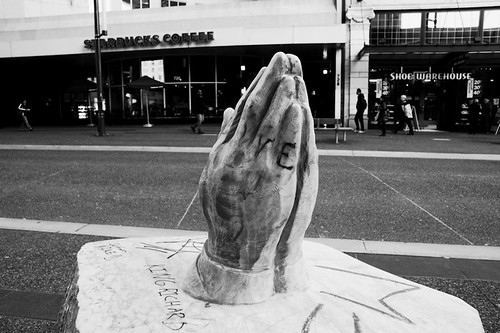
My favorite public intellectual is Umberto Eco. A professor of linguistics and medieval history who is undaunted in analyzing the press, social decline, and the phenomenon of semantic and social power is a hero, even if he's wrong. Jean-Paul Sartre was one. In fact, we can find them in Europe. In the United States, we read Sartre and Eco and Artaud and Robertson Davies, and we go and do likewise, or we long to go and do likewise. In the past, we couldn't, because publishers were necessary accomplices, and they were convinced that brainy stuff don't sell. Indeed, it is unlikely that the public would ever buy a book by an intellectual. If someone were to write about science, that might be alright, and if someone were to write "inspirational," then that sells (like Praying Hands sculptures and naughty "angels"), but they could not imagine giving a chance for an intellectual linking theology, organized religion, and a critique.


At any rate, the publisher has disappeared. More specifically, the publisher has "de-rezzed." Their image has broken into a trillion pixels, their inventory into a terraflop of bytes, and their editors -- long ago fired as unnecessary fussbudgets -- have become budgetary fustian of ages past. Now, therefore, the public intellectual is any intellectual who dares, and Americans are known for their daring.

In fact, one need only go to the parent of this blog -- blogspot -- to find genuine intellectuals offering good and sound advice on public matters. If one wishes to go to WordPress instead, then there are intellectuals there, too. If one goes to a "community" site like DailyKos, then there are intellectuals there as well. In fact, there are hundreds of intellectuals, and I mean the term genuinely, who are writing well, speaking truly, and offering sincere advice.

Therefore there are no public intellectuals in the United States.

We, like depression, are legion. We speak with a thousand voices in a hundred ears. We are myriad spirits attempting to possess a single body. No one pays us any attention unless we do something to achieve spectacle or unless some microcardial politician whose stirp goes to Tail Gunner Joe decides to investigate us.

So, why do we not speak? We do. We talk all the time. Why do you not hear us? You do. You hear us through a filter, probably, as our ideas show up in reaction shots on politicians' faces or in phrases that candidates use or in ideas that politicians reject as frankly absurd. We lack the powerhouse of e-mail forwards that move conspiracy theories from place to place, and we will never get the television.

For myself, I worry that the public intellectuals of the United States, by being so varied, various, free and ignored, have no way to develop an idea. There is no point in having them, if they can't actually use their minds to mature ideas. It's wonderful when a journalistic intellectual says something and each lonely garret responds, but it would be so much better if the conversation took that thesis, debated, refined, and made it practical and pragmatic without the need for walls or pay or paywalls.

Monday, May 02, 2011

Haunted Words 3: Earn

The frayed knot between morality and social activism has never been so thoroughly worn as by the evolution of the word “earn.” If other market-driven terms are zombies, then this one is like the unfaithful servants of Odysseus, punished with a corpse tied to its back. It pollutes our conscience most, ennervates our outrage, and dazzles us most often with a false sense that gilt is glory. I loathe the word “earn,” because I cannot mean it. I abhor it because I can neither intend nor rehabilitate it, and the places where it goes wrong are so varied that I think the word was always a sin.

Ðæs wæs gud cynninga! The bard who said so used litotes, and English and German speakers were known for it. Litotes's understatement is not the sarcasm of children or the poor mouthing of southern college football coaches. Instead, it creates a gap in the auditor's mind. If I list all of Roosevelt's accomplishments and say, “That was a good president,” the listener objects that I have set too low a value on the deeds. She then must supply her own value, and the litotes engages her, like a burlesque dancer using layered lingerie, to supply with imagination what frustration provokes.

Earning is supposed to be a function of justice, isn't it? In one context, we use it like “deserve.” We say that the scholar earned his degree, the villain his downfall, the meek heroine her prince. In each case, we are declaring the outcome fit and just. However, we use the same word for money and contracts. This is the meaning that shows up in fool phrases like “earn your keep” or “earn your daily bread.” The implication of the first is that its object is kept, and the second implies that some people out there are eating improperly. We further use “earn” simply as a way of saying “suffered for.” I am going to have a beer tonight, because I've earned it, I might say, but what I mean is that my suffering justifies a drunk. Finally, we use it as “met a contract.” In this last way, for example, the consultants earn their pay, even though they tell us nothing and give us less. We cannot begrudge them their payment, because we agreed upon it in advance.


The quadruple conflation would be reason enough to study the word “earn” and demand that a person use something more precise, but what is insidious is that mixing the meanings has brought us to an immoral and immobile state. We who have concern for justice, who have empathy, who worry about fairness, find our throats robbed of their voice, our hands of their gestures, as the grimly smug rich man says, “Hey! I earned my money! Why should my money go to some lazy Welfare queen who won't get off her bon-bon eating ass and earn a living?”


That bastard lie depends on confusion. It takes one meaning of 'earn' (contract) and claims it must be another (fairness), while the Other who suffers and breaks the cliche (earn one's bread) is guilty of another (not deserving 'earn'). These two lies are raised to the power of a third: "my money." We can argue the provenance of money, and I would recall Christ's words that the money's owner's name is on it (U.S. Federal Reserve), but that's not the lie. The lie is that "my money" encodes the belief that the money is the speaker's before and after any contract, that it is fully his, like a foot, a testicle, or a daughter's uterus. What do we say to a creed of malice and ignorance like that?


Persons who translate labor into money, money into value, goods into money, and justice into contracts are operating with an axiomatic handicap. Their assumptions are immoral, or at least amoral.


Morality depends upon a scale or register of values above the human and natural. Whether one calls this religious in the sense of revelation or simply transcendental deduction, the moral is atemporal and trans-social for the adherent. Where ethics answers with “It depends,” morality argues “It never does.” To do this, to perform the magic of reaching beyond a moment, a person, a group, a moral set has to have obligations and references that are outside of the individual's scope in every sense. Ethics tells a person, “Look around: you must consider your actions in light of others.” Morals tells a person, “You must consider your actions in light of others and values whose virtues may be beyond your needs or vision.” Both demand getting beyond the self, and the moral demands getting beyond the powers that be, too.


The sort of person who uses “earn” in every day discourse likes to “earn what” she “has.” She will tell you that she worked for everything she has. When she says this to you, she is conferring justice on its acquisition. The “earn” may be true empirically, in that she was paid a contracted amount and she did not steal more, but she has moved the earning of a salary to the justice of the salary and then taken the salary to the possessions and glazed them all with the same sticky wet juice of satisfaction.


The “earn” person is passing sentence. “Earn” in this context is purely a value judgment, and it is always employed as a law that is higher than fairness. Even though “earn” is supposed to equal “justice,” the people who speak the word most often will insist in one breath that “Life ain't fair, go cry to Mama,” and, in the other, “You've got to earn everything you get.” In other words, “earn” replaces “fair.” In their ethical scheme, the value judgment of “earn” is paramount. They will not complain at the unfairness of CEO pay versus worker pay, but they will complain that the poor person “hasn't earned” a free breakfast. Further, they will demand policy changes to address this last point, while they accept the first condition as the way of the world. In other words, unfairness is just, and not earning is unjust.


What seems clear to me is that “earn” is a self based system. It is immoral because, as a value judgment, it is self-applied. It has no value in consensus. As a conveyor of “justice,” it has lost its only ability to carry that meaning, and yet people continue to twist that concept into their usage so as to pronounce themselves, and only ever themselves, worthy of their present circumstances and others unworthy.


In toil, the man who is fifty-five years old, arthritic, and working on a framing crew in South Florida without health insurance is working much, much harder than I am. In toil, I am working much, much harder than a stock analyst. In toil, the thirty year old stock analyst is working harder than a teen pop sensation. However, the last is paid the most, the first the least (maybe; I might make less). I have suffered the rich man's contumely day after day, and the analyst has not. The groundskeeper has had that same contumely and imagined others. What have we laborers earned more of?


The word “earn” means nothing that its speakers intend, I think. Worse, when we speak it or allow it to be spoken, we enter into a world where we are implying a compelling justice beyond fairness, and yet tainting it with money and suffering. On that basis, we allow ourselves to be lied to and neutralized by the rich, who can always point to their stacks of gold and say, “You go ahead and make money the old fashioned way. Look: I still earned it.”