Confession: I live in the middle of radish fields, and the only movie theater plays nothing but "Smash and Boom III" and "Tyler Perry Presents Loud and Noisy." Consequently, I will sound like a moron if I talk about Spike Jonze's film, "Her." I will, therefore, instead, talk about reviews of the film and the premise of the film and hope that I don't miss any of the former that invalidate my commentary and that the latter is as it has been communicated.
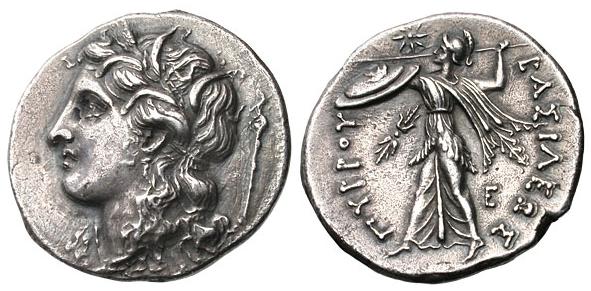
Tentatively, therefore, I want to propose the following: "Her" plays upon the Classical myth of Pygmalion and Galatea, and yet it does so in such an attenuated and developed way that reviewers either miss the model or do not bring it up. This mythic structure has a great deal to offer us, both in terms of a contemplation of art and the powers of humanity, chaos, love, creativity, and, indirectly, politics.
The story occurs in Ovid's Metamorphoses X, in one of the Orphic songs. You can read a translation here.
The song is very, very short, and the tale is very evocative. Pygmalion is a sculptor who is, in some versions, very ugly. In all versions he is very skilled. He makes a sculpture of a woman whom he could love -- the perfect girl. In Orpheus's version, she is chaste by virtue of her marble-whiteness. He loves the sculpture so much that he wants no real woman for a bride. At one point or another, Venus/Aphrodite turns the statue -- Galatea -- into a real woman.
The Victorians loved the story. W. S. Gilbert did a version, and G. B. Shaw (yes, yes, a Modern in . . . and yet not) did the famously class-based satire Pygmalion that became the rather denatured My Fair Lady. Of course Rousseau had written a Pygmalion as well, reflecting the later-Romantic fascination with the limitations of creativity, and this would show up in pictorial treatments by the Pre-Raphaelite Brotherhood.
For the artists of the turn of the 19th - 20th century, the theme seemed to be the power of imagination, and the dangers of fascination. "The Lady of Shallot" is, in some ways, a mirror of Pygmalion: that which can be imagined can be beautiful, but having it brings danger. Their versions of Galatea, like other products of artistic imagination, inevitably transferred human stains or impossibility when they crossed into reality. Either the human malleability of the lover or the demands of perfection would, like Frankenstein or Mr. Hyde, show the impossibility of the perfect more than they would affirm the value of the real.
The new "Her" would not be the first use of the Pygmalion theme with technology. We have a long, long, long line of silly and crude efforts, from 1970's science fiction fear films about super computers. "Colossus: The Forbin Project" from 1970 set the tone for the "Oh my gosh, it has taken over the world, because we're not logical enough," but "Demon Seed" had the best creep factor, especially with the explicit (at the end) Pygmalion/Galatea dynamic, with poor Julie Christie being the unwilling model. For the silly, we get everything from "Weird Science" (super models from a Tandy TRS 80!) to "War Games" (yes, it's silly, and the Galatea is the non-geek girlfriend).
"Futurama" had a great time with the social scourge of "robosexuality." In one episode, it was a way of discussing the hysteria and vacuity of Proposition 8's anti-homosexuality. The show even had Hubert Farnsworth do a parody of the self-parodying "storm clouds" ad from the National Organization for Marriage ("nom nom nom"). In another episode, though, Fry downloads his own Lucy Liu-bot. To discourage him, Professor Farnsworth shows him a government propaganda film, I Dated a Robot! (If you haven't seen it, you should click on the link, as it's one of the finest bits of parody in the show's history.)
For a legitimate enactment of Pygmalion and Galatea, where there is potential culpability or unforeseen implications of reality, literary fiction had a flirtation with Galatea 2.0 by Richard Powers in 2004. It is a very well written novel with extremely fine style and control. The "Galatea" of the title is, ostensibly, an effort at natural learning for an AI. The neuroscience and AI in the novel is quite good, but the real Galatea of the novel is the novelist's own wife, who breaks away from him in the course of the book, having an affair as the marriage breaks down.
"Galatea," we may understand, is every romantic love. Men attempt to make their mates. (Neil LaBute plays assure us that women attempt to make their mates, too.) Consequently, we believe we find the image, but then we believe that we create the girl/boy inside the woman/man we love. After Venus gives the gift, though, comes the problem of change, life, and the fact that what was perfect only remains perfect if people are immobile or manage to move together.
The Shaw Pygmalion has to understand that his Galatea may not remain an experiment, that language does not remake the person, that class is or is not simply a disguise (it's not clear). (This ambiguity is gone in "My Fair Lady.")
The early Modernists had a strain of rejecting reality. W. B. Yeats's "Sailing to Byzantium" posits a reality of art that is parallel to the reality of daily experience. It might emanate from artworks, but it isn't coexisting. T. S. Eliot would argue for a Christian mystic experience that is, again, separate, superior, informing, but away from the quotidian, where all paths lead to the same place, and the place is not any one physical place.
The Victorians and early Modernists were living in a world where empire had shown Western aspirations and appetites in action on a global scale. Whether the Belgian Congo or the British Raj, the best practices had resulted in atrocities, repression, and oppression. Appetite had triumphed over planning. For the Modernists, the high minded belief in progress had smashed into World War I, when the most "civilized" nations on earth had used chemical weapons against each other.
Today? Are we stuck reiterating the tragedy of love alone, or can we look at Iraq, Afghanistan -- not to mention Honduras, Nicaragua and other places where American best practices have been at work -- and feel a similar skepticism about projecting human will into practice itself? Surely it is the fate of love, just as love itself, to be lashed to humans who do not live in sync, but is it in the realm of any human creation to breathe without carrying with it the stain of its creators?
If we re-tell Pygmalion/Galatea simply to explore the degree to which the beautiful can only exist fleetingly, and outside of the grasp of the mind, then we do not add much. It's true that the American public is cynical, that one doubts that even the architects of the neo-liberal invasion of Iraq and the supposed vision of a spreading garden of democracy achieved by the overthrow of Saddam believed what they said, but just crossing our fingers behind our back -- swearing that we didn't really mean it when we said that we thought we were making the world a better place -- does not absolve us from having done our best and having created. We, with our names and bumper stickers attached, sent troops to destroy and enforce governments. We, with our right wing radio telling us that Jesus was involved, did what we said we believed what was right and good.
We, with very sincere dreaming in print, made the Internet, opened it to the .com's, sold domains, and preached freedom. We created the world that spies on us in order to sell us pregnancy supplies before our daughters have missed their second periods. We created the super-intelligent super intelligence in our action movies, and now the 4th amendment is unknown.
An OS coming alive and loving its user sounds more like the Demon Seed than a lesson in love to me.
"He showed concernment for his soul. Some things
In his experience were hopeful. He
Would sit and watch the wind knocking a tree
And praise this countryside our Lord has made.
. . . though a thirst
For loving shook him like a snake, he durst
Not entertain much hope of his estate
In heaven. Once we saw him sitting late
Behind his attic window by a light
That guttered on his Bible; through that night
He meditated terror, and he seemed
Beyond advice or reason. . .
. . . In the latter part of May
He cut his throat. And though the coroner
Judged him delirious, soon a noisome stir
Palsied our village. At Jehovah's nod
Satan seemed more let loose amongst us." -- Robert Lowell, "After the Surprising Conversions" 1946
Robert Lowell is one of those poets with very few friends and very many enemies, and that's at least partly due to the fact that there are several editions of Robert Lowell. There is Robert Lowell the agrarian (above) of New England, Robert Lowell the diffident yankee, Robert Lowell the insane person, Robert Lowell the confessional, and Robert Lowell the noisome political actor. That's a lot for one poor madman to bear. It's even more for one bundle of poetic skill to have to voice. Me? I pick and choose. I kind of like his snarky poems about other poets, despite the poet, and I somewhat like the pretending stridency of the early stuff.
What I really like, though, is the madness that has an unchanging essence. It is a very American form that did not quite mature with our century.
I quoted a long stretch above because of it is a subtle butterfly net. It purports to be a poem written by one of Jonathan Edwards's deacons reporting after a visit from the great man. This deacon reports the score board: the saved soul of the dissipate or indifferent. However, it then goes on, like a physician discussing a disease of the soul, and notes how the patient was lost to hereditary and environmental conditions. It ends by noting that the entire village begins to have a rash of suicides, and the bass gorges itself on the spawn of the stream.
First, this is A-OK with me, because the evangelical movement continues along the path described here. A successful meeting results in X souls saved. I have seen a weekly service at a school populated by Christian students have an alter call as a regular feature. Further, the ministers exclaim at each meeting that the top priority for the students is to save their classmates by introducing them to the Gospel. Later, the speakers are ranked on how many were saved.
(I used to be upset that these folks assumed that anyone in the U.S. had not heard the Gospel. However, my students, who attend church every week, do not recognize Gospel quotations -- even ones I consider most famous, like "the last shall be first, and the first shall be last," or "Judge not, lest ye be judged," or "Let he who is without sin cast the first stone." Now, my complaint is that the ones who are supposed to "introduce" the others to the Gospel are unlikely to have read one of them still.)
However, the poem is only consciously about the underlying problems of evangelical preaching. By speaking of this figure powerless to stop his village from killing itself, completely unequipped to deal with his crisis, Lowell gets at despair itself and the call to repentance. When we convince people that they are sinners in the hands of an angry God, it gets pretty hard to convince them that forgiveness is available. Some people will never believe in their own guilt, but more will never believe in their forgiveness.
Each pleasure or admiration will call to mind some way of falling short. It took the exceptionally radical (and I think toxic) view of perseverance of the saints to get evangelical preaching past this point. Today's evangelicals preach a once-saved-evermore-saved to get people past even being bothered by their sinning, but this introduces its own poisons.
So it is, also, that the modern -- triumphant over disease, glorified by radio, triumphant over the atom and the atmosphere -- had a horror betraying each marvel. Every chemist could be a murderer, and every physicist a world killer. The Janus mask of the 20th century never came off, and being responsible was too much for anyone but the most glib, oblivious, or maniacal.
Finally, though, Lowell's own guilt is captured. The depressive will fall back to William Cowper's malady of feeling damned and need distraction or encouragement, but all of the latter will fail, as it does not penetrate the internal certainty -- the "Satan let loose." Lowell, who had his insanity possibly as an incubus, had his guilt, too.
The flies that fall to the water's edge are food to the trout.
I watched "The Hunger Games" movie. I thought it was astonishing that they went to all that trouble to make an actress who isn't Shelley Duvall look exactly like Shelley Duvall, and the star was an amazing simulacrum of Ellen Paige, although more likeable. The film constructors had to create both effects, too, so these shouldn't have been accidents. Woody Harrelson's scalp wig, on the other hand, freaked me out.
I haven't been able to stop thinking back on the movie, and I think my subconscious is worrying over it. There was something down there that bothered me -- something I'm not ready to articulate. On a superficial level, there is the political recall.
In 1948, George Orwell wrote 1984 about how a nation can use war as an excuse for constant privation and a cover for the misdirection of funds. That same year, London was the host of the Olympics, and they referred to the events as the Austerity Games. This year, the E.U. is facing "the New Austerity." It's not a repeat for any but the British -- for the other nations it is a reminder of desolation and conquest, not victory -- and they held Austerity New Games, where professional athletes and sponsorships changed the appearance of everything and the context of nothing.
Because today's Olympian is professional, she can have a logo on her fanny at the beach volleyball. There can be wealth on the tributes. However, the wretchedness of the austerity games was that a nation that had to ration cheese was asked to celebrate the perfected form of man and the amity of nations.
That's superficial, though. I don't think The Hunger Games is aware of the connection, although it has benefited from it. No, what had me going this time was another parallel. The books and movie concern an evil central power and hard scrabble provinces upholding their independence. In fact, the political structure could as easily come from George Lucas as reality, because "district twelve" could be Dantoine. For that matter, it's not far from Josh Whedon's "Firefly." Nor is it much off from some of Heinlein's corrupt central powers.
Let's face it, rebels are sexy.
If I drew political parallels with today, then what parallels would others feel? "Corrupt state that takes all our work and lives in high fashion and makes fun of us, while we do all the work" is a summary not only of The Hunger Games attitude toward the capital but the TEA Party's attitude toward the I-95 megalopolis. That got me down. Yet another way for the ill informed to feel ill treated and go on ill advised, I thought.
So, is it possible to write a story with a central power as a hero? Is it possible to write a pro-Union story? One can write an anti-rebel story (there are such), but one that proposes the use and joys of unity and stability? It's not very likely, is it?
This is the problem that Milton ran into, isn't it? From a narrative point of view, the center of establishment or power is a lousy her. The only way to tell the story is by making the speaker for power a rebel him or herself. Bedford Forrest the slave trading rich Memphis man was hardly a figure of romance, but Nathan Bedford Forrest the Ku Klux Klan founder who would never give up against the repression of the state warmed hearts.
Are we going to be doomed to sagas about how great it is to resent the government? Is the best we can hope for a William Gibson novel, where corporations take the place of the Empire? Is that as near to reality we can hope for?
1. What does the novel do?
Ian Watt famously argued that novels are separate from other genres in their development of "psychological realism." By this he meant that the novel features interior experience, growth of character and mind, and an individual. There are other definitions, and Watt's is not the gospel account it once was, but this is at least a critical observation of a thing novels do and have done as they have grown.
I would point to the fact that the genres that fathered the novel are a) biography, b) stage drama, c) satire, d) hagiography, e) history, f) travelogues. Think of the earlier novels and their lines, and you'll quickly recognize that most of the early ones offered a frame tale of biography -- the life of David Copperfield, or David Simple. When the Licensing Act of 1737 made the English stage an entirely Ministry affair, the playwrights turned to writing up their plays as stories. This gives us Henry Fielding, but theater strikes had earlier given us Aphra Behn's Oroonoko. The structures inside the drama-derived novels therefore had long established histories. What did Defoe do but bring the criminal biography to great glory? All that remained was for the satirists to get into the game and for Walter Scott to create the historical novel.
Novels, in short, worked around following an individual. Whether they were bildungsromans or not, they had an interest in showing revelations and realizations and interactions that would grow.
2. No one with the answers can ask a question.
A person with power has a hard time with a dramatic agon. When your hero is Superman, it gets ridiculous the amount of Kryptonite you have to invent so that there's an interesting fight. When "Star Trek: The Next Generation" has hyper-warp phasers and teleporters that don't malfunction, they have to go play 19th century on the holodeck to have any conflict.
A novel needs a weak or bewildered or imperiled protagonist. It doesn't have to be an underdog, but we're bored if the Invulnerable Man faces the Average Robber.
3. You break the world, you bought it.
Rebellions give any author an opportunity to present a monster that is omnipresent and monolithic. Furthermore, it allows a motivation for the monster to do almost any wickedness against the heroine. The hero of such a saga serves to embody the political principle that the author wishes to promote, and yet the author is never forced to answer all the nagging details that would show up if he had to have that heroine win and become queen.
Frank Herbert's Dune series has the same "corrupt central world sucking dry the lives of the provinces" that is familiar to "Star Wars" and "Hunger Games" and TEA Party, but he was working from sociology and history, and so his fantasy world was literally feudal. The others are much more vaguely gestural. The impossibility of governance with virtue was Herbert's theme, in the end, and so he had his hero rebel (who was also an aristocrat) win. For four books, the message gets clear: one may be good or powerful, and one may serve one's people or be good, but goodness itself changes with a time frame.
The audience reads into the rebel, but most authors cheat and make their heroes, like Paul Atreides, blue bloods who convert or royalty in disguise ("Luke, I am your father" is not much different from "That... that birthmark! My own child, the heir to the throne had just such a mark!"), so readers get to feel clever, refined, cultured, and able to lead the rebellion.
4. Leading a rebellion is like winning a peace.
The "rebel leader?" Actual rebellions tend to be disorganized because they're rebellions and filled with rebels. I invite any and all to review the glorious Civil War career of Joe Brown, even if you look at a Bowdlerized version of it.
In romance and saga, being the leader of a rebellion allows one to be a reformer, warrior, and guide and to not merely overcome overwhelming odds, but to establish the glorious reign.
--
We are doomed, I think, to these narratives. For us, our fictional governments will always be the enemy, and all our fictional rebels will be wide eyed innocents driven to extremity.
I will let you look up the word yourself, but you'll need a good dictionary. If you see a reference to Sinclair Lewis, you've got it.
Just as he was an Elk, a Booster, and a member of the Chamber of
Commerce, just as the priests of the Presbyterian Church determined his
every religious belief and the senators who controlled the Republican
Party decided in little smoky rooms in Washington what he should think
about disarmament, tariff, and Germany, so did the large national
advertisers fix the surface of his life, fix what he believed to be his
individuality. These standard advertised wares--toothpastes, socks,
tires, cameras, instantaneous hot-water heaters--were his symbols and
proofs of excellence; at first sight the signs, then the substitutes,
for joy and passion and wisdom. -- Sinclair Lewis, Babbitt
Sinclair Lewis had the luck of getting to be a great, great cynic and being the first one across the tape when it comes to the stereotypes of America. He wrote bitterly about purchasing the American mind. From the agitated malcontents and racists and dreamers who looked for a frontier, we were losing scope. If there was no more a chance to go West to find gold, the gospel of getting rich hadn't changed: we just began to think the frontier was inside our borders. As the perspective grew narrower, we were selling our minds at wholesale prices. He got to be the first man to write Elmer Gantry. He wasn't the first one to write Main Street. He won the Nobel Prize.
He didn't win the fight, though. In Main Street, Arrowsmith, and Babbitt there is one consistent satirical target: the fatuous, jowl flapping, self-sure, raw faced dullard who nevertheless gets rich and bewildered in America, drunk on belief in platitudes. (That's what "babbittry" is. Pedantry won over writerly instinct, so I had to tell.)
It's a trap!
I will no longer bail water on the Titanic. I get it: the ship's sunk, the horse has fled and died, the party's over, she's gone home with someone else, the ship sailed, the train left the station, Elvis left the building, the sun's gone down, dawn has dawned on a new day, and there is no turning back now. (Is there ever "no turning back" except now? Was there no turning back then?) America belongs to . . . the golfers. America belongs to the Chamber of Commerce, and they don't even want it. It is the inheritance of the Republican Party, the quantifiers, and the people who have home-town spirit and the motivational posters to prove it. The people who think that global warming is "in dispute" because "those scientists" can't be trusted, that "both parties are the same," who believe that they're in the middle class and that they will get rich -- these are the rightful heirs of the land of natural resources, the natural rulers of the nation of the partly educated and lackadaisically free.
There is not a thing I can do about that. Even the "art of a well timed turd" is an useless plastic art when it comes to this tide. I am not young. Young folks shout themselves hoarse over these things and never realize that every generation does the same about the same things because "the bourgeoisie is rising" forever, and it is the nature of the thing to be dull witted and disappointing. Babbitt's SUV radio plays Rush Limbaugh complaining about how They are trying to take his wealth, and Babbitt thinks I'm a complainer.
I just want to help Babbitt be unhappy is all. After all, given the ratings of AM screaming radio, I presume that there are a good many people who want to be angry and unhappy. I'd like to get in on that. I picked up Sinclair Lewis's character because his theology is in improvement. In fact, Lewis wasn't just beating up idiotic rich men; he was satirizing the American religion of self-improvement, dieting, and technology, the belief every American has that he will be rich, that he will rise, that cautionary tales are fiction.
Babbitt himself has an iconography of gadgets. His children are the same. The world improves, as proven by the march of stuff, the never ending song of chrome finishes and carbon fibers and televisions in 3-D with surround sound. This is the empirical evidence of the divine grace of progress. We feel that challenged now, what with the crisis in the one fundamental value, land, but there is still a belief out there, despite all the actual evidence to the contrary, that "I" will make progress, that "people who know what they're doing" will flourish and that tomorrow will have better people in it, and a better surroundings.
Self-improvement is not a matter of faith, but of evidence, once you make one swap. If you agree to this exchange, you, too, can "do lunch" and worry about the size of your riding vaccuum cleaner; if you do not, you will never be comfortable. If empirical and material standards are the only real or knowable things, everything flows after.
How should an economy work? Should it provide maximum capital at the greatest efficiency or the greatest happiness for the greatest number? Is the law that binds society together one of moral obligation or of natural contracts for defense and exchange? What is the value of a man or woman to society? Is it the person's "honor" (marked by birth status and behavior in a code of ethics), or is it the material the person accumulates and contributes?
The questions I am posing are the basic questions that underpin materialist and empiricist value structures and essentialist and metaphysic value structures.
If anyone at all tells you that "capitalism" is the economic system of buying and selling at a profit, then that person is lying to you or completely uninformed. Capitalism is an economic system whereby all moral constraints on sales are removed, where wage and price reflect not cost, but cost and rental on capital. Furthermore, it emerged fitfully, not all at once, and in England for the most part.
People were trading in markets for as far back as we can find. A Phoenician cloth seller and a modern fabric shop operated in much the same way. Both bought their supply and sold with a markup. That's not capitalism. Capitalism, ideally, is a bunch of bankers deciding there ought to be a cloth shop, hiring a shop staff, and then demanding a cut of the profits every month, when their only "work" had been having money. Capitalism is also, though, being able to buy up all the cloth for a season and hold off selling until the price went up enough.
In the 18th century, when Adam Smith argued in favor of capitalism in The Wealth of Nations, what he was describing was already happening. He argued that it should happen more, mind you, and he had brilliant analysis, but he wasn't the king, and no one passed laws because of him. Smith thought that man had a "good nature." See, a lot of folks in the middle of the 18th century thought that was the case. They thought that humans, if schools and laws and churches didn't mess with us, were good. Further, Smith, like Hutcheson and a number of others, thought that we were born with morality in us. We had a "common sense" of what was good or bad. No one would starve a region to get rich! People aren't like that, and saying that they are is "superstition."
Smith also thought that what he was describing was a fact of nature. Leave people alone, without the interference of those nasty and corrupt kings and Popes, and people will operate a more efficient market.
That was it. That was the critical argument.
1. Capitalism is a natural state.
2. People are benign by nature.
3. The natural state is more efficient than any system designed by man.
4. It is best, therefore, to have limits on commerce removed.
Now, I'm sure #2 makes you shake your head. I do not know of too many times in history when intellectuals thought people were basically good other than the middle of the 18th century. However, the arguments against removing the limits on trade were coming from the aristocrats ("we're born with rights and obligations"), the church ("Christ demands that we give to the poor"), and the poor ("You owe us first"). None of these were as persuasive as the idea that man had gotten it wrong with kings and Popes and that "nature" and science would lead us to big money.
Never mind, though. No one did anything because of Smith's argument. They struck down Edward VI's corn laws because it made money for London and for the large land owners and for the corn factors who supported the members of Parliament. Let's be real. However, the argument stuck around. It was an argument that asked everyone to make a clear distinction, to pick a side: do you choose visible measures or moral ones?
It's apple time
Capitalism becomes self-validating.
When you do not have to give the poor first dibs at the wheat harvest, and when you can pre-sell your wheat to a dealer, then dealers ("corn factors") can move massive amounts of wheat from one region of the country to another. London can be fed. Hooray! Also, of course, England can export wheat to France during its revolutionary period. Hooray again! There is wealth 'created.' There is prosperity. The state has money for bigger navies and stuff.
Stuff is showing up.
Of course, during all of this, the poor have gone hungry. Prices have gone way up for the retail customer, but the aggregate customer, the large Market rather than that piddly little market town, is doing great guns. If you need proof of how naturally good it is, simply look at the money involved. If you need further proof, look at the STUFF! Pay no mind to the poor.
Once the real material *stuff* is your measure, improvement is always at hand, and progress is always going to occur. (Look, I'm not going to go into the whole "GDP must grow; capitalist nations are imperialist" and all that stuff. I don't need to.)
Even if an economy or epoch doesn't make any progress at all, an empiricist value system can tell the people that there is continual improvement because there is constant change. All you need to do is say, "Cymbalta is a new drug for treating pain," and you have a major bit of progress, don't you? (Hey, look at Snus!)
If you don't accept material as a sign of progress, then happiness proves elusive. If the .mp3 player that is also a marital aid, pasta maker, car battery starter, and TV remote isn't progress, then progress either vanishes or gets qualified into oblivion. Length of life is progress, but it gets qualified by new diseases. Literacy is progress, but unemployment obviates it. Clean water is very much progress, but it is only on offer for a minority -- the same minority who pretty much had it before.
So, playing golf and driving an SUV and wearing the right color tie or skirt? How about the TV-hat for watching one's iPhone? The rules that govern social ascent and verifiable happiness for the Babbitts are matters of faith, of religion. They worship the works of their own hands, the idols of their own making, and lose, in the process, morality.
Of course, in exchange, they get a sort of ennervated happiness.
Years ago, when amateurism looked like something new, when it even seemed like an invention or discovery worthy of Time Magazine's yearly benevolence, I wrote -- and Heaven help me, enjoyed writing --an article on film adaptation. (I did not want to be part of a social revolution. I wanted to contribute knowledge to high school students who use the Internet for everything.) I enjoyed it for the pleasure of analysis, which is the complementary joy of English composition. Composing (writing) is bringing the stray herd of words and ideas together and making them all behave, making them function toward an end. Analysis is the breaking down of objects, and I love to examine and re-examine and then recombine. (My next will address how sad it is that such a fundamental concept as the difference between synthesis and analysis is forgotten and consigned to Philosophy class, when it's everyday knowledge. It could even be Business.) It is why we speak of "creativity," after all, for the ability to make a new thing from the old is as near to creation as most of us who lack plastic skills will ever get.
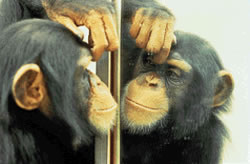
(A chimp has the ability to know that its reflection is an image of itself.)
In that article, I said that film adaptation (well, I implied that I said it) is not properly judged for literalness or inclusiveness or total fidelity, that a film is a separate artwork from its source and should function accordingly. How, then, is it an adaptation at all? If your movie of "Along Came a Spider" isn't going to try to be the same as the book I read, then how is it an adaptation? Well, I implied that films are adaptations of a thing in the original, not the whole. One adapts the theme, the aesthetic, the plot, or the worldview of the original, and then one employs the devices and strengths of film's art to do the thing the source did, whether that source was a ballet or a cartoon. One judges the adaptation by the achievement of the sameness within the newness. (It's like composition in that regard; the same words, but a new arrangement.) You keep the plot of the novel, or you achieve the same philosophy as the novel, or the same "point" as it, or the same worldview, or the same "effect" as it, but you use what film does to do it. If you succeed, you have adapted (made to fit). If you fail, you have not.
Adaptation is, therefore, an analytical composition. (The sentence in the Wikipedia article now saying, "it is derivative" was not mine, but amateurs are amateurs, and there's no stopping the boobAsp -- someone with a mania for categories and containers and little interest in the substances inside them -- from stomping along after one writes. I was ever comfortable with impermanence, as the achievement alone was my thrill.)
Alles klar?
There is a "however" coming in this essay. The "however" is with interesting people, like Stanley Kubrick, and dullards, like Roland Joffe. Kubrick's "The Shining" violates the plot, aesthetic, and theme of Stephen King's The Shining, but it's a better film than King's novel is a novel. (Some people say the same about his "A Clockwork Orange," which absolutely violates the intent and worldview and theme of Anthony Burgess's A Clockwork Orange, but I feel that both novel and film are great.) Kubrick's film is not the same at all. It is, in a sense, not an adaptation. However, his artistry and intellectual heft and cultural timing were such that we among the intelligentsia and literati and professoriate forgave him, blessed him, and honored him, and the cinephiles, who never cared about the source works to begin with, carried him about on their sloped shoulders, moth larvae and nits in a displaced nimbus around his frenzied comb-over.
Stanley Kubrick was an interesting person. He was canonized, in the academic sense. He became a lesson in film school, and dull wits always learn the wrong lessons from school.
The problem with dullards is that,
"Some are lost in the maze of schools And emerge as coxcombs Nature meant for fools." (Pope)
The follow along directors after Kubrick are a loutish lot, half aware, half there. Where he could ignore almost everything Stephen King wrote in order to return to his solitary theme of the duality of the human psyche and civilization's Jungian shadow, he could do so because American, and western European society, was wretched, like Alex de Grand in "A Clockwork Orange" hearing the reminder of his cultural heritage, Beethoven, with the very same theme. How does a world of urban and urbane and polite and political deal with the shuddering bulk, the terrifying grin, the ravenous evil, of holocaust, genocides, and laissez-faire starvation?
[It's a long explanation. I urge you to look at some of the books on Kubrick. The author of The Short Timers, the collection of short stories upon which "Full Metal Jacket" was ostensibly based, wrote an essay for Esquire or The New Yorker or something that I read some years back that talked about his conversations with Kubrick during the adaptation and Kubrick's obsession during that process with Jung. That obsession, whether articulated in Jungian terms or not, is present throughout Kubrick's films. To be too brief: imagine that we have an inherited savage in our subconscious, a violent, gleefully hateful thing that is not the "id," but the negation of civilization. Civilization has to let that creature out in a safe form, if it is to function. Individuals in tightly controlled and anesthetized societies must reconnect with the savage, or else the savage will emerge in a crazy way. Wouldn't it be a good thing for a Jew after the war to examine that, to see in the holocaust and Mi Lai alike an expression of the savage in every apple faced youngster? Wouldn't it be good to take intellectuals, the ones partly to blame for the rise of the mechanized evil of the Reich, and make them confront their own culpability? Don't believe me. It's ok. They're just movies. The point is that other people think this is happening and so are happy to see a novel by Stephen King turned into a meditation on how suburban marriage (and what would become the main text of "Fight Club" as the "feminizing" of men) can be another control that is susceptible to the Shadow.] The little shoal of broken heads, scattered wits, and eager tits known as the other directors married the self-congratulatory Film World with the despair-induced coma of post-Modernism ("post-mortemism" is an old joke, but I think there's merit to it, because post modernism is not merely a collection of works without a manifesto, a series of nervous tics without a disease, but it is also a profoundly despairing "movement," in that it proclaims the vaccuum of Movement art; whatever emptiness we may now see in movements, giving up the effort is rather cheap) to announce "Whatever it is, it's alright." Oh, Donald Kaufmann's "Adaptation." doesn't count, so don't even bring that up.
No, if you'd let me...
Look, it's just that it's...
Ok, fine, let's do talk about it. "Adaptation." doesn't count because it is an examination of adaptation. To say that it is an adaptation that examines adaptation is incorrect, because the adaptation within the examination is merely more cogitation. As a film, it is purely discursive. There is no "inside" to it at all. The film is completely outside itself at all times. Every element of the film, whether visual or spoken or gestured, is not a reference to a world, but a reference to potential references. Each thing is a question, not a statement, and certainly not a statement about the art object that is putatively source.
Now, can I proceed?
No? Well, we'll have to argue about that particular movie some other time, then. Better yet, go to Film Comment and get cheers from the chorus. Meanwhile, I'll while away the mean.
So, these vacuoles that I'm referring to -- wretched creatures like the "remake" of "Wings of Desire" into "City of Angels" or "Bedazzled" or "Wicker Man" -- and the "adaptations" of works of literature like the Roland Joffe horror shows "Fat Man and Little Boy" and, of course, the most flightless, bloated, emetic turkey of them all, "The Scarlet Letter," passed themselves off as "different artworks." Anyone who complained that they had done violence to their originals got dismissed the same way that a fanboi is dismissed for saying, "But Rochester should never have blond hair!"
Because we had recognized that adaptation was not literalism, the film world had taken that as license to "riff on" source material. Because post modernism had used history in original works (like Mason & Dixon by Pynchon) freely as a metaphor, and because commercial media had begun to re-spin source tales over and over again (endless Christmas specials with the same Scrooge-vision for the regular characters of one's favorite TV drama or comedy), film makers had decided that the historicity and factuality of the source had no relevance. In fact, repetition or fidelity was "square" (or, when Gus van Sant did it in his "Psycho," "super post modern"), and so it was the duty of film makers to prove their artistic mettle by artless meddle, and every person unappreciative could be, should be, and must be, one tribe or another of Philistine.
What, then, do we do when new works, completely new works, use the names of old works? Do we say these are adaptations, when both the creators' intent (announced, usually) and execution are not to adapt any aspect or element of the original, but merely to "riff on the classic" or "tell a story the original author didn't get?"
Let me put a case to you away from film to make it clearer. Rod Stewart, who is a fine soccer player, sang a version of Tom Waits's "Downtown Train" and had a top 40 hit, back when there were such things. Stewart's version reiterated the chorus quite a bit, as well as introduced an orchestral marshmallow in both speakers to occupy any quiet, and his producing machine also made sure that there were sweeps of sentiment that simplified any possible irony. Waits's song had been complex, melancholy, and even bitter, and Rod's song had been a rendezvous between lovers. Stewart said, though, that, while he respected Tom Waits, he thought he found things in the song that Tom had missed. So, folks: is he "riffing?" People who would hesitate to object to a violently free film will quickly sneer at Rod Stewart's comment, and yet he kept all of the same lyrics and generally maintained the chord structure. He changed the aesthetic of the song. He kept the frame and changed the heart, because his purposes were different from the original purposes.
Ok, so here's my position. When you adapt, then that's no big deal: you adapt. When, though, you "riff," you have some duty to acknowledge that you are creating a new artwork by creating a new title. If you wish to muddle about with the Gawain story to make it fit the 1950's audience, then have the grace to call your title "Prince Valiant."
Microsoft did a very, very evil thing some years ago when they decided that Java's cross-platform programming language was a threat to their goal of One Ring to in the Darkness Bind Them. They wrote their own version of Java that would run only on Windows machines. This was known as "polluted Java." They released it free, and all sorts of polluted Java got out. It was like a virus, some thought. The biggest thing is that people couldn't tell if they had "real" Java or polluted Java applications, and so they couldn't tell, without laborious testing, if their Java applications were cross-platform or not. Well, an "adaptation" of "The Scarlet Letter" that has Hester and Dimsdale grooving in the woods while Micmac Indians teach the Puritains how to tolerate is polluted art.
"Riffing" on Beowulf is your business. Have a ball! Prove that you have no slavery to history (or fact) by simultaneously insisting that Christian influences in the work are not historical (thus belying your historical freedom as a post-modernist) and thereby continue the work begun by the Nazi scholars but now in the name of your Robert Graves quoting Wiccan friends and merging "myths" from different continents, centuries, and ethnicities in the belief that there must have been some gigantic vanilla porridge of Story underneath that you -- you clever dickens, you -- can decode. Go on! Have fun. Be a director who claims that Beowulf bored him at age 14 and therefore it is a boring work, and be a man who is so filled with satisfaction and self that he cannot realize that he has just admitted that his mind has not grown from early puberty. Go on! Get money for the project. Work with sinews and CGI to erect hundreds of thousands of tent poles in theater seats, and mistake that for interesting -- but do so under the banner of the U.S.'s PG-13. Declare artistry while feeding a multi-input, single-output media machine, and hope for a Christmas release and lots of dolls to be sold. Go on!
Do NOT call it "Beowulf," though. Call it "Wild Wolf, Monster Slayer" or "She Dragon: It's Really Hot in Here." Call it "Handsome and Grendel."
What is being done is not, simply put, adaptation. What the film makers are doing is not any attempt at adapting. It is an attempt at taking a title, of replacement. Roland Joffe wanted to replace Hawthorne's tale with his own, and Gaiman, the pleasures of The Graveyard Book notwithstanding, is not to be forgiven his involvement in the theft film of "Beowulf." As technology has allowed films to tell impossible tales faithfully, film makers have decided to cease even adapting. By itself, that would merely leave room for future films -- a future "Lord of the Rings" trilogy -- but it is combined with a gleeful kleptomania and pollution.
Film makers, know this: Post modernism is no cover for theft, and it is no excuse for being a polluter. If you will not adapt, then do not steal. If you will take a name, then be aware that you risk pollution. There are stakes on the table, and some of us still care.
There are items in the cultural inventory that are not disposable. That is one of my objections, and I won't hide it. "Riffing" on a James Patterson novel does not bother me as much as "riffing" on George Eliot. The reason is not any dead white European snobbery, either, but rather than some items exist in a web of reference that constitutes culture, and when we release "polluted Java" into the stream, we are contaminating culture. Additionally, though, the simple fact is that this is not an act of adaptation. It is an act of erasure and rewriting. When the author or or studio executive has that in mind, then the result will be a new thing. It's much better if we notice that The Lion King is Hamlet than that Disney studios called it "Hamlet" and made it with cartoon lions singing Elton John songs, while they claimed that they "saw things that Shakespeare missed in the story" or that "Shakespeare is boring" and so they wanted to improve on it.
This is going to be short, with nothing significant in it, so I figure that I might as well make sure that the illustration is worth looking at. For those who wonder about my process, it's creating the images that takes most time. Getting links to various sites takes time, too, and coming up with the ideas and the writing is nearly no time at all, but the illustrating takes an eternity, and I'm often not very happy with the results in any case.
T is pleasant, sure, to see one’s name in print; A book ’s a book, although there ’s nothing in ’t. -- Byron
First, a book, and then a movie. That's the way of things, after all. All books turn into movies when once they're watered with sufficient money and vanity. The main page article at Wikistupidia today was Battlefield Earth -- a film designed and executed as a war against humanity. Had it possessed any force, it would have qualified as a form of assault. It, you see, was a book. I don't know why it had been a book, except that it required delusions on the part of fewer people to appear that way.
I did so, and now I have to demur from all of those established, celebrated, and wise reviewers.
One hates to show one's own vainglory, but this one does hope that you readers mine are clicking on the links, as I have made an effort to have them be entertaining and even metaphorical. If you have, then you already have a sinking feeling in the pits of your stomaches or stomae, because you have seen the author's photograph at the Simon Armitage site. It's the kind of thing that can cause fits. As a man of limited beauty, myself, I do not begrudge the Poet his half-face Mesmer portraits, nor his grimace of portent.
I got the book on Friday, and today is Monday, and it is done. What I found interesting about myself during reading was that I spent far less time reading the translation than I did reading the Pearl Poet. I couldn't keep my eyes on the right hand side of the page. I was magnetically drawn over to the noble verse itself. Part of this is because I have read the poem in Middle English before, so the language isn't that much of a barrier to me. However, when I was not drawn to the left, I was often as not catapulted there by the translation.
Oh, there are stinkers. Stinkers are inevitable in any translation. I have to pick on the poor poet some time (although I suppose he is not so poor now that his book is selling like mad, and I think of how Aurelian Townshend died "a poor pocky poet" who would write a century of sonnets for a few pence), so I'll stick in my thumb and pull out something dumb.
Around 2116, we get this:
He's lurked about too long engaged in grief and gore. His hits are swift and strong -- he'll fell you to the floor.
Well, "he'll fell you to the floor" kind of sounds dumb. It's not Anglo-Saxon litotes. It fails to undercut enough to catch the spirit of "that was a good king," but it's following on a description of chopping and maiming and clobbering and mincing people. It's the kind of thing that makes you rub your eyes, do a double take, and fly to the left page to see what the Pearl Poet wrote. Was our glaring contemporary being fair?
He has wonyd here ful yore, On bent much baret bende. Ayayn his dyntes sore Ye may not yow defende
is what our unknown poet wrote. Don't ask me to translate it, please. You can pretty much do that yourself. You don't need my efforts.
Oh, alright!
He has lived here for years,/ On doing much grief and gore bent./ Against his sore blows/ You may not yourself defend.
Simon Armitage has decided to go the "fluid" route and avoid the stiffness of previous poets (dunces including W. S. Merwin and Tolkien, we gather) who tried to maintain cognates where possible. Being knocked down just seems a little less fluid and a little more watery. I don't consider it quite the same in force as being defenseless. Never mind, though. Perhaps Mr. Armitage's squire is telling Gawain that Bersilak is a black belt in Aikido or Tai Chi.
What bugs me, though, and the reason I am dissatisfied and constantly jumping to the left, is not a particular weak spot here or there. I commend Mr. Armitage generally on his translation. If his goal was liveliness and a translation into contemporary poetry, he did a fine enough job. What scarred my mind as I tried to read the translation was not any given word choice, but the fact that the alliteration is whatever happens to fit the form and sense for contemporary British English. The Pearl Poet was not a fool, I think we can all agree, nor a shoddy craftsman. Double negatives were still in his language, but they were not at all necessary. The general subject-verb-object monotony of Modern English was dominant for him, too. However, he varies. He chooses which consonants to alliterate, decides when to repeat words, knows when a double negative will be amplification.
There is a muscularity to his preferred consonants. He likes p's and t's when men are being mainly, and he likes l's and m's when ladies are lounging (and lying). The effect is to make the throat work, to make the sound embattled, to create importance with repetition. With Armitage, you can easily miss that there is any alliteration present, but with the Pearl Poet, there is no way you can forget it. His linguistic effects are not pyrotechnic, but they are expert. Form and sense are perfectly married. They're so perfectly married that we sit back and stare, slack jawed, at how one human could have gotten every word right over the course of thousands of lines.
Listen to the original lines, above. Listen to how the 'you not defend you' acts as a sign of absolute doom, how impossible the situation is as the page presents it. "Knock you down" is not merely an accidental bit of bathos, it's a sign that fluidity has come at the cost of appreciation.
---
Oh, the movie?
Well, I'm watching "The Holiday." Critics were dismayed that it did not do well at the box office last year. One made a bitter comment about how the public had decided, instead, to go see some fart and vomit comedy instead.
Well, I don't know about the latter very much. After all, I watched pieces of "Jackass" on Comedy Central last night and laughed until tears came to my eyes, but I did so with my finger on the "flip back" button on the remote so that I would not see at all any of the bits that offended me. However, I will say that "The Holiday" is about letter perfect as romantic comedies go.
I don't generally like romantic comedies, as my own romantic life is more farce than comedy, and I do not find that the happy ending ever comes. After all, any ending is necessarily not happy, when it comes to romance, and freezing the action at the moment of marriage and claiming that all of time has been soaked in bliss, that the future is only an unending line of joys, can no longer fool me. However, for clever dialog, true characterization, and innovative situation, I have to say that "The Holiday" gets very high marks. Oh, and beautiful people who would never be without suitors have to go through much suffering to find suitable suits. Other than that, it's pretty good.
I've been silent for a while, as a semester has intervened, and I'm sure that all of you are waiting to see if I have anything to say about Mr. Pullman's The Golden Compass. After all, fundamentalists of all sorts are upset at the film, and e-mail is flying. Worse still, unlike other campaigns of shock and "awwww," the fundamentalists are correct: Philip Pullman did, indeed, write his books to be atheist fables. Before condemning them, I decided to do the unthinkable and actually read the first novel, the one that has been filmed, and then come to a conclusion.
I may not be a New Critic anymore, but I was trained by New Critics and still do their stuff first. Therefore, my instinct is to say, "I don't care what the author wanted to do, or what the author said he did; the book is the book, and that's that." Therefore, I wanted to read the book to see if the book, and then potentially the film that resulted, would achieve this goal Pullman claimed. This is aside from the other active issue of whether going to such a movie encourages other commissions which funds and rewards the endeavor, etc. That's a different argument for different people to have, and it's one that I may approach tangentially, below.
What struck me first about the book The Golden Compass was, "Wow. I could never do that." This is a common reaction when I read a book, but moreso when I read a book from a genre that I do not find natural. Science fiction and fantasy are alien to my internal fictionalizing. My personal fantasies are hackneyed and predictable. I rarely think of grafting in massive blobs from the Thule Society's acolytes into a language of "what if the Reformation never happened," and therefore when I met the novel's imagining of such a world, it struck me as very detailed.
It was interesting. If the Reformation had not occurred, would Calvin have become a Pope? Would the universities in England have retained their ecclesiastical orientation? Would "science" have never developed as a thing independent of church concerns? "Well, that's fun," I thought. "Oh," I thought, "I can certainly have enjoyable arguments about whether this bit would have occurred, or this, and I'm sure that this is wrong."
By page 200, I was face to face with the Problem of Science Fiction, though. Soon after that, I met with the Problem of Fantasy Fiction. These two things meant that the fun of pp. 1-50 was having to pull more and more against two fat monsters sitting on the other side of the teeter-totter.
In brief, then (and in bullets):
The problem of science fiction is that such authors tend to be excellent at plot. They have endless action, and the action points are quite diverse. They have the detective novelist's knack for making tenuous details swing large acts. They also have fantastic pace. Their inner ears are highly attuned. As sensitive as the protagonist of "The Black Cat," they can hear a reader yawn from a hundred pages and a thousand days away. This doesn't sound like a problem, but it is. Plot is unrealistic. Plot, by its nature, involves an editorial vision, and therefore highly or tightly plotted works inevitably bounce a message against the reader's unconscious and whisper: "I have a point, here. I have a message. I have a goal. I am deferring or speeding a conclusion." Plots are always teleological. Plots are, of course, good. However, the heavier and more obvious the plot, the more that whisper becomes a speech, then an harangue.
Science fiction authors stink at character. They really do. Almost invariably, they produce wooden characters. If they have any complex characters, they limit the cast to one or two actual minds, and the rest of the characters are less character than impulse. Villains are impulses, and heroes are impulses, and love interests are desires, and few have regrets, considerations, motivations, or observations, and they never change.
Fantasy authors do very well with inventing or adapting history and beliefs in the supernatural. The prince of this must remain Tolkien, with Lewis as his viceroy, but even before Tolkien the job of the fantasist was to take a known codification of the uncanny (night hags, cautionary tales, infant mortality hidden by folk tale, marital infidelity, etc.) and either combine many together or expand them into an active plot. However, these remain pastiche. Although they may create a new system of the uncanny or may merely exploit it, and although they can achieve a new landscape of potential plots and actions, where quotidian motivations and desires can be amplified or made morally unambiguous, they remain pastiche. Therefore, they can only have value to the degree that they succeed in making plain something hidden in the originals that they have borrowed.
The heroes and heroines of fantasy works, and especially those aimed at young audiences, are uncommonly stupid. No, really. They're unbelievably stupid. Unlike folk tales and tales of tricksters, fantasy figures have to possess unbreakable blindness. The reader sees ahead of them, and yet the fantasy figure never thinks, never considers, and definitely never learns.
Oof! That's nearly as bad as the wordy intellectualism below, and I'm trying very hard not to be all self-indulgently brainiac and stuff. Here. Look at this picture.
So, there's Pullman, reminding me of both the limitations of the fantasy author and the limitations of the science fiction author. I was impressed primarily because he is a science fiction author and a fantasy author, and both of those are outside my mindset. However, the borrowed elements were obnoxious, the pastiche had no hortatory or heuristic value, the plotting was severe and yet seemed to lead only to the next installment, and the character stupidity was simply overwhelming.
The novel goes on and on and on about The North. The North, you may recall, is "Ultima Thule" and "Hyperborea." If that's not creepy enough, then the heroic anthropomorphism in the book is a bear, from a race of bears known as panserbjorn. Ill yet? Hearing the gentle, soul numbing strains of Richard Wagner? Obviously, some faction of the Wagner hallucinations is involved, and there are "Gyptians" about as well. They're nice folks, of course, so I'm not implying that any of the racialism is grafted in. No. Instead, the source is much more immediate, much more amnesiac. Our other great set of supernatural figures are the witches, and they are every bit the witches that Madame Sosostris would know. Contemporary "pagans" unwittingly (generally) take in vast draughts of Thule Society, Wagnerian, and Theosophist flotsam and stitch it all together into a self-laudatory opiate. Mr. Pullman seems to have been keen on their fantasies for his fantasy novel.
The fantasy novelist's love of characters with the intelligence of an overripe rutabaga shows up in Lyra, the antiseptic and antisexual heroine of the book. (When I say that she is anti-sexual, I mean that she is asexual, of course. More of that anon.) She has no awareness of her own sex, no experience of gender, no interactions with the world that would indicate that she is more than an abstraction, and no expressions of thought beyond, "Oh, dear" and "My darling." She meets a big Polar Bear who can take down a castle with his paws, and she wants to hug it. She interacts with the bear for a few pages, spends perhaps two days in its company, and then, from being very tentative and constantly afraid, immediately begins referring to it as "Dear" and "Darling" and "my love." I suspect that even a tween reader will notice this sudden change. (Oh, and that cuddly wuddly bear returns the affection zero-fold. Never mind: the heroine is too stupid to notice and too poorly conceived to react.)
Ever since Jack the Giant Killer, fantasy characters have done things for no better reason than a wild hair. Lyra is no different.
Finally, Pullman the atheist propagandist does show up in the novel. I was reading with a weather eye out for this, and, had I not, I might not have noticed it quite so much. Generally, the book is about as anti-Christian as Vanity Fair. The man thinks himself a thinker, I guess. I think myself one, too, but I do not presume to write novels. At any rate, when he has adult characters talking metaphysics, all halts. Everything bogs down as two people lecture one another about Pullman's concept of quantum mechanics, choice, multiple event universes, contingency, and will. It is not only wretched, but it is no more aesthetic than Frankenstein's neck.
Another break for another dance:
My verdict? Well, it's an interesting book with an intolerable heroine, clumsy efforts at philosophy, and a background in the shabby inheritors of theosophism that should make anyone with any moral or intellectual sense wretch. It's not, however, "anti-Christian." I understand from some fairly unimpeachable sources that the really explicit atheist propaganda occurs in books 2 and 3 of the set. Therefore, on the subject of whether fundamentalists should be avoiding the film or book because of potential spiritual damage to the consumer, I would say that they are wrong. There isn't even significant intellectual damage. There is a weakening of defenses against nonsense, and it might make more of that dreadful "neo-pagan" stuff seem less obviously idiotic, but that's no reason to boycott.
If we're worried that putting money in Pullman's pocket will result in more efforts to destroy the Faith, then I have nothing to say. He already got paid, and he won't get more or less if you go or do not go to the movie. When it comes to that, though, I should say that the films that posit a moral universe with rampant evil and an absence of God do more harm than even one trying to stick its tongue out at Christianity, but that leads me to what I really wanted to talk about today, which is actual atheism vs. what Mr. Pullman is.
I know this post is long. I do apologize. I understand if you go have a Coke right now, so long as you promise to come back.
Mr. Pullman is, he says, an "atheist." Well, that's bunk. He's not an atheist at all. He's an anti-theist. There is a big difference. An atheist does not believe that there is a god of any sort. Therefore, he or she has no thoughts on those who believe in a god. In general, I myself am an aatheist, which is someone who lives in a world without a belief in those without a belief in the divine. This is different from an AAtheist, which is a person who lives in a world of twelve step programs.
Argument by analogy is dangerous, but I'm going to try to be fair with this one. Let's suppose the subject is not God, but rather something neutral or indifferent: Baffin Island, Canada. I say there is no Baffin Island. I've never met anyone from Baffin Island. I think the claims made for it can be answered more logically another way. I think that those who drew it on the maps were operating out of ignorance. Therefore, I think there is no Baffin Island. I am in a minority in my society in being an aBaffinist, surely.
So? As an aBaffinist, I just go about my business. Oh, it comes up in conversation sometimes -- particularly in dormitory common rooms -- and I quickly find out that neither I nor my Baffinists can prove the case to one another. I can't convince them, and they can't convince me. I quickly, therefore, come to a modus vivendi.
What would make me change from an aBaffinist to an anti-Baffinist, though, would be if 1) Those who believed in Baffin Island insisted that I agree, 2) They constrained my free action. Following the analogy, an a-theist would become an anti-theist if he believed that the World were forcing him to agree. I see no evidence that this is the case. Additionally, an atheist might say that he or she is unable to be employed or unable to run for office without having faith. I do not accept that my prayer forces the atheist to pray, nor that the rash of politicians claiming faith can be attributed to the faith's philosophical and theological claims. I don't think that "In God We Trust" amounts to forcing the atheist to believe, as the atheist believes there is nothing there to believe in.
So, Mr. Pullman's novels are filled with The Church. They are at great pains to speak of Original Sin. They are avid about Angels. They require killing angels. They have great amounts of church control.
This is atheism?
It's anti-clericalism, and there's a fine tradition of that from Christians. It's anti-authoritarianism, and there is a fine tradition of that, too. It's anti-theism, as well. This, of course, only confirms the object being argued against, and Mr. Pullman is either too dull or too passionate to care that he must affirm the divine to have his character "kill" the divine. He must affirm the power of faith and the meaningfulness of it to have his characters fight against the organizations impelled by that power. There is nothing atheistic involved in these works. There is something Satanic in the most literal sense, because there is an acknowledgment of God and a desire to do Him in. It's a world with flying witches, talking bears, nature spirits, and all sorts of things, but it is also one that explicitly rejects a unifying supernatural. Oh, lots of little ones are ok. One big one, though, would mean authority.
Like I said, the vision is not "humanist" (and I cannot tell you just how aggravating it is that atheist societies are calling themselves "humanists" -- do they actually want to make my job, and the jobs of other Christian Humanists, impossible by tarring us with their brush?), because the entirety is hinged on the soul, ghosts, eminence, prophecy, and all sorts of tatters of contemporary magical theory, and what is glorious in the books is most emphatically not the human. If it were, then the human desire to connect with the divine would be praised at least as much (more, in my view, given the results of that love in art) as the human desire to manipulate the environment with tools. Instead, though, we have the framework of theology used to protest that someone once told Mr. Pullman that he had a bedtime.