Showing posts with label Observation. Show all posts

Saturday, January 24, 2015

Falling from Small Heights

"Man is, and was always, a block-head and dullard; much readier to feel and digest, than to think and consider." -- Thomas Carlyle, Sartor Resartus
As part of an "assessment instrument," I've been reading sample essays from Oh-ficially scored sources. See, our students read four very short arguments responding to a common prompt and then write their own argument about which is the best case. We free ourselves of subjectivity by using nationally certified sources. Our old essays are now too well known by the students, and we need new ones for the exit assessments anyway, so that means reading this year's samples. The old set responded to "As people rely more and more on technology, their capacity for problem solving and creativity will surely diminish." The responses were quite different from one another in approach, and the best was different from the middle one in thought as well as expression.

This year, all the prompts are business related. The best one, for our purposes, was, "For the leadership of the future, it is imperative that children be trained in the values of cooperation rather than competition." The responses, graded by the Official services from six to one, all agree with the prompt, and the differences between them are differences of compliance with written English. The "six" has complex sentences, and the "one" has sentence fragments.

They are all dumb. In fact, the "six" would have gotten only a B from me, because even it had the "Leaders will need to be encouraged in their school" object/subject number confusion (unless all "leaders" go to the same school). Not one of the responses was analytical. Not one questioned the dichotomy of the prompt. Heck, the "five" essay began with one of those, "The dictionary defines competition as..." gambits that is only supposed to be used if a person intends to redefine a term.

Consider this my answer, and my protest to the stupids that this Official voice wanted to offer people going to its test prep site.
 
"Skepticism (is) the virtuous mean between two vices: absolute knowledge and absolute ignorance." -- Odo Marquard, "Skeptics: A Speech of Thanks," in In Defense of the Accidental


"Competition" and "cooperation" are actions incomplete in their own. They both require objects, company, friends and enemies. One competes or cooperates with. These are neither values that can be taught in the abstract, nor are they transactions that can be consistently enforced without teaching a social setting that mandates the activity.

The submerged assumption in the writing prompt is that "MBA culture" has harmed America. Well, that's hard to argue, but it's also important to follow. "CEO America" looks at quarterly profits, does not know or care what the core business is, and is pleased to fire all of the labor force and eliminate all the goods being made by the company, because those are debts. The resulting "profit" will increase the stock price, which will increase the CEO compensation, and the trading of the stock will increase the company value, which will increase its price on being bought, which will ensure the board a good package on the merger. Thus, all of those making decisions will make enormous profits. The things being made will cease, but. . . that's not the business of the CEO. The CEO and board's duty is to shareholders, not to "consumers" or "labor."

Obviously, the effects of stock traded corporations are evil. Obviously, CEO's are bad for business and bad for the larger economy. Obviously, market funds are bad for the nation. Even their positive effect on stimulating start-ups is cancelled by their decapitation of those same businesses when they begin to produce, and especially when they manufacture. The specific evil is a system we have developed of captial pitted against commodities. When capital moves and "innovates" and "is made" without any relationship commodities, then there is a separate industry of "wealth workers" who set themselves in opposition to those who work in everything else, because their fundamental task is to shake capital free from any attachment to any person. (If you don't think we are post-capitalist in this manner, I'll see you in comments.)

By nature, humans are cooperative. By nature, humans are competitive. By nature, humans compete against themselves preferentially over other people, and we do not need studies to establish this.

Look around you at lunch. How many people are playing Candy Crush or played Tetris? How many people are playing video games solo? When they play in networks, do they play against one another, or do they play with each other in teams? In general, people play against fixed goals and against their own performances, seeking to be perfect at things. It is why they go to the gym and shoot hoops or lift weights.

At work, how often are you asked for help? How often do you ask for help? The point is that people are competitive, but not hostile, and they are cooperative, but not sycophantic. Indeed, we do need to battle the damage done by the naive assumption that "capitalism" is Darwinism and the even deeper lie that Darwin's "survival of the fittest" meant survival of the biggest, toughest, or strongest -- "fitness" means toward the environment, and strong, mean, nasty critters are not very adaptable. We have to fight the fascist theme that "America" is about individuals fighting it out without any help against one another for a triumph.

More, though, we need to understand that we are under assault by a post-capitalist economic theory that is disloyal, immoral, and corrosive of all values and value.

Sunday, November 03, 2013

What Changes

Brought to you in GLORIOUS


The utterly inexplicable Stand by Me opens with gang #2 mesmerized and propelled into action by the question, "Hey! Want to see a dead body?" Gang #1 has claimed the corpse, they discover after their Odyssey. I would like to reiterate, here and now, my initial reaction to the movie, since no amount of pay could have moved me to read the book: Who the hell would want to go see a corpse?

Oh, sure, might as well ask, "Who the Hell would read a Stephen King novel," since the questions are equivalent. After all, what is the question except a promise that, some pages ahead, King is going to describe a corpse? In that regard, he is providing pornography for virgins. If he gets it right, the readers who know he did will not get any reward except a trip to a place in memory that cannot bring any joy, and, if he gets it wrong, his readers by and large will be none the wiser. He is not, generally speaking, describing a corpse as much as he is describing what pathology photos look like or what a corpse feels like to an objectifying gaze. Thus, the virgin gets the joy of self-fulfillment or self-abhorrence, but no real experience has changed hands.

The little blighters of the story are supposed to Change and Learn, and the experience Refines the character from the dross, revealing, like Buonarroti's marble chips, the prisoner within. The thing is, King missed everything. I know, or suspect (I cannot really speak to the man's state of mind, only the narrative), because of what has changed in me.


You see, we think of the dead and living, and we fear thinking of dying, but Death. . . death the thing, the moment, the extinguishing, is something we cannot think of. For centuries, poetry has spoken of the pale rider, the midnight visitor, the hungry stranger, the guttering wind, and we have mistaken these as parables. They are not. They are as literal as our minds can accept of death itself.

At the time of her death, my mother and I had nothing unsaid. We were sympathetic to an enviable degree. There were still times, of course, when she would refuse to say and I could not intuit, but our feelings were open, and I had no apologies to give or accept. This does not, of course, take even an atom off of the scales (on my eyes or that I eye) whereby guilt is measured. It was my job to keep her alive, to swat away medical mistakes, to hear all the doctors and translate into English, to call in the family when deathly ill turned to moribund but then to be wrong. I knew that I couldn't win, but I also knew that losing, as I had to, was going to be bad -- very bad. When, therefore, my mother's death did not cripple me, I knew that this was just a sign that what was coming was going to be a wave spawned from a deeper shock -- slower to arrive and higher when it arrived. 

I tread water furiously as she died. I fairly ran from the deathbed. I told myself a true lie -- that I was giving up my place to her sister and to the rest of the family. I had nothing to say to her, nothing to hear, for we had spoken often of our love, and my own prickliness was something she was finally understanding. (I confess: she still could not tell my "exasperated" and "sad" faces from "angry" faces. When your own Mama thinks you're pissed off all the time, the problem might be in the face. (Then again, I've never been too in love with this one. (A very short line of ex-girlfriends can endorse the sentiment, by the way.)))

In truth, more was happening. (I cannot, by Goggle, find the true source of the definition of a swan as "Grace and calm above; furious paddling below." I was told it by an absent friend.) I was trying to avoid the evidence. If my mother was going to die, I didn't want to see it. I simply didn't need to, I thought. Let it be a fact, as abstract as my own death. Let it be a case of here and then gone. Let me drive in to the funeral and comment on the coffin. That's the modern thing, after all.

As I'm sure you know, I was there at the death. I arrived fifteen minutes after the actual death, but it's not long enough that the stranger was not still in the air. The skin's color changes in a flash, and the full relaxation of the face into a droop did not suggest rest, to me. My mother's life force was five times that of anyone else I've known. It was furious, and she barely had any flesh. Without animation, the corpse was and is a negative affirmed. It wasn't loss: it was lostness.

Prior to my mother's death, I had put two dogs to sleep in my arms, and the swooping in of death in those circumstances was frighteningly sad. This is similar, because now there is a body that bears only a resemblance to a being whom you love passionately and fully, but this is worse, because the body fights. Even as the hospice personnel were making it "easy," there was nothing easy at all. If I were to have an angelus that said, "All was well at all that time," it would not change the effect on me, because what struck deeply was the core of the core -- life itself versus ceasing. 

Prior to this grief, I would sing odes to death (mine only) daily. I considered it rather normal. After all, I knew that I was praising rest, not death, really, and, when I last came near to genuineness, I had shuffled away from suicide as being an insufficient improvement over living. Nevertheless, I had, and still actually have, little relish for the days. I have a mighty slate board in my mind of wins and losses, and the latter have been etched, while the former keep getting erased or forgotten. Every month, my poverty runs me against abject failure as an adult, and without feeling qualified as an adult, asserting my skills as anything else are unlikely.

That has stopped now. Now, I think that I want to live. I don't have a good reason for it. I won't even say, "I'll quit when the stupid people do." After all, they replace themselves, and more. I can only say that we should know Death. We should know the unreasoning enemy who bears us no malice. Death is behovely. We are the ones who fight it with more than just our will.

Tolstoy wondered what value any of his work had, in the face of death. The Death of Ivan Ilych is one explanation, but it's not Tolstoy's own. No, that story is not about meaning, but about meaningfulness during life. It is about one very, very narrow question: "What are you living for?" The contemporary Kierkegaard would say,
"And when the hourglass has run out, the hourglass of temporality, when the noise of secular life has grown silent and its restless or ineffectual activism has come to an end, when everything around you is still, as it is in eternity, then eternity asks you and every individual in these millions and millions about only one thing: whether you have lived in despair or not." -- The Sickness Unto Death
Despair is any state wherein the infinite (soul) and finite (mind and body) and the barrier between them (self) are unaware of their own heterogeneity. (It works out much more simply and profoundly than it seems, but you can do that on your own.) Tolstoy was right, though, that we will never get out of despair if we never see death.

I am miserable (sum quod eris) (non posse non peccare) ("I am a man -- reason enough to be miserable" (Menander's Epitrepontes, I think, because it isn't Dyskolos), but to even feel that requires the flame. I have changed from my experience with dying, but not heroically. I am grieving, and not myself. Instead, I am, I think, far, far sadder than I was, because I have seen the inescapability of the flesh, the way that the rock refuses to let go of its figure, and I have heard the groans that must accompany the liberation.
 

Saturday, May 04, 2013

Me and My Brain

My mother died at the end of March, during Holy Week. Since then, I have discovered that, just as no one in my family knows me (and I'm easy to know -- I've left a pretty wide swathe across the Internet), so I don't really know them, either. Alike, we know where people were, and we do not know what time has done, or what they have done during the battle with time.

I knew my brother as a man of slogans, bluster, intimidation, and basic goodness. Hard times had not done good things to that kernel. I have become, since they knew me, maybe lazier.

First, I don't argue with dumb people anymore. Well, I very, very rarely do. I'm far more apt to explain something once and say, "I can see that you're not trying to understand" and then let them go hang. This is a function of security in my opinions. I now know that they're not weak, so I can be more certain that the person disagreeing and wheeling out anecdotal evidence and "This one time" proofs is self-deluding.

Second, I don't have much in the way of hopes. Quite a while ago, I scaled those back to simply no longer being a host for parasites and staying out of the elements. Being free of parasites is important, but it's not easy to achieve these days. You get a cell phone or some cool new service like Netflix, and the next thing you know it hatches out into a parasite that eats your bread before you can.

Third, I expect disaster. I have learned not to expect it, expect it, but I have seen arbitrary firings and layoffs, and I have seen nepotistic promotions and replacements far too often to hope for a meritocracy in any sense where my merits might count -- provided I even had any.

So, about that being lazier, I think I can explain.

Oncet, I'd blame all my bad features on birth defects. Finally, I realized that that was stupid and counter-productive.

Let us suppose that the psychoanalysts of the Tavistock school are correct and children who are hospitalized frequently and for long periods of time are liable to depression. So? Let us suppose that any boy disqualified from sports will have some maladjustments in social skills. So? All of the things that might have been true could be interesting explanations of past phenomena, but they bore no relationship on any present tense. I.e. you know why you felt or were more likely to feel a particular way, so bully for you. Now, though, you make yourself.

After that, I even got free of the physical complaints. I got all better, thanks to medicine. Hooray.

[Essayists always have digressions. This is supposed to look like one.] I always knew that my feet hurt. . . a lot. They hurt much more than anyone else's. They hurt when I was twenty-two, and twenty-five, and thirty, and forty, and forty-five. In other words, they have been constantly painful, every day. I can wear rubber sneakers or hard soled shoes, and my feet hurt. I can get Dr. Scholes's most expensive orthotics, and my feet hurt. I can even get a foot rub from a pretty girl, and my feet hurt.

A neurologist the other month, when talking to me about my spinal arthritis, said, "Oh, that? That's probably neuropathy." I began to protest that I was not some slovenly diabetic, and he explained that all the radioactive tracers and compounds I had gotten in my veins for all those years tended to settle in the extremities and kill nerves. In other words, it was medicine killing nerves in my feet, and thus there was nothing to do for it.

I have also always gotten tired more quickly than other people. I hear the same thing in response to this as I heard about the feet: "Lose some weight." Ok. I have. I'm just as tired. "Lose some more weight." Alright. I have no objection to that, but I rather suspect it won't have the magical properties being touted. In fact, now that I think back, "Dyspnea" is a side effect of every medicine I take and a primary symptom of what I grew up with. Also, the warranty I got on my last surgeries said, "Normal lifespan," not normal life.

I may, eventually, be able to forgive myself for how tired I get. I will never be able to convince anyone else, though, that I'm not getting lazier as the days go by.

Sunday, January 06, 2013

What I am learning

"The greatest pleasure of a dog is that you may make a fool of yourself with him, and not only will he not scold you, but he will make a fool of himself, too." -- Samuel Butler (of Erewhon).
I missed church again today, and I was going to write about my new literary revelation, which is that no age deserves to say that it has poetry of any sort until it can approach what has already been written in Job 14:18-22:
"But the mountain falls and crumbles away,
and the rock is removed from its place;
the waters wear away the stones;
the torrents wash away the soil of the earth;
so you destroy the hope of mortals;
You prevail forever against them, and they pass away;
you change their countenance, and send them away.
Their children come to honor, and they do not know it;
they are brought low, and it goes unnoticed.
They feel only the pain of their own bodies;
and mourn only for themselves." (RSV)
When anyone gets blinkin' near that, then there is poetry. Until then, everyone needs to shut up the shop and wait patiently, reading.

I'm not going to say that, though. I'm also not going to go into renewed raptures about "books that changed my life" and tell you all to buy a copy of At Swim-Two-Birds, especially since Dalkey Archive Press seems to be run by a bunch of jackanapes, and getting an old copy is dodgy and a foreign copy is expensive.

No. Instead, I'm going to take back something really depressing I wrote before. In "Where Do Babies Come From," I wrote about how youth signs to age, how the old "hear the mermaids singing" with despair. It's one of my less read posts, but it's one of the more maudlin ones. I was non-plussed by the commercials made by the director of "The Immortals." They weren't homoerotic as much as. . . queerly erotic. . . in that they weren't aimed at getting young people hot and bothered about being young people. I wrote:
"The youth of beauty, and the beauty of youth, demand those who lost years to watch and demand them to seek out the joy of their own vital pulse, the concerns of the overhang and undertow that remove their exceptions, and who can blame either party? The one who missed and misses longed and longs and surfaces briefly in the filling of senses, and the one in potential is compelled and curtailed, devoted and dovetailed by and in time. Nature could allow no exception, and will complies."
"We, like the commercial, long for what is lost, and we will buy some jeans. We will need some help, perhaps, need a supply, but we will avoid that longing and shovel dirt into the hole."
Ptui!

I take nothing back, but I should point out that a hidden caveat is necessary: these statements are true for the fragmented. J. Alfred Prufrock, Hugh Selwyn Mauberly, L'Etranger, the Misfit -- these folks, when they get to the old age home, slaver pointlessly and go back to their rooms for the knotted rope. (You guys noticed that I'm not linking my allusions anymore? I have. I wonder why that is? Probably lazy rather than stuck up.)

Oh, I shouldn't be exclusionary: we would find Mrs. Haversham, Catherine, and Cordelia at the home, too, although with less grim resolutions or loud complaints, probably. We men whine worst.

Every dog I have had has taught me something. I am convinced that each is an angelos, even if none are particularly angelic. Well, Macheath was. Macheath was the best behaved, most worried and conscientious creature I have ever met on any number of legs. She showed me what duty means and set before me a bar that I shall never meet. As I was missing church, I went to go walk the dog and pray aimlessly (both of the actions).

Let me tell you what Rambolina is teaching me.
Other than that you can have a trepanning scar in the top of your head and show no ill effects, except an inability to house train, she's showing me that a ball really, truly, cannot move if no one is there to throw it.

While we were out, she began scanning the tree tops for squirrels. Now, we all know how dogs feel about squirrels, and rabbits, and mice, and shiny bugs, and turtles, but Stella actually watches them up in the trees. She then began to try to climb a tree to get at a noisy squirrel. After she had wrapped herself around the trunk a couple of times, she looked over at me and as much as said, "Now, please undo this."

That longing, that "call of surfeit to loss," is only a sharp pain, a knife in the joints, for we who are broken away. In a family, even with a puppy, the youth's surfeit shares and supplies the old. It is a sweet drug that tempers the melancholy and lifts the gravity soaked mind. It is what is meant to be, as the old remain the cushion against which the young can always punch and declaim, and the young offer strength against the eroding wind and water.

That's my Sunday school lesson for the day.

Tuesday, September 04, 2012

It's a Trap!

I watched "The Hunger Games" movie. I thought it was astonishing that they went to all that trouble to make an actress who isn't Shelley Duvall look exactly like Shelley Duvall, and the star was an amazing simulacrum of Ellen Paige, although more likeable. The film constructors had to create both effects, too, so these shouldn't have been accidents. Woody Harrelson's scalp wig, on the other hand, freaked me out.

I haven't been able to stop thinking back on the movie, and I think my subconscious is worrying over it. There was something down there that bothered me -- something I'm not ready to articulate. On a superficial level, there is the political recall.

In 1948, George Orwell wrote 1984 about how a nation can use war as an excuse for constant privation and a cover for the misdirection of funds. That same year, London was the host of the Olympics, and they referred to the events as the Austerity Games. This year, the E.U. is facing "the New Austerity." It's not a repeat for any but the British -- for the other nations it is a reminder of desolation and conquest, not victory -- and they held Austerity New Games, where professional athletes and sponsorships changed the appearance of everything and the context of nothing.

Because today's Olympian is professional, she can have a logo on her fanny at the beach volleyball. There can be wealth on the tributes. However, the wretchedness of the austerity games was that a nation that had to ration cheese was asked to celebrate the perfected form of man and the amity of nations.

That's superficial, though. I don't think The Hunger Games is aware of the connection, although it has benefited from it. No, what had me going this time was another parallel. The books and movie concern an evil central power and hard scrabble provinces upholding their independence. In fact, the political structure could as easily come from George Lucas as reality, because "district twelve" could be Dantoine. For that matter, it's not far from Josh Whedon's "Firefly." Nor is it much off from some of Heinlein's corrupt central powers.

Let's face it, rebels are sexy.


If I drew political parallels with today, then what parallels would others feel? "Corrupt state that takes all our work and lives in high fashion and makes fun of us, while we do all the work" is a summary not only of The Hunger Games attitude toward the capital but the TEA Party's attitude toward the I-95 megalopolis. That got me down. Yet another way for the ill informed to feel ill treated and go on ill advised, I thought.

So, is it possible to write a story with a central power as a hero? Is it possible to write a pro-Union story? One can write an anti-rebel story (there are such), but one that proposes the use and joys of unity and stability? It's not very likely, is it?

 This is the problem that Milton ran into, isn't it? From a narrative point of view, the center of establishment or power is a lousy her. The only way to tell the story is by making the speaker for power a rebel him or herself. Bedford Forrest the slave trading rich Memphis man was hardly a figure of romance, but Nathan Bedford Forrest the Ku Klux Klan founder who would never give up against the repression of the state warmed hearts.

Are we going to be doomed to sagas about how great it is to resent the government? Is the best we can hope for a William Gibson novel, where corporations take the place of the Empire? Is that as near to reality we can hope for?

1. What does the novel do?
Ian Watt famously argued that novels are separate from other genres in their development of "psychological realism." By this he meant that the novel features interior experience, growth of character and mind, and an individual. There are other definitions, and Watt's is not the gospel account it once was, but this is at least a critical observation of a thing novels do and have done as they have grown.

I would point to the fact that the genres that fathered the novel are a) biography, b) stage drama, c) satire, d) hagiography, e) history, f) travelogues. Think of the earlier novels and their lines, and you'll quickly recognize that most of the early ones offered a frame tale of biography -- the life of David Copperfield, or David Simple. When the Licensing Act of 1737 made the English stage an entirely Ministry affair, the playwrights turned to writing up their plays as stories. This gives us Henry Fielding, but theater strikes had earlier given us Aphra Behn's Oroonoko. The structures inside the drama-derived novels therefore had long established histories. What did Defoe do but bring the criminal biography to great glory? All that remained was for the satirists to get into the game and for Walter Scott to create the historical novel.

Novels, in short, worked around following an individual. Whether they were bildungsromans or not, they had an interest in showing revelations and realizations and interactions that would grow.

2. No one with the answers can ask a question.
A person with power has a hard time with a dramatic agon. When your hero is Superman, it gets ridiculous the amount of Kryptonite you have to invent so that there's an interesting fight. When "Star Trek: The Next Generation" has hyper-warp phasers and teleporters that don't malfunction, they have to go play 19th century on the holodeck to have any conflict.

A novel needs a weak or bewildered or imperiled protagonist. It doesn't have to be an underdog, but we're bored if the Invulnerable Man faces the Average Robber.

3. You break the world, you bought it.

Rebellions give any author an opportunity to present a monster that is omnipresent and monolithic. Furthermore, it allows a motivation for the monster to do almost any wickedness against the heroine. The hero of such a saga serves to embody the political principle that the author wishes to promote, and yet the author is never forced to answer all the nagging details that would show up if he had to have that heroine win and become queen.

Frank Herbert's Dune series has the same "corrupt central world sucking dry the lives of the provinces" that is familiar to "Star Wars" and "Hunger Games" and TEA Party, but he was working from sociology and history, and so his fantasy world was literally feudal. The others are much more vaguely gestural. The impossibility of governance with virtue was Herbert's theme, in the end, and so he had his hero rebel (who was also an aristocrat) win. For four books, the message gets clear: one may be good or powerful, and one may serve one's people or be good, but goodness itself changes with a time frame.

The audience reads into the rebel, but most authors cheat and make their heroes, like Paul Atreides, blue bloods who convert or royalty in disguise ("Luke, I am your father" is not much different from "That... that birthmark! My own child, the heir to the throne had just such a mark!"), so readers get to feel clever, refined, cultured, and able to lead the rebellion.

4. Leading a rebellion is like winning a peace.
The "rebel leader?" Actual rebellions tend to be disorganized because they're rebellions and filled with rebels. I invite any and all to review the glorious Civil War career of Joe Brown, even if you look at a Bowdlerized version of it.

In romance and saga, being the leader of a rebellion allows one to be a reformer, warrior, and guide and to not merely overcome overwhelming odds, but to establish the glorious reign.

--

We are doomed, I think, to these narratives. For us, our fictional governments will always be the enemy, and all our fictional rebels will be wide eyed innocents driven to extremity.


Monday, July 23, 2012

Let's Talk About Chaos


"Ah! when the ghost begins to quicken,
Confusion of the deathbed over, is it sent
Out naked on the roads, as the books say, and stricken
By the injustice of the skies for punishment?" -- W. B. Yeats, "The Cold Heaven"

I remember that we grew very quiet, as a nation, the last time an ostensibly intelligent person turned killer, and we do so again today. As ever, we have to stipulate in advance that crazy people are crazy in mind as well as act, that murder is, by itself, proof of a disordered mind. And so, with our new H. H. Holmes, like our Unibomber, we have an insane person who gestures at a body of beliefs. We cannot blame the beliefs for the acts, nor can we think that the beliefs are more relevant or less because of the acts, but often these Crazy People show us silences that society should not have. They reveal repression.

Jonathan Nolan gave voice to the intellectual argument for anarchy in The Dark Knight, and our recent killer believes in it. Just as the Unabomber believed in the "Human Experience" Harvard class and what it taught about the lived life's degradation under the assault of technology and the sociological exchanges of modernism limiting our meaning, so this killer alledgedly believes in an intellectual core beneath chaos. What impressed critics about the argument that The Joker made in the movie was that it was somewhat coherent, if insane.


The Joker, you'll recall, argued that violence, by its nature, whether on the part of the state or against the state, was alike. Destruction was inherent, and all persons were guilty, and his job, he argued, was to make this guilt manifest at the same time that he encouraged the "joke" of destroying the toy-like rules of social control. Inside the new Batman fiction, it's a worthy idea, since the first film had been all about a group of social engineers who selectively reinforced or undermined cities and nations. 

There is no ready export of such a philosophy. In fact, it is itself an export of an older moral and philosophical realization. On the one hand, there is the psychological realization that all of us are sinful and guilty and that therefore the restraints carry only temporary force. We are animals held back by shock collars, and violence is all that prevents us from violence. The other offshoot of this is the idea that chaos, in the form of anarchy, is a method of freedom. In the movie, The Joker explores both possibilities. He puts two boats up, where the people are supposed to demonstrate their wickedness, but they fail to do so. This is in keeping, incidentally, with how people really are unless under duress. When his "game" fails, he simply shrugs, because he never really cared about making that point anyway, so long as there was chaos.

Suppose you believe in the social contract. In this, each person has the power to club the next but gives up the club in order to not be clubbed. Over time, some people think, more rules will creep in, and they will always favor the people who already have wealth or power. Eventually, all the clubs will be night sticks, and all the rules will apply to poor people. To "reset," there is a way only of getting back to the first state. From true chaos, private agreements and natural relationships of power might be formed.

Libertarians think this is swell, so long as there is money in gold and there are profits. Anarchists think that all the laws need to be smashed so that even a single law can be thought out without the prejudice of wealth or power.

Let's add in another group while we're here in the mob. Some people think that screaming, clawing, clubbing, sweating lawlessness is better than air conditioned apartment living because competition determines success and therefore virtue. They believe this is as true of people as bacteria, so we owe it to our children to ensure that they are only begotten by the "fit." Race you to the steroid stash.

If we do not talk about this, we leave people to think about it on their own, without input. They see The Joker, and they hear his side, and then they go on the Internet and read like-minded materials. They might fall in with "Black Bloc" Anarchists, or they might fall in with neo-Nazi's. In the end, it doesn't matter, because it is the failure to speak of chaos and law that has allowed for solitary voices to prevail. In the Batman movie, The Joker isn't proven right or entirely wrong, but the film is working from its own provocative, and intentionally discussion inducing, position of what a "super hero" is.

The old Reds recognized that they were hypocrites, at their best. Bertolt Brecht's "For Those Who Come After" points out that "We who wanted friendliness never could be friendly ourselves." They knew that they were not the workers they sought to liberate, and sometimes they even knew that they didn't especially like the workers. Their faith in the inevitability of a revolution drove them on because they thought it was right. Those who believe that chaos is either necessary or desirable, on the other hand, seem far less self-aware.

Knowing that the system we live in is corrupt and corrupting is not difficult. Knowing that the answer is violence is. Since these measures inevitably involve enforcing one's own philosophy upon others militarily and coercively, the "freeing" one is doing is often fatal and always unwanted. To believe that the laws need to be torn down is one thing, but to believe that they need to be torn down against the people within them is mad. It is fighting for peace. Similarly, concluding that laws diminish one's finances takes a mind of low wattage. Deciding that, because one's own finances have been diminished, the rest of the world must change to fit takes overweening pride.

Has the world run out of land or space for free communes and syndicates? If not, then Bo Gritz and the great Idaho anarchist experiment are always good ways of convincing the world of one's virtue. Deciding to fly a plane into the IRS building in Dallas is not.

In fact, these seem as if they are not intelligent or intellectual gestures at all. I would go so far as to say that such a person cannot be intellectually sound, because violence and the belief in violence in this case is an intensifier, a desire for redress and revenge. It has nothing to do with chaos as improvement. It has to do with being so upset with taxes or grades or dates that others must suffer. It is childish -- a tantrum with guns.

Sunday, July 15, 2012

The Joy of the Loveless

"I decided that if the
shaking of her breasts could be stopped, some of
the fragments of the afternoon might be collected,
and I concentrated my attention with careful
subtlety to this end." -- T. S. Eliot, "Hysteria," 1920
Your life, like most lives, is a tale of inappropriate loves that swerved one way or the other in the chaos of time by the impact of mismatched forces. Appropriate love, all the sober gray heads would agree, is of a living object better and bettering than the self; this definition may be behind our stumbles, but, like the naked mole rats we resemble, we feel our way by warmth on our pelts, blindly going "Warmer, warmer... colder, colder," falling this side or that of apathy's zero state.

And you thought Art History wasn't a good major!

 I was at the circus yesterday -- Mal-Wart, I mean -- and my absurd remnant of desire had me looking at women, girls, crones, and mothers, and then each would go from retina to a filter that may not be the same as other men's. I did not go to sexual attraction, but fitness of soul. A carriage, a posture of head, a relaxed face, would say that she was angry or worried or innocent, serious or vain. After that coarse speculation came nothing, really, but a reflected impulse, whereby I thought on time or life. Some women, more girls, did not inhabit their bodies, and others did not master them. Some were younger than their years, but more were older or matched.

I saw several who were in the last of their teens, but their world was older. They had become mothers or already learned to fear a ringing phone, and so their minds were not where their flesh was. Another was about twenty-five, but her eyes never held anything they touched, and her feet never reached the ground when she walked, and I realized, "She thinks seventeen." (There is not a word missing in that sentence.)

There may be more stages, more fixed points than the ones I know about, but it seems to me that there are ages we actually are. The "want to grow old" age is a mind that cannot have a number on it, because it is an age that, by its primary desire, tells itself that it is dependent, controlled, and inexperienced. Then, though, there is seventeen. Some thirteen year olds -- tough kid boys with older brothers who initiate them into beer and drugs early, girls who 'blossom' early and are stunned by the shockwave -- think seventeen, but it's usually the thinking of the triumph over puberty. It is having won against one's own body, feeling its contours as reliable and being relieved, at long last, of daily name calling, back stabbing, and fighting with same sex peers.

Some people are mistakenly under the impression that thinking seventeen is happiness. Ask someone who is seventeen, though. The next year is twenty-three. The graduating college person, the full of information person, the self-confident competent person who announces independence for the first time and competency for the first time and isn't awed by it -- this is the person who has the beer party, who goes to that strange restaurant with her friends, who organizes a potluck on her own. This is the person who writes the famously dense novel filled with every idea he or she ever had. (The genre of the novel of twenty-three could fill two graduate seminars.)

Then there's thinking thirty. Most of us past thirty think thirty. The thrills are gone. It's not neat to get mail in the mailbox. Parties are boring. Dating is dreaded. More money thought than creative thought goes on, and there is worry. One is at full power, but only to find that the world really has only a very, very small spot on the dance floor for each of us to move in.

I have just discovered that there is thinking fifty, too. This is the regretful and the "Oh, no" thinking, as well as the thinking of diminishment. It remains until the last thought -- being the person who is weak, and that, like the first, has no number associated with it. The first mind is one we flee as quickly as we are able, and the last is one we adopt only after we have no other choice.

The women I looked at fell into ages -- ages of mind. I also looked at their kindness, because to me that may be most needed. When I came back to the house, after that trip to the circus, I saw a man my age moving some heavy thing in a ditch. His wife was standing behind him with her arms crossed under her bra, her cropped hair a blond contrast to her red face. He placed the thing somewhere and looked eagerly under his arm behind him, and then bent back down. This is all I saw, but I was going 20 mph, so I saw that much. I also saw that she was a woman of a stunning figure at twenty, a heart of frustration lurking beneath it, and a mind of ways things must be done. (I have no praise for the man, but her stance was a cliche.)

Als das kind kind war
We think and are, at first, in love. Some people mistake this for joy. They are allowed to do so, because it can seem that way later, but it is, instead, trust. When one has no trust left, the thinking "when I grow up" seems idyllic, because it was a time of loving parents and teachers and police and aunts and uncles and the family dog. Even as it meant no self control, no power, it meant love. It was a false love, because it was a temporary one. All those things could be stronger, smarter, and wiser than the child, but not better -- as gummy eyed poets have said, and as Jesus made clear (it does occur to me, now, that, although Jesus in other places says that we must become children again and that the prophecy is fulfilled that the wise are made simple, the simple wise, the particular circumstance of this saying was of sick children and children suffering and having faith). After the completely thoughtless phases of grabbing whatever is wanted are gone, the aspiring young who think about their future are fine.

The next mind we inhabit is the one of self-aware division, where we fall victim to love's mating and lust's warfare, and we know it. I doubt there is a person who has gone through the mind and not been aware of some falseness to the driver. As for falling in love, I could point you at Shakespeare or other Elizabethans who have such precise words for it. ("This senior-junior, giant-dwarf, Dan Cupid; /Regent of love-rhymes,  lord of folded arms,/ The anointed sovereign of sighs and groans,/ Liege of all loiterers and malcontents." Marriage, the goal of earthly love, "’T is just like a summer bird-cage in a garden,—the birds that are without despair to get in, and the birds that are within despair and are in a consumption for fear they shall never get out.") Most of the Restoration wits saw love as a disease and lust as its fever, and they had elaborate metaphors for it -- what else but a disease could make a person behave in such a way, and what else but a fever could animate a person to such a degree?

Passing, or not passing, that, we join, or we join around the mind of twenty-three. I now advise teenagers to marry, and to do it quickly, because the false love of seventeen is negated by the false love of twenty-three. At seventeen's mind, it is union. The other person is better than you and has all the parts you lack, and two-in-one will solve the failure of isolation's deficits. Palm to palm and chest to chest, face to face, we have union -- a wonder enough to keep us forever and yet transient enough, mutable enough, to make us aware that it may be a shadow. She isn't better, and he isn't. She makes you a better person . . . somewhat, and he makes you stronger. . . when he isn't ruining everything. Union is so rarely complete, synchronized, and without tugging on the rope that we have a valid love, a good love, but still a misdirection.
Marry, children! Marry soon, or don't, because when you begin to live in the mind of twenty-three, you will fall in love with someone else. Around the age of nineteen, you will meet the most fascinating, compliant, coy, and agreeably cryptic and great person, ever: You.

From nineteen until thirty, you are the most interesting person you know. Why are you like ___? Why don't people like you more? Why aren't you wealthier? Why do you procrastinate? All these questions and more will come to you in time, and you'll answer them and others -- several times over. This is not a quality of the affluent only, either. The first flush of reflection, which occurs the moment the hormones take their claws off the gas pedal, leads to more.

The thirty mind can hit at twenty. It's just when you no longer think of yourself as a glorious subject, and instead think of yourself as a persecuted subject. The thirty year old mind is responsible, dutiful, over-stretched, under-appreciated, and busy. No one knows the beauty and sophistication of the great Self that the twenty-three year old was, and no one will see how wrong he is. Instead, whatever answers to the Big Mysteries of Me the person came up with, those stick, because now we are busy.

Imagine a man who marries at twenty-three -- a normal enough time. He might go into the wonder of self for a short time. That wonder lust wanderlust takes a person to blame first, then persecution, and then understanding, followed by repetition on a more accurate level. First up for most people is "Mom and Dad made me this way." That's the usual answer, but it doesn't usually last. However, if that man has his first child and is running his business the next year, he goes right from seventeen/nineteen to thirty, frozen at the introspective point until the next grand turn.

The love of the self's intricacies, its labyrinth of history and the pachinko game of the future, can better the self or worsen the self and probably does. However, it is not love of an object. The unexamined life is not worth living, Socrates said, but the examined life is not lived at all. The love affair of nineteen to twenty-three is necessary refining, but it's a false love. It precedes another false love: the battering of the body and will against other men and women and against capital to secure against time some light -- a profit, a trust, land, a home, generations, traditions. I don't think I need to argue with anyone very hard that this effort is rarely successful on its own terms and never a proper love. Love of children is great, but it isn't the spur.

Being fifty in mind means a panic, sure. It means knowing that the clock is running down, really. It's not the knowing, though: it's the inescapable, daily pain. Unlike an injury, age picks surprising joints and muscles to fire. So, we look back. We look ahead. We evaluate. The thirty age mind gets disgraced, often when the children are old enough to not need a custodial parent. The seventeen year old mind gets shouted at, often when the marriage mate is doing the same. The nineteen year old seems more attractive than even the seventeen year old: it's time to once again discover the self, to find out where things went wrong, to tap into potential, to talk to people of the opposite sex who are engaged in those quests.

Most of us are sane. We just wish, think, and grunt. We don't go nuts. Furthermore, that foolishness washes off, eventually, but we're left with the self, and then memory as its grist.

As for love affairs, I have no advice. I was rejected by eHarmony. But that love? Well, the soul is big enough to fold and open, and I can't see any love but one as sovereign.

Saturday, March 17, 2012

How We Fight

Pelham Bay, Bronx, NYC

"You give a head of canvas and oakum an expression of anger and leave it with it, with the convulsion, the tension enclosed once and for all, with a blind fury for which there is no outlet. The crowd laughs at the misery of imprisoned matter, of tortured matter which does not know what it is and why it is, nor where the gesture may lead that has been imposed on it for ever.” – Bruno Schulz, The Street of Crocodiles, “Treatise on Tailor's Dummies.”
The title "Why We Fight" was taken, twice, so I figured I'd look today at how we fight, presuming only to answer how we fight without our bodies and without our bodies' extensions -- weapons. Again, only because I can't stand the competition, and there is an enormous amount of competition on "how to fight" with and without weapons for Internet readers.

Sometimes we fight because of a proposal or a clash of viewpoints. It happens, but it happens very rarely. Present tense fights are dialogs that become a list of charge sheets, and the charges become battery.
"Dodd-Frank is more regulation, and it's killing the banking industry. In fact, that's why no one's getting a loan."
"That's crazy. Dodd-Frank hasn't even been funded, so how it can be killing anything is beyond me."
"I know a guy who is on the board of a bank, and they had to hire someone just to keep up with all the regulations and make sure that the bank could fill out all the new paperwork. That's 100% Dodd-Frank, and that's profit that should go to the bank instead of the government."
"What the? If they hired someone, then that's good, but the money from hiring that person isn't going to the government, and I'm sorry they didn't have their books in order, but..."
"Their books were fine! This is regulation killing the business."
"If they're doing fine, they're not getting killed...."
These two people are about to fight, if one of them doesn't find a way to Zen out.
 You see, the evidence to support the claim is anecdotal ("I know a guy") and the interpretation of the data is a non-sequitur on both sides (just because it isn't funded doesn't mean it can't have an effect; hiring a compliance officer doesn't mean the "government" is getting anything; supposing D-F required funds, which it doesn't, there would be no conclusion that this were harming, much less killing banks, which are showing high profits). The two are confirming a past position with new ones, probably. One began with an allegiance to what is today called "conservative," and the other at least didn't. This meant that the fight was like enemy troops discovering each other in thick woods: the fight that happens is bloody, sloppy, unwinnable in a conventional sense, and frequently the one that survived was the one most flexible, not the one most powerful.


We fight, actually fight, not in the present, but over the past tense. 


A huge, lysurgic photo to download. Call it GFDL.A crepe myrtle holding its empty seed pods.


Our memories are monologs. In fact, the problem with people who try to write fantasy novels or memoirs from memory is that those memories can't hold conversations, and those imaginations can't actually give dialog with blocking intent or separation from the speaking mind. Our memories, then, are what she said. They are what we said. 

If I offend you, right now, you object. It takes knowing me, having an architecture of hurt and malice, six cylinders of  unredressed grievance, to get the fight going, and then there has to be an objective. Given that we're talking about fighting and not arguing, there is only one real objective, and that is to make the other person into your own image to correct her or him. Barring that, the objective is obliteration of the other person.

Why you're fighting (dang it! I know -- it's because we are free and they put no value on life and we are defense contractors) is that the other person's differences (of opinion, of outlook, of value) are so great that your memory has an object in it that needs to be addressed. You have, in your past tense, a hurtfulness, unpleasantness, and disgust, and now, 
"Of course she got the job. She's black, isn't she."
Here it is. Oh, no, not again. You warned him (in your monolog in your mind) not to spout this racist crap again, and yet....

Because you need to get rid of the disgust, unpleasantness, and hurt, you have to get the other person to 1) agree with you, 2) agree with you enough to no longer elicit these feelings, 3) no longer elicit these feelings. Fights like this are idiotic, of course, because they can't be won. The most anyone ever gets is #3, and that by silence or evasion. How often have you had or heard a fight, a real fight, where one person says, "You're right. I didn't realize that I harbored such racist views. I'll be more careful from now on?"


Outside of marriage, where I doubt the sincerity or neutrality, I've never seen or heard of it.

Outside of marriage, what people get is behind Door #3. They get silent resentment. They get, "I'll never say nothing around her again" or "She's simply insane."  However, that works. It's functional. Civilization persists. The value of the two individuals has changed, as far as each is concerned. The one who thinks he won and the one who thinks he lost each knows that there was no victory, and each thinks that the other person is foul, and now the other person exists in memory as "Disagreeable jerk that I have to watch what I say around."


The first human who hurled an insult instead of a stone was the founder of civilization.  ~Sigmund Freud
 
 What I have described is what Freud was thinking of. It means that we reconceptualize each other, sure, but civilization continues. We stay out of each other's garden, wait for the next elevator, pretend to have cramps when there is a get together after work, and generally keep an averaged piece by fighting viciously until there is silence. Our objective had been to "correct" the other person by bringing the other person's rough edge into compliance with our own smooth side.

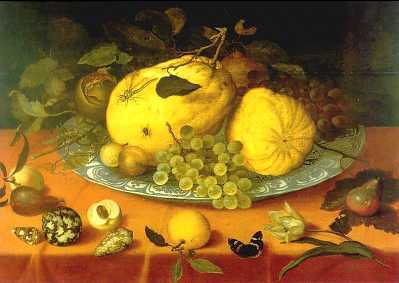
Balthasar van der Ast, Fruit with Shells, 1620
There is another way we fight, though. Remember how I said that fights are in the past tense? Remember how I said that they come because there is an affective state attached to a person before the incident that sparks the fight? Sometimes, people do not seek necessarily to get the other person to think the same things, but to feel the same things.

If you made me angry with what you did, I am angry. Now, when I call you into my office, I could explain your error and wring a confession out of you, show your error and teach the right way, ask for a narrative and see if you confess your error, or show the error and explain how that makes me look. I can pretty quickly get you to agree to never do it again, and you may do it again afterward or not, but it probably won't be lack of respect if you do.

Some people, when angry, do not want to have the other person see the right. In fact, the way the boss will explain things will demonstrate this. "So, Jane, tell me about typing up the assessment report."
"Well, I looked at the guidelines from the NEA and compared those to the SACS requirements and took the material we had submitted last year as well as this year's statistics, and I put the new data into the fields for instruments. I then changed the narrative for the learning objectives to match the updated statements, like you said to do. And. Um, that's... Oh! I called Renee to be sure that we were using the right form this time."
"And did you think about the Mission Statement?"
"The Mission Statement is listed."
"Oh really, Jane? Perhaps you can show it to me, then. Considering the fact that I distinctly remember telling you that the Mission Statement had to be at the top of every form, I'm at a loss to see where it is. I swear! First you don't put it in, and then you use the one from fifteen years ago!"
Many of us work for Executive Hardcase.
It goes on like this. (I apologize for any workplace flashbacks. I drew upon a real boss of mine for the above, where I was Jane.) Now the boss in this case is not looking to fix anything. The boss is not even being a sadist. The boss is, rather, fighting for the same objective, but a different value as other fights. He wants sympathy/remaking. In this case, he is angry, and he demands that the employee be made to feel the emotion that he was made to feel.

This is something that often separates masculine and feminine discourse in argument, as well. It is by no means always the case, but it is often the case that women will fight for an emotional sympathy. "You made me feel unhappy, and this fight is not over until you show that you feel as unhappy as you made me feel" is the dynamic of the argument. Is it fair? It's not any less fair than, "We won't stop until you agree with my logic" is. Both, in the end, are about achieving an overwriting of the other's state to show the power of the one, even as, paradoxically, they seem to be revenge. The person not letting go until fear is achieved is doing so because she or he felt powerless against the other inflicting that emotion.

The only reason I feel like sharing this guide to How We Fight is to bemoan a simple fact. The fight that depends on agreeing with propositions has a sort of annihilating draw option. There is a way to walk away in silence, with both parties thinking less of the other but peace achieved. In the instances where a person demands emotional pounds of tears, I know of no such thing. Perhaps skilled acting might work, with the cost only of integrity, but I don't know what to do with someone who wants anger from me, or sadness from me, because, honestly, that's asking for something that's not in the public sphere.

Monday, March 12, 2012

Ennervation Never Knows


"I can endure my own despair,
But not another's hope." -- William Walsh

The child skins its knee, and the pain is the worst of its life. It moans and keens with all of its mind at the unending and raging pain. The adult cuts itself with a knife while doing a routinely dangerous task, sucks air between its teeth, curses, sends reason to caution the primitive mind, invokes time's wisdom to know that all pains end, rushes to find unguents, wraps the wound, closes its eyes in mastery, and controls the impulse of pain. The older person's night time undressing reveals wounds along the legs, dried blood smears like comet tails from punctures on the forearm or thigh, and fear, a dull fear, comes up, and the older person asks itself when these damages happened, which enemies had struck during the night, and how unprotected it is against the environment, and then its reason and sense of time, stronger now than the senses of touch, say that such things are predictable and inconsequential.

The teenaged boy jostles its friends. They slam dance to socialize, because the little demons that inhabit them will not allow stillness, and looking one another in the eye would be faggy, and they rate women. The most imaginary flaw could cause emesis or impotence, they claim. Else nothing could stop their mighty virility from accomplishing its mission, but they would demand that the waif lose weight and the buxom woman get enhanced.
Their oppositely arrayed army mourn the imperfection of all the boys and perfection of all the imaginary men. Those who breathe are vile, and those who shimmer on screens or reflect from pages have every desire locked inside them. These here are immature -- a just complaint if ever there were one -- but those. . . those understand. Those are prettier, kinder, and listen.

The older person fails to notice. The mate, even the child, was a formula solved some time earlier. Since that time it has remained an integer of certain quantity and an attribute of certain quality. Only the things that are jarring, disagreeable, unsolved show up, and these as things that will not rest, will not allow the natural process to go its way. The woman cannot believe that the man isn't taking things seriously, as he is happy all the time, which means that he is indifferent, and the man cannot believe that the woman can never be satisfied, as things are not in crisis, and they have both formed conclusions. It is now just a matter of time between fights and resolution.

Ahem.
Sorry about that. Rather grand sounding, isn't it? After all, it is the way of us to be fresh and then grow stale, to lose connection to our sense of each thing as time goes on. People speak of the senses growing dull. Ears, eyes, tongue -- each has its own diminishing returns. However, there is also a simple process of ennervation, whereby the nerves running to these senses decrease and our ability to feel decreases. Ennervation is aging, and all of our awareness follows the pattern of the physical.
"I've got a wild man wizard, and he's hiding in me.
Illuminating my mind." -- Harry Chapin, "Taxi."
In youth, a fantasy strikes, and it fills up the horizon, fills in the holes of the heart left by disappointment in strength, attention, love, accomplishment. In youth, we can devote days to exploring our other selves: the knights, the shield maidens, the saviors of D-cup desperate women wearing thin their leather bikinis, the neglected beauty of the realm of power discovered by the lovely man, the radioactive scientist, the battle hardened soldier of either sex, the gang star, the respected woman who wins all she desires by her fire-hardened femininity and toughness, the cowboy, the Indian, and we can write it out in dreams -- visual, poetic, waking, sleeping, and prose.
"Julie Daydreaming," by Berthe Morisot
  As adults, we toy with our psychic familiars, pulling them from the closet in times of stress, embarrassed to be seen in public with them. Older still, we cannot capture even a half hour of what was once whole days of fascination, and we have no patience for reading or seeing another person's dreams realized. 'Oh, that fantasy book series is treacle for teenagers,' or 'That series on HBO is some middle aged guy's fantasy life; whoopee for him,' we say. The truth is that we feel guilty looking in at what we had.
I do not mean to complain of time's many gifts.
"Death and the Girl," Ego Schiele, 1915

 Our greatest desire, when young, and we do not know it, is to be free of the "insane and furious master" lashing us (Republic 329), lust. Our greatest desire as adults is to cease being the half-persons that everyone since Aristophanes has said is the way of sex (Aristophanes says, in Symposium that we were one ball, and we were trying to be gods, so Zeus split us in half, into male and female, and now we spend all our lives trying to reunite). In age, we can call on lust unreliably, but it's there, and the raging fire becomes a steady flame.

When young, a disappointment leaves us screaming our nights away as surely as the scraped knee left us howling as toddlers. Anger goes to destruction. We wish we could escape our own ability to feel so deeply. Time takes care of that, at least for a while.
By practice and discipline, we can tame the winds of youth. There is less to help us feel again when the nerves no longer connect. And, at last, when they reach no farther than the mind itself, there is no place for feeling to go but to the mind itself, and we go back again to our impulse, desire, and wish.

Monday, March 05, 2012

Once

I have found myself in the unenviable position of explaining punk rock to a generation that has no contact with it. It has heard the term, but the meaning of that term is at least doubly remote. It is remote in the sense that any musical movement is a fossil due to the destruction of radio, and it is remote in the sense that whatever this movement denoted, it simply is neither spoken of in a coherent manner nor played on whatever musical media as exist.
Photograph by Man Ray

"Well, like, um, The Clash?" crickets. "Ok, Blondie?" Nope. "Talking Heads? The Police? The Buzzcocks? Joy Division? The Ramones?" They have, some of them, heard of The Ramones, largely due to the habit of set decorators and costumers in Hollywood to put Ramones paraphernalia in television shows and movies. Now, a fair amount of what they have heard is punk at two removes, but the all stars of 1977 - 1985 are unknown to them.

Honestly, it is not germane to anything, and so I should not spend precious seconds mentioning any of this irrelevant history to college students, as both the free market and the shifting historical record that is culture have determined that what changed my world has been erased, but I have devoted perhaps five minutes, total, to this task, and I usually mention, as an example of the kind of punk I was, Talking Heads. I'll focus on what I think is the song they're most likely to have heard, "Once in a Lifetime." (Actually, "Burning Down the House" is more likely, I guess.) I tell them to imagine that they woke up one morning with complete amnesia. Imagine looking at their lives without any history at all. Just look at where they are and who they are at this exact moment. Cut a slice through time like a slide under a microscope and examine it. What conclusions would you draw?
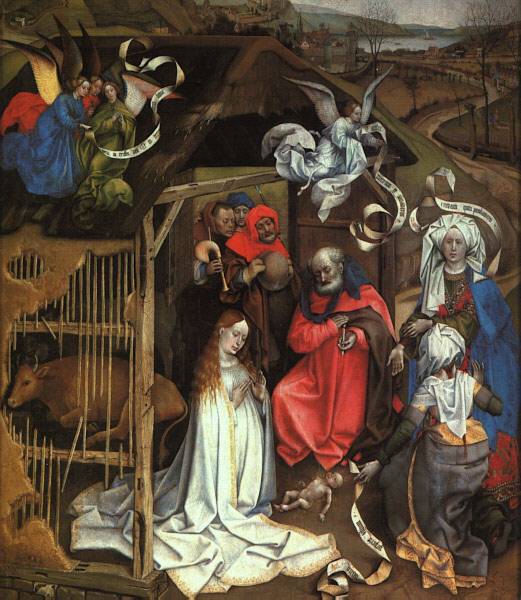
The Nativity, Robert Campin

"That's deep," they say. Yes, I say.

W. H. Auden squeezed a whole anthology entry out of Breugel, so I figure I can use the Master of Flemalle for a blog post. Auden was talking about suffering's banality as a corollary of the banality of evil, though. If the Nazi executioner might look like a businessman, then the martyr might look like a piece of paper crossing that businessman's desk.

What I try to tell kids, from David Byrne's artistic game, is about the nature of hierarchy in time, how sense-making depends on time and how lost emphasis is without priority. When I was a collegian, exploring everything, sticking my tongue into every crevice and trying to pry the lid off of every jar, Mr. Byrne was always the upper classman I admired. He was ahead of me intellectually and creatively. He had cooler friends, and he did the drugs I never would, but he and I were thinking along the same lines, but I was following.

Now, I have probably caught up with him intellectually. He still has some mighty cool friends, and money frees him to a courage that I will never have. Reading his journal, I have to say that he's awfully interesting and still more creative than I'll hope for, but he's no longer commanding spaces I haven't seen.

We were both interested in the idea of how the createdness of art altered its experience. We both wondered about how everyday utterance was shaped by ritual and how poetic cadences had roles in the group experience.

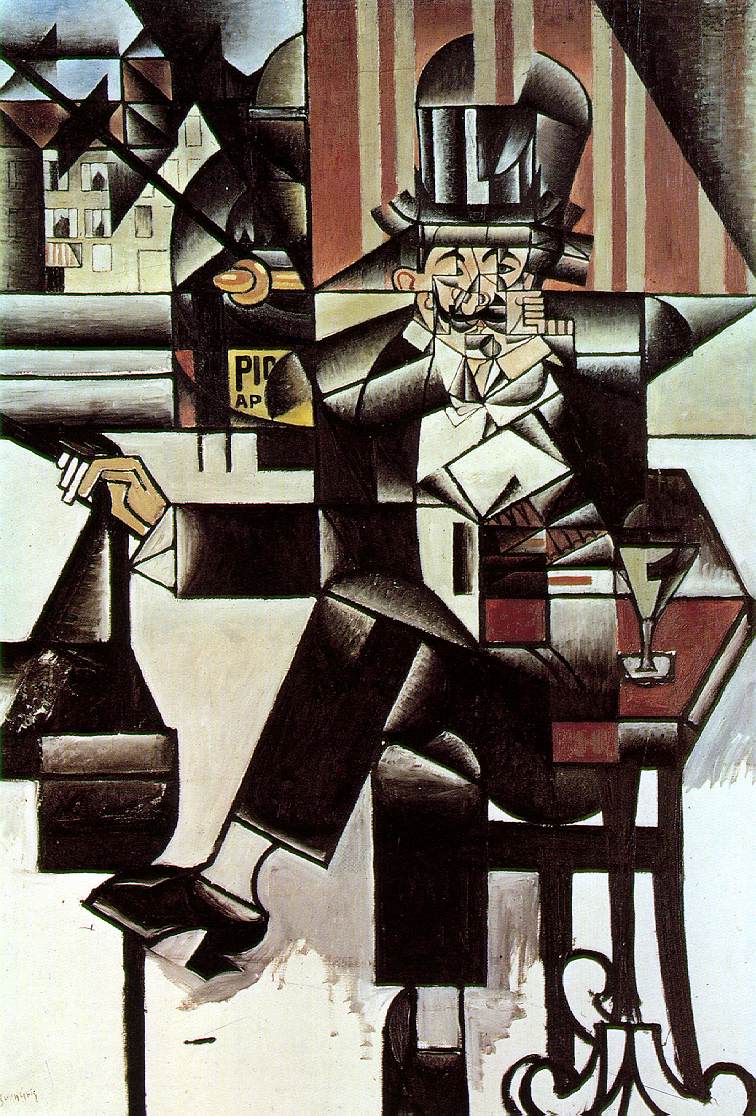
The Man at the Cafe, 1912, Juan Gris
What is the present moment?

In truth, not only do we fail to understand the slices of living and perceiving that together go into the narration that we call "our lives," but each individual moment is itself unperceived for the most part. Even without going to the radical Taoists and asking that we know all the sky, water, earth and that we lose our selves in the process, there is simply more of you than you will credit at a single time.

Your "now" is only the part of sensation and memory and desire that crosses into the organizing facility of the mind. If the ego is "the thing that knows what sort of person you are," then "now" is merely what the ego wishes to credit. There are a thousand things that a "person like you" or that "you, in particular" would not care about that are happening to and with you at this instance, and these are silent. They leave no impression on the tablet.

I do not know what is happening. I only know what I said happened.

One time is no time, after all, because we are continuous if we are at all.

Wednesday, December 21, 2011

Advent


Let us make it clear: this is not about the Christmas spirit, or about the solstice, or about a Fox News personality's paranoid frisson. This is, first and foremost, about time. “Time and tide,” we say, when the words are synonyms in Old English. When it's “Eastertide” or “Christmastide,” the “tide” means “season” and “time.” This, then, is about Advent tide, and why that isn't Christmas.

I will acknowledge right off that I am peculiar. I am an anti-rationalist (which has nothing to do with irrationality, by the way) and a Christian humanist, and so I'm attracted to mysticism. I follow a long parade of better minds in this regard. From Kierkegaard to Wittgenstein, philosophers who have dealt with the insane limitations of enquiry have come to the conclusion that IF there is a Something Grander, reason won't go there.

However, liking mysticism is rather like being an inhabitant of Greenland. Someone lives there, you know, but they'd have a devil of a time getting you to visit.

Like Anglo-Saxon, Greek had more than one word for time. “Chronos” is the word used for time in general, and it's the customary word. However, the New Testament famously (ok, famously in the circles of people who read Greek) uses the other word, “kairos.” Even if you reject the tradition of Christian writing on the New Testament, the word “kairos” carried with it a sense of “right time” or “particular moment.” Therefore, a translator might say, “And at one particular time she was to be delivered,” but that can also mean, “She was due” or “When it was correct” (Luke 2:6).

W. H. Auden and Christopher Isherwood (or vice versa) have an essay in The Dyer's Hand about /kairos/, and I read it when I was young and impressionable. I didn't like it. I hated it. Consequently, it has informed my outlook ever since. Auden ties the breakthrough between supernatural reality and quotidian reality to separate cycles of time, whereby our natural, plodding time will assemble itself through myriad acts of free will and necessity into these few shocks of transcendent history, when God's history and our history converge in the “fullness of time.” (It turns out that I am a liar or a doddering fool, as I have searched electronic versions of The Dyer's Hand and found nothing, but I have found “For the Time Being” by the author. I have also discovered that Kierkegaard had quite a bit to say about “fullness of time.”)

Precision is impossible with these concepts because of how fluid they were. W. B. Yeats wanted to find history circling itself in “gyres,” where there would be moments of contact between the coils of the unwound spring. These contact points would be transcendent, as a single grand narrative played out over and over again. The French Symbolists, especially as they suffered revival by T. S. Eliot, saw a second world's signification lying beneath the scattered and broken objects of the war-ravaged landscape. While they silently held onto a priesthood of art by having the Poet be the one who could see the hidden, they also overtly secularized transcendence. It was supernatural, anti-rational, profound in the literal sense, and timeless.

By The Four Quartets, Eliot's mysticism was more classically Christian. He had, instead of a counter-narrative in life, the counter-narrative of humanity and, even below that, a rhyming, pulsing sense of spirit in time. I think Eliot would not have liked Kierkegaard, or anything that denied essence, but the two visions fit well.

The reason I am rambling through all of this is to show that this feeling, “like a splinter in your mind,” is hoary and persistent. Some of our more sensitive and thoughtful people have also found in it not a grand illusion, but a grand truth. For myself, I have to go back to the real before I can find anything super-real.

Metaphors of Life
How do we speak of life and time? We speak of the “circle of life” and the “river of time.” Sometimes we use a metaphor of a train, a journey, or growth for life, and the interconnected events of nature are sometimes phrased as a balance. The Magna Mater is kind of rare these days, but sometimes Mother Nature shows up, if only in advertisements for personal hygiene products.

The circle of life is both value neutral and nullified. It is purposeless, perpetual, and indifferent. We can only break it by caring or evading it. Further, it is a metaphor of biology and science, as it focuses upon eating and reproducing as the meaning of living. Since every time we speak the language, our language speaks us, this metaphor betrays our desires or infects them.

The “river” of time has been around for thousands of years. While Heraklitus might himself have meant to propose a stoical and mystical end, the metaphor is quietistic. It is fatal, as it suggests the particulate nature of the speaker, the hopelessness of understanding, much less commenting upon, the current, and the inevitability of events.

I was out in the managed wilderness yesterday, and I closed my eyes and listened. To listen, there must be sound instead of noise, and being far from a highway allowed me to hear things as they were without our intentionality splattered across them.
Digression for pastoralism
I apologize for being a self-indulgent jerk (it's ok: I forgive me), but this is what occurred to me while I was out there.
Most of all, the birds and the wind sound. The wind does not sigh, at least not here, not often. It swells a chorale, the chords shifting gracefully like curtains sweeping across the land, and the tree limbs and leaves, those freed corpses rolling about as tides of memnto mori until they bed in graves about the path, sing and shake rhythm and counter melody beside. And when the wind falls silent, it is only thinking of the next long syllable to play on the world. The lake's surface knows in its body what we cannot hear in our ears: there is always a breeze, for what else is the current?

The birds play tree specific notes. Sp! Sp! Is all the straw-blended sparrows say, until one says, Food. As each peeps and sings, the songs clash, but that mixture and burble is the hillside in winter. Besides, the loudest call, and most common, comes from the one who respects no season: the red tail hawk who is always complaining to no one in particular about the one that got away. When it is silent, it is only because it has no complaint.


The respiration of nature
Nature's order is each of the things we have said of it, but it is something more basic, too, something we carry in ourselves. It is wax and wane, ebb and surge. The natural world respirates, and respiration carries within it the cycle and the motion, for we never have the same breath twice.

When we humans set out order, we plan, and we will. We intend, and we let either a goal or a past event (history) set forth our intention, but the natural world accommodates by allowing any individual item to be whatever it is and still set the growth/release model.

Tide
The Anglo-Saxon tide is a period of time, a season, and an area of time when things are right. Like /kairos/, it is fullness, fitness, appropriateness. It can also be “area of time surrounding on a calendar,” but that is only true in a very limited sense. This is Christmas tide.

The Advent, for Christians, is not a time for simple meanings. The signal events in the Christian story are the ones most difficult, most ambivalent, calling for joy and grief simultaneously, for awareness of birth and death. I heard a young man pray in thanks for Christmas, because “Fathagod” it was “the time when you took all that sin on yourself.” For that young man and his dualist theology, he could only think of Advent as the birth of the crucifixion. The life of Jesus was hardly there at all.

The birth's meaning is far greater than his understanding, I think. As Auden and the others were saying, this is a moment, for Christians, when the three times intersect, when the natural order and the narrative order and the divine shatter. The moment of incarnation is parallel, proleptic, and also unique. Mary's response to Gabriel in the annunciation mirrors Jesus in the garden of Gethsemane, and the taking up of her flesh mirrors the words of institution at the last supper. (In other words, the flesh is important, in all its suffering.) At the same time, it is when the first sin, when Eve and Adam wanted to know what evil was and got their wish, is given the complex answer in the new humanity. All of that is involved, and so every sign repeats, leaps forward, calls to something from before, and evokes in such a way that any effort at pinning it down to “Happy baby” or “Whew, the cross is coming” or “He will ascend” is missing everything for trying at something.

No one knows when Jesus was born, not even the year. The traditional mass and feast for Jesus was set for December 25th in the west. For many Sundays prior, traditional lectionaries have readings to prepare for the feast, as this is not a question of Christmas, but of the Advent, nor of a day nor time, but of a tide.