"Man is, and was always, a
block-head and dullard; much readier to feel and digest, than to
think and consider." -- Thomas Carlyle, Sartor
Resartus
As part of an "assessment instrument," I've been reading sample essays from Oh-ficially scored sources. See, our students read four very short arguments responding to a common prompt and then write their own argument about which is the best case. We free ourselves of subjectivity by using nationally certified sources. Our old essays are now too well known by the students, and we need new ones for the exit assessments anyway, so that means reading this year's samples. The old set responded to "As people rely more and more on technology, their capacity for problem solving and creativity will surely diminish." The responses were quite different from one another in approach, and the best was different from the middle one in thought as well as expression.
This year, all the prompts are business related. The best one, for our purposes, was, "For the leadership of the future, it is imperative that children be trained in the values of cooperation rather than competition." The responses, graded by the Official services from six to one, all agree with the prompt, and the differences between them are differences of compliance with written English. The "six" has complex sentences, and the "one" has sentence fragments.
They are all dumb. In fact, the "six" would have gotten only a B from me, because even it had the "Leaders will need to be encouraged in their school" object/subject number confusion (unless all "leaders" go to the same school). Not one of the responses was analytical. Not one questioned the dichotomy of the prompt. Heck, the "five" essay began with one of those, "The dictionary defines competition as..." gambits that is only supposed to be used if a person intends to redefine a term.
Consider this my answer, and my protest to the stupids that this Official voice wanted to offer people going to its test prep site.
"Skepticism (is) the virtuous mean
between two vices: absolute knowledge and absolute ignorance."
-- Odo Marquard, "Skeptics: A Speech of Thanks," in In Defense of the Accidental
"Competition" and "cooperation" are actions incomplete in their own. They both require objects, company, friends and enemies. One competes or cooperates with. These are neither values that can be taught in the abstract, nor are they transactions that can be consistently enforced without teaching a social setting that mandates the activity.
The submerged assumption in the writing prompt is that "MBA culture" has harmed America. Well, that's hard to argue, but it's also important to follow. "CEO America" looks at quarterly profits, does not know or care what the core business is, and is pleased to fire all of the labor force and eliminate all the goods being made by the company, because those are debts. The resulting "profit" will increase the stock price, which will increase the CEO compensation, and the trading of the stock will increase the company value, which will increase its price on being bought, which will ensure the board a good package on the merger. Thus, all of those making decisions will make enormous profits. The things being made will cease, but. . . that's not the business of the CEO. The CEO and board's duty is to shareholders, not to "consumers" or "labor."
Obviously, the effects of stock traded corporations are evil. Obviously, CEO's are bad for business and bad for the larger economy. Obviously, market funds are bad for the nation. Even their positive effect on stimulating start-ups is cancelled by their decapitation of those same businesses when they begin to produce, and especially when they manufacture. The specific evil is a system we have developed of captial pitted against commodities. When capital moves and "innovates" and "is made" without any relationship commodities, then there is a separate industry of "wealth workers" who set themselves in opposition to those who work in everything else, because their fundamental task is to shake capital free from any attachment to any person. (If you don't think we are post-capitalist in this manner, I'll see you in comments.)
By nature, humans are cooperative. By nature, humans are competitive. By nature, humans compete against themselves preferentially over other people, and we do not need studies to establish this.
Look around you at lunch. How many people are playing Candy Crush or played Tetris? How many people are playing video games solo? When they play in networks, do they play against one another, or do they play with each other in teams? In general, people play against fixed goals and against their own performances, seeking to be perfect at things. It is why they go to the gym and shoot hoops or lift weights.
At work, how often are you asked for help? How often do you ask for help? The point is that people are competitive, but not hostile, and they are cooperative, but not sycophantic. Indeed, we do need to battle the damage done by the naive assumption that "capitalism" is Darwinism and the even deeper lie that Darwin's "survival of the fittest" meant survival of the biggest, toughest, or strongest -- "fitness" means toward the environment, and strong, mean, nasty critters are not very adaptable. We have to fight the fascist theme that "America" is about individuals fighting it out without any help against one another for a triumph.
More, though, we need to understand that we are under assault by a post-capitalist economic theory that is disloyal, immoral, and corrosive of all values and value.
I have been active
on the Internet since 1990. In those days, we had Usenet at the
university and moderated private bulletin board systems (FidoNet)
for amateur fun. This makes me four Internet generations ago, if we assume that an Internet generation is about five years, rather than twenty-five.
Indulge with me in nostalgia. Before the FCC decided to sell bandwidth to the .com
top level domain, the Internet was a place of low or no graphics,
where users were almost exclusively .edu accounts (with a few .sys,
.mil, and .gov), and most accounts were a first initial and last name
(mine being misspelled by the IT people at my U, so I had anonymity even then). HTML sites were
usually navigated by Lynx or one of the other text-only Unix based
clients. Since the entire endeavor was text on slow dial up
connections or fast connections on computers with monochrome
displays, it was an empire of words subordinated to either a group's
activity (e.g. rec.bicycle) or a group's academic research.
University and government workers created massive amounts of free
information, and the early HTML systems were ways to link information
infinitely. People spoke of beginning with an interesting note
in the newspaper, clicking on an odd term, following to a strange
fact, seeing a strange name, and spending hours “surfing” from
site to site, but all of this was via reading.
When America Online
and CompuServe opened their closed systems to the Internet, everything changed. There were floods of new users who
reflected average America. While many snobs thought that “killed”
the Internet, it was, instead, the underlying decision to
commercialize the Internet,
combined with hypertext, that
turned the Internet into
today's creature of clicks and “eyeballs.
By
1996, and certainly by 2001, most “Internet” users only knew the
world wide web, not Usenet,
not discussion. The world
wide web itself “was” a series of commercially profitable sites,
with the last of the .edu
created purchased (e.g. Bartleby.com, created by Columbia University
library to make all of its
Columbia UP reference works available for free,
was sold, then resold) or
forgotten. University
server sites
providing
information became gradually
invisible to average users
because they went
unadvertised,
and “the web” was no longer a place where persons “surfed” on
an adventure of information. Certainly by the time the "tech bubble" burst, each website invested in keeping visitors on sites, in sites, and preventing
outside linkages. Websites became more pictographic, with
an increase in sensationalism, as
the same pressures that turned superabundant newspapers in 1900 into the Yellow Press created increasingly narrow and vertical forms of discourse (“vertical” refers to
information that is recursive
and closed, in this case). What had been peer groups
in conversation became
interest groups engaged in a
tailored retail experience.
“Friendster” and “MySpace” were non-profit simulacra of the older Internet. They
succeeded, to the degree they did, by offering like-minded cultures
and subcultures. (There have been other
simulations since, including Reddit.)
However, when
their host/software
companies offered stock, they
were purchased by media corporations
that, as early as 1998, had been imagining an
Internet/cable
vehicle whereby visitors would be captive, ordering television shows,
movies, books, radio, and the rest on an a la carte basis by the Internet. '
Neither
the websites nor the delivery technologies were in place for such
visions to be realized. (This
vision, and its failure, was paradoxically
critical to the collapse of
Enron. The Amazon Kindle/Fire
is getting very close to its
realization today, according to critics. If they can "own the pipeline" and the store and the production, then the consumer choice is finally completely eliminated -- or "business uncertainty is minimized," if you prefer.)
I'm no Electronic Frontier Foundation warrior or GNU freak. I haven't the money to be the first or the skills to be the second. I did join Wikipedia in 2003, though. My frustrations with it were that it was not dedicated to a common project of construction as much as it was a "community." My criticisms of capital in technology are not propelled by idealism or ideology. They are directed solely at an analysis of the deterioration of academic freedom and investigation because of a capitalized web. One thing I've noticed is that a genuine analysis of technology cannot be found under the title of "technology" writing. For about ten years, I noticed that the writing about computer technology, in particular, fell into one of two camps. Either a new device or program was the Swiss Army Knife of Heaven -- able to turn every student into a buddha and genius -- or the next device or program will free the Fenris wolf and extinguish the sun for once and all. "Tech" writers are either reviewers or advocates. Sometimes, even worse, they're salesmen. Look, capitalized websites serve capital. I get it. That's just and right. But non-capitalized websites are now all but invisible, especially since Facebook learned from MyFace's failure and AOL's persistence and began to fold in a whole universe of outside websites into its "you're still on Facebook" experience. Regular people are beginning, just beginning, to realize one of the more cynical web "memes": If you're not paying for the product, then you are the product. All of the commercial Internet is riding on public infrastructure. Ask AT&T how it feels about cable companies getting access to "their" infrastructure. Well, how should we feel, then, about commercialized Internet services working against the public's interests or the nation's constitution? EU investigators found out that a person who creates a Facebook account and immediately deletes it generations twenty thousand pages of data that Facebook does not delete. That, after all, is their data. Windows 8.1 is roping all its users into Xbox Live accounts and beaming geo-location to Microsoft. Apple does that with iTunes. This is without even talking about a smart phone. Any person who owns such a thing is foolish, in my opinion (as a phone, it's a phone, but as a computer, is it equal to a laptop? as an mp3 player is it equal to even a Walkman? doesn't it offer imitations of a dozen functions but at inferior performance, and all with the solitary advantage of fitting in a pocket?). I'm sure you have already read that the new iPhone made news for not including a backdoor into user encrypted data for NSA and FBI.
Going onto Google is a losing proposition. It geolocates the browser. After a few searches, Google begins to tailor results to "customize the web experience." It predicts the sorts of results this user wants. It discounts, for example, "old" web pages -- so if you're looking for a news story from 2004, you won't find it, because Google simply doesn't want that to show up, because "normal people" don't search for old information. A few more searches, and the results are "customized more." Google's search is used by Bing, by the way. Facebook will tailor search results and "help" the user extensively as well. Doesn't that scare you? Don't you see why that's the end of the world? The limitations are being made, in the case of Amazon, Facebook, and others, on the basis of likely purchases, not what one wishes. In the case of Google, it's made on the basis of what you have been interested in before. In other words, these merchants are making decisions about the sorts of questions you can ask, and answers you can get, on the basis of likely sales, likely happiness, not answers, not knowledge, not growth. As an academic, I have to have open searches, because the Internet has consumed the library. Once that library has then become a public library with card catalogs assembled by advertisers, whole floors of the stacks go missing. The only answer to it is yet more capital outlays in the form of JSTOR and EBSCO subscription services. Meanwhile, the Facebooking of conversation has pushed conversation into interest groups, where like meet like, the agreed hear from the confirmed. That is guaranteed to be sterile or frenetic.
My only real rule, and it's about me and for me, so I don't have to justify it before any tribunal, is that I won't talk about myself on this blog. I'm fully aware that there is no other subject, if we trace the matter analytically through hoop after hoop, but you can take your hoop and put it in your nose. The simple fact is that I don't like me. I don't find me interesting. More, I loathe "bloggers" who write about the miracle of their daily lives. While these verminous scourges are less common these days, when I began here, they had not yet found their Facebook selfy Reddit Instagram Pintrest nirvana.
I recognize that I have an audience of perhaps two, thinking optimistically. I have made this so.
I want to change the rules a little. I want to talk about the vitreous that blocks me, even if it isn't universal. For example, anyone who reads all of this blog gets the impression that it is written by someone with clinical depression. That makes it nothing special. My last (look down) commented on the fact that this is just how things are, and talking about it might be profoundly useless. However, today I decided to make a play list for my funeral. I didn't do that because I'm planning on hastening the pale visitor's conquest, but because I've gotten a couple of cancers. That's no big deal, except that I'm paid so little that some months mean hunger (really), and our insurance just pushed the deductible from $3,000 to $5,000. I just, in essence, got a $5,000 pay cut.
The IRS has chased me around and taken this month's paycheck. The reason is that my mother borrowed against a life insurance policy of mine some fourteen years ago. The insurance company made sure that the premiums would never go to repay the loan, and therefore the policy would die. When it did, the company reported that I had gotten $5,000 in "income." I, of course, had gotten not a cent. My mother had. She's dead. I don't blame the taxmen. I blame the insurance industry that wants old life insurance policies to die, because they're too cheap. Nevertheless, I owed $1,000 on the "profit" I had made when the policy died. I barely get $1,000 a month, so I wasn't exactly able to pay them from my excess funds.
There's good news, though. If I owed $10,000 or more, there is a "Fresh Start Initiative" to take care of me to renegotiate! But owing $1000? Well, hell, boy, everyone can afford to pay that!
I've been working at a job for 10 years where I am making $5,000 less per year than the starting pay for my position.
Still, money is not something I think about until I have to. I hate money. I hate the people who allow money to carry value. It is, after all, the most abstracted and irrational unit in the world. It is unconnected to morality in the extreme. It is unconnected to work nearly as far. The construction worker works much more than the stock trader, but the stock trader makes an obscenity of ejaculating money, while the construction worker makes a wage and destroys his body while listening to Rush Limbaugh and Neil Boors.
My college president thought it would be a good idea if all of us provided our Facebook profiles to him for a new intranet (that would be linked to the school's Facebook page. . . I'll let you figure that one out). We were also supposed to explain our conversion experiences. When did we realize that Jesus was Lord? What book or preacher was most important to us?
"Consider the lilies of the field. They spin not, nor do they weave...."
I do not do Facebook. I never will. I have Reasons. I put "A Poor Man's House" by Patty Griffin on my funeral play list. My first song is "On the Nickel," because it says, "If you chew tobacco, and never comb your hair," which sets out two of my conditionals.
I took a long time, but I finally came up with a response to the president's request. He wanted to know, so I decided I should tell him. I wrote two documents. I'll share them here, I guess. Maybe I won't. One is the actual story of how I lost my faith thanks to the evangelical movement and its emphasis on altar calls. I came back to it later and discovered a quiet, certain, faith. I never, in the document, point out the problems with the theology and polity that this college president and his new trustees embrace. I only tell the truth. Then I turned in a second document and explained why Facebook and all of the commercialized web is the destruction of academic inquiry.
This second one is boring as a sand pudding. I will post it here.
The point is that we once had a volunteer Internet, where discussion was organized by joint projects or activities. We exchanged that for interest groups and consumer subsets under Facebook or one of the others -- all designed as being conversation under the power of sale.
I will offer one of my blogs of Ideas next.
I remember the t-shirt from 1991: "The Internet's Full: Go Away!" That was a response to the "AOLamers." I thought the snobs were wrong then, and I was right, but I thought the Internet had been destroyed then, and I was right about that, too. In 1993-4, I thought the invasion of graphics into websites was the problem. I was feeling a symptom. The truth is that the decision to sell bandwidth to .com meant that, at best, the "real" Internet of Usenet days would exist only in an underpopulated, unadvertised, esoteric bubble, but "the web" would become a midway of freakshows, where the marks are the exhibits.
I have known more prostitutes than police, more police than strippers. I have had conversations with strippers when they were off the clock, but I'm not an expert on what they do or why they do it. By the way, the number for the first two professions I mentioned is two and one. The difference is that I knew the detective was a detective the entire time I was an acquaintance of his, but I only knew one of the prostitutes had been a prostitute. The other was working, and I didn't know about it.
There are many, many documentaries by and about strippers. The most interesting facet of their profession is the labor exploitation. The psychological exploitation isn't something the women seem to cite very often, but the labor conditions would have Samuel Gompers calling out his guys. Watch any documentary on the job, and you'll come to the conclusion that the women are stolen from, subjected to poor conditions, and encouraged to spend all of the money they make on dangerous surgeries.
As for prostitutes, the subject is endlessly complicated from a labor point of view. Even the issue of trafficking turns out to be complex, as the numbers of women enacting a "Lilya 4-Ever" scenario are probably low. (Even one is too high a number.) However, again, the women face economic exploitation that leaves them constantly having to work more to obtain the big payday they can see just over the horizon.
For a while, Salon.com was a cutting edge left wing political site. Then it became a click-bait site, where every article was written by Tracy Clark-Flory. "Ten Things about 'Divergent' that Related to My Lesbianism" and "Sex Toys and Me" and "Gender Equality and My Girlfriend" and on and on and on -- every piece was, "And how this totes relates to me! I'm amazingly hip! I like sex. With girls!" Now, Salon is trying to be a left wing political site with writers again, although designed as if every person on the Internet were either blind or color blind and viewing things on a 3" screen. (Don't get me wrong, "Miracle Pasta Recipe as a Hipster Lesbian" articles still run every day.)
All along, Salon has had a "sex positive" feminism. (That means, for people who like to reduce long arguments to clickable bylines, that it is a feminism that embraces sexual pleasure as a right and believes that it is good to discuss desire and set out sexual norms that avoid shame.) They ran, back in 2003 or so, a series from a Washington call girl. They also ran a story from a woman who was a prostitute in Cuba for a while. Both women attested to the same thing: the body takes over, and there is a bit of pleasure that's simply due to wiring, and they lost intimacy. "Intimacy," according to biochemists, is oxytocin. According to everyone else, it is a bond and closeness that follows a sexual encounter that is often the best part. Sex workers stop having that, and they report difficulties in achieving it with their mates, if they are married.
Sex work is not supposed to leave women an emotional wreck. I beg to disagree, but my sample size was small, and I do not wish it larger. It is enough, as far as I am concerned, to think that, at best, the women can count on "not awful" and then pay the price of a divorce from emotional connections.
There is a movie available on Netflix that I cannot hiss enough. It's called "Whore's Glory" in English, and it's only accidentally good. The German film maker gets credited for sympathy for the women, but I saw none. I saw, instead, a voyeuristic impulse that controlled the film so that the narrative simply had to lead to some on-campus intercourse. While the documentarian was chasing down the most degraded red light districts in the world, he let the prostitutes themselves talk about whatever they talked about, and the extremely young girls in India made a case against their dehumanization that is utterly shattering. For the most part, though, the women talk about how little money they're making, gossip about each other, and talk about Johns. Their attitudes toward men is as commercial, affectionless, and dry as it could possibly be.
A stripper in a documentary talked about how she came to see her breasts as an ATM. She would shake them around, and pull money out. Every man she saw on the street, she said, she thought of in terms of whether he would tip well or not. She had stopped dating, because she was convinced that every man she met went to strip clubs and was as bad as the customers who gave her tips, and whom she despised, every night. The prostitutes in "Whore's Glory" spoke of men either in idealistic terms -- the man who would be different, who would protect her, who would give her money -- or in terms of a cully.
Strippers can get tax deductions for their breast augmentation surgery. Silicone is the real drug of choice for the industry. Sex workers, despite what apologists say, have a correlative link with narcotic use.
To sex workers, people look like Johns or unicorns. To strippers, men look like suckers to be played. To cops. . . .
The NYCPD detective I knew was a great guy. However, he told me himself that he had had to learn to look at the world a new way. The world inside the force looked like a war against scumbags -- that's you and me -- and victims -- also you and me -- and people trying to keep them from doing their job -- also you and me. When you see bad people and hear lies all day, you expect every stranger to be a liar. When you live and die by the idea that, like the military, you're not "fighting for" an abstraction, but for the guy next to you, the loyalty you build means that of course the witness is lying about the other cop doing something bad.
I find it rather easy to believe that a policeman shot an unarmed Black man to death in the middle of Ferguson, MO. I would believe he did it for the young man failing to obey. I know that the grounds for shooting for police have shifted since 2006, that police can now shoot if they believe they are in danger. No longer do they actually have to have their lives actually in danger; they only need to think so. Since Ferguson PD beat another Black man and then charged him for destruction of police property for bleeding on their stuff, I absolutely believe that these cops -- whose county superiors later arrested an alderman for "failing to obey" -- would kill because they weren't being obeyed.
The police have a natural psychological bias. See crummy people all day, and you'll start thinking all people are crummy. See violent people all day, and you'll assume everyone's violent.
The problem is that the police only get to enforce laws, and they have to tolerate annoying citizens. If they can't do their jobs without releasing information, without being protested, without freedom of assembly, then they can't do their jobs at all. Police who "must" get MRAPP's and Strykers and automatic weapons and LDAP's aren't police: they're paramilitaries.
The recruiting for police makes it seem like a W A R on crime. The SWAT gear and military surplus allows all of the police to go out with JSOC styled garb and point rifles at empty-handed protestors. It allows the police to say that the crowd are "f*cking animals." It seals the assumption (that the public is criminal -- an entire prison population waiting for booking) with the rituals of conquest (not occupation).
The old "war on drugs" gave us the legal abuses that glaze these affronts. The "no-knock warrant," which is now served by SWAT teams, comes from the drug war. The roving wire tap comes from the drug war. The invention of SWAT itself comes from the drug war. However, all the heavy weaponry in local cops' hands comes from the 9/11 freakout. Someone thought that it was a great idea to put military junk in Wayback, Arkansas so that it could deter the Islamic invaders. Marry the "no knock" warrant and the SWAT with that stuff, and you've got Ferguson, almost.
If strippers need breast augmentations ad infinitum and sex workers look for central nervous system depressants, then what of the Valiant Watchmen on the Wall? It's possible to see the behaviors that we've seen across America in the last five years without a widespread drug problem among the police, but, as long as we're making SNAP recipients pee in a cup, making school teachers pee in a cup, making parolees pee in a cup, why not ask the local police to be screened for anabolic steroids and testosterone supplements? It's only fair. We do, after all, want to arrest any law breakers.
Wayne LaPierre, executive Vice President of the National Rifle Association, announced his current argument about gun ownership on the day after the Newtown, CT mass shootings. On December 12, 2012, LaPierre announced that what caused shootings by nice young people was mental illness and video games. The answer, he declared, was easy and obvious: "Only a good guy with a gun can stop a bad guy with a gun."
The Republican Party, and much of the Democratic Party, has faithfully echoed LaPierre's remarks. The GOP has been relentless in saying that video games and R-rated movies are to blame. (Today is the day after a shooting in Santa Barbara, and something called The Daily Republican has an article pointing out that the shooter's father is a movie director and therefore tied to the "culture" of violence. I won't link to it.) Paul Ryan and a few others have even talked about the culture of "urban youth." Poor people outside of "urban" areas are deserving poor, but the people who are "urban" have a bad "culture."
LaPierre has been doing that "kids today and their scary movies and video joystick games" junk for a long time. In fact, it's such a stale act that, when he responded to Newtown in 2012, he did so by blaming "Natural Born Killers" and the video game "Mortal Kombat." A movie from 1994 and a game from 1992 were to blame, he claimed, for a severely mentally ill child killing his mother and then children at a primary school. It was such a lazy and slapdash evasion, blaming "media culture," that it didn't catch on. The people who have followed LaPierre have typically done so by just using "culture" as the grand conflating variable -- the monkey wrench with which they plan to deny any causality to a correlation between guns and crime (e.g. "Sure, when children have access to guns they're more likely to have gun violence, but how do you blame the gun instead of the insanely violent culture?").
What amazes me, though, is the staggering number of people -- mostly men -- who seem competent enough to hold down jobs who will say that "only a good guy with a gun can stop a bad guy with a gun." That is, quite literally, the dumbest argument of all time.
First, if you have been near a shooting, you know, as I do, that you didn't know it when it was happening. You are trying to sleep, and the noise you hear outside will be anything -- your brain will do its best to ignore it, as you're trying to sleep. If you can't ignore it, you'll imagine that it's a trash can lid falling, a piece of metal falling from a rooftop, anything. If you are going down a street, and someone is shooting ahead of you, you will be thinking, "Where do I need to go next? She's pretty. Do I have money to go there? Maybe I'll walk this way," and you simply won't process the sounds as gunshots. Even if you know what gunshots sound like, you won't think "gunfire" until your eyes tell you something is wrong or your ears give you other signals -- quiet, screams, sirens.
Second, if you process quickly, you have to be extremely accurate -- as accurate as you are fast, at least -- to know where the gunshots are coming from, take cover, get your own gun, remove the safety, chamber a round, and then shoot as few times as possible. Every time you miss, your bullet will continue travelling until it is stopped by something solid, like an innocent person's body. If you were in Santa Barbara and strapped, there is no way you would say, "Pistol shots," get your gun out, and aim carefully before the shooter had moved on.
Here, though, is why it's the stupidest argument in history: I'm writing this on Memorial Day.
During war, do all of the good guys come home uninjured and all of the bad guys die?
In war, we have good guys who are well trained, expecting to have to fire, armed with the best weapons, and facing off against "bad guys with guns," and yet -- amazingly -- it appears that bad guys with guns actually win some of the time and good guys with guns kill bystanders sometimes and good guys with guns are killed sometimes. In other words, in the best possible case of a "good guy with a gun" -- an armed soldier anticipating battle -- we do not get greater safety, just greater casualties and greater death.
"Fashion is something barbarous,
for it produces innovation without reason and imitation without
benefit." -- George Santayana
My brother had a radical retropubertal resection of his prostate to treat aggressive prostate cancer. Due to the relationship we have, I could not have offered him any advice. If I had, it would have been ignored or operated in reverse. My opinion of his opinion of my opinions is not relevant here. The point is that I had told our intermediary, our father, that I hoped he would not get the surgery done by a DaVinci surgical robot. He did.
My dislike of the surgical robot was based on reading on the benefits of robotic vs. manual surgery. So far, the story of the robotic assistants is mixed. There has been no clinical advantage in outcomes for using robotic suites thusfar. The robot surgeries have a much higher incidence of surgical complications, though.
Additionally, I was against the idea because of how much of a fashion there is for them. When "everyone" is in favor of a brand new treatment, and the old treatment did not have noticeable deficiencies, then cui bono? Pro Publica has been watching the corporation behind the two robot prostate surgeons pretty carefully and has documented several instances of dangerous, unethical, and shady practices. Essentially, the companies that make the robots are investing in getting their surgical suites bought and used. They are also investing in medical research and ensuring that the report on whether the robots are clinically worthwhile points the right way.
As a patient, it turns out that the best bet is to go with a surgeon manually performing the surgery, if she or he has many repetitions. The robotic suites are responsible for more accidental injury than traditional surgery. However, the robotic suites discharge patients to home quickly. A patient who has a robotic surgery goes home quickly. This may give a better clinical outcome in the sense that such a patient is not exposed to hospital pathogens. However, the real benefit of the robotic surgery is to the health insurance company and, at least theoretically, the hospital administration, as both benefit from getting the patient out of the hospital bed as quickly as possible, whatever the surgical outcome.
When I was in graduate school, I was fortunately unfortunate enough to have to work full time and to do that work in a biochem lab. There, I worked with people developing bench science into a medicine, and the things had to be researched against and with everything. I was aware that any university researcher would investigate an agent every which way, so when the first Cox-2 inhibitors appeared on the market and advertised that they were good for patients taking Coumadin, I asked the local School of Pharmacy to check into the studies on patients on Warfarin. Two weeks later, they got back to me and said, "There aren't any." "What do you mean." "There aren't any." "Does that sound screwy to you?" "Yes. I wouldn't take the medicine, if I were you, and we're going to have to investigate this further." It was eighteen months later that enough people had died for the Vioxx scandal to begin.
"MBA culture" is notoriously slimey and wicked. It's the whole, "If the law lets us do it, then we have to do it" mindset. It's the mindset that leads to doing anything for this quarter's profits, even if it means destroying the productive capacity. MBA culture has been running the pharmaceuticals since 1990. Aside from a few wild-eyed hippie start ups, it runs medical device makers, too.
There are surgical fashions and fads. This fact alone ought to make every human who depends upon blood and oxygen freak out (i.e. everyone but Dick Cheney).
You only realize the perniciousness of surgical fashions and medical fads when they've passed. Where I live now, it is automatic that every hyperthyroid patient will have a thyroidectomy. It's automatic. Personally, I think that's barbarism, since there are good ways of suppressing thyroxine without hacking away at a fairly small organ and thereby making a person dependent, for life, on daily purchases of Synthroid. Oh, it's easy to say, "They have no endocrinologists in the turnip fields where you live, so let 'em get to zero thyroid function and replace physiologically," but that is admitting that "Paying every month to a pharmaceutical company" is a way of life. (Hyperthyroid patients can go into remission.) Similarly, every inguinal hernia here gets the mesh. Good old mesh. Nothing bad ever happens with mesh. Every atherosclerotic gets a stent. (Re-occlusion is less common now than it used to be, I admit, but the rates of reliance on stents is unaffected by this. It was the fashion here. No bypasses: stents.)
Whenever there is a fad or fashion in medicine, the question is who is making the decision? Usually, it's the health insuring group. They, in turn, make it for all patients, and not just their own.
Yesterday, I was at a used book store, and I mentioned that I had just had a lumbar radiofrequency ablation of nerves getting pinched by spinal arthritis. The proprietress told me about her husband. You see his problem was really that one of his legs was longer than the other.
Remember that one?
That was a scam that went around in the late 1980's and early 1990's. Faith healers and quacks alike used the gag. Put the patient in a chair, hold up his legs at a very slight angle to his body (coinciding with dominant leg/hand), and one leg will be "longer" than the other.
"He used to go to ______, where he'd get these inserts for his shoes that would let him walk right, and he'd keep them until he'd wear 'em out, and then he'd go get more. But _____ isn't in business anymore, and when he went to the orthopedist, they didn't want to do that!"
She was unhappy with the orthopedic surgeons who didn't want to feed him more rubber heels.
"He went to his chiropracter to be sure it wasn't an alignment issue."
So, because the fellow went to an orthopedic surgeon, you can guess what happened next. The surgeon wanted to surgically repair the herniated disks. Two surgeries, much pain, and the patient is still convinced that it was all a matter of walking "wrong" and needing special soles.
For my part, I just had nerves killed. There was no promise of making anything better except pain. I have arthritis in my spine and cannot take any anti-inflammatory drugs. However, commercials are airing now for all the people who don't take Warfarin but do take blood thinners to take a new pill instead.
If "everyone" is having something, someone is wanting it to be that way. Make sure you know who it is, why it is, and that you agree completely.
"Now that highway's coming through,
So we all got to move.
This bottom rung ain't no fun at all." -- John Doe, X, "See How We Are"
In 2003, I made the same salary that I make now, until I was laid off. However, I did far better, because I was not in a "right to work" state that was eager to cooperate with any bill collector, no matter how shady, and garnish, pre-tax. That job lasted only three months, more or less, because the year before the head of the schools had written over one hundred million dollars in bad checks. The school system therefore laid off everyone who had been hired that year. However, I had money left over enough, after paying rent and power and the like, to keep paying rent and groceries and telephone for another six months. Today, a paycheck does not last a month.
We have insane inflation. If it's measured by indicators, then our inflation rate is flat or terrifically low, but it is about like the incessant hammering of a man's gaze on a woman's body. It looks for any slip, any weakness, to see the forbidden and then glories on "win." Ritz Crackers now come in half roll sizes for the same price. . . because you might buy them. Your "big" candy bar got smaller and flatter to get wider. The result of shopping anywhere but Mal*Wart is that irrationally selected items of grocery will be $1-$2 above that evil empire of land destruction.
Once, I went to a school that charged $7,000 a year for tuition, and that was the highest outside of the professionally expensive schools (Ivy League, Bard, Sister Cecilia's Special), and the retiring head of Coca-Cola gave the university $110,000,000.00. The school responded by raising tuition, and one VP was honest enough to say they were doing it because Vanderbilt and Duke were raising theirs, and, if we didn't raise ours, people would think we weren't as good.
Businesses seem to be run by the dicta that they have a duty to maximum profits. This is not true even in neo-classical economics. As Henry Ford said, their goal should be the highest quality possible for the lowest cost possible while paying the highest wages possible. Once you believe that your job is "maximize profits," then the job gets easier, and you believe perforce in every other organism as a resource to be mined.
The majestic pile
I was in church this morning, and the offeratory came around. I thought about how I had no cash to put in the plate, and how I was uncertain that I would have money even in two weeks to send off to help pay for the house I'm living in -- much less cover expenses.
I thought that I might put a pain pill in the plate.
(Prescription drugs do not go into the inflation index, I bet. Then again, they don't increase in cost. They all cost exactly the same thing, which is a metered price-per-dose, and that price depends on how far you can be pushed before you would rather die or suffer. These days, $2.00 and $3.00 seem to be popular dose prices.)
"Do you remember that fell evening,
When you heard the banshees howl?
Those lazy drunken bastards
Were singing 'Pity in the Vale.'
They took you up to midnight mass
And left you in the lurch,
So you dropped a button in the plate
And spewed up in the church." -- Shane McGowan of The Pogues, "The Sickbed of Cuchuliann"
Pogue mahoney and all that, but this is not a matter of shame or tradition. This is a matter of relief. Life is beautiful, when once want is gone, which is why want never seems to leave.
"What a jovial and merry world
would this be, may it please your worships, but for that inextricable
labyrinth of debts, cares, woes, want, grief, discontent, melancholy,
large jointures, impositions, and lies!" -- Corporal Trim to
Uncle Toby, Laurence Sterne, Tristram Shandy
Critically, functioning in any given context depends upon having the prerequisites. Even the widow's groat is not a prerequisite of church, but it is of being a church member. One always feels insufficient if one is insufficiently integrated. Going to the town commission meeting is free-ish, but one knows that voices carry best when carried by money. Old cars are charming, and then they are not.
When we wonder why the poor do not voice their opinions more or participate more in local politics, we show our own obliviousness. The inverted world we occupy, where a pocket sized computer that plays only games, the DS III or whatever it may be now, is easy to get, but where shelter is dear and food is a war between corporations that own all brands and want to test each buyer's attention to the limit, makes it quite, quite clear that only the wealthy have three dimensions to their social and political selves. The rest of us are fractions and shadows -- sources of revenue or labor or data alone.
I do not want to be a resource, human or otherwise, for the continuation of the lopsided wave that is American capitalism.
Years ago, when amateurism looked like something new, when it even seemed like an invention or discovery worthy of Time Magazine's yearly benevolence, I wrote -- and Heaven help me, enjoyed writing --an article on film adaptation. (I did not want to be part of a social revolution. I wanted to contribute knowledge to high school students who use the Internet for everything.) I enjoyed it for the pleasure of analysis, which is the complementary joy of English composition. Composing (writing) is bringing the stray herd of words and ideas together and making them all behave, making them function toward an end. Analysis is the breaking down of objects, and I love to examine and re-examine and then recombine. (My next will address how sad it is that such a fundamental concept as the difference between synthesis and analysis is forgotten and consigned to Philosophy class, when it's everyday knowledge. It could even be Business.) It is why we speak of "creativity," after all, for the ability to make a new thing from the old is as near to creation as most of us who lack plastic skills will ever get.
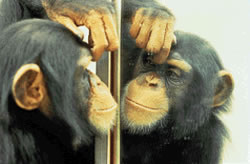
(A chimp has the ability to know that its reflection is an image of itself.)
In that article, I said that film adaptation (well, I implied that I said it) is not properly judged for literalness or inclusiveness or total fidelity, that a film is a separate artwork from its source and should function accordingly. How, then, is it an adaptation at all? If your movie of "Along Came a Spider" isn't going to try to be the same as the book I read, then how is it an adaptation? Well, I implied that films are adaptations of a thing in the original, not the whole. One adapts the theme, the aesthetic, the plot, or the worldview of the original, and then one employs the devices and strengths of film's art to do the thing the source did, whether that source was a ballet or a cartoon. One judges the adaptation by the achievement of the sameness within the newness. (It's like composition in that regard; the same words, but a new arrangement.) You keep the plot of the novel, or you achieve the same philosophy as the novel, or the same "point" as it, or the same worldview, or the same "effect" as it, but you use what film does to do it. If you succeed, you have adapted (made to fit). If you fail, you have not.
Adaptation is, therefore, an analytical composition. (The sentence in the Wikipedia article now saying, "it is derivative" was not mine, but amateurs are amateurs, and there's no stopping the boobAsp -- someone with a mania for categories and containers and little interest in the substances inside them -- from stomping along after one writes. I was ever comfortable with impermanence, as the achievement alone was my thrill.)
Alles klar?
There is a "however" coming in this essay. The "however" is with interesting people, like Stanley Kubrick, and dullards, like Roland Joffe. Kubrick's "The Shining" violates the plot, aesthetic, and theme of Stephen King's The Shining, but it's a better film than King's novel is a novel. (Some people say the same about his "A Clockwork Orange," which absolutely violates the intent and worldview and theme of Anthony Burgess's A Clockwork Orange, but I feel that both novel and film are great.) Kubrick's film is not the same at all. It is, in a sense, not an adaptation. However, his artistry and intellectual heft and cultural timing were such that we among the intelligentsia and literati and professoriate forgave him, blessed him, and honored him, and the cinephiles, who never cared about the source works to begin with, carried him about on their sloped shoulders, moth larvae and nits in a displaced nimbus around his frenzied comb-over.
Stanley Kubrick was an interesting person. He was canonized, in the academic sense. He became a lesson in film school, and dull wits always learn the wrong lessons from school.
The problem with dullards is that,
"Some are lost in the maze of schools And emerge as coxcombs Nature meant for fools." (Pope)
The follow along directors after Kubrick are a loutish lot, half aware, half there. Where he could ignore almost everything Stephen King wrote in order to return to his solitary theme of the duality of the human psyche and civilization's Jungian shadow, he could do so because American, and western European society, was wretched, like Alex de Grand in "A Clockwork Orange" hearing the reminder of his cultural heritage, Beethoven, with the very same theme. How does a world of urban and urbane and polite and political deal with the shuddering bulk, the terrifying grin, the ravenous evil, of holocaust, genocides, and laissez-faire starvation?
[It's a long explanation. I urge you to look at some of the books on Kubrick. The author of The Short Timers, the collection of short stories upon which "Full Metal Jacket" was ostensibly based, wrote an essay for Esquire or The New Yorker or something that I read some years back that talked about his conversations with Kubrick during the adaptation and Kubrick's obsession during that process with Jung. That obsession, whether articulated in Jungian terms or not, is present throughout Kubrick's films. To be too brief: imagine that we have an inherited savage in our subconscious, a violent, gleefully hateful thing that is not the "id," but the negation of civilization. Civilization has to let that creature out in a safe form, if it is to function. Individuals in tightly controlled and anesthetized societies must reconnect with the savage, or else the savage will emerge in a crazy way. Wouldn't it be a good thing for a Jew after the war to examine that, to see in the holocaust and Mi Lai alike an expression of the savage in every apple faced youngster? Wouldn't it be good to take intellectuals, the ones partly to blame for the rise of the mechanized evil of the Reich, and make them confront their own culpability? Don't believe me. It's ok. They're just movies. The point is that other people think this is happening and so are happy to see a novel by Stephen King turned into a meditation on how suburban marriage (and what would become the main text of "Fight Club" as the "feminizing" of men) can be another control that is susceptible to the Shadow.] The little shoal of broken heads, scattered wits, and eager tits known as the other directors married the self-congratulatory Film World with the despair-induced coma of post-Modernism ("post-mortemism" is an old joke, but I think there's merit to it, because post modernism is not merely a collection of works without a manifesto, a series of nervous tics without a disease, but it is also a profoundly despairing "movement," in that it proclaims the vaccuum of Movement art; whatever emptiness we may now see in movements, giving up the effort is rather cheap) to announce "Whatever it is, it's alright." Oh, Donald Kaufmann's "Adaptation." doesn't count, so don't even bring that up.
No, if you'd let me...
Look, it's just that it's...
Ok, fine, let's do talk about it. "Adaptation." doesn't count because it is an examination of adaptation. To say that it is an adaptation that examines adaptation is incorrect, because the adaptation within the examination is merely more cogitation. As a film, it is purely discursive. There is no "inside" to it at all. The film is completely outside itself at all times. Every element of the film, whether visual or spoken or gestured, is not a reference to a world, but a reference to potential references. Each thing is a question, not a statement, and certainly not a statement about the art object that is putatively source.
Now, can I proceed?
No? Well, we'll have to argue about that particular movie some other time, then. Better yet, go to Film Comment and get cheers from the chorus. Meanwhile, I'll while away the mean.
So, these vacuoles that I'm referring to -- wretched creatures like the "remake" of "Wings of Desire" into "City of Angels" or "Bedazzled" or "Wicker Man" -- and the "adaptations" of works of literature like the Roland Joffe horror shows "Fat Man and Little Boy" and, of course, the most flightless, bloated, emetic turkey of them all, "The Scarlet Letter," passed themselves off as "different artworks." Anyone who complained that they had done violence to their originals got dismissed the same way that a fanboi is dismissed for saying, "But Rochester should never have blond hair!"
Because we had recognized that adaptation was not literalism, the film world had taken that as license to "riff on" source material. Because post modernism had used history in original works (like Mason & Dixon by Pynchon) freely as a metaphor, and because commercial media had begun to re-spin source tales over and over again (endless Christmas specials with the same Scrooge-vision for the regular characters of one's favorite TV drama or comedy), film makers had decided that the historicity and factuality of the source had no relevance. In fact, repetition or fidelity was "square" (or, when Gus van Sant did it in his "Psycho," "super post modern"), and so it was the duty of film makers to prove their artistic mettle by artless meddle, and every person unappreciative could be, should be, and must be, one tribe or another of Philistine.
What, then, do we do when new works, completely new works, use the names of old works? Do we say these are adaptations, when both the creators' intent (announced, usually) and execution are not to adapt any aspect or element of the original, but merely to "riff on the classic" or "tell a story the original author didn't get?"
Let me put a case to you away from film to make it clearer. Rod Stewart, who is a fine soccer player, sang a version of Tom Waits's "Downtown Train" and had a top 40 hit, back when there were such things. Stewart's version reiterated the chorus quite a bit, as well as introduced an orchestral marshmallow in both speakers to occupy any quiet, and his producing machine also made sure that there were sweeps of sentiment that simplified any possible irony. Waits's song had been complex, melancholy, and even bitter, and Rod's song had been a rendezvous between lovers. Stewart said, though, that, while he respected Tom Waits, he thought he found things in the song that Tom had missed. So, folks: is he "riffing?" People who would hesitate to object to a violently free film will quickly sneer at Rod Stewart's comment, and yet he kept all of the same lyrics and generally maintained the chord structure. He changed the aesthetic of the song. He kept the frame and changed the heart, because his purposes were different from the original purposes.
Ok, so here's my position. When you adapt, then that's no big deal: you adapt. When, though, you "riff," you have some duty to acknowledge that you are creating a new artwork by creating a new title. If you wish to muddle about with the Gawain story to make it fit the 1950's audience, then have the grace to call your title "Prince Valiant."
Microsoft did a very, very evil thing some years ago when they decided that Java's cross-platform programming language was a threat to their goal of One Ring to in the Darkness Bind Them. They wrote their own version of Java that would run only on Windows machines. This was known as "polluted Java." They released it free, and all sorts of polluted Java got out. It was like a virus, some thought. The biggest thing is that people couldn't tell if they had "real" Java or polluted Java applications, and so they couldn't tell, without laborious testing, if their Java applications were cross-platform or not. Well, an "adaptation" of "The Scarlet Letter" that has Hester and Dimsdale grooving in the woods while Micmac Indians teach the Puritains how to tolerate is polluted art.
"Riffing" on Beowulf is your business. Have a ball! Prove that you have no slavery to history (or fact) by simultaneously insisting that Christian influences in the work are not historical (thus belying your historical freedom as a post-modernist) and thereby continue the work begun by the Nazi scholars but now in the name of your Robert Graves quoting Wiccan friends and merging "myths" from different continents, centuries, and ethnicities in the belief that there must have been some gigantic vanilla porridge of Story underneath that you -- you clever dickens, you -- can decode. Go on! Have fun. Be a director who claims that Beowulf bored him at age 14 and therefore it is a boring work, and be a man who is so filled with satisfaction and self that he cannot realize that he has just admitted that his mind has not grown from early puberty. Go on! Get money for the project. Work with sinews and CGI to erect hundreds of thousands of tent poles in theater seats, and mistake that for interesting -- but do so under the banner of the U.S.'s PG-13. Declare artistry while feeding a multi-input, single-output media machine, and hope for a Christmas release and lots of dolls to be sold. Go on!
Do NOT call it "Beowulf," though. Call it "Wild Wolf, Monster Slayer" or "She Dragon: It's Really Hot in Here." Call it "Handsome and Grendel."
What is being done is not, simply put, adaptation. What the film makers are doing is not any attempt at adapting. It is an attempt at taking a title, of replacement. Roland Joffe wanted to replace Hawthorne's tale with his own, and Gaiman, the pleasures of The Graveyard Book notwithstanding, is not to be forgiven his involvement in the theft film of "Beowulf." As technology has allowed films to tell impossible tales faithfully, film makers have decided to cease even adapting. By itself, that would merely leave room for future films -- a future "Lord of the Rings" trilogy -- but it is combined with a gleeful kleptomania and pollution.
Film makers, know this: Post modernism is no cover for theft, and it is no excuse for being a polluter. If you will not adapt, then do not steal. If you will take a name, then be aware that you risk pollution. There are stakes on the table, and some of us still care.
There are items in the cultural inventory that are not disposable. That is one of my objections, and I won't hide it. "Riffing" on a James Patterson novel does not bother me as much as "riffing" on George Eliot. The reason is not any dead white European snobbery, either, but rather than some items exist in a web of reference that constitutes culture, and when we release "polluted Java" into the stream, we are contaminating culture. Additionally, though, the simple fact is that this is not an act of adaptation. It is an act of erasure and rewriting. When the author or or studio executive has that in mind, then the result will be a new thing. It's much better if we notice that The Lion King is Hamlet than that Disney studios called it "Hamlet" and made it with cartoon lions singing Elton John songs, while they claimed that they "saw things that Shakespeare missed in the story" or that "Shakespeare is boring" and so they wanted to improve on it.
Ok, that does it! I have had absolutely enough. Some feckless ass was on the television my mother was watching this morning, Holy Saturday by the way, explaining how to raise YOUR CHILD to be a millionaire. His website is a monument to himself, with copyright notices aplenty. He was on this television show with a youngster, and the youngster looked like a parody of Gordon Gecko (the video isn't there, yet; you should thank me).
I am FED UP with the idea of the imperial rich man.
I am sick unto death of the myth of the CEO. Look, it's not that I necessarily hate the rich. I don't hate politicians, and I don't hate rich people. Some friends of mine are extremely rich (really extremely), and some are in politics, but there is a huge difference between a person who is rich and a person who sets out to be rich, just as there is a big difference between public service and power. However, in America, we have this desire to be ruled. It's nasty and shameful, and we don't like to admit it, but we have an inbred hatred of anarchy.
I thought, when I read it, that Carlyle was just being provocative, or perhaps he was falling victim to the same malicious, poltergeist zeitgeist that moved Matthew Arnold to do his thing. Both of these authors, and many more beside, said that we loves us some powerful men, that we needs us someone to give us orders. They seem proto-crypto-fascist to us, and loads of folks hate Carlyle, in particular, for what he said. Don't get me wrong, the zeitgeist can explain them, but it can't explain them away.
In the United States, we have always followed our own accidental way. We have put a bounty on public intellectuals. They are not allowed. Seriously: we don't allow them. We allow journalists, but not intellectuals. As soon as it looks like one is about to arise, we point out that she or he is a communist, a feminist, a Black nationalist, crazy, or something else so that we can black list and black ball them and keep them off center stage. We relegate them to "think tanks," at best, and then those release corporate reports. The result is that our policies emerge by accident. Our practices far supersede our theories. We also have this wonderful practice of talking up freedom and liberty already assured and democracy by definition and never investigating what they mean. Instead, we are more addicted to tradition than a Dickensian beadle or a Waugh headmaster.
Why do we avoid socialized medicine? Because our private system is the system we formed in the mists of time. Why do we have gerrymandering? Because this is the system we worked out ages ago. Why do we have the electoral college? Because the founding fathers (great men, all) decided on it in their wisdom.
"Money well timed, and properly applied, will do anything." John Gay, The Beggar's Opera, II xii
Well, I've worked at Wikipedia for four years now. I've written some 250+ articles on the site. I admit this to my shame, I'm sure, but it is a truth I must confess. I was drawn to it for two reasons. The first was that there is a lack of opportunity for those of us who are generalists to write. The professional journals do nothing but "applied Lacanian insights into the underclass (re)presentations of the (m)other in the post-colonial narratives of Mrs. Gaskell" or the similar. The second reason was that it promised to have a flat hierarchy and to test the idea that the crowd, each contributing, was, in aggregate, well intentioned and knowledgeable. People who knew nothing would concede to those who knew, and people who wanted a quick giggle would give ground to people who helped them with information.
However, Wikipedia has a CEO-founder. James Wales (Jimbo, Jimmy, etc.) made money in business and then donated some to found Wikipedia. The project succeeded, and I suppose everyone out there knows to what degree it has succeeded. What is curious, and what has always been curious, is that, from the day the thing started to this, people have predicted that it would collapse under its own weight, and, from the first day to this, James Wales has been a sort of voice of authority or CEO for Wikipedia.
The US loves CEO's. George W. Bush promised to be the "first CEO president" of the United States, and I would argue that he has, indeed, been exactly that. In what way has he failed to be one?
The CEO is an ubermensch. He walks into a meeting, where competing underlings shout out their reports, and, in a dash, a trice, a flash, he uses his superior will to decide between them. He is "the deciderer." The CEO does not read all those reports. They would sully the instinct. They would pollute the will. They would tether the judgment. They would drag the CEO's impulses into the paralysis of consideration and contemplation, and, worst of all, fear. The attitudes of the employees do not matter (see Cheney's response to 70% of the American people thinking the invasion of Iraq was a bad idea: "So?"). You see, the CEO is fearless, and therefore attuned to "instinct" and will. George W. Bush has boasted of not reading newspapers, not reading reports from his Cabinet, not reading much at all (when he isn't boasting that he reads deep stuff, even if it hasn't been released yet), because he needs to remain the one to decide, not to deliberate. He sees his function as the Magic 8 Ball of government -- when all things are indeterminate, just ask, and he'll pick one for you.
Of course, most corporate CEO's have one task: the profitability of the stock. Notably, this is not "viability of the company," "earnings of workers," "quality of goods and services," but only "profitability to shareholders." Now, "profit" can be generated a lot of ways. One is to sell the company. Another is to increase markets. Another is to decrease costs. Since all other companies are trying the same things, "selling the company" and "decreasing costs" are a hell of a lot easier than "increasing markets." Now, interestingly, "costs" include cleaning up the environment, health plans, safety measures, work environment, and workers. What's more, if you fire 2 of 3 workers, threaten the third, and hire temporaries without benefits to make up the slack, you have increased profit, even though it actually costs more to do that because the costs are on a different part of the balance sheet. The CEO who figured this out got rich.
This is our hero?
This is our leader?
Well, Wikipedia, as a corporate entity of users, has worked consistently to establish hierarchies. The people who volunteer there find the idea that no one is in charge intolerable. They really hate it, and each thinks that, since no one is in charge (except Jimbo), he or she should be in charge. When Wikipedia died, it did not do so because it got too large, but rather because it got too small. Power developed, and people selected themselves for it. They wanted, desperately, passionately, to know where they stood in the ranks. They wanted to know who was above them and who below, and they wanted to know what it meant. It was important for each and every one of them, and therefore all of them had a seriously vested interest in making sure that there was a single point of power above them all, a CEO.
How can you be in charge of a project with no hierarchy, unless you can assure all the rest that there is a single commander and that this commander favors you? If Jimbo were not the CEO of Wikipedia, then none of the others could claim to have rights.
Remember my definition of the CEO's job, above. The CEO is to be the deciderer. The CEO is to be the tie-breaker, the leader, the one who is unburdened with ethical or moral considerations that might lead to fear. The CEO is to be, in other words, an ego unburdened by superego.
Google "CEO scandal" some time. The list is long. Some throw parties for themselves with ice sculptures that urinate vodka. Some get hookers. Some get hookers and vodka. Some spy. Some start wars across the planet without thinking about it. This is to be expected: the CEO is impulse, not judgment. The CEO is "profit" (i.e. "gimme") and not work. So, when Jimbo Wales turned out to be screwing Wikipedia to screw "the Canadian Anne Coulter," it was no surprise. After all, the man listed Ayn Rand as his favorite author.
So, do you want to make your child a CEO? Do you want to make "millionaire" the goal? That's easy: teach the child that its impulses are perfect and give it arbitrary obstacles. Make sure that it remains selfish, inconsiderate, unthinking, and gluttonous. You can do it, America: you worship them, so you can make your children the gods they already think themselves.