I have known more prostitutes than police, more police than strippers. I have had conversations with strippers when they were off the clock, but I'm not an expert on what they do or why they do it. By the way, the number for the first two professions I mentioned is two and one. The difference is that I knew the detective was a detective the entire time I was an acquaintance of his, but I only knew one of the prostitutes had been a prostitute. The other was working, and I didn't know about it.
There are many, many documentaries by and about strippers. The most interesting facet of their profession is the labor exploitation. The psychological exploitation isn't something the women seem to cite very often, but the labor conditions would have Samuel Gompers calling out his guys. Watch any documentary on the job, and you'll come to the conclusion that the women are stolen from, subjected to poor conditions, and encouraged to spend all of the money they make on dangerous surgeries.
As for prostitutes, the subject is endlessly complicated from a labor point of view. Even the issue of trafficking turns out to be complex, as the numbers of women enacting a "Lilya 4-Ever" scenario are probably low. (Even one is too high a number.) However, again, the women face economic exploitation that leaves them constantly having to work more to obtain the big payday they can see just over the horizon.
For a while, Salon.com was a cutting edge left wing political site. Then it became a click-bait site, where every article was written by Tracy Clark-Flory. "Ten Things about 'Divergent' that Related to My Lesbianism" and "Sex Toys and Me" and "Gender Equality and My Girlfriend" and on and on and on -- every piece was, "And how this totes relates to me! I'm amazingly hip! I like sex. With girls!" Now, Salon is trying to be a left wing political site with writers again, although designed as if every person on the Internet were either blind or color blind and viewing things on a 3" screen. (Don't get me wrong, "Miracle Pasta Recipe as a Hipster Lesbian" articles still run every day.)
All along, Salon has had a "sex positive" feminism. (That means, for people who like to reduce long arguments to clickable bylines, that it is a feminism that embraces sexual pleasure as a right and believes that it is good to discuss desire and set out sexual norms that avoid shame.) They ran, back in 2003 or so, a series from a Washington call girl. They also ran a story from a woman who was a prostitute in Cuba for a while. Both women attested to the same thing: the body takes over, and there is a bit of pleasure that's simply due to wiring, and they lost intimacy. "Intimacy," according to biochemists, is oxytocin. According to everyone else, it is a bond and closeness that follows a sexual encounter that is often the best part. Sex workers stop having that, and they report difficulties in achieving it with their mates, if they are married.
Sex work is not supposed to leave women an emotional wreck. I beg to disagree, but my sample size was small, and I do not wish it larger. It is enough, as far as I am concerned, to think that, at best, the women can count on "not awful" and then pay the price of a divorce from emotional connections.
There is a movie available on Netflix that I cannot hiss enough. It's called "Whore's Glory" in English, and it's only accidentally good. The German film maker gets credited for sympathy for the women, but I saw none. I saw, instead, a voyeuristic impulse that controlled the film so that the narrative simply had to lead to some on-campus intercourse. While the documentarian was chasing down the most degraded red light districts in the world, he let the prostitutes themselves talk about whatever they talked about, and the extremely young girls in India made a case against their dehumanization that is utterly shattering. For the most part, though, the women talk about how little money they're making, gossip about each other, and talk about Johns. Their attitudes toward men is as commercial, affectionless, and dry as it could possibly be.
A stripper in a documentary talked about how she came to see her breasts as an ATM. She would shake them around, and pull money out. Every man she saw on the street, she said, she thought of in terms of whether he would tip well or not. She had stopped dating, because she was convinced that every man she met went to strip clubs and was as bad as the customers who gave her tips, and whom she despised, every night. The prostitutes in "Whore's Glory" spoke of men either in idealistic terms -- the man who would be different, who would protect her, who would give her money -- or in terms of a cully.
Strippers can get tax deductions for their breast augmentation surgery. Silicone is the real drug of choice for the industry. Sex workers, despite what apologists say, have a correlative link with narcotic use.
To sex workers, people look like Johns or unicorns. To strippers, men look like suckers to be played. To cops. . . .
The NYCPD detective I knew was a great guy. However, he told me himself that he had had to learn to look at the world a new way. The world inside the force looked like a war against scumbags -- that's you and me -- and victims -- also you and me -- and people trying to keep them from doing their job -- also you and me. When you see bad people and hear lies all day, you expect every stranger to be a liar. When you live and die by the idea that, like the military, you're not "fighting for" an abstraction, but for the guy next to you, the loyalty you build means that of course the witness is lying about the other cop doing something bad.
I find it rather easy to believe that a policeman shot an unarmed Black man to death in the middle of Ferguson, MO. I would believe he did it for the young man failing to obey. I know that the grounds for shooting for police have shifted since 2006, that police can now shoot if they believe they are in danger. No longer do they actually have to have their lives actually in danger; they only need to think so. Since Ferguson PD beat another Black man and then charged him for destruction of police property for bleeding on their stuff, I absolutely believe that these cops -- whose county superiors later arrested an alderman for "failing to obey" -- would kill because they weren't being obeyed.
The police have a natural psychological bias. See crummy people all day, and you'll start thinking all people are crummy. See violent people all day, and you'll assume everyone's violent.
The problem is that the police only get to enforce laws, and they have to tolerate annoying citizens. If they can't do their jobs without releasing information, without being protested, without freedom of assembly, then they can't do their jobs at all. Police who "must" get MRAPP's and Strykers and automatic weapons and LDAP's aren't police: they're paramilitaries.
The recruiting for police makes it seem like a W A R on crime. The SWAT gear and military surplus allows all of the police to go out with JSOC styled garb and point rifles at empty-handed protestors. It allows the police to say that the crowd are "f*cking animals." It seals the assumption (that the public is criminal -- an entire prison population waiting for booking) with the rituals of conquest (not occupation).
The old "war on drugs" gave us the legal abuses that glaze these affronts. The "no-knock warrant," which is now served by SWAT teams, comes from the drug war. The roving wire tap comes from the drug war. The invention of SWAT itself comes from the drug war. However, all the heavy weaponry in local cops' hands comes from the 9/11 freakout. Someone thought that it was a great idea to put military junk in Wayback, Arkansas so that it could deter the Islamic invaders. Marry the "no knock" warrant and the SWAT with that stuff, and you've got Ferguson, almost.
If strippers need breast augmentations ad infinitum and sex workers look for central nervous system depressants, then what of the Valiant Watchmen on the Wall? It's possible to see the behaviors that we've seen across America in the last five years without a widespread drug problem among the police, but, as long as we're making SNAP recipients pee in a cup, making school teachers pee in a cup, making parolees pee in a cup, why not ask the local police to be screened for anabolic steroids and testosterone supplements? It's only fair. We do, after all, want to arrest any law breakers.
To
begin to write for the third time on this subject, I would need to go
to the ends of the subject. As with each previous time, the real
occasion for writing is obscure, as it should be, if
there is going to be any use to it. Way back in 2001 and 2002, the fools who had to
have something to say as they closed their thirty minute tours of
news would quote governmental press releases and talking points
fallen from Dick Cheney's desk and say, "It's no exaggeration to
say that 9/11 has changed everything." I didn't believe them. I
vaguely remember a floating head on a screen waxing poetic and
summoning all the atmospheric Murrow he could (but only managing Brokaw) and saying that we would be telling our children about the
event that defined their world. It was Pearl Harbor. . . or not quite
that, but it was like it.
The
news readers going bassoprofundis was
inconceivable comedy to me. Even looking back, the most I can come up
with by way of how I felt is a paraphrase of Lincoln, who said that, if the United
States were ever to die, it would be by suicide, not conquest.
Then again Lincoln embarrassingly
underestimated the thanatopsic urge. So did I.
Oh,
historians of the time in question have said that Cofer Black and the
Spook Patrol began giving W. Bush daily briefings with unfiltered
intelligence -- that is, with no analysts involved, no hierarchies of
threats, no assessments of feasibility or reliability, just every
single hateful and violent threat made by the whole world -- and this
every morning before the Ovaltine. It scared Bush senseless, and he said "Yes"
to every request. This is how the USA PATRIOT ACT went from
controversial to routine -- even boring. The same scary people
with scary reports kept working on their haunted house routine,
because Obama began saying his job was, "Keeping Americans safe"
in 2009. The man who campaigned on civil liberties began devouring
them at a pace that his predecessor would not have imagined.
Assassinations?
Secret detentions? Suspension of habeas corpus? Phone taps on a
national scale (i.e. a small nation of people, not every person in
this nation)? "Why object, if you have nothing to hide"
uttered as a legitimation, when it had last appeared in satire or
dystopian cliche? All of this has come to be a portion of the
invisible architecture of American reality -- a base condition for
living for most citizens. W. H. Auden's "The Unknown Citizen"
is unteachable now, both because its commentary has been bunted in front of home plate and, more, because its world of a state with an indexed population of statistics is now so far beneath the N.S.A.'s capabilities
and the ostensible goals of "total informational awareness"
as to seem boring.
September
the eleventh thrust a cup of hemlock into national hands. Our leaders presented as a chalice, and all drank.
I do not
mean, though, that losing "the American way" or civil liberties was the death of
America. Instead, I mean that, frighteningly, the vapid people were
right: we changed everything on the day, soul first.
In
2011, the little people who live inside of the television asked, "What have we learned
from 9/11?" We learned nothing, of course. We learned nothing because there was nothing to learn from a billionaire attacking centers of international capitalism. We learned nothing because 9/11 handed its victims suffering rather than pain, and suffering neither teaches nor presents norms. Most of all, though, we learned nothing
because to learn we must first recognize our world and ourselves.
September
the eleventh was suffering for those of us in New York City. I feel
confident that it was for those in the affected wing of the Pentagon
and for the families of the lost in Pennsylvania as well. No one can learn from suffering, only from pain, but suffering is less
focused. Rarely is suffering for a particular reason, or
even for a passion. Even more rarely is suffering for a passion or
reason that carries with it a moral value or heuristic principle.
Instead, people may grow
while suffering, but they grow by having empathy or understanding (of
humanity, of self, of family) increase.
Most of us would rather attend a seminar.
Among our problems with 9/11 is just simple recognition. "We" don't do much introspection of the moral
sort. For a nation of self-help patrons and "Face the Press in
Review This Week" organizers, we love to look at the individual
self and the weekly events, but not much from a decade or a
community.
Why there is a new government,
and why the parties are disenfranchised
The
Republican Party has variations on "self" in its
definitions. It's the party of "self-reliance," of
"individual liberty," of "personal responsibility,"
and it performs a fan dance with libertarianism. (Well, it used to.
Since 2012, it has been more of a peep show, where the primaries are
all access libertarian and the general elections put on a flag
G-string.) The Democratic Party is the party of good governance, of
community building, of ensuring welfare and commonweal. Most of its
definitions feature "community" and "common" in
them.
September
the eleventh made both parties aliens to the United States. Unlike
the United Kingdom and numerous European nations, the U.S. has no
"government" distinct from its politicians. We do have a
civil service, but it is weak and without an identity of its own. It
is certainly not operating contrary to the political system. There
could be no American "Yes, Minister" the way there was an
American "House of Cards," because our civil servants have
less and less job security and are beholden to political appointees
who face the spoils system. Thus, most talk of "the government"
Americans do has been faulty from nearly the day of Andrew Jackson.
It has certainly been faulty since the 1980's. However, since 2001,
we have begun to grow
a government, complete with self-protection and ideology separate
from the political EVEN AS the traditional civil service has been put under more political control than ever before.
This
government of 9/11 begins and ends with a fiat: It is the job of
government to keep the citizens safe from "evildoers"/
"those who wish us harm" (the difference is one of dialect, not language). You heard Bush say that his job
was keeping Americans safe countless times. You may have even heard
Cheney and others lie and claim that Bush was a good president
because there were no terrorist attacks on Americans during his
presidency. If you have been listening, you have also heard President
Obama define his job this way, and probably as often as his
predecessor.
The
problem is that, well, keeping citizens safe from harm is simply not
one of the duties of the presidency. The president of the United
States is the head of the executive branch. He is the chief cop and
the chief enforcer of laws. In war, she is the coordinator of the
armed forces ("commander in chief"). There is no warrior
king, priest king ("decider"), or even "CEO president" function to the
job. Armed forces keep us safe from foreign powers, and police keep
us safe from those on our soil if
they have broken a criminal law. Secret services stop agents of enemy
and foreign powers. Quick: what part of the government is the Secret
Service a portion of?
We
all want to be safe, of course. However, we also all want to be asked
how we are kept safe, if we are a democracy. A critical difference
between democracy and fascism is that we do not believe that a Great
Man (or woman) might, with will or strength, achieve what the people,
with consent, do every day. A critical difference between democracy
and the Soviet is that we do not believe that the Party or state
leadership can, with critical efficiencies or expert policy, achieve
what we do in our stumbling consensual manner.
Never
mind my idealism, though. The parties are aliens to the government of
the United States because this government dedicated to keeping
Americans safe has a new question to ask. It is no longer concerned
with the individual's happiness or the group's welfare, as both are
irrelevant. Instead, it asks, over and over again, "Who are you?
What is the identity of the citizen?"
Define for yourself the goal of N.S.A. and other agencies dedicated to defeating foreign
agents in an era when "agent" no longer means what it once
did. Whereas once an agent was a person not only acting in the
interests of a foreign entity but acting at the behest of that
foreign entity, an agent now does not need the alien entity's
knowledge, much less involvement. This is because the agent is no
longer of a foreign power, but a foreign ideology. Furthermore, that ideology is not named. It isn't "the Communist Party": it's "terror" or "wishing us harm."
Even
though we in the United States do not have an official religion or
official ideology, we have a shifting net of enemy ideologies that
are largely identified solely by the willingness of anyone
propounding them to, coincidentally or consequentially, advocate
violence against the U.S. military, U.S. citizens, U.S. territory, or
U.S. assets. Think back to 1978 for a moment and remember the
anti-nuclear protests held throughout Europe. It was a weapon that made plain the
fact that some of Europe would be a battlefield in a coming war
between the U.S. and U.S.S.R., and the people living on that
battlefield were less than pleased. Some of them were infiltrated by
Soviet agitators. Some of them were violent. Most of them were
neither. Were that today, would N.S.A. label "Belgian" or
"Social Democrat" as enemy ideologies? Under the
philosophy that demands that all believers in a religion or religious sect are "enemy" today, it might. This is a
consequence of 9/11 and defining the goal of government as
"protecting Americans." Once that becomes the goal,
violence is the only qualification for enemy status.
Imagine
that you are floating in the ocean. Now, so long as you float, you
will be rescued. However, a line is tied to you and attached to
everyone you know. For reasons unclear to you, some of these people
cannot swim and have weights attached to them, while others are just
struggling swimmers like yourself. Even the people you are tied to who are swimming are themselves tied to all the people they know, and some of them are sinking. It is fairly likely, depending upon how
many people you know, that you will be dragged down.
As
far as the security government is concerned, a person is not a
person. A person is a set of associations -- a deferred identity calculated by its connective power. Each association is
either dangerous or not. If an association is not dangerous, it
carries no weight. If it is dangerous, it weights the person.
Furthermore, the attachment's weight is determined by its own
attachments. Are you an enemy of America? Well, a friend of yours who
has a friend in the Peace Corps who made friends with a group of
people in Yemen has sunk you. You do not know this, of course,
because you do not know your friend's friends. Your friend, in fact,
does not know his friends are today called "terrorist" by
someone. They, indeed, do not know that they are "terrorists,"
necessarily. Even if they have shouted, "Death to America,"
they could have repented of the view. It would not matter. It does not matter because the government's role is to "keep Americans safe," not to produce an accurate risk assessment.
Once
we take the one, small step, from "provide for the common
welfare" to "keep Americans safe," safety trumps all
political activities and all operations of the state. The citizens
cease to have civic value and transform into menace or neutrality, and only menace or neutral. The two political parties, therefore, become entirely beside
the point. Individual liberty or community building are meaningless
questions to a government dedicated to detecting threats and sifting
its own population into only two piles.
I
could offer up homespun analogies on the philosophy of safety. I
could ask you to compare a nation to a household and to think of the
effects of parents who seek to keep their children safe at all
costs with not a thought to the children's happiness, prosperity, or education.
However, those analogies foster reductive thinking, because nations
are not families, or businesses, or enough like anything except
themselves to be profitably compared except to each other. In fact,
nations are capable of a phenomenon that is almost without parallel
in any other organism: they can grow alienated from themselves.
Nations can, under the worst possible circumstances, begin to operate
one way while believing another; they can begin to concentrate power in one
spot while announcing it in another. The most famous, and therefore
guarded against, condition of national alienation is the phenomenon
of bureaucracy. When the civilization is not rule by the demos
(democracy) or representative (res publica/republic) or
divine person, or by select family, or by the wealthy, but, instead,
by bureaus, then an unthinking, vegetable mind governs indifferently
to all concerns and makes all political exchanges inefficient.
We
are not in a bureaucracy. We have something else. Dana Priest's
report on “Secret America,” where she began to see just how large
the expenditure and secrecy is in Classified work, certainly
testifies to a potential bureaucracy of safety, but, forgetting the
inefficiencies of duplication and lack of oversight, we have an
alienation where no one votes for safety as a national priority.
Neither chamber of Congress, no election, and no presidential order
reorganizes society onto safety first. All the same, it is there, and it determines the activities of all other facets of the nation.
One
way that we can tell that our nation is alienated is the staggering
bathos of the safety measures. When, two weeks after September
eleventh, military with sub-machine guns were stationed in Penn
Station in New York City, it did not make travelers feel safer.
Coming in from Madison Avenue and having one's eye first fall on a
soldier with a slung machine gun did not set a commuter's mind at
ease. The harlequin pantomime that has replaced airline boarding –
shoes off, hands up, standing in a booth – does not give safety, either.
Crucially, both “left” and “right” react the same way to
these measures. The left rejects the loss of civil liberties, and the
right fears “the government” and calls for a right to have
personal firearms to protect itself. These measures launched in the
name of security represent no one's political idea, no one's
civil goal, and deliver no one's social good, but there they are. The most conservative president in history and the current president alike have presided over measures seemingly no one has endorsed.
What
began as an urge to reverse every expansion of civil
liberties of the 1970's with the USA PATRIOT ACT turned into
something else. It has turned into something with the power to
generate itself, something that moves by a vegetative mind, with a motive (to make
America safe) that is paramilitary and unconstitutional. The
government that is arising now, what people call “the security
state” (a misnomer, as this is not the state; it is beneath the
state and beside the state), sets out an end goal that cannot be
achieved without the elimination of free will.
"Fashion is something barbarous,
for it produces innovation without reason and imitation without
benefit." -- George Santayana
My brother had a radical retropubertal resection of his prostate to treat aggressive prostate cancer. Due to the relationship we have, I could not have offered him any advice. If I had, it would have been ignored or operated in reverse. My opinion of his opinion of my opinions is not relevant here. The point is that I had told our intermediary, our father, that I hoped he would not get the surgery done by a DaVinci surgical robot. He did.
My dislike of the surgical robot was based on reading on the benefits of robotic vs. manual surgery. So far, the story of the robotic assistants is mixed. There has been no clinical advantage in outcomes for using robotic suites thusfar. The robot surgeries have a much higher incidence of surgical complications, though.
Additionally, I was against the idea because of how much of a fashion there is for them. When "everyone" is in favor of a brand new treatment, and the old treatment did not have noticeable deficiencies, then cui bono? Pro Publica has been watching the corporation behind the two robot prostate surgeons pretty carefully and has documented several instances of dangerous, unethical, and shady practices. Essentially, the companies that make the robots are investing in getting their surgical suites bought and used. They are also investing in medical research and ensuring that the report on whether the robots are clinically worthwhile points the right way.
As a patient, it turns out that the best bet is to go with a surgeon manually performing the surgery, if she or he has many repetitions. The robotic suites are responsible for more accidental injury than traditional surgery. However, the robotic suites discharge patients to home quickly. A patient who has a robotic surgery goes home quickly. This may give a better clinical outcome in the sense that such a patient is not exposed to hospital pathogens. However, the real benefit of the robotic surgery is to the health insurance company and, at least theoretically, the hospital administration, as both benefit from getting the patient out of the hospital bed as quickly as possible, whatever the surgical outcome.
When I was in graduate school, I was fortunately unfortunate enough to have to work full time and to do that work in a biochem lab. There, I worked with people developing bench science into a medicine, and the things had to be researched against and with everything. I was aware that any university researcher would investigate an agent every which way, so when the first Cox-2 inhibitors appeared on the market and advertised that they were good for patients taking Coumadin, I asked the local School of Pharmacy to check into the studies on patients on Warfarin. Two weeks later, they got back to me and said, "There aren't any." "What do you mean." "There aren't any." "Does that sound screwy to you?" "Yes. I wouldn't take the medicine, if I were you, and we're going to have to investigate this further." It was eighteen months later that enough people had died for the Vioxx scandal to begin.
"MBA culture" is notoriously slimey and wicked. It's the whole, "If the law lets us do it, then we have to do it" mindset. It's the mindset that leads to doing anything for this quarter's profits, even if it means destroying the productive capacity. MBA culture has been running the pharmaceuticals since 1990. Aside from a few wild-eyed hippie start ups, it runs medical device makers, too.
There are surgical fashions and fads. This fact alone ought to make every human who depends upon blood and oxygen freak out (i.e. everyone but Dick Cheney).
You only realize the perniciousness of surgical fashions and medical fads when they've passed. Where I live now, it is automatic that every hyperthyroid patient will have a thyroidectomy. It's automatic. Personally, I think that's barbarism, since there are good ways of suppressing thyroxine without hacking away at a fairly small organ and thereby making a person dependent, for life, on daily purchases of Synthroid. Oh, it's easy to say, "They have no endocrinologists in the turnip fields where you live, so let 'em get to zero thyroid function and replace physiologically," but that is admitting that "Paying every month to a pharmaceutical company" is a way of life. (Hyperthyroid patients can go into remission.) Similarly, every inguinal hernia here gets the mesh. Good old mesh. Nothing bad ever happens with mesh. Every atherosclerotic gets a stent. (Re-occlusion is less common now than it used to be, I admit, but the rates of reliance on stents is unaffected by this. It was the fashion here. No bypasses: stents.)
Whenever there is a fad or fashion in medicine, the question is who is making the decision? Usually, it's the health insuring group. They, in turn, make it for all patients, and not just their own.
Yesterday, I was at a used book store, and I mentioned that I had just had a lumbar radiofrequency ablation of nerves getting pinched by spinal arthritis. The proprietress told me about her husband. You see his problem was really that one of his legs was longer than the other.
Remember that one?
That was a scam that went around in the late 1980's and early 1990's. Faith healers and quacks alike used the gag. Put the patient in a chair, hold up his legs at a very slight angle to his body (coinciding with dominant leg/hand), and one leg will be "longer" than the other.
"He used to go to ______, where he'd get these inserts for his shoes that would let him walk right, and he'd keep them until he'd wear 'em out, and then he'd go get more. But _____ isn't in business anymore, and when he went to the orthopedist, they didn't want to do that!"
She was unhappy with the orthopedic surgeons who didn't want to feed him more rubber heels.
"He went to his chiropracter to be sure it wasn't an alignment issue."
So, because the fellow went to an orthopedic surgeon, you can guess what happened next. The surgeon wanted to surgically repair the herniated disks. Two surgeries, much pain, and the patient is still convinced that it was all a matter of walking "wrong" and needing special soles.
For my part, I just had nerves killed. There was no promise of making anything better except pain. I have arthritis in my spine and cannot take any anti-inflammatory drugs. However, commercials are airing now for all the people who don't take Warfarin but do take blood thinners to take a new pill instead.
If "everyone" is having something, someone is wanting it to be that way. Make sure you know who it is, why it is, and that you agree completely.
Years ago, when amateurism looked like something new, when it even seemed like an invention or discovery worthy of Time Magazine's yearly benevolence, I wrote -- and Heaven help me, enjoyed writing --an article on film adaptation. (I did not want to be part of a social revolution. I wanted to contribute knowledge to high school students who use the Internet for everything.) I enjoyed it for the pleasure of analysis, which is the complementary joy of English composition. Composing (writing) is bringing the stray herd of words and ideas together and making them all behave, making them function toward an end. Analysis is the breaking down of objects, and I love to examine and re-examine and then recombine. (My next will address how sad it is that such a fundamental concept as the difference between synthesis and analysis is forgotten and consigned to Philosophy class, when it's everyday knowledge. It could even be Business.) It is why we speak of "creativity," after all, for the ability to make a new thing from the old is as near to creation as most of us who lack plastic skills will ever get.
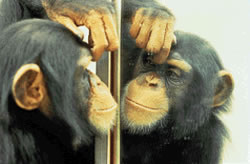
(A chimp has the ability to know that its reflection is an image of itself.)
In that article, I said that film adaptation (well, I implied that I said it) is not properly judged for literalness or inclusiveness or total fidelity, that a film is a separate artwork from its source and should function accordingly. How, then, is it an adaptation at all? If your movie of "Along Came a Spider" isn't going to try to be the same as the book I read, then how is it an adaptation? Well, I implied that films are adaptations of a thing in the original, not the whole. One adapts the theme, the aesthetic, the plot, or the worldview of the original, and then one employs the devices and strengths of film's art to do the thing the source did, whether that source was a ballet or a cartoon. One judges the adaptation by the achievement of the sameness within the newness. (It's like composition in that regard; the same words, but a new arrangement.) You keep the plot of the novel, or you achieve the same philosophy as the novel, or the same "point" as it, or the same worldview, or the same "effect" as it, but you use what film does to do it. If you succeed, you have adapted (made to fit). If you fail, you have not.
Adaptation is, therefore, an analytical composition. (The sentence in the Wikipedia article now saying, "it is derivative" was not mine, but amateurs are amateurs, and there's no stopping the boobAsp -- someone with a mania for categories and containers and little interest in the substances inside them -- from stomping along after one writes. I was ever comfortable with impermanence, as the achievement alone was my thrill.)
Alles klar?
There is a "however" coming in this essay. The "however" is with interesting people, like Stanley Kubrick, and dullards, like Roland Joffe. Kubrick's "The Shining" violates the plot, aesthetic, and theme of Stephen King's The Shining, but it's a better film than King's novel is a novel. (Some people say the same about his "A Clockwork Orange," which absolutely violates the intent and worldview and theme of Anthony Burgess's A Clockwork Orange, but I feel that both novel and film are great.) Kubrick's film is not the same at all. It is, in a sense, not an adaptation. However, his artistry and intellectual heft and cultural timing were such that we among the intelligentsia and literati and professoriate forgave him, blessed him, and honored him, and the cinephiles, who never cared about the source works to begin with, carried him about on their sloped shoulders, moth larvae and nits in a displaced nimbus around his frenzied comb-over.
Stanley Kubrick was an interesting person. He was canonized, in the academic sense. He became a lesson in film school, and dull wits always learn the wrong lessons from school.
The problem with dullards is that,
"Some are lost in the maze of schools And emerge as coxcombs Nature meant for fools." (Pope)
The follow along directors after Kubrick are a loutish lot, half aware, half there. Where he could ignore almost everything Stephen King wrote in order to return to his solitary theme of the duality of the human psyche and civilization's Jungian shadow, he could do so because American, and western European society, was wretched, like Alex de Grand in "A Clockwork Orange" hearing the reminder of his cultural heritage, Beethoven, with the very same theme. How does a world of urban and urbane and polite and political deal with the shuddering bulk, the terrifying grin, the ravenous evil, of holocaust, genocides, and laissez-faire starvation?
[It's a long explanation. I urge you to look at some of the books on Kubrick. The author of The Short Timers, the collection of short stories upon which "Full Metal Jacket" was ostensibly based, wrote an essay for Esquire or The New Yorker or something that I read some years back that talked about his conversations with Kubrick during the adaptation and Kubrick's obsession during that process with Jung. That obsession, whether articulated in Jungian terms or not, is present throughout Kubrick's films. To be too brief: imagine that we have an inherited savage in our subconscious, a violent, gleefully hateful thing that is not the "id," but the negation of civilization. Civilization has to let that creature out in a safe form, if it is to function. Individuals in tightly controlled and anesthetized societies must reconnect with the savage, or else the savage will emerge in a crazy way. Wouldn't it be a good thing for a Jew after the war to examine that, to see in the holocaust and Mi Lai alike an expression of the savage in every apple faced youngster? Wouldn't it be good to take intellectuals, the ones partly to blame for the rise of the mechanized evil of the Reich, and make them confront their own culpability? Don't believe me. It's ok. They're just movies. The point is that other people think this is happening and so are happy to see a novel by Stephen King turned into a meditation on how suburban marriage (and what would become the main text of "Fight Club" as the "feminizing" of men) can be another control that is susceptible to the Shadow.] The little shoal of broken heads, scattered wits, and eager tits known as the other directors married the self-congratulatory Film World with the despair-induced coma of post-Modernism ("post-mortemism" is an old joke, but I think there's merit to it, because post modernism is not merely a collection of works without a manifesto, a series of nervous tics without a disease, but it is also a profoundly despairing "movement," in that it proclaims the vaccuum of Movement art; whatever emptiness we may now see in movements, giving up the effort is rather cheap) to announce "Whatever it is, it's alright." Oh, Donald Kaufmann's "Adaptation." doesn't count, so don't even bring that up.
No, if you'd let me...
Look, it's just that it's...
Ok, fine, let's do talk about it. "Adaptation." doesn't count because it is an examination of adaptation. To say that it is an adaptation that examines adaptation is incorrect, because the adaptation within the examination is merely more cogitation. As a film, it is purely discursive. There is no "inside" to it at all. The film is completely outside itself at all times. Every element of the film, whether visual or spoken or gestured, is not a reference to a world, but a reference to potential references. Each thing is a question, not a statement, and certainly not a statement about the art object that is putatively source.
Now, can I proceed?
No? Well, we'll have to argue about that particular movie some other time, then. Better yet, go to Film Comment and get cheers from the chorus. Meanwhile, I'll while away the mean.
So, these vacuoles that I'm referring to -- wretched creatures like the "remake" of "Wings of Desire" into "City of Angels" or "Bedazzled" or "Wicker Man" -- and the "adaptations" of works of literature like the Roland Joffe horror shows "Fat Man and Little Boy" and, of course, the most flightless, bloated, emetic turkey of them all, "The Scarlet Letter," passed themselves off as "different artworks." Anyone who complained that they had done violence to their originals got dismissed the same way that a fanboi is dismissed for saying, "But Rochester should never have blond hair!"
Because we had recognized that adaptation was not literalism, the film world had taken that as license to "riff on" source material. Because post modernism had used history in original works (like Mason & Dixon by Pynchon) freely as a metaphor, and because commercial media had begun to re-spin source tales over and over again (endless Christmas specials with the same Scrooge-vision for the regular characters of one's favorite TV drama or comedy), film makers had decided that the historicity and factuality of the source had no relevance. In fact, repetition or fidelity was "square" (or, when Gus van Sant did it in his "Psycho," "super post modern"), and so it was the duty of film makers to prove their artistic mettle by artless meddle, and every person unappreciative could be, should be, and must be, one tribe or another of Philistine.
What, then, do we do when new works, completely new works, use the names of old works? Do we say these are adaptations, when both the creators' intent (announced, usually) and execution are not to adapt any aspect or element of the original, but merely to "riff on the classic" or "tell a story the original author didn't get?"
Let me put a case to you away from film to make it clearer. Rod Stewart, who is a fine soccer player, sang a version of Tom Waits's "Downtown Train" and had a top 40 hit, back when there were such things. Stewart's version reiterated the chorus quite a bit, as well as introduced an orchestral marshmallow in both speakers to occupy any quiet, and his producing machine also made sure that there were sweeps of sentiment that simplified any possible irony. Waits's song had been complex, melancholy, and even bitter, and Rod's song had been a rendezvous between lovers. Stewart said, though, that, while he respected Tom Waits, he thought he found things in the song that Tom had missed. So, folks: is he "riffing?" People who would hesitate to object to a violently free film will quickly sneer at Rod Stewart's comment, and yet he kept all of the same lyrics and generally maintained the chord structure. He changed the aesthetic of the song. He kept the frame and changed the heart, because his purposes were different from the original purposes.
Ok, so here's my position. When you adapt, then that's no big deal: you adapt. When, though, you "riff," you have some duty to acknowledge that you are creating a new artwork by creating a new title. If you wish to muddle about with the Gawain story to make it fit the 1950's audience, then have the grace to call your title "Prince Valiant."
Microsoft did a very, very evil thing some years ago when they decided that Java's cross-platform programming language was a threat to their goal of One Ring to in the Darkness Bind Them. They wrote their own version of Java that would run only on Windows machines. This was known as "polluted Java." They released it free, and all sorts of polluted Java got out. It was like a virus, some thought. The biggest thing is that people couldn't tell if they had "real" Java or polluted Java applications, and so they couldn't tell, without laborious testing, if their Java applications were cross-platform or not. Well, an "adaptation" of "The Scarlet Letter" that has Hester and Dimsdale grooving in the woods while Micmac Indians teach the Puritains how to tolerate is polluted art.
"Riffing" on Beowulf is your business. Have a ball! Prove that you have no slavery to history (or fact) by simultaneously insisting that Christian influences in the work are not historical (thus belying your historical freedom as a post-modernist) and thereby continue the work begun by the Nazi scholars but now in the name of your Robert Graves quoting Wiccan friends and merging "myths" from different continents, centuries, and ethnicities in the belief that there must have been some gigantic vanilla porridge of Story underneath that you -- you clever dickens, you -- can decode. Go on! Have fun. Be a director who claims that Beowulf bored him at age 14 and therefore it is a boring work, and be a man who is so filled with satisfaction and self that he cannot realize that he has just admitted that his mind has not grown from early puberty. Go on! Get money for the project. Work with sinews and CGI to erect hundreds of thousands of tent poles in theater seats, and mistake that for interesting -- but do so under the banner of the U.S.'s PG-13. Declare artistry while feeding a multi-input, single-output media machine, and hope for a Christmas release and lots of dolls to be sold. Go on!
Do NOT call it "Beowulf," though. Call it "Wild Wolf, Monster Slayer" or "She Dragon: It's Really Hot in Here." Call it "Handsome and Grendel."
What is being done is not, simply put, adaptation. What the film makers are doing is not any attempt at adapting. It is an attempt at taking a title, of replacement. Roland Joffe wanted to replace Hawthorne's tale with his own, and Gaiman, the pleasures of The Graveyard Book notwithstanding, is not to be forgiven his involvement in the theft film of "Beowulf." As technology has allowed films to tell impossible tales faithfully, film makers have decided to cease even adapting. By itself, that would merely leave room for future films -- a future "Lord of the Rings" trilogy -- but it is combined with a gleeful kleptomania and pollution.
Film makers, know this: Post modernism is no cover for theft, and it is no excuse for being a polluter. If you will not adapt, then do not steal. If you will take a name, then be aware that you risk pollution. There are stakes on the table, and some of us still care.
There are items in the cultural inventory that are not disposable. That is one of my objections, and I won't hide it. "Riffing" on a James Patterson novel does not bother me as much as "riffing" on George Eliot. The reason is not any dead white European snobbery, either, but rather than some items exist in a web of reference that constitutes culture, and when we release "polluted Java" into the stream, we are contaminating culture. Additionally, though, the simple fact is that this is not an act of adaptation. It is an act of erasure and rewriting. When the author or or studio executive has that in mind, then the result will be a new thing. It's much better if we notice that The Lion King is Hamlet than that Disney studios called it "Hamlet" and made it with cartoon lions singing Elton John songs, while they claimed that they "saw things that Shakespeare missed in the story" or that "Shakespeare is boring" and so they wanted to improve on it.
I apologize for interrupting my philosophico-historico-politico-misanthropy about rurality and orality, but for once I'm going to write a blog entry like everyone else's blog entry. I'm going to write about something I did. I hope you'll all forgive me. I ain't telling where I found that scene, because I ain't writing about that place. Instead, I want to offer a site review. Before we were all addicted to "microblogging" (as if blogging weren't already a miniaturized form of expression), people used to offer up reviews of websites. Before that, we used to write reviews of restaurants and stores and things -- reviews of places. That's what this is.
In NYC, a popular bit of graffiti was, "Pray for Pills." Well, let us take time to at least hope for Xanax. I went to Best Buy yesterday.
I went to Taulkinham, because I had me some things I needed to do. That's a 100 mi., 2 hr trip, but it's the nearest non-Wal*Mart shopping to me. While there, I visited Sabbath Lily, and Old Navy and Barnes Ignoble, as well as a mall-bounded Earth Bound Trading Company (where one can buy the religious objects of all sorts of exotic cultures and put your weed in them). When I left the behemoth mall, I thought that I would look at the world of appliances and noisy electrical gadgets at Best Buy. Like going to see a "Brokeback Mountain"/ "Time Traveler's Wife"/ "Julie and Julia" triple feature, I wish I hadn't gone. (Scenery is not a character. Trying to come up with ways to keep the man and woman apart so as to prevent having to explain romance's endurance is not interesting. Julia Child is fascinating; bloggers should do something half so interesting before they get to be part of the story.)
Best Buy has always been the place to find out what our corporate overlords want our future to be. They declare that they sell "what's hot," but, of course, they do no such thing. They, in fact, participate very, very actively in creating demand. Ever since they went with an all-Windows/no OS/2 software policy, in order to get synergy with Microsoft, Best Buy has been a "synergy" kind of place.
Disney coined the term "imagineer." I have a new term: imaginerr. An imaginerr is a person who imagines a future that will generate maximum profit, and then shapes the consumer to fit the product. It is a person who designs people rather than entertainment. The Disney folks were evil for creating tinfoil simulacra and then saying, "This is American history." They Bowdlerized and forced narrative frames onto reality and sold the result as reality. That was and remains plenty bad, but in boardrooms of MBA's right now, marketeers (like mousketeers, but without the charm) are designing you.
Best Buy have been in bed with the imaginerrs of our future. They don't sell 3G phones before they're popular because 3G is hot: they sell them to make 3G ubiquitous and then to become the "the place for 3G." They have a long, long history of moving exclusively toward whatever product line or product type the major corporations are planning to shove us toward.
If you go to the Best Buy, be prepared to read the future. The subtext of their sales floor is what the goobers and yaboes of next year will be. They will show you tomorrow's yawning maw. When I went yesterday, the subtext was not below the line at all. It was bold, and it said: THE TELEVISION IS YOUR DEITY. Your television will eat your computer, your telephone, your games, your stereo, and everything else. You must serve your television, because your television will be the SOLE "entertainment module" in your home.
Everything, and I mean every damn thing, plugs into the television or the iPod. Their computer selection is off to the side, but those they have boast of their media server readiness. Their stereo equipment has ceased to exist, except in the form of A/V componentry that plugs into your television. Stereo speakers are ALL for your television, to provide the greatest Sens-o-round experience in Doubly 5.2 Direct X. Telephones are for video and send to your video server. Their DVD's are almost all Blu-ray now. Even small stereos were not to be found, as they were all extensions of iPods.
I looked for a CD player and some bookshelf speakers. Alas, fool that I am, I should have stayed in my cave. CD players are not good. Now, mp3 players rule. The irony that mp3, which was a compression method designed to allow us computer nerds to back up our higher fidelity .au files, has replaced the .au file because of the sheer gluttony of the idiocracy is only painful if you think. You see, the iPod/mp3 player is "better" than the CD player, because "you can get, like, thousands of songs on there." They sound like junk, but, when you listen on a 0.25" cell phone speaker, subtlety isn't your game to begin with. Speakers? Sure. Center channel, or satellite, or subwoofer? Is it for behind my television or beside my television?
The store was loud, extremely.
The blue golf shirts were following me around (they may have been people, but I'm not sure). The customers, though, were that added element that made the soup's bilious toxins really pop. They were a mixture of extras from Axe body spray and Mountain Dew commercials, with some Ford Truck background extras woven between them, wallets extended like offerings to pagan gods. In the parking lot, these animated rag dolls were trying out the latest moves they'd learned on Grand Theft Auto or auditioning for MTV Rims, or whatever it's called.
Walking into the store was an insult. Looking at the merchandise was a confirmation that the corporations of the world want me to suffer needlessly for their amusement. Walking out was like surfacing after being held underwater by a bully.
So, do I want to go look at electronics again? The web is safer, closer, and, fortunately, devoid of people.