Showing posts with label Anti-rationalist neohumanism. Show all posts

Wednesday, February 04, 2015

Sale of the Century

The challenge of historicism post Hegel is not diagnosing ghosts for the metaphors by which they organized their lives or elaborating upon the tropes that kept them from seeing the plain truth before them, nor is it in diagnosing the dead's schizophrenia and condemning their certitude that phantoms were real. Explaining to one another that they were all infected and limned by the absurd "seven races of man" and exploring the narrative of such a belief is not frightening. No. What the anxiety of historicism is the awareness it commands of us that we ourselves are hooded by a metaphor we speak so often that we no longer hear it and the dire likelihood that many things we know to be obviously true, even clear states of physical being, are just as much phantasms as the "murderer's brow ridge."

Once we learn about Hegel's idea of history as an ineffable force, we're confronted with a paradox and a panic. The paradox is that, if history is determining and no person is ever free of history, then how was or is anyone ever able to come to the realization that history is a determining force? It would have to be the historical moment of Hegel that made it necessary and fitting for Hegelianism to occur, because there is no room for "genius" to be effective. The panic is that the student of history as much as the subjects of historical narratives is being controlled by the historical moment.


In the 1970's American intellectuals devised the notion of "paradigms" and "paradigm shifts." Around the same time, Michel Foucault wrote about the "episteme." Both are related, if not genealogically descended, from Hegelian historical determinism. In both cases, every generation or epoch of humanity organizes not merely what it knows, but what it can know along specific framing metaphors. It may be "father/family" that acts as a prefiguring metaphor in an age -- showing up in everything from discourse about the king/nation to church/flock to landlord/tenant to market regulations -- or it may be "inviolability of the body." Regardless, the who world of speakers and thinker is captured before it even emerges by a pattern of perception, processing and speaking. Political and economic power flows through these figures, but human knowledge itself moves only when "revolutions" occur in these frames.

We can reaffirm this anxiety, if we ever start to calm down or feel hopeful, by resorting to Marxism or remembering the painful lessons of Wittgenstein. According to the former, super-structure is only ever a reflection of base conditions. Marx never quite got around to writing a book about art, but the Marxists have hardly been able to shut up. Let's just say that what exists in language is not anything so coarse as Immanuel Goldstein's NewSpeak from 1984, nor is knowledge and artistic expression controlled by the capitalist directly, but what we can know and say and ask is at least engaged in a project of social and economic control. It gets that way coincidentally, and not because someone at Goldman-Sachs declares it, but ideas that spread do so because they are going through expensive media that is funded by investors, and "successful" persons are emulated, so individual, class-conscious, and free expression is at long odds.

Wittgenstein simply casts a doubt on the status of interrogation. He does not make knowledge less likely, but he points out so clearly that our words control our thoughts that he makes any honest person a skeptic about even asking questions.

No one wants to hear that he or she is a fool, and no one prospers by talking about the emperor's nakedness. However, I'm about to suggest that something "obvious" is actually artificial and mercantile.
I have dealt with being a religious intellectual for a long time. As I have gotten older, I have recognized that the dormitory conversation about "is too!" "is not!" in regard to God never grows up, because every year a new group comes into the dorm room. Therefore, I try not to get involved with naive arguments on the subject. People who argue their passions instead of their reason are impossible to reason with, so, since my religion forbids my slapping them, I really don't have much to say.

However, I was drawn on the subject too recently. I get annoyed by the "Stupid people are religious" line. I can have 20+ years of college education, and the other person can have a high school degree, but that person is much "smarter" and "knows" more because he (or she) does not believe in God. After all, he is following the course of Reason and Science. Only people who don't know anything believe in a "magic sky father."

What I said there caused enormous hurt. I said, "You bought your atheism from the store, and it was on sale, cheap." I pointed out that all of his argument was a script written for him and a discourse of power, that he had swallowed a cultural narrative that had been invented. He had not discovered it, had not bravely achieved courageous individualism against the repressive hoards, and he had not surmounted some vast intellectual height. He had gone along with a cliche.

That is what I'd like to discuss, perhaps in my next, since this is already long and has big words. Atheism is an invented concept. It is a cultural moment that has a history and functions in history. Like most of the poisonous metaphors that limit perception, it tells a lie about itself. Like most of the successful cultural adhesions of the last century, it serves capital.


Saturday, January 24, 2015

Falling from Small Heights

"Man is, and was always, a block-head and dullard; much readier to feel and digest, than to think and consider." -- Thomas Carlyle, Sartor Resartus
As part of an "assessment instrument," I've been reading sample essays from Oh-ficially scored sources. See, our students read four very short arguments responding to a common prompt and then write their own argument about which is the best case. We free ourselves of subjectivity by using nationally certified sources. Our old essays are now too well known by the students, and we need new ones for the exit assessments anyway, so that means reading this year's samples. The old set responded to "As people rely more and more on technology, their capacity for problem solving and creativity will surely diminish." The responses were quite different from one another in approach, and the best was different from the middle one in thought as well as expression.

This year, all the prompts are business related. The best one, for our purposes, was, "For the leadership of the future, it is imperative that children be trained in the values of cooperation rather than competition." The responses, graded by the Official services from six to one, all agree with the prompt, and the differences between them are differences of compliance with written English. The "six" has complex sentences, and the "one" has sentence fragments.

They are all dumb. In fact, the "six" would have gotten only a B from me, because even it had the "Leaders will need to be encouraged in their school" object/subject number confusion (unless all "leaders" go to the same school). Not one of the responses was analytical. Not one questioned the dichotomy of the prompt. Heck, the "five" essay began with one of those, "The dictionary defines competition as..." gambits that is only supposed to be used if a person intends to redefine a term.

Consider this my answer, and my protest to the stupids that this Official voice wanted to offer people going to its test prep site.
 
"Skepticism (is) the virtuous mean between two vices: absolute knowledge and absolute ignorance." -- Odo Marquard, "Skeptics: A Speech of Thanks," in In Defense of the Accidental


"Competition" and "cooperation" are actions incomplete in their own. They both require objects, company, friends and enemies. One competes or cooperates with. These are neither values that can be taught in the abstract, nor are they transactions that can be consistently enforced without teaching a social setting that mandates the activity.

The submerged assumption in the writing prompt is that "MBA culture" has harmed America. Well, that's hard to argue, but it's also important to follow. "CEO America" looks at quarterly profits, does not know or care what the core business is, and is pleased to fire all of the labor force and eliminate all the goods being made by the company, because those are debts. The resulting "profit" will increase the stock price, which will increase the CEO compensation, and the trading of the stock will increase the company value, which will increase its price on being bought, which will ensure the board a good package on the merger. Thus, all of those making decisions will make enormous profits. The things being made will cease, but. . . that's not the business of the CEO. The CEO and board's duty is to shareholders, not to "consumers" or "labor."

Obviously, the effects of stock traded corporations are evil. Obviously, CEO's are bad for business and bad for the larger economy. Obviously, market funds are bad for the nation. Even their positive effect on stimulating start-ups is cancelled by their decapitation of those same businesses when they begin to produce, and especially when they manufacture. The specific evil is a system we have developed of captial pitted against commodities. When capital moves and "innovates" and "is made" without any relationship commodities, then there is a separate industry of "wealth workers" who set themselves in opposition to those who work in everything else, because their fundamental task is to shake capital free from any attachment to any person. (If you don't think we are post-capitalist in this manner, I'll see you in comments.)

By nature, humans are cooperative. By nature, humans are competitive. By nature, humans compete against themselves preferentially over other people, and we do not need studies to establish this.

Look around you at lunch. How many people are playing Candy Crush or played Tetris? How many people are playing video games solo? When they play in networks, do they play against one another, or do they play with each other in teams? In general, people play against fixed goals and against their own performances, seeking to be perfect at things. It is why they go to the gym and shoot hoops or lift weights.

At work, how often are you asked for help? How often do you ask for help? The point is that people are competitive, but not hostile, and they are cooperative, but not sycophantic. Indeed, we do need to battle the damage done by the naive assumption that "capitalism" is Darwinism and the even deeper lie that Darwin's "survival of the fittest" meant survival of the biggest, toughest, or strongest -- "fitness" means toward the environment, and strong, mean, nasty critters are not very adaptable. We have to fight the fascist theme that "America" is about individuals fighting it out without any help against one another for a triumph.

More, though, we need to understand that we are under assault by a post-capitalist economic theory that is disloyal, immoral, and corrosive of all values and value.

Thursday, December 25, 2014

Why You Think the Internet Stinks Now

I have been active on the Internet since 1990. In those days, we had Usenet at the university and moderated private bulletin board systems (FidoNet) for amateur fun. This makes me four Internet generations ago, if we assume that an Internet generation is about five years, rather than twenty-five.

Indulge with me in nostalgia. Before the FCC decided to sell bandwidth to the .com top level domain, the Internet was a place of low or no graphics, where users were almost exclusively .edu accounts (with a few .sys, .mil, and .gov), and most accounts were a first initial and last name (mine being misspelled by the IT people at my U, so I had anonymity even then). HTML sites were usually navigated by Lynx or one of the other text-only Unix based clients. Since the entire endeavor was text on slow dial up connections or fast connections on computers with monochrome displays, it was an empire of words subordinated to either a group's activity (e.g. rec.bicycle) or a group's academic research. University and government workers created massive amounts of free information, and the early HTML systems were ways to link information infinitely. People spoke of beginning with an interesting note in the newspaper, clicking on an odd term, following to a strange fact, seeing a strange name, and spending hours “surfing” from site to site, but all of this was via reading.

When America Online and CompuServe opened their closed systems to the Internet, everything changed. There were floods of new users who reflected average America. While many snobs thought that “killed” the Internet, it was, instead, the underlying decision to commercialize the Internet, combined with hypertext, that turned the Internet into today's creature of clicks and “eyeballs.

By 1996, and certainly by 2001, most “Internet” users only knew the world wide web, not Usenet, not discussion. The world wide web itself “was” a series of commercially profitable sites, with the last of the .edu created purchased (e.g. Bartleby.com, created by Columbia University library to make all of its Columbia UP reference works available for free, was sold, then resold) or forgotten. University server sites providing information became gradually invisible to average users because they went unadvertised, and “the web” was no longer a place where persons “surfed” on an adventure of information. Certainly by the time the "tech bubble" burst, each website invested in keeping visitors on sites, in sites, and preventing outside linkages. Websites became more pictographic, with an increase in sensationalism, as the same pressures that turned superabundant newspapers in 1900 into the Yellow Press created increasingly narrow and vertical forms of discourse (“vertical” refers to information that is recursive and closed, in this case). What had been peer groups in conversation became interest groups engaged in a tailored retail experience. 


“Friendster” and “MySpace” were non-profit simulacra of the older Internet. They succeeded, to the degree they did, by offering like-minded cultures and subcultures. (There have been other simulations since, including Reddit.) However, when their host/software companies offered stock, they were purchased by media corporations that, as early as 1998, had been imagining an Internet/cable vehicle whereby visitors would be captive, ordering television shows, movies, books, radio, and the rest on an a la carte basis by the Internet. '

Neither the websites nor the delivery technologies were in place for such visions to be realized. (This vision, and its failure, was paradoxically critical to the collapse of Enron. The Amazon Kindle/Fire is getting very close to its realization today, according to critics. If they can "own the pipeline" and the store and the production, then the consumer choice is finally completely eliminated -- or "business uncertainty is minimized," if you prefer.)

 I'm no Electronic Frontier Foundation warrior or GNU freak. I haven't the money to be the first or the skills to be the second. I did join Wikipedia in 2003, though. My frustrations with it were that it was not dedicated to a common project of construction as much as it was a "community." My criticisms of capital in technology are not propelled by idealism or ideology. They are directed solely at an analysis of the deterioration of academic freedom and investigation because of a capitalized web.

One thing I've noticed is that a genuine analysis of technology cannot be found under the title of "technology" writing. For about ten years, I noticed that the writing about computer technology, in particular, fell into one of two camps. Either a new device or program was the Swiss Army Knife of Heaven -- able to turn every student into a buddha and genius -- or the next device or program will free the Fenris wolf and extinguish the sun for once and all. "Tech" writers are either reviewers or advocates. Sometimes, even worse, they're salesmen.

Look, capitalized websites serve capital. I get it. That's just and right. But non-capitalized websites are now all but invisible, especially since Facebook learned from MyFace's failure and AOL's persistence and began to fold in a whole universe of outside websites into its "you're still on Facebook" experience. Regular people are beginning, just beginning, to realize one of the more cynical web "memes": If you're not paying for the product, then you are the product.

All of the commercial Internet is riding on public infrastructure. Ask AT&T how it feels about cable companies getting access to "their" infrastructure. Well, how should we feel, then, about commercialized Internet services working against the public's interests or the nation's constitution? EU investigators found out that a person who creates a Facebook account and immediately deletes it generations twenty thousand pages of data that Facebook does not delete. That, after all, is their data.

Windows 8.1 is roping all its users into Xbox Live accounts and beaming geo-location to Microsoft. Apple does that with iTunes. This is without even talking about a smart phone. Any person who owns such a thing is foolish, in my opinion (as a phone, it's a phone, but as a computer, is it equal to a laptop? as an mp3 player is it equal to even a Walkman? doesn't it offer imitations of a dozen functions but at inferior performance, and all with the solitary advantage of fitting in a pocket?). I'm sure you have already read that the new iPhone made news for not including a backdoor into user encrypted data for NSA and FBI. 

Going onto Google is a losing proposition. It geolocates the browser. After a few searches, Google begins to tailor results to "customize the web experience." It predicts the sorts of results this user wants. It discounts, for example, "old" web pages -- so if you're looking for a news story from 2004, you won't find it, because Google simply doesn't want that to show up, because "normal people" don't search for old information. A few more searches, and the results are "customized more." 

Google's search is used by Bing, by the way. Facebook will tailor search results and "help" the user extensively as well. 

Doesn't that scare you? Don't you see why that's the end of the world?

The limitations are being made, in the case of Amazon, Facebook, and others, on the basis of likely purchases, not what one wishes. In the case of Google, it's made on the basis of what you have been interested in before. In other words, these merchants are making decisions about the sorts of questions you can ask, and answers you can get, on the basis of likely sales, likely happiness, not answers, not knowledge, not growth.

As an academic, I have to have open searches, because the Internet has consumed the library. Once that library has then become a public library with card catalogs assembled by advertisers, whole floors of the stacks go missing. The only answer to it is yet more capital outlays in the form of JSTOR and EBSCO subscription services. 

Meanwhile, the Facebooking of conversation has pushed conversation into interest groups, where like meet like, the agreed hear from the confirmed. That is guaranteed to be sterile or frenetic.

Friday, October 10, 2014

Therapeutics and Cures

I am myself indifferent honest, but yet I could accuse me of such things that it were better my mother had not borne me. Iam very proud, revengeful, ambitious, with more offences at my beck than I have thoughts to put them in, imagination to give them shape, or time to act them in. What should such fellows as I do crawling between heaven and earth? We are arrant knaves all; believe none of us. Go thy ways to a nunnery. -- Hamlet III i
Hamlet is a great play for grumbling. It has the best condemnations of life one could hope to find. Hamlet, the character, is a peevish young man, but Shakespeare was a middle aged man who had license to write a peevish young man. It's the perfect combination.

"You know, I just can't stand myself/ And it takes a whole lot of medicine/ For me to pretend that I'm somebody else," Randy Newman wrote, in "Guilty," and the song (on "Good Old Boys") hit a common vein for muddled up men. From guys in foam trucker hats to bicultural intellectuals with delivery marijuana in Manhattan to stifled men hurling insults and encomiums at ESPN, the sense of self-loathing may be the most common sense, the only commonsense, in the American man.

I suppose there are men who like themselves. I think I've met some who, standing in a flood light and a room of mirrors, puff their chests out and say, "That's what I'm talking about!" However, I'm not talking about the water bugs who can live on a soap bubble. If those men don't make up for their lack of self-loathing in outright hatred from everyone they know, then I, at least, will hold them odious.

We begin in fantasy. We start as princes to be, quarterbacks and inventors of indispensable goods that will benefit humanity. We dally in plans that give us joy because of their fundamental justice: every plan is an affirmation of our potential, our uniqueness, our power. We even put plans into action and make achievements. However, we are not the jet pilots, the commandos, the secret agents, the wizards and rock stars we knew we could be, if reality honored -- if reality only allowed us to enact our plans.

Sartre said that Hell is other people, and the adolescent's fantasies fail to take into account other people, except as objects. Young men's plans fail to take into account unfairness as a founding principle of society. Each individual relationship is as fair as the two persons make it, and there is goodness beyond description to be found, but lurking behind the immediate, always present beyond the personal, is a force like entropy -- a force of profit, of grasping, of protecting power and subjugating the masses, and this force asserts itself like a flood against the leaky boat of the personal and the social.

Thoughtful people talk about The Combine or The System or late capitalism (although we're really in a post-capitalist state, to my way of thinking, as capital has divorced itself entirely from commodity and produces rents without reference to any commodity exchange). The less thoughtful people talk about The Government or immigrants or nepotism or loss of traditional values. All of the young men who had their plans and put their plans into action and found themselves anxious at the end of every month, or deciding which bill to be late on, know that something isn't right. All of them know that they have failed, and they know, accurately I'd say, that they never really had a chance.

Anger turned inward is depression. Yeah, well, depression is also realism.

Some of the most capable, beautiful people I have known have been crippled by depression. It never mattered what they could do. It only mattered how far they failed themselves, and they had failed themselves pretty deeply.

It occurs to me at this date, far too late a date, that we are a strange, crazed people. We are trying to "treat" depression. We are not trying to treat the fact that inflation is occurring (all food products are shrinking and staying the same price -- as if there were only a few manufacturers and they colluded to raise prices by shrinking portions. . . but such a thing could never really happen, could it?) but not showing up in an inflation rate, that surplus labor has meant increasing profits and no increase in employment, that tax rates for the top go down, while the taxes on the bottom go up. . . but I'm only speaking of money, because money is bothering me, personally. We have no frontiers, no new societies for humans to forge their identities anew, so our old accumulations of cultural power have begun to rot and invite violence. We have turned our nation into the value system of the MBA, and the MBA's value system is anti-humanistic and anti-human (as well as irrational).

There is no cure for depression. There is no point in asking for this or that thing, this or that process of chemistry, to intervene. Depression is not, after all, abnormal. It is legitimate, and it comes from never becoming persons. It is despair, in the Kierkegaardian sense, but it carries with it its own ever-shifting demands. Unlike Kierkegaard's notion of despair, where one must live in the eternal present and engage the self in full awareness of the religious obligation, this is a compass with fixed legs: as the self gets more engaged, its expectation of what it requires to be fully alive moves farther along, and the gap is an acute sadness.

That, I suspect, is a prospect of living.

Sunday, November 03, 2013

What Changes

Brought to you in GLORIOUS


The utterly inexplicable Stand by Me opens with gang #2 mesmerized and propelled into action by the question, "Hey! Want to see a dead body?" Gang #1 has claimed the corpse, they discover after their Odyssey. I would like to reiterate, here and now, my initial reaction to the movie, since no amount of pay could have moved me to read the book: Who the hell would want to go see a corpse?

Oh, sure, might as well ask, "Who the Hell would read a Stephen King novel," since the questions are equivalent. After all, what is the question except a promise that, some pages ahead, King is going to describe a corpse? In that regard, he is providing pornography for virgins. If he gets it right, the readers who know he did will not get any reward except a trip to a place in memory that cannot bring any joy, and, if he gets it wrong, his readers by and large will be none the wiser. He is not, generally speaking, describing a corpse as much as he is describing what pathology photos look like or what a corpse feels like to an objectifying gaze. Thus, the virgin gets the joy of self-fulfillment or self-abhorrence, but no real experience has changed hands.

The little blighters of the story are supposed to Change and Learn, and the experience Refines the character from the dross, revealing, like Buonarroti's marble chips, the prisoner within. The thing is, King missed everything. I know, or suspect (I cannot really speak to the man's state of mind, only the narrative), because of what has changed in me.


You see, we think of the dead and living, and we fear thinking of dying, but Death. . . death the thing, the moment, the extinguishing, is something we cannot think of. For centuries, poetry has spoken of the pale rider, the midnight visitor, the hungry stranger, the guttering wind, and we have mistaken these as parables. They are not. They are as literal as our minds can accept of death itself.

At the time of her death, my mother and I had nothing unsaid. We were sympathetic to an enviable degree. There were still times, of course, when she would refuse to say and I could not intuit, but our feelings were open, and I had no apologies to give or accept. This does not, of course, take even an atom off of the scales (on my eyes or that I eye) whereby guilt is measured. It was my job to keep her alive, to swat away medical mistakes, to hear all the doctors and translate into English, to call in the family when deathly ill turned to moribund but then to be wrong. I knew that I couldn't win, but I also knew that losing, as I had to, was going to be bad -- very bad. When, therefore, my mother's death did not cripple me, I knew that this was just a sign that what was coming was going to be a wave spawned from a deeper shock -- slower to arrive and higher when it arrived. 

I tread water furiously as she died. I fairly ran from the deathbed. I told myself a true lie -- that I was giving up my place to her sister and to the rest of the family. I had nothing to say to her, nothing to hear, for we had spoken often of our love, and my own prickliness was something she was finally understanding. (I confess: she still could not tell my "exasperated" and "sad" faces from "angry" faces. When your own Mama thinks you're pissed off all the time, the problem might be in the face. (Then again, I've never been too in love with this one. (A very short line of ex-girlfriends can endorse the sentiment, by the way.)))

In truth, more was happening. (I cannot, by Goggle, find the true source of the definition of a swan as "Grace and calm above; furious paddling below." I was told it by an absent friend.) I was trying to avoid the evidence. If my mother was going to die, I didn't want to see it. I simply didn't need to, I thought. Let it be a fact, as abstract as my own death. Let it be a case of here and then gone. Let me drive in to the funeral and comment on the coffin. That's the modern thing, after all.

As I'm sure you know, I was there at the death. I arrived fifteen minutes after the actual death, but it's not long enough that the stranger was not still in the air. The skin's color changes in a flash, and the full relaxation of the face into a droop did not suggest rest, to me. My mother's life force was five times that of anyone else I've known. It was furious, and she barely had any flesh. Without animation, the corpse was and is a negative affirmed. It wasn't loss: it was lostness.

Prior to my mother's death, I had put two dogs to sleep in my arms, and the swooping in of death in those circumstances was frighteningly sad. This is similar, because now there is a body that bears only a resemblance to a being whom you love passionately and fully, but this is worse, because the body fights. Even as the hospice personnel were making it "easy," there was nothing easy at all. If I were to have an angelus that said, "All was well at all that time," it would not change the effect on me, because what struck deeply was the core of the core -- life itself versus ceasing. 

Prior to this grief, I would sing odes to death (mine only) daily. I considered it rather normal. After all, I knew that I was praising rest, not death, really, and, when I last came near to genuineness, I had shuffled away from suicide as being an insufficient improvement over living. Nevertheless, I had, and still actually have, little relish for the days. I have a mighty slate board in my mind of wins and losses, and the latter have been etched, while the former keep getting erased or forgotten. Every month, my poverty runs me against abject failure as an adult, and without feeling qualified as an adult, asserting my skills as anything else are unlikely.

That has stopped now. Now, I think that I want to live. I don't have a good reason for it. I won't even say, "I'll quit when the stupid people do." After all, they replace themselves, and more. I can only say that we should know Death. We should know the unreasoning enemy who bears us no malice. Death is behovely. We are the ones who fight it with more than just our will.

Tolstoy wondered what value any of his work had, in the face of death. The Death of Ivan Ilych is one explanation, but it's not Tolstoy's own. No, that story is not about meaning, but about meaningfulness during life. It is about one very, very narrow question: "What are you living for?" The contemporary Kierkegaard would say,
"And when the hourglass has run out, the hourglass of temporality, when the noise of secular life has grown silent and its restless or ineffectual activism has come to an end, when everything around you is still, as it is in eternity, then eternity asks you and every individual in these millions and millions about only one thing: whether you have lived in despair or not." -- The Sickness Unto Death
Despair is any state wherein the infinite (soul) and finite (mind and body) and the barrier between them (self) are unaware of their own heterogeneity. (It works out much more simply and profoundly than it seems, but you can do that on your own.) Tolstoy was right, though, that we will never get out of despair if we never see death.

I am miserable (sum quod eris) (non posse non peccare) ("I am a man -- reason enough to be miserable" (Menander's Epitrepontes, I think, because it isn't Dyskolos), but to even feel that requires the flame. I have changed from my experience with dying, but not heroically. I am grieving, and not myself. Instead, I am, I think, far, far sadder than I was, because I have seen the inescapability of the flesh, the way that the rock refuses to let go of its figure, and I have heard the groans that must accompany the liberation.
 

Sunday, August 11, 2013

How Bill O'Reilly Can Be Accidentally Correct

Well, Bill O'Reilly is going to have a heck of a time being correct on purpose. He made an argument, a very smug one, on the absolute proof of the existence of God. In case you missed it, it happened a while ago that O'Reilly said,
O'REILLY: See, the water, the tide comes in and it goes out, Mr. Silverman. It always comes in, and always goes out. You can't explain that.
His statement was stupid, and it still is. In fact, it is a bottomless stupidity, because it requires Mr. O'Reilly to not merely not know something that most of us know, but to actually forget things that he almost surely learned.

What causes the tides? The moon. The moon is large enough to attract rocks, to attract water, to pull on everything, even making the Earth bulge just a wee bit. Effectively, as we go from day to night, as the moon goes from over the water to opposite the water, a huge wave develops from the center of the ocean rising, then falling. Voila! The tides come in and go out. 

However, O'Reilly thought that the tides were mysterious, proof, in their reliability, of God. Nothing so vast could be so precise and so regular, it seemed to him, without the omnipotent being attentive to it. Interestingly, another argument of ignorance for God is that something is too unreliable or small to be anything but evidence of God. Thereby people will argue that a cancer in remission or a car accident must establish a divine intervention (randomness mandating a controlling intelligence) and that the modern tide tables' precision proves that God is being a global harbormaster.

I know that there is a God, but I would not offer the sort of argument that either Bill O'Reilly did -- where the vastness of anything proves it or the bewilderment of chance demands it -- and the idea of holding up such an argument as if it were self-proven is sadly funny. However, Bill O'Reilly, as I said, got accidentally correct. The first place was by showing, rather than knowing or telling, the process of his need.

It's not my place to judge anyone except students who pay me, and then I only judge their writing. I do not know the depth or complexity of Bill O'Reilly's faith, and I hope that it is deeper than he showed in that anecdote. What he showed, though, was a faith born out of incomprehension rather than mysticism and an assumption that Authority is always in control of all large actions. A person touched by that need will carry with him an assumption that "the government" is in control, that a bad meal at a restaurant was the result of "the staff" persecuting him, etc.

O'Reilly's attitude toward tides is not fundamentalist Christian. We can glance back a couple of centuries and see how actual puritains viewed the inexplicably large. See Daniel Defoe's The Storm as one grand example. At that time, no one knew how the winds worked, really, although they were getting close, and you can see that Defoe ascribes divine power to a place beyond the physical but saw in individual providence of survival or perishing as tinged with God's power. Defoe, unlike some today, had the brains to realize that bad events did not equal a scourge. (See also his A Journal of the Plague Year.)

O'Reilly's "proof," that tides are too big to exist without some Authority in charge, is a true statement about a mind set, a psychology. For some people, all things incomprehensible are also under authority. The atomic bombs are well regulated, the NSA spying is too big to understand and thus a self-aware and self-controlled entity. 

The other way O'Reilly was accidentally accurate is that, in the most technical sense, we really don't know what causes the tides.
  1. The moon's mass is sufficient to attract the oceans, which are 70% of the earth's surface (0.02% of the mass of the planet).
  2. Time lapses with cameras on a Foucault's pendulum show that stones on a mountain side rise and fall with the moon.
  3. #2 is probably wrong on the how they compensate with the cameras.
  4. In physics, gravity is the weak force that all particles of matter have attracting to other particles of matter.
So, each bit of matter wants to be near all other matter.
Very well. How?

The truth is that the simplest, most logical explanation for the tides is the gravitational effect of the moon. All persons of sense would accept that answer. Certainly, that's my answer. However, Isaac Newton, when he was working with gravity, couldn't explain how it reached out. He had to resort to spirits, in effect, and "fluxions" to get things attracted. No one can see a "gravitron" or any strings pulling pieces of matter together. We universally recognize the force as present, but it isn't even like a magnet with iron filings.

Bill O'Reilly's explanation is no explanation for the existence of God, although it does give us insight into a paranoid personality complex. Further, if he were to be correct, on the basis that no one can adequately explain gravity, he would exchange one type of indeterminacy (perfect regularity, but no visible cause) for another (perfect agency, but no visible means).


Friday, December 28, 2012

Tense and Christmas

"I will say to God, 'Do not condemn me; let me know why you contend against me.'" -- Job 10:2
"Those at ease have contempt for misfortune, but it is ready for those whose feet are unstable." -- Job 12:5
On Christmas day, or boxing day, if you read this then, we are in peculiar straits, at least insofar as the usual Christian message goes. The Dean of the National Cathedral sent out his Christmas remarks this morning, and he said that Christmas reminds us that "peace will overcome strife."

Despite Afghan police shooting their allies, felons shooting EMS workers, young men shooting children, movie goers, politicians, and each other, what he said is true -- as is the papal call for peace and the angelic host's call for joy -- but is is a multivocal truth that it inhabits. There is an obvious truth, such as was seen in World War I's Christmas Truce, but there is another truth that is hermeneutic and only read through tears.

Let us recall what many would have us forget: the passion and incarnation are linked, just as the teaching is, and the freedom Christians lay a claim upon is at a savage cost. The ministry of Jesus isolated from the incarnation and passion is ethics, as the passion without the ministry is narcissism or masochism. The incarnation without the baffling message and bitter humiliation is tinsel.

Last Sunday night, Turner Classic Movies aired "The Passion of Joan of Arc." Like Mel Gibson's agit-prop movie, this film delivers exactly what the title promises: Joan in extremis. We watch the mocking and martyrdom of a girl, and Melle Falconetti's performance is so graphically real that it is hard both not to deplore the director for sacrificing so much for art and oneself for the implication of enjoying, on some level, the performance. However, the movie put forward again the Christian mystery of suffering, which makes it an odd choice for December 23.

If you will abide me, I will try to discuss suffering to the degree that any of us might, and explain how it can be that we can believe that peace, like the wings of a brooding God, can prevail.


2012 has not ended the political states of the world, although it has seen more theocratic states rise than there were, and it has not seen the sky rent in twain, although we have all felt some death this year. The greatest watchword for the year may be "divided," and that does not pertain merely to political parties. Poverty is interspersed with wealth, and slow disease hides amid happy populations. As the year ends in a wail of sirens that drowns out the carolers, there are not generalities but confusion.

Newtown is probably the most emotionally revolting moment since 9/11/01. It has driven observers to the customary human reactions: a desire to know why, a desire to isolate it, a desire to ensure that the "world" present in one's horizon has certainty. With 9/11, we got "al Qaeda and Iraq did this" leading to "the muslims hate us because freedom" and then "revenge, wanted dead or alive." Those three steps gave a contour to experience that kept it from the realm of suffering -- at least the way that I'm using the term.

Narratives make sense of untamed experience. When we can fit explosions into "attack; agents of evil; reason for evil is evil without rehabilitation," then we have them in magnified version of a playground shoving match. We understand it. We can have pain from it, and we are prepared to accept more pain in the process of finishing the narrative ("hit them back"). Suffering is Job's country.

In the eighteenth century, two approaches to theodicy relied on Job. Leibniz's Theodicy of 1710 "turns directly to Job as a type of the man who makes a partial complaint about unjustified evil," and Leibniz "distinguishes between local malice -- the brigands who make off with his goods -- and the divine purposes served by the loss" (Jonathan Lamb Rhetoric of Suffering 64). On the other hand, Immanuel Kant wrote "On the Failure of all the Philosophical Essays in the Theodicee" in 1796 and argued, very much like a Romantic, that Leibniz's justification of evil in the plenitude of creation is not a consolation for suffering at all, but only a sentence. For Kant, what made Job acceptable to God is that Job never wavered in proclaiming himself innocent. Job's singleness of character and intensity of feeling of pain kept him from ever giving in to the temptations of the Accuser and ultimately granted him the direct encounter with God in the theophany (Lamb 66-7).

If I lost you in the Latinate terms, let me try it again. Leibniz said that God's plans are too big for us to judge, and what we have done to us may be "bad" and yet "good" within a larger scope of time or place or person. In the simplest scenario, imagine a batter in a baseball game. When he strikes out, he may wonder why his prayer's weren't answered, but the pitcher who gets a strikeout may praise God for hearing him. Good, Leibniz argued, is ultimately up to God. Kant said that that is no comfort for man and no guide, either. On the other hand, he felt that Job's purity of soul and determination were such that he was rewarded with God's declaration of mystery, but the answer to why evil exists is not given. Soren Kierkegaard, who saw Kant as usually sterile, said, "Job’s significance consists not in his having said it ('The Lord gave, and the Lord took away; blessed be the name of the Lord') but in his having acted upon it."


It may not surprise you to know that I agree with Kierkegaard "Only the person who has been tried and who tested the saying in being tested himself, only he rightly interprets the saying; Job desires only that kind of pupil." From the earliest moments of the Jewish tradition and the Christian faith, suffering has been present. It is not mandatory, but it is there, always.

(The great) Charlie Pierce had the most graceful little essay I have seen in a long time last Friday. His "out on the weekend" for last weekend contrasted the original and altered lyrics of "Have Yourself a Merry Little Christmas." The altered lyric puts "We'll hang a shining star upon the highest bough" in place of "Until then, we'll have to muddle on somehow." The original lyric, he argued, is the true spirit of optimism, that we are all muddlers -- believing that we will go on, that we will make headway. (Additionally, the song has an aura of loss and poverty about it, as the singer is having a little Christmas rather than an "li'l ole" Christmas.) As he put it, the people who demand smiles are the betrayers, for
"They want us to stop and stare at the artificial gleam of their private stars high up on the boughs they have designed forever to be out of our reach."


Whether it is a divorce or the cold hand gripping your heart when you get news of a disease, whether it is an eternal fight to gain a basic right or a particularly arbitrary visitation of violence, suffering exposes us to its tempering heat.

Suffering does not, so far as I can tell, "build character." It may impart wisdom, but, by itself, it does not do anything. It does not arise out of a message nor resolve into a lesson. It is not for something. It cannot be weighed or measured, denied or affirmed.

Job is not informed that his suffering has been for someone or something. Only by living and maintaining his integrity (Job 27:5), by becoming a new man, does the suffering lead to an epiphany. Job can bless the name of the Lord when he has a different understanding. Similarly, Joan of Arc testified that God might well allow her to be imprisoned and killed, because His ways are not our ways. She had to admit that God's horizon is not ours. Both of them have gotten "wisdom," in that suffering is leading them to stand in a new place and have thus a new parallax on life.

I suspect that a person who suffers passively emerges with scar tissue and little more. A person who denies suffering to turn it toward injury will well up with rage and spread the contagion of suffering -- sending missiles into the ground a continent away to do to hundreds of places what was done here and to inflict on scores of places the same horror of empty places and unknown losses as we went through at 9/11. A person who commands suffering to mean, too, announces ahead of time that it cannot teach, for he has already laid out the options for the suffering to fit into.

We come to tense, to verbs, and this is where we are bound by dark magic.  The preterite has us at "am" and "is." Ours is experiencing, not life. We have memory and history, and remembering makes up most of the mountain and tide of intellect, but we only see a segment of a line.


You are the car in "Tron," or a water bug skittering across the surface of the water, or a snail going over the smooth cement. No matter what metaphor you use, you are a line segment.
The burning tip of the segment is the present, and it is larger than the rest.

The other end of the line segment is "living memory," and it is both small and diffuse.


From your vantage point in the onion bulb of the present, you and I form lessons and hypotheses. This is what we are afforded and commanded by the to-be verb. However, a clear beginning-to-end set of experiences is always beyond our reckoning. I cannot say, "Ask her out, because all she can do is say 'no,' and 'no' is no worse than what you get for not asking," but I have only my context, my rays of experience.


Suffering is otherwise, else ways. Suffering, distinguished from injury, appears with paradox or enigma around it, and it comes always with powerlessness. It suspends time's regulation and the preterite's control, because it defies cause and effect. Hurricanes have causes in warm oceans, but the hurricane that sends a storm surge up your river and over your house, while your neighbor is dry might as well be random. The building that falls, or the overpass that fails, or the violence of the mad, all render cause and test time because, more importantly than how fearfully "random" they are is the fact that they never end.

I have already written about how 9/11 wasn't a day for those of us who were in Manhattan. It was more than a month of fire and smoke, and longer than that of the dead. The BP beaches are not done, and they will never be done, burning through the soil, water, and people of the Gulf. The childless parents will suffer on a scale that has no contact with pace or time.

When we know, truly, that God considers death no punishment, that it is a thing neither good nor bad, but merely the way of all things, then suffering is a way of moving us to see beyond time, beyond the segment we occupy. There is no acceptance. There is, instead, an ability to weep, drink gall, and yet praise the name of the Lord. In a joyous birth may be a martyrdom, and in the darkest death may be redemption. The values of things do not come from our perspectives as a group, even less alone, but only from that which is past time and emanating all life.

Wednesday, November 07, 2012

Non-fiction

"If no one asks me, I know what it is. If I wish to explain it to him who asks, I do not know." -- Augustine, Confessions IX
I used to love Henri Bergson's philosophy. It was wacky in the way that only French and 18th century British philosophy can be, because it simply ignored the prior centuries and conversations and asserted a thing and then followed the implications. If the maestro is correct about time being a perception rather than a physical reality, then you're off and running, or at least trotting, beside him as he works out the myriad consequences.

I do not know if anyone ever exactly said why his philosophy was a door stop, why it shuttered the building and silenced the rest, but it did. There were few followers, because there was little to follow. It wasn't like Nietzsche, where the system sort of ends in a great, guttural growl, but once time is only perception, pretty much everything else gets idiosyncratic. You have to think about it a while, but you'll see that you can't reason on any subject, really, without time being something that we agree upon.

Even as Einstein would say that the physics property called time was relative, the human quality called time could never be more flexible than local. Oh, you -- you can say that time is a fiction, but I bet your computer clock is set. Like language and the myth of "slippage" that the deconstructionists wittered on about, it's true that absolute time is false and that we are all locked into a contract. Our time is nothing greater, in the end, than a network of contracts to go and do things, and between those actions we say time exists. The universe knows not "8:00 AM."

Our "8:00 AM" only means something between it comes between "7:00 AM" and "9:00 AM," not because there is any magic in the number or the time. Our "butterfly" only has meaning because of the contexts embedded in the signifier, not the magic of the sound. Yeah, yeah. The world is so, like, enslaving, man.

(I'd like to see the deconstructionist free herself from the paradigm of the clock.)

Time is not a fiction, if it's a shared delusion. If we share it, then it's not imaginary, because we've never been able to enforce universal fantasies. However, it's also not a reality, if none of us can talk about it rationally or even know how we keep speaking of it. It's this ongoing activity, but we can throw it into a pool, hurl it into futurity, and slice it into segments, and all without a definition or apprehension.

Do you feel time passing? I know. . . reading this would make anyone aware of time passing.

Anyway, the cruel lights of the sky, the poorly disguised commands of the economic machine, and the way the earth stumbles like a disoriented dancer through three hundred plus spins to get back to where it began all sound out a loud chomp of regularity and regulation. Things are regular, and we think they are timing.

Our souls wait for the Lord as surely as the watchman waits for the light of dawn. In that waiting, there is no time. Do you know why, all through the Psalms, the singer talks about waiting for the dawn in anxiety, why Jesus told two parables about people setting watch for the night? I doubt the least aware shepherd doubted the sunrise or was confused about the seasons, but waiting is a quality of time.

In the eternal, there is no beginning or ending, for "eternity" means timelessness, and without time such terms have no sense to them. We wait for the Lord just like the watchman waits for dawn. In the period of endless extension (waiting, dark), the solution goes by its own schedule (dawn, God). At the moment of coming, it is no more waiting. Time kicks in.

Time is not a fiction. It is a narrative.

We take our strands of life, our yarns, and the card spins us together. We accept the narrative of work, the narrative of season, the narrative of paying bills, and even the narrative of death, but time isn't responsible for any of these things. Time is the result of them. Here, we can lose our memory, or just lose our control over memory, and we can lose the power to imagine, but that is not time. Time is when we comply, put stickers on the planner, adjust our gait to the dance floor, and have a thing to tell or be told.

There are tribes and groups that live without a future tense. There are some with low number counts (how many? hrair!), but they still have a sense of time because they tell stories and have history. My sparkle-brained puppy cannot tell anything, and she has no time: she carries in her skull memories and a blurry pocket of "now" that might be fairly long, but not time.

I have grown sick of the tale.


Monday, March 05, 2012

Once

I have found myself in the unenviable position of explaining punk rock to a generation that has no contact with it. It has heard the term, but the meaning of that term is at least doubly remote. It is remote in the sense that any musical movement is a fossil due to the destruction of radio, and it is remote in the sense that whatever this movement denoted, it simply is neither spoken of in a coherent manner nor played on whatever musical media as exist.
Photograph by Man Ray

"Well, like, um, The Clash?" crickets. "Ok, Blondie?" Nope. "Talking Heads? The Police? The Buzzcocks? Joy Division? The Ramones?" They have, some of them, heard of The Ramones, largely due to the habit of set decorators and costumers in Hollywood to put Ramones paraphernalia in television shows and movies. Now, a fair amount of what they have heard is punk at two removes, but the all stars of 1977 - 1985 are unknown to them.

Honestly, it is not germane to anything, and so I should not spend precious seconds mentioning any of this irrelevant history to college students, as both the free market and the shifting historical record that is culture have determined that what changed my world has been erased, but I have devoted perhaps five minutes, total, to this task, and I usually mention, as an example of the kind of punk I was, Talking Heads. I'll focus on what I think is the song they're most likely to have heard, "Once in a Lifetime." (Actually, "Burning Down the House" is more likely, I guess.) I tell them to imagine that they woke up one morning with complete amnesia. Imagine looking at their lives without any history at all. Just look at where they are and who they are at this exact moment. Cut a slice through time like a slide under a microscope and examine it. What conclusions would you draw?
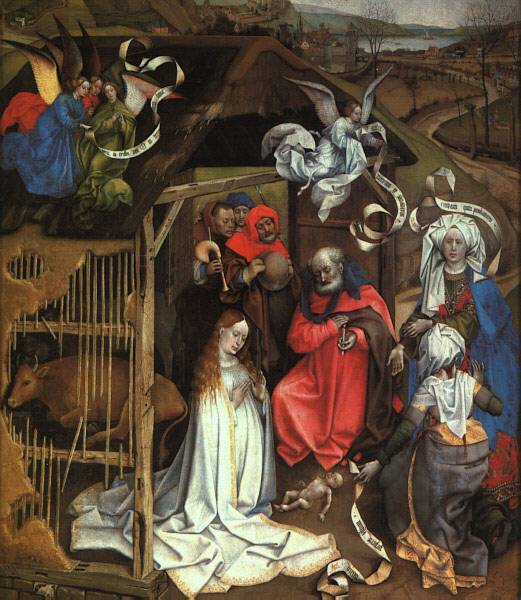
The Nativity, Robert Campin

"That's deep," they say. Yes, I say.

W. H. Auden squeezed a whole anthology entry out of Breugel, so I figure I can use the Master of Flemalle for a blog post. Auden was talking about suffering's banality as a corollary of the banality of evil, though. If the Nazi executioner might look like a businessman, then the martyr might look like a piece of paper crossing that businessman's desk.

What I try to tell kids, from David Byrne's artistic game, is about the nature of hierarchy in time, how sense-making depends on time and how lost emphasis is without priority. When I was a collegian, exploring everything, sticking my tongue into every crevice and trying to pry the lid off of every jar, Mr. Byrne was always the upper classman I admired. He was ahead of me intellectually and creatively. He had cooler friends, and he did the drugs I never would, but he and I were thinking along the same lines, but I was following.

Now, I have probably caught up with him intellectually. He still has some mighty cool friends, and money frees him to a courage that I will never have. Reading his journal, I have to say that he's awfully interesting and still more creative than I'll hope for, but he's no longer commanding spaces I haven't seen.

We were both interested in the idea of how the createdness of art altered its experience. We both wondered about how everyday utterance was shaped by ritual and how poetic cadences had roles in the group experience.

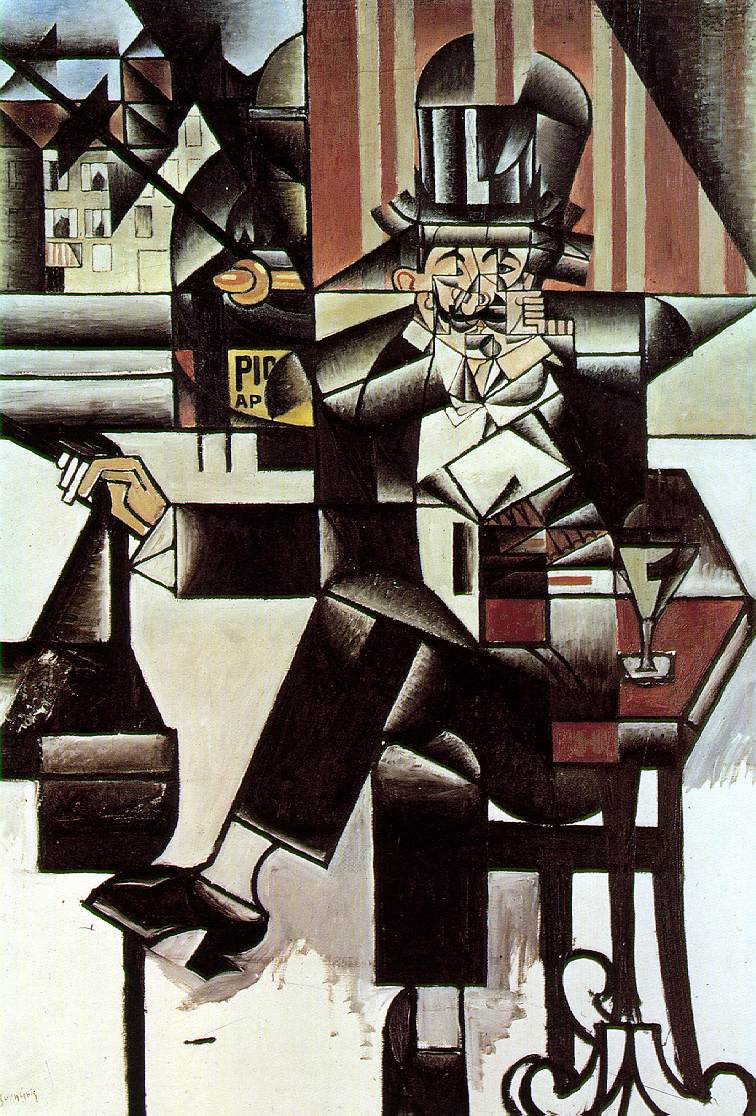
The Man at the Cafe, 1912, Juan Gris
What is the present moment?

In truth, not only do we fail to understand the slices of living and perceiving that together go into the narration that we call "our lives," but each individual moment is itself unperceived for the most part. Even without going to the radical Taoists and asking that we know all the sky, water, earth and that we lose our selves in the process, there is simply more of you than you will credit at a single time.

Your "now" is only the part of sensation and memory and desire that crosses into the organizing facility of the mind. If the ego is "the thing that knows what sort of person you are," then "now" is merely what the ego wishes to credit. There are a thousand things that a "person like you" or that "you, in particular" would not care about that are happening to and with you at this instance, and these are silent. They leave no impression on the tablet.

I do not know what is happening. I only know what I said happened.

One time is no time, after all, because we are continuous if we are at all.

Friday, December 30, 2011

Happy Independence Day!

The well known Christmas azaleas
Today is Independence Day. Congratulations to all of us.

In American Samoa, today is two days, as the islanders decided that the calendar should go from December 29th to December 31st, with no December 30th in between. They can do that, and they did. As the Christian Science Monitor put it, they "lost December 30, 2011 forever." That's right: it's gone, and it's NEVER COMING BACK! What's more, they lost Friday.


"The time present is seldom able to fill desire or imagination with immediate enjoyment, and we are forced to supply its deficiencies by recollection or anticipation." -- Samuel Johnson, The Rambler #203

We just had Christmas, of course, and I am sure you all enjoyed my constipated philosophical traction-pull on time and tide. Based on the number of comments I got, I would say that it managed to make a month at Mal-Wart shopping for Air Jordans seem like a healthy occupation. It's ok. At least I agree with you: it was boring. This time, I promise to only be repetitive.

Do you remember December 31st, 1999 or 2000? Did you feel a tingle when the clock switched from 11:59 to 12:00 AM? If so, were you touching an electrical wire or engaging in a sex act? When you woke up the next morning, did you find that all of your prior notions were subtly different? Did you find that your attitudes toward, say, cutting and pasting information in a business report or a scholarly study were softened? Did you notice that your memory was worse (permanently, I mean)? Did you say, "Hey! I'm not in the same country I went to bed in! I feel like the nation-state has lost its boundaries as a meaningful geopolitical unit?"

I ask this because, just as "by the year 2000, the #1 problem for Americans will be too much leisure time," so also "in the twenty-first century" everything has changed. You didn't notice? You thought that these things were slowly moving, some on a glacier and others on a surfboard? Well, that's because you weren't looking at the calendar the right way. You were being Samoan.

Call this the "Samoan version" of the same photo.
I don't blame you if you ignore the quotations I sometimes include in my essays. Johnsonian quotations in particular can sound so balanced as to be self-negating and nugatory. However, his quote this time is about the present and how we're not busy enough (by the year 1800, excess leisure will be the #1 problem for the English, someone surely predicted) to occupy our full attention, and so we either remember the past or dream of the future. For Sam the young man, that was a cue to wag a finger at the folly of vain imaginings and delusions. For me, though, it's something else.

I've made the point many times that you rarely or never see a map with "You Are Here" at the corner. That label is almost always in the center, because the sneaky truth is we make the maps, not nature. The terrain is as it is, but we organize it for our maps, and we make sure to spin the world's expanse out from our observing pens. The map is a reference in two senses -- we refer to it, but also it is a marker of a spot we occupied when we constructed it.

The calendar is a reference as well. Time is the thing we live in, through, and with. It courses through the blood firing out from the heart and fitfully returning. It allows all that metabolism to take place. It makes for growing and growing old. It says warm and cold. It doesn't care about our calendars. Instead, our calendars try desperately to match it.

He put away childish things

The New Year comes along, by the calendar, but nothing will change this time more than another time. Any given packet of time that we call by name is just an agreement -- a handshake whereby we agree on when to arrive and depart the party. However, we can use these names because we all learned them, all agreed to them. If the town clock were ten minutes fast, and every citizen set his watch by it, the clock would not be ten minutes fast until someone from another town came by.

Samoa has done what any one may do. They have decided which position in the calendar they will agree to. They had been in the United States's day, and now they wish to be in Australia's day. The BBC World Service has been interviewing people and expecting them to act the way that the British did when they updated their calendar by Act of Parliament. in 1752, when the British were supposed to have rioted and demanded their eleven days of life back. The Samoans seem to be "happy campers" with regard to the calendar change, and well they should be. They have made their own decision on where they are, and when.


Time as it goes through us, as nature makes it and as it pumps through the veins of the world, cannot be argued with. As I grow older, and as my charge has new complaints, I know that there is no arguing with biology, no prevailing on time. If the weather says that we will have water and sun enough for azaleas on Christmas, then so it will be, and if January 1 happens, the world does not know or care.

We are not twenty-first century women and men, nor twentieth century. Like calendar dates, those are references -- words meant only to themselves (the words) stick to one position while their subjects (time, nature, people) move on. You are free, reader! No Mayan, and no abacus clack of days, can master time as it flies, as it slows, as it endures, as it pulses and beats upon our broken shores, nor signal when we recollect or anticipate. We are free of dates, days, and time even as much as we are their subjects.

Monday, December 19, 2011

First miracle/ First sin


"If the light is,
It is because God said, 'Let there be light'" - Dante Gabriel Rossetti, "At Sunrise"

A couple of posts ago, I mentioned that light is the first miracle, so my constant reader will not be surprised that my title refers to that. In fact, I don't care if my readers are pagans, Zoroastrians, or Raelians, (a church whose founder names himself after "The Lamb Lies Down on Broadway" and recruits via "go topless day" is something North America deserves), the Hebrew account of Genesis is an amazing organization. I personally do not view it as a scientific or historical organization, or at least not as we routinely use those words, but that is because the Hebrews were quite capable of writing science, quite willing and able of writing history, and they had these genres already (the question goes to 10th and 6th centuries, extant texts, and internal indications of generic conventions that would mark a structural history). They simply didn't need Genesis to be either of them in our sense. (As I said, this is a personal view and not one I want to push. It has nothing to do with the foolhardy "evolution" spat, either.)

It should be apparent by now that I'm attracted to mysticism, but mysticism is something like Greenland: you know that it's there, and some people love it, but it's really hard to convince anyone else to visit. The creation story in Genesis is logical, emphatic, and also reflecting some pretty deep mystical realities. In other words, what may be true in physical science and what is certainly true in perception, affect, and interpersonal communication are sometimes at odds, and, when that happens, it is better to know the latter than to insist on the former. People who insist on mathematical and physics-based realities when the hot confusion of the world throws dung at them tend to end up in a wooden shack in Montana. (That the Unibomber was a mathematician has more than some logic to it.) (Don't take this from me, by all means. Ask Sartre (both of those links were interesting) and read that nasty little Camus's tale of shooting innocent Arab men.)

In the case of the first miracle, though, we're in luck, because physicists shouldn't have too much of a fit if I say that light is a miracle. I am probably wrong (and we live in a probabilistic universe), but my understanding is that there is light and dark. The paradigm of "on/off" still applies. Light either is or is not, and it does not allow for "0.5 of light" or "potential light." There isn't a calculation with "0.2 photon applied to 2.4 roetgens."

June, 1998
We have to retreat, when we want light, to "let it be." We either have light, or we cry out for it. We either have relief from light in a time of true dark, or we suffer for the overload. Either way, light itself is too basic to be understood in any component part. All we may do is accept it as a whole and find attributes to it, like color, wavelength, and diffusion, but it is either there or not.

I said, above, that Genesis goes in emphatic order, and you probably thought that I meant it went from least to most important. In a sense, it did -- a moral sense -- but in another sense it is organized from most powerfully complex to least. Light out of the continuum of darkness, the land from the continuum of sea, the starry sky heavens from the terrestrial, then grasses before angiosperms, division of terrestrial time into its familiar seasons, days, nights, etc., fish and birds (and God told them to multiply that day, and by the next day they have populated the seas and skies and earth, which is kind of a clue that the readers of the story originally would not have thought of 24 hours), then we get cattle and insects, and then man in God's image. This order reflects the systems that require greatest interdependence, in many cases, to those that rely upon the prior. Man is the last and least in some sense -- the island creation, sitting atop the mass on the throne of the garden. (Genesis 2, you know, tells a different story.)

The order presented in the two accounts is harmonized. It is essential. In this creation, there is a dynamic order at work rather than a rigid one. Like light, like respiration, there is an order of wax and wane, growth and sustenance that needs no rule in order to reflect a very real rule.

As for the first sin, we all know what it was. It was the desire to understand, to create, to "be as gods, knowing good from evil" (Gen. 3:11). It wasn't any apple. the disobedience is in the acting on a desire to take on the responsibility God had of knowing what lies on the other side of creation. Inside the paradiso, mankind is part of creation, united with it in being innocent -- unable to create and murder, unable to create goodness because unaware of evil. The enemy offers them the chance to be creators, to take on the responsibility, to wear God's shoes, to find out about what one creates from and what parenting keeps at bay.

So we have an elaborate doctrine of original sin. (If you're dusty on why babies are damned, etc., then read that: it's the Roman Catholic doctrine summed up pretty well. This is not my view, but it's the view that all the other churches in the west are reacting against.)

There are a lot of things to say about the first sin. All I want to focus on, though, is the fact that we can't handle the truth.

Go, go, go, said the bird: human kind
Cannot bear very much reality. -- T.S. Eliot, "Burnt Norton"

We cannot handle very much, indeed, of that sort of reality, because we remain inside of the created universe, the physical universe, and if we ask questions about its nature, about the state of "not/is," we are asking ourselves to take on a perspective beyond that state. We cannot question God without being like unto gods, and we cannot be like unto gods so long as we are ourselves. We are imperfect. We do not know, any longer. We do not hear the song, rise and fall with the divine breath, see the light behind light.

Our fellows read Paul's epistles and fixate on the change of "nature" from "sin nature" to a heavenly one and miss entirely the fact that we still see as through a glass, darkly. We're still small vessels with cracks in them. Paul's epistles are like,
"...that wonderful piece de Interpretatione which has the faculty of teaching its readers to find out a meaning in everything but itself, like commentators on the Revelations who proceed prophets without understanding a syllable of the text.”  – Jonathan Swift, Tale of a Tub, Section II

In every thing that we do, we repeat our first sin. We now can create, but broken things. Our hands, hearts, and minds are incomplete, broken, and so we have the urge we asked for, the knowledge of both the chaos and the order, but we only make ourselves over and over again.

We strive for Eden and make dictatorships, because our orders never manage dynamism. Worse, we amplify ourselves in our creations. We magnify our desires with our assemblies, exaggerate our loneliness in our social networks, and testify loudly about the brittleness of our attainment when we claim to have found solutions.

I fear this has become a rant. I did not start out that way. I, too, will never overcome flaw.

Monday, October 17, 2011

The borders of Paradise

This morning, and I have all my essay ideas in the morning before thoughts can side track the natural impulse, I heard an Iranian-German artist lady talking about filming dancers in Iran. She said that dance is absolutely forbidden in Iran, but they have something called "rhythmic movement" that is allowed.

"No good work whatever can be perfect, and the demand for perfection is always a sign of the misunderstanding of the ends of art." -- Ruskin

We can take Ruskin's quote and nod sagely. "Yes, yes," we say, "and out of the crooked timber, what-what." The later Victorians were full of awareness of imperfection, situated as they were in the satiated and regretful phase of empire. Category and clarity had swept away the sights of beggars, but not the beggars themselves, and "The least pain in our little finger gives us more concern and uneasiness, than the destruction of millions of our fellow-beings," as Hazlitt wrote in 1829. Many had come to realize that the noise could not be shut out, that, as Horace said, "Naturam expellas furca, tamen usque recurret" (in Epistles) ['You can drive Nature out with a pitchfork, but she will return again']. Cover the nudity, and it's still under the covers.

Nevertheless, when we persist through these ages of empire, of decay, of self-conscious sadness, there is a tendency on our parts to turn from a red faced public servant with a sack full of fig leaves to John Cage. We go from purists to artists of Autotune. This produces its own dialectic, if not enterically then exotically. The religious fundamentalist and the political fundamentalist alike appeals to any population that is awash in too much embracing of porous borders. Each generates its own idealistic ideology, its own Zion Celeste.


The political idealists are easier to talk about than religious revolutionaries, as they seem to conform to readily understood causes that have economic and material bases, and they often transform into other parties, other organizations. Thus, it's not so hard to talk about fascists in Germany (but you'll have a heck of a time nailing them down in Italy), and it's not that hard to talk about the John Birch Society in the U.S. or the National Front in the U.K. These groups all set out to be puritanical -- to achieve an ostensibly conservative goal by the eradication of all accumulated state apparatus and the imposition of a morality and clarity that had been muddied by Them and the agents of evil.

The political groups want to stop the flow of population, the drift of genes, the spread of culture, the transformation of economic structures. In that regard, they are not conservative, but Utopian. They are not, and never have been, summoning glories of the past but promising a thing that cannot be: a frozen moment of security. To achieve any of their goals would require immense power, tremendous abridgments of liberties, and endless regulation -- as both Italian and German manifestations of fascism have attested (and the latter also required a reiteration of slave labor for its economics to function). This is because they are attempting the impossible: they want to stop nature.

It is natural for people to mix their genes, to mix their tongues in more than one way, to invent and forget, and to flow as far as they can to opportunity, because humans are opportunistic.

Is the same true of political purists of the communal variety -- the socialists? Since these groups begin by embracing paper work and rules and the state's place in administration, it is hard to see how they are betrayed by their actuality as much as that they fail by siphoning off their potential in their implementation. The ideological and idealistic energy behind their endeavor lessens with each aparatchik, each factory boss promoting his buddies, each rigged election, and each set of police necessary to monitor these.


In Iran, they had a completely idealistic revolution. It was simple: they would have a real theocracy. In Afghanistan, the same thing, more or less, from a different branch of the religion. In 17th century England, too, they had a clean, clear idea: the Lord's own nation, led by saints inspired by the Holy Spirit. We know from history that the English were unhappy with their government and, because of the semi-feudal nature of the remaining state, were able to affect a second revolution to restore, but with changes, the prior government and nation state structure. That is not to say that Cromwell failed, or the Taliban failed, or the Ayatollahs failed, because "fail" depends upon the goal sought.

I know that it's convention for the Marxists to reject religious socialism as being non-revolutionary, it's also true that the power of the supernatural ideal powers the endeavor once in place far more effectively than a philosophical system. The problem, though, is that they have a problem of ensuring that their ideology extends into the subject. In other words, when Christianity or Islam ceases to be a religious choice and becomes your employer or your state, then your state and your employer have to, as a matter of existence and operation, extend religious faith into the mind and soul of the employee and citizen.

The ideal, which is lovely and functioning when idealists join, becomes state power when those idealists triumph and make the ideal the innervating element of the state.

Once Oliver Cromwell became Protector General, it became necessary to ensure the Christianity of the people. Instead of trusting the people to be Christian, the state now had an interest, and therefore it had to have proof. Further, it needed to specify for its functionaries how and what would be considered moral. Idealized states spin paper as a precondition of their existence. Perfection, after all, is only perfect if it is protected in a static position, and that means ruling out change or ruling in qualities.

Therefore, the Iranian "rhythmic movement" and "approved hairstyles for men" are examples both of the native authoritarian extension of power into an ideological space of the subject and the deterioration of the subjective ideal that frames the power impulse. A state may start out with the simple ideal of good men and women, but it will need to say what constitutes good, and then what constitutes bad, and then it will make the soul of the individual, as well as the body, its concern.

Our dilemma, then, as humanity, is that we accept the blood and pus and confusion of allowing each other to sin, and thereby create a call for our overthrow, or we strive to a perfection that, by its nature, is death. Either that or, more sensibly, we worry about the neighbors' health and happiness and our own goodness.