Wednesday, January 05, 2011

Sympathy for the Plague Rats

Stranger passing by, consider, for a moment, the plague rat. In the hold of a ship, gnawing on grain or bounding out onto a dock – weaving through odor rich streets or spinning a nest of fabric, straw, string, and dirt for its young – the plague rat carries death along with it wherever it goes. We curse the creature, calling it by its ancient name of 'vermin' and 'pestilence.' The bird masks of the physicians in the seventeenth century that astonish people today might well have been matched by rat masks for the undertakers.

My thoughts have turned to this animal for natural reasons. On the Monday after Christmas, I was at a fine restaurant to have a fine sandwich of meat and dairy and a beverage of sugar and emolument. As I went into the Splash Mountain-style switch back of the line (queue, for our stranger strangers), a family came in behind me. Pa, for that, I feel certain, was his name, wore a Metallica tour t-shirt emblazoned with “Kill 'Em All” on it. Ma was wearing a plain jeans and shirt combo. Jr. was sporting black hair dye, wallet chain, an open jacket, and a weight problem, while his younger brother, Trip, was fitter, more appropriately rock 'n roll. Sister had very effective makeup and bangles and t-shirt and showed her figure to great advantage while obscuring her features in an unmistakeable announcement that she was not 'pretty.' She was made up in the way that they call 'emo' – which is to say the thing that happened when punk cosmetics were stolen by the heavy metal kids and then stolen by the goth kids and then stolen by the heavy metal kids again. Junior is the focus of this story, though. Junior was a plague rat.


Pa may have had the t-shirt, but Junior had the power. Although he spoke with perfect politeness and effeminacy, Junior accomplished his goal by coughing at a rate of five to seven times a minute without ever once bringing a hand or arm up to block. He did not cover his mouth or even show a twitch of a muscle as if any part of his brain had any motor impulse toward covering the cough. He did not turn his face toward the ground, or away from people. He simply coughed, straight ahead, constantly, from his doughy face toward whatever surface was unlucky enough to be within three meters of him.


I pulled up the hood to my jacket. I turned away. I went to a different cashier. I sat away from them. I did what I could, even if it meant not getting to stare at Sis's body. I fell ill.


The next morning, I had a sore throat. The next day, I was coughing, and that night I nearly died. When I went to the doctor, he assumed, I think, that it was a boo-hoo cold, but, in fact, I had pneumonia. I had a good fever, and my breathing sounded like a hookah convention. (Hey! I'm Aqualung!)


Anyway, the word I used to describe Junior in my mind was “plague rat.” All during my illness (I'm a bit better, but I'm not healthy yet) the word stuck in my mind. It kept clicking, like a rock stuck in the tread of a sneaker, everywhere I went. I don't know how it is with you, Stranger, but when that happens to me, it usually means that I'm not done with the concept.


Oh, and it often means that Jungian synchronicity is going to happen.


Sure enough, the book I've been reading at lunch, At Home, by Bill Bryson, talked about the plague after I had fixated on my term. He made the point that the plague killed the rats right along with the people, and so it isn't as if the plague rats were getting out of the deal unscathed. Indeed, we think of the plague rat as a creature maliciously spreading a disease, but, in fact, it is an animal that spreads a disease by bumbling.


The two-legged sort of plague rat – our bulbous friend at the Burger King – is a fool. He is sick, knows that he is sick, and thinks of no consequences. The world stops outside of his flesh, apparently, or outside of the present moment. Thus, he wants to go, and so he goes, but covering a cough is not an active thought. Or he could be a malicious animal of a different sort than we usually think by just being as selfish as a toddler. It might be that he feels that his suffering is the only suffering of any note, that the rest should suffer with him, or that his hunger is more important than another's safety. Any one of these three would be wicked, but stupidly wicked, bestially wicked.


I think most plague rats, though, are fools, not egomaniacs. Consider the rat itself. If we want to find a wise rat, a rat with complicity, we need to look at the ship's rat that knows that the ship is sinking and manages to jump just in time. That's the clever rat. Odds are that the ship is out at sea and it won't make any difference, but at least the rat has escaped a certain death. The plague rat, on the other hand, has no foreknowledge, cannot read the weather, cannot see the fireships sailing alongside, cannot feel the creak in the wood, doesn't know the bilge is backing up, doesn't realize that the last flea bite was worse than the one before, doesn't notice that there are extra bumps on its arm pit and neck. The plague rat just gets sick and dies.


You see, that other rat – the swimmer – is incomprehensible to me. I feel less sympathy for it.


I moved to Manhattan in August, 2001. In a month, terrorists attacked. At the end of the year, my boss left her position to take another, sealing my doom in the job. The next year, as I prepared to leave, the power went out to the entire northeast of the U.S. I moved down to Baltimore that year and began working in a public school. The pay was good, but I started in August and, by October, there were whispers of crisis. By December, it was clear that the school system had a budget of -$130,000,000. The prior year's administration had written one hundred and five million dollars of bad checks. By January, all persons hired that year were laid off, which meant me. Private grants kept me employed through the term. At the start of the next school year, the principle, vice principle, and eighty percent of the administration had left, and I was unemployed. I moved down to where I am now, and things seemed alright. Last year, they eliminated 20% of the faculty.


The plague rat is leading a doomed existence, and its illness makes it seek a nest all the more. It thus nestles close to people most urgently, and its corpse's passengers flee. The ship's rat leaves just before the disaster strikes. I have never understood the ship's rat, and I'm beginning to feel more and more sympathy for the other fellow.

Saturday, January 01, 2011

From Flaubert

"Axiome: la haine du bourgeois est le commencement de la vertu." -- Gustave Flaubert, The Dictionary of Received Opinion
When I first read Flaubert's dictum that "hatred of the bourgeoisie is the beginning of wisdom," I wasn't sure how to take it. I encountered it while there were still punks roaming the earth and when I still was one. Surely I had thought the same thing, after all, that no man could achieve anything without first starting from hating the bourgeois. In fact, I spent the years from age fourteen to nineteen in a seething rage against all things middle class, especially the mall, the high school, the pretty, the glad handing, the cologned, the puffed dudes and fringed girls, the top forty radio, the best seller lists, and Gene Shallot.

I also knew, though, because, like a good many punks, I had gone into academics, that Flaubert might mean something more literal, given his era. He might mean a class with borders, and might in fact be snobbish as much as scornful. One never knows. Then there is the worry of irony, as Flaubert's irony is not always obvious. Hesse, after all, would bawl and blast the bourgeoisie as the worst of all things. Dostoyevski would. Lawrence would. In fact, pretty much all the good authors did. Therefore, it might be irony... but that trend wasn't by a trend by Flaubert's day....

Never mind. I put my disgust at the middle sorts into the background as I tried to calm my narcissism. There is a period of two decades or thereabouts when both sexes find themselves fascinating, both for beauty and revulsion. Either way -- as objects of admiration or poking with a stick -- they think that their own selves are very worthy of exploration; and then they think that their biographies are necessary for understanding themselves; and then they place their biographies, if they make it this far, in a perspective that stretches to their individual horizons. For me, that meant that I had my long stretch of thinking my awfulness needed a witness. Then I needed to think about how it happened to be that way, which meant biography. Then a decade followed where the importance of my biography gradually took its proper place in the context of history and ceased to be the star of the show. During this process, I explained away that five year misery of hating the middle classes as just normal rebellion and achievement of individual identity. Ho-hum. It was ever thus. Sic transit gloria mundi.


Recently, though, I've begun to wonder if that's true.

  1. First, the authors I named above share a quality, aside from their scorn: they, like perhaps 80% of the punks, are the children of middle class parents.
  2. Second, I realized that the things that I set out in endless manifestos in 1978 of "Things I Hate about Them" are things I still hate. In other words, it wasn't a phase. I may not have much paisley print, but I still have the pit of the stomach gagging when "Top Video of the Day" comes on.
  3. Third, I began to see that there was something about the middle classes themselves that separates them from the upper and lower classes, aside from money.
Ask yourself this: are the children of the working class raised filled with hatred of the values of the working class? Are the children of the upper class raised with hatred of the values and culture of the upper class? Lower class children grow up hating their material conditions and with aspirations, but do they grow up wanting nothing so much as the chance to write a stinging satire or direct a cruel portrait of their hideous families? Do the children of the wealthy emerge to write poetry ridiculing their habits of education, manners, and socializing?

Working class children may adopt a middle class speech, but the language itself will be retained, while middle class children are eager to climb or descend, whichever way they may, in language. Upper class children may affect lower dialects to "pass" in society without embarrassment, but they are not abandoning their speech, grammar, and syntax.

The children of the middle class, though, seem to have perhaps fifty percent satisfaction at any moment. The rest of the time, there is a strong kick against the pricks. The reason children of the middle class tend to remain in the middle class -- or they did before the current generation -- but they change their approach and focus, and, most importantly, they change what the middle class is.

You see, the upper and working classes tend to be defined by one another, by relations of power and capital. The former tends to spin "culture" off from itself as an armor or a set of shibboleths. The latter creates contrary, counter and resistant culture, or such culture develops synthetically from the accretion of economic migration and mixed assimilation of populations. Only the middle class has a self-aware culture.

The middle class tends to come from the middle class and from the working class. Rarely do the uppers fall, but the lowers have risen from time to time in the US, UK, Germany, and Netherlands. Thus, in these cases, the middle class is a sort of consensus of averaging. No view gets to be reflected, as all views are taken down to their most palatable features. The middle class is known not by its money -- especially not in the U.S., where Americans stupidly call themselves "middle class" whether they make $20,000 a year or $200,000 a year -- but in culture. It has no title as its entry point. Its entryway is a set of views, a set of speech habits, a set of values. In other words, it is a voluntary matter more than the other classes.

You want to be middle class? Act middle class and do not have a physical identity that causes rejection by the myopic eye of the middle class itself. The eye is myopic because of its nature: "normal," "middle," "average."

The values, the culture, is how the middle class is middle. Smart? Not too! Crass? Not too! Tolerant? Some! Generous? Realistically! Art? Understandable!

No child can love that if the child wants to have an identity. Early adulthood is the time of making oneself a self, and there is no way to be a self without having something outstanding. All of that must be pruned off for the middle. The only people who may excel in the middle are the ones who do so with physical attributes of beauty or health or service or strength. They cannot be too artsy, too fartsy, in other words, and any child who does not accept physical extremes must perforce reject the middle's standards.

At the same time, none of us ever escapes. As Flaubert, Hardy, and others would show, they could hate the middle classes, but they could write about nothing else, and their own values were resolutely bedded in the soil of the bourgeois system. This is, too, normal and natural. You see, if I stick out and have to hate the vacuity of the pop-driven, unreflected, ignorant art in the middle class, I actually remain with them in, say, my views of serving on juries and paying taxes. If I reject their ovine capacity for self-deception and political insensibility, I probably share their views on funding public schools.

Thus, we -- we haters of the bourgeoisie -- become the components of the next one. Our exaggerations and corrections give slight shifts to the lumpy Jell-o. "Suddenly" it seems that "average Americans" are tolerant of gays in the military, for example. Well, it wasn't sudden, unless you believe that everyone cringing in shame in the 1970's growing up to be those people in the 2000's is sudden.

Anyway, it was just a thought I had.

Tuesday, December 28, 2010

Seed on the Dusty Plain


We choose our friends, but not our family, the proverb goes. Neither, I think, do we choose where we were planted.

I have been reading Mark -- mainly because I almost always read Luke and do not like John so much and therefore tend to go a long time unacquainted with Mark -- and I have stopped temporarily at the parable of the good seed. That was on Saturday. On Monday, yesterday, I went along toward the great metropolis where the Wal*Mart has replaced the K-Mart (a friend of mine defines "New South" as "n. the thing that exists just before the Wal*Mart replaces the K-Mart"), and I hit a familiar pothole in the road. Driving a sleek sports car as I do, each pothole is noticed, and I would not wish to ruin my fine suspension with one.

This particular pothole is, as I said, familiar. It is familiar because I hit it regularly. First, I hit it because I am in position to hit it after I dodge a prior hole. Second, though, I hit it because a shadow falls across the road just at that point and obscures the hole. Since I have no depth perception due to an old dueling accident, I use light and shade to determine distance as I drive, and therefore I miss this hole nearly every day that I go on that road.

As I worried about my finely tuned linkages, I absolved the pothole of any responsibility. I realized that, when it comes to blame, there is none. The tree came first (it is a white oak), and the road is the newcomer. The pothole chose to occur in the shade of the tree -- probably literally -- rather than the tree choosing to hide the hole from me.

That led me to consider something. It's hard for trees. Trees have trouble enough without us, and then we add more. Watch a construction site some time, and you will notice that the first act of builders is to blow hell out of every tree. They will then mow, push, level, and then pave. After that, they will pour cement where they want it, build the object desired, and then finally come back in and, at great cost, plant trees that are of a different type, different family, and different but uniform age, to "ornament" the place. (I link there, because some land was given to that university on condition that none of the trees be harmed. The bulldozers blew hell out of every tree, and then they said, "Oops. Do you want the land back now, lady?")

What can a tree do? It doesn't choose its family, nor its genus or species. It doesn't choose its location, either, and in that way it has an even worse time than we do. We can get violent -- most often do -- and take aim at body or mind, or shrink to nothingness, or wander off into the wild to die horribly from some inexorable Universe that will be deaf to our cries. (I wonder if more male geriatrics wander off to their deaths than female? I would hypothesize so.)

A tree is stuck, waiting for fungus, storm, drought, or the axe to drop it.

It's only hope is to hide.

A neighbor across the way had pines growing all around his house. His house had been built according to the usual plan -- meaning that whatever had been there had been blown hell out of and pines had been planted because they grow quickly and drop needles and cones that people like -- and there was a veritable corona of telephone-pole-straight pines all around his house. Then, though, his brother or brother-in-law, who, like him, was on a fixed income, had a pine fall into the house during a storm. After the premium increase, the deductible, and everything else, he was ruined. The neighbor concluded, therefore, that the stupid pines were more stupid trouble than they were worth -- the stupid things. He and his son, therefore, went out to clear them. They hired a local free agent to haul the trees, but he and son did the cutting.

The buzzing and crashing went on all day. When they were done, they were in a little house on a prairie. They were small bubble of brick on a blight and stumps, although they hired men with tractors to pull the stumps up. (Pines are easy that way.) The thing is, he missed one.

He didn't see it. He and his grown son both kept on cutting, and they walked around a tree all day without seeing it. That pine tree had learned the great secret of knowing how to hide.

Some trees are lucky and clever and learn the mystic secret of hiding from us, from pests, from storms. In their dotage, of course, they will forget and be caught, but the trees that evade, the ones that face up to their circumstances and limitations -- these are heroes, I think.

Sunday, December 26, 2010

Wetness, Holy Innocents, observed

It is snowing here, not far from Florida, on this date. Snowflakes act like tracer rounds for the rain, though -- illuminating the wind, providing clothing for the invisible snaking columns of air. We think they blow on us, when they are simply swerving on their way from ground to sky or sky to ground.

It's hardly a Christmas sweater, or a gang in Christmas sweaters, but it is still an unusual thing in the tropical Gulf of Oil.

The day has a religious feast associated with it. The XM/Sirius music channel has reminded me of the fact that today is the Feast of the Holy Innocents (well, ok, so it's day after tomorrow). Those who, strangely, want to deny the historicity of Jesus (and I mean that it's strange; none of the early opponents of Christianity, who would have had every opportunity, did so; in fact, none of the early historians had any trouble at all) speak of the difficulty of Matthew's account, and yet the story is far more logical than moderns think.


Let's take those Magi. We call them that as if it were a nationality. It's not. It's a job title. You know it better as "magician" or "magus." Get between those two concepts. They were wise men and magic doers. What they really were was Parthians. That means they were Zoroastrians. That means they watched the sky quite a bit. They were monotheists with a religion that still exists.


Here's where things get 'logical.' Prior to the birth of Jesus, there had been multiple efforts at resisting Rome throughout the near east. The only successful one had been Mithridatus. His birth had been attended with a comet. He wore a comet in his crown, in fact. His title was "king of kings." (That, by the way, is a job title, too. It's rather like "commander in chief." It means that he was the king who commanded other kings in a military alliance against Rome.) See The Poison King for a great deal on this (it gets a thumbs up from this reviewer). To the Romans, comets signified disaster. To the Zoroastrians, they signified fire from the skies -- the divine coming to touch the earth -- the birth of a great king or savior.

So, if there was a new star, the Romans would have been either afraid or filled with dread, and they surely wouldn't be eager to write it down with joy. On the other hand, the Parthians, who were in need of a new Mithridatus, would look for which country the star appeared in and go to find the new king of kings.

Herod Antipas was a weird cat. He was halfway Roman but halfway Jewish. He knew that the people didn't like him, that they saw him as a traitor, and he never had an easy rule. If a comet appeared, and if it was in the astrological house of the Jews, he would have been mightily afraid. All the other near eastern kings would be looking for a successor to himself. I.e. there would be not only a rebel inside his kingdom, but one that the other military powers to his east would support.

That's scary.

As for the Romans, they would hardly notice or care. Judea was important for them, but they were petrified of another Mithridatus as well. They were also petrified of another Spartacus. Their tax farmers had increased brutality behind them, and they were readier than ever to ignore a bit of blood.

My point is this: if there was a new star, the rest follows very, very logically, including the slaughter of the innocents. That is all one needs. However, instead of considering history, which includes awareness of culture, politics, and religion, the people who wish to disprove the story of the nativity in the Gospel take their own contemporary empiricist assumptions about meteors and stars and their meaning, their own Romanized culture, and project backward, even as they claim that a lack of evidence is evidence of a lack.

The snow has stopped.

My miracle this Christmas was seeing a great improvement in the one I care for. There will never be "better," but there is a lessening of the "much worse." There are times, indeed, when the world grows very thin.

Wednesday, December 22, 2010

Rhapsody on a Warm Christmas


I
Most folks don't know what a rhapsody is, except a) a thing by George Gershwin that gets played every day on the local NPR station, or b) a thing on the cell phone for, like, getting music. Well, that's not what a rhapsody is at all. A rhapsody is an ode, but one with no fixed subject or form. It's a hodge podge. It's a gumbo, and since "ode" came to mean "whatever," it's a 'whatever' of 'whatever,' with the only rule being that it not stay on any subject for long.

Speaking of which, I can only abide hearing "Rhapsody in Blue" once a year, and not the twice a day that "classical" radio insists upon. I know the people who donate to the radio station like it. I realize that people who don't know Johannes Brahms from Joe Jonas will hear it and like it and be more likely to stop flipping stations. I get it. If that's the criterion, why not play "that thing... you know... the one from the movie? that one?" Oh, wait: they do.

II
In case you did not read the last posting, and, if we face facts, after a hiatus of four months and a series of impenetrable pieces, it would be very likely that you did not, let me state it plainly: I do like turkey vultures. I don't have one as a pet, as that would defeat the purpose, but I look upon them as the working class of the animal kingdom. They're the construction crews, the sanitation engineers, the humble.

I can well imagine them having schedules of work to be done, clearing roads and moving carcasses from busy sections of town. They certainly have meetings. They're moderately social birds, amongst themselves, but no one else seems to get near them. In the early morning and late afternoon, I see vast flocks -- real flocks of them swirling in a maelstrom of black over a nearby bank downtown. What they're doing is gaining height on a thermal near the rail road tracks, and the microclimate dictates that as one of the best spots, but I can imagine conversation:
"Alright. It looks like we've got a goat in the field off 86, a deer in the highway feeding 16, and a two dogs in 80. I need three of you to take care of the dogs. Lisa, Carl, Eric, and Joe Bob will get the goat. I'm going to need shifts on the deer. Bring your young ones with you, and be sure to empty your stomach first. This is a big job."

The other reason I like them is that they have no guilt in themselves. They are flying Dalits.

Like other untouchables, they handle corpses. Like other despised groups, they touch ordure. In our American society, they deal with the aftermath of our domestication of food animals, and they deal with the aftermath of our internal combustion engines. They are our sin eaters.

Yesterday, I saw a dead turkey vulture in the road. There was no one to handle its corpse.

III
There is despair all around this Christmas. No one needs to look for it, and the imagination starved creatures at corporate media have fallen back on their "sadness" and "sadness and redemption" package pieces for the radio and television. --Little girl loses house at Christmas. --Father determined to provide for children this season, but job gone. --Unemployment lines beside jewelry stores. --Diseases cured in time for parents to be reunited when mother invents new recipe and father wins lottery.

I find these stories to be poisonous when they're true. They have in them the lie of the preterite, and they have the worse lie of the ending. These stories end. They wrap up. They start somewhere and end somewhere else. Lives don't.

Of despair this year, I have discovered two flavors, both bitter. One is the gasping, heart pounding powerlessness of poverty. I had known it well already. The other, though, is the draining, inexorable watch of death. Standing and waving one's arms in futility as powers evaporate, as intellect is extinguished, as neither better nor worse occur. I can only think that the two combined could not be born by any person.

IV
Is there any such thing as patience? I have doubts these days.

As two generations now have been exposed to the temporal foreshortening of the web, I am not sure but that patience was hand-in-hand with concentration. The fate of this second was sealed a while back. Perhaps the reason that I encounter curiosity in perhaps one student every two years is that it requires memory and patience to have.

I, though, blame myself for not being patient enough. When one holds a telephone and tries to change channels with it and asks me, then, to come and find the remote control, when it's actually in the other hand....

V
Maybe I will say something surprising about my teacherly attitude toward the cell phone. I may even quote a student paper without permission in the process. Not today, though: some talentless tart may be caterwauling on the glowing box, and I must hurry to my telephone to watch it.

Sunday, December 12, 2010

Freedom Is No Mistake

I was walking down the dirt road the other day, spitting tobacco at beetles as I went and wondering when the band that changed everything would finally be available on iTunes, with Mimir, my pet buzzard on my shoulder, when I saw a flier that someone had stuck on the windscreen of my John Deere that I'd left out on the back 400. The flier said,
Friend!
Do not believe the
LIARS!
You have a
CHOICE!!

Will it be heaven or HELL?

Come to the FREE WILL Church and hear the truth.

"You shall know the truth, and the truth shall set you FREE."


Well!
That certainly was a slap in the jaw, or a pull of the beard. I hopped on my Ducati and told Mimir to wait for me at t'house, and I drove down to that church. There was no one there, so I went off to the manse of the pastor. I had to park the motorcycle up on the road to avoid the mud down by the manse's lot, but I went up to argue with the pastor that those who say that there is no freedom might be mistaken, but they are certainly not liars, as the lie requires a prior foreknowledge of the falsity of the statement being made and a mendacious intent, and that he should immediately disavow and refudiate the flier or amend its language.

He, though, would do no such thing. You can imagine my astonishment, but he went on to argue that the proof of absolute freedom was such that any man (not woman, for women, lacking souls, lack the capacity to morality -- I had to applaud the bravery of his Thomism in that regard) who suggested a lack of freedom was a liar. I shall reproduce his comments.

"Chance, chaos, and entropy are facts. No straight thing, whether a line or a motion, is possible in human life. From our earliest moments of life, we recognize that our world is lapsarian, that our efforts are inadequate, that we either must invent or recognize the ideal world to have satisfaction. No monument wins against time, and nothing set in motion remains, nor anything at rest, either. All is impermanence, and yet impermanence due to chaos, noise, error, want, failure, perversity of nature or crookedness of nurture or amalgamation of composition. We wish for good luck because we need good luck. These truths are so elemental that we assume them and never speak o them. We wish we could wish them away. How, then, can we possibly live in systematized, ordered, and determined worlds when even as simple a matter as boiling water is subject to entropy? No.
"And, supposing that a person said that we are all, indeed, un-free in soul and free in body, then howso shall we have such a thing? In what form might the soul be chained where the body is not? Were creation worthy of God's will if it were all shadow play? This seems unlikely to the point of insanity.
"I might not be able to prove that a man's will has acted freely, but he can himself not deny that it has not been placed in subordination."


I confess that he argued with heat. After he offered me a cordial and the two of us spoke for some time further about the metaphysics of system versus actor, we parted on good terms. I was able to persuade him to change the tone of his fliers in the future, although not to change is view on the fundamentals.

I came back and talked to Mimir about the whole thing. He had been hard at work. He said that there had been a dead raccoon on highway 280 and a fawn on 151, and the crews were backed up for hours clearing away the bodies. Traffic was getting in the way, and his people were going as quickly as they could, but they were starting to run out of capacity. I told him that I always respected the work he did, but there was a time for such recreations and a time for serious work, like philosophy.

"The problem, I believe," Mimir said, "is one of definition. He is struggling with one meaning of 'freedom' against many other definitions of freedom. He battles the Calvinists with Heisenberg and Maxwell, of all things!"

I agreed. Indeed, I suspect that there is a big difference between being free and being disorderly. Freedom requires volition, and chaos requires frustration or agnosticism. It is non-thoughtful, non-affective, non-spirit, non-physical, and it isn't even properly spoken of as a force as much as a thing all forces do. Not being able to be what we want is not the same thing as being free; in fact, it is somewhat the opposite. Our imperfections and imperfectibility may not prove our damnation, but they don't quite make us free.

The Gnostics looked at the flop that is life and decided that we've got to jump up from bodies to pure spiritual sparkiness, where the chaos won't apply and a fresh rule book can be written by those in the know. That's the inverse of the Pentecost, where the spirit comes down and enflames the flesh, flashing out and bringing the perfect down to the imperfect through revelation and inspiration. However, neither one of them can answer the question of who gets to go or gets gone to. Neither one of them can answer the question of whether the people were free to hear or foredoomed.

We can all agree, indeed, that we're inadequate, that chaos happens, but we can't agree beyond that because, quite frankly, we can't see beyond that. Anyone who says otherwise is guessing, and it's just awful to go around calling people names on the basis of a guess.

Saturday, November 27, 2010

A fallen idol

When I was fourteen years old, I was visiting in south Georgia. I had been given $5 and allowed to spend it any way I wanted, so long as I spent it. (This is what people did before there were gift cards.)

I went to the only store in walking distance, Boney's Drug Store, and looked through the spinners. I had attempted, previously, to read comic books, but the effort left me cold. There was far too little story. The whole issue could be summarized in four sentences, I found. (I didn't know that I was demanding. I was officially Slow. My IQ scores said so.)

I saw this (and this is the only photo I could find of it, folks, so sorry if it ain't pretty):


At fourteen, there was one thing that attracted me to the book. It was, of course, the fact that at that time (1975-6), there was a famous band with the same name. The fact that I could lay my head along the edge of the paper and imagine that I could see the woman with the dice hat's breasts had nothing to do with it. I bought the book, and I read the book.

Well!

The book hit me straight off with "Adalbert Stifter," with "Carl Jung," much praise of "Nietzsche," much more praise of "Wagner," and, at fourteen, I pronounced those names naively and sought the works of each. The book also told me of "Immanuel Kant." I could not find any books by Wagner, fortunately, but I found and read The Portable Nietzsche. It would have been more fruitful had I gotten Stifter or Hoffman. I then got Critique of Pure Reason. I read these books. I really did.

This was the gateway book, you see. It was the book that set the course, that made anything but Philosophy or literature impossible for me.

In the years that have passed, I have defended Steppenwolf from its many critics. I read Kierkegaard's Either/Or and there found (in the A volume), a short passage where he speaks of a "magic theater for madmen only where every dream will come true," and I saw that Hesse was copping existentialism. That had always been my view anyway.

So strongly did I defend this book that I never re-read it, and I have now assigned it for another to read. It looks like this now:


I should have left well enough alone. I re-read The Lord of the Rings not that many years ago, and I had been unable to ignore the homoeroticism and the palpable aristocracy of the book, the belief in Good Blood, as I had every time before. I can still endorse the books, still say that it takes a peevish reader to object for these reasons, but I could not ignore the reasons. That was a warning that the things of totemic power when a teen might prove less worthy in middle age.

I know that Steppenwolf was written in 1920. I know that Hesse can't know about the Nazis. I know that when he's in love with Wagner, it's a sign of how in love with Wagner a certain intellectual was. I know that the neo-eastern esotericism of Hesse isn't so very wildly different from the cultism of the theosophists or the Nazi interest in India. I know that we can ignore some of this as innocent in impulse and guilty only in act. The same impulse can go harmlessly toward the existential or awfully toward the nasty selfishness of Nietzschean Darwinism. (Oh no! No, you do not get to deny it. You can say that Hitler misunderstood Nietzsche, and Hitler obviously did, but there is no way to deny that Nietzsche's triumph of the will is not rooted in a battle of the greater over the lesser selves, who are to be dispensed with, that it has in it a knife and blood in the gutter.)

Still, if I can forgive all of the really smelly cabbage of the book, I'm having a hard time with the didacticism. I even know how it can be excused as the inverse of Kierkegaard's method. K. would tell in fiction a thing and then explain it in philosophy, while Hesse seems to have this tedious "treatise on everything my book will teach" before there is any fiction. Still, some balls! Some ego. Some isolation!

The reason the idol is wooden and hollow, I think, isn't even the style, the historical awareness, or my loss, but the fact that the young can conceive of the self as a project and as a pure project, with Society as an enemy, and, later on, one realizes that society is pretty wretched, but one is always in it. Pee in the water all you want, but you're still in the stream.

Friday, November 26, 2010

Why not

1. No one will get it.
2. The ones who get it won't care, but since there won't be any, that's not a real danger.

I have developed my manifesto. Manifestos are important, as I argued before. Whenever one's art, whether it's painting the house multiple colors or making a unique lawn watering scheme or a tree fort for the children or a decorating scheme for the kitchen or writing an essay that borrows from journalism and academic style, fails to get the response one wishes, the natural and inevitable response is to write a manifesto.

Mine is not for a movement, though. It's just mine. I have decided that my own position, in the post-Sputnik age, the Watergate and Apollo age, is rebel humanism. The right wing frequently... well, the left, right, top, bottom, and every other wing, plus guard, plus side... tells the audience what its greatest fear and weakness is by campaigning most vigorously against a phantom menace. In the case of the so-called Christian fundamentalists (who seem to miss the fundamentals and behave in ways far from Christian morality), they have had a full on war against "seccalurhummanisss." Secular humanists, they say, are everywhere, are plotting, are organizing, and are effective. It is difficult, therefore, for anyone to even understand the word "humanism" properly (hence my link).

Me? I know the empiricism. I know of the physics. I have no problem sharing the facts and statements of our age. Indeed, I am on a computer. However, I, and perhaps others, have rebelled against the proscribing of the horizon by scientism, the belief that what is known is what is knowable, that what is perceptible is what is knowable, that what is inferrential is more reliable than what is deductive, that reason is sufficient. Mine is not merely anti-Rationalism, although I found that and took to it, but I was rebelliously humanist before I found those people, I think. Nope. I know what the theses are, but I have no reason to suspect they are a limitation.

If we would know why Pentheus lies in pieces, we must ask how he behaved.

If we would know why Gulliver is in the stables, we should ask where he's been.

We can listen to Jung, or Bakhtin, or nearly anyone, but they have the human as the "shadow," the "mad," the "beast," and all sorts of other pejorative names. If it's us, then why all the names, except that we are, again, trying to suggest that it's not really part of us, that it's the manure of humanity, the vestigial tail, an atavism? If a person decides, "I will allow myself to be really alive next weekend," then the effort will fail. It's a stupid idea.

The truth is that "You are here" is at the center of all maps, and we, as the cartographers, can never escape our human-centrism. We can never escape the limits of being created things (take your sense of the word -- be an atheist, and it's still true), historical things, accumulations and chemicals. Nor, surprisingly, is that depressing. It is only doom and gloom if you wish to set up a new, ephemeral idol in the niche formerly occupied by the chunk of wood.

Wednesday, November 24, 2010

Favorite films

Hey, kids, do not follow me on Face Book, Twitter, and reddit! I don't have accounts on any of those sites and do not want one.

I've finally realized something. The favorite movies of the American public may include things like "Titanic," but right now the
  1. "I am Joe's Amygdala," starring Sarah Palin
  2. "The Pawnbroker," starring Eric Cantor Boehner.

Blug.
(Graph from ThinkProgress.com)


Monday, July 05, 2010

Meet Legion

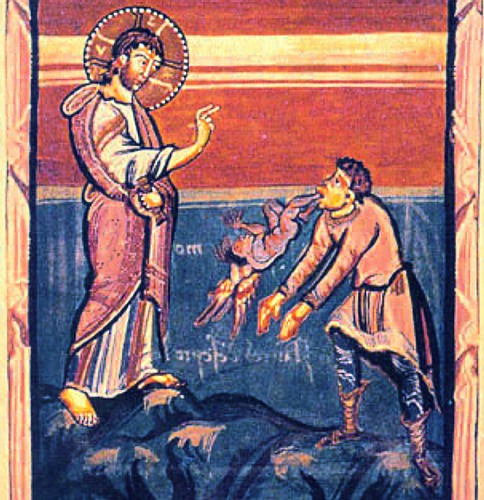
The story of the man possessed by Legion in the New Testament is utterly striking. Whether you have read the Gospels or not, the story is absolutely shocking for how little it resembles what you think you know about the world. It's short, so here it is in the NSRV (new standard revised version) form (Luke 8: 27 ff):
As he stepped out on land, a man of the city who had demons met him. For a long time he had worn no clothes, and he did not live in a house but in the tombs.
28 When he saw Jesus, he fell down before him and shouted at the top of his voice, "What have you to do with me, Jesus, Son of the Most High God? I beg you, do not torment me"-- 29 for Jesus had commanded the unclean spirit to come out of the man. (For many times it had seized him; he was kept under guard and bound with chains and shackles, but he would break the bonds and be driven by the demon into the wilds.) 30 Jesus then asked him, "What is your name?" He said, "Legion"; for many demons had entered him.
31 They begged him not to order them to go back into the abyss. 32 Now there on the hillside a large herd of swine was feeding; and the demons begged Jesus to let them enter these. So he gave them permission. 33 Then the demons came out of the man and entered the swine, and the herd rushed down the steep bank into the lake and was drowned.
34 When the swineherds saw what had happened, they ran off and told it in the city and in the country. 35 Then people came out to see what had happened, and when they came to Jesus, they found the man from whom the demons had gone sitting at the feet of Jesus, clothed and in his right mind. And they were afraid. 36 Those who had seen it told them how the one who had been possessed by demons had been healed. 37 Then all the people of the surrounding country of the Gerasenes asked Jesus to leave them; for they were seized with great fear. So he got into the boat and returned.
38 The man from whom the demons had gone begged that he might be with him; but Jesus sent him away, saying, 39 "Return to your home, and declare how much God has done for you." So he went away, proclaiming throughout the city how much Jesus had done for him.
I hope that wasn't too long. The story is told by Mark and Matthew as well, and although there are variances in Matthew, the story is basically the same. Do you notice anything missing in this account?

Come on, folks! You've been watching your horror movies. You've seen your television shows, like "Supernatural." Where is the war? This is the only actual dialog between Jesus and a demon in the Bible, and the demons aren't hollering defiance and war. They are not vowing revenge. What else is missing? Here is a man possessed by many, many demons -- enough to take out a herd of swine -- and he can break chains, so you'd figure that he could do some serious damage to the village, right?

This is strange.

If you want a Left Behind "Rapture Ranger" going to war with your Christian soldiers and counting on the Mighty Fortress that is our Lord, then this story is frustrating in every possible way. The demons manifest their evil by making their victim hurt himself. They show that they are demonic by being remorseful and despairing. They do not fight Christ. Instead, their first reaction is to ask if He has come to give them their torment in advance, because they know that the torment is coming. In other words, they are fully conscious of their guilt, and they are fully conscious of the fact that they not only will lose the struggle, but that they should lose the struggle.

What do they do when Jesus sends them into the swine? The compel the swine to drown themselves.

"Legion" is despair. The man with these demons suffers exactly as a person would who has the more malignant form of the disease depression.

This tells us enormous amounts about "demons," and despair. An animal, a pig, that held human despair would charge off a cliff. It could not endure the suffering. A man, imbued with reason, would instead harm himself. His elevation above the animal means a greater capacity for suffering because of consciousness, because of futurity, responsibility, and morality.

If you wish to see the story of the possession as a metaphor, as many no doubt do, then, just as other "demons" were epilepsy, this "demon" is our Scriptural evidence of depression. The man possessed by Legion is the patron saint, more or less, of those who suffer despair. The disease, when it comes from disease and not events, is like a herd of maledicting spirits: each voice speaks ill of every event, or even every lack of event. Each night is spent with a foreign, invading spirit turning the resting mind to whatever thought is most ill to the sleeper, and every morning sun is cast over by the clouding demon that calls it too hot or too late or too early, and the ledger is kept by demons that only know debits against the account.

The man who dwelt among the tombs was afflicted by the army of evil despair, and so there was not one thing to remove. Had his friends told him that the day was fine, the next spirit would have said, "Yes, but I have accomplished nothing in it." Had a loved one pointed to all that he did, the next voice would have said, "But it is too late to do any good for anyone." Like poisonous mercury, it would fracture and reassemble with one effect but as many bodies as necessary.

I only saw this meaning in the story this week. You may not think the story illustrates despair, but you cannot evade the despair of the demons. Frozen monks speculating on spiritual warfare are finely metaphorical, but this is Gospel, and we do well to consider it first, and those people who have a vested interest in war metaphors in their religion need to find some justification for it. Jesus won that fight already, but we can lose it all with violence, civil war, hate, and despair.

Saturday, April 24, 2010

Half a Real Good Time (Together)

"We are born crying, live complaining, and die disappointed." -- Thomas Fuller.
Fuller's statement is one of my favorite aphorisms. It's one of those great efforts at summing up the human experience in terms vague enough that no one can disagree and pointed enough that no one can repeat the statement without being in the author's own mood. In fact, Fuller's statement suffered reiteration in the 1980's as, "Life sucks, and then you die." That, however, misses the power and nuance, and so I offer up the following:
For immediate release
Order to printing press for vinyl bumper sticker run
Distribution: all truck stops and Affiliated convenience shops:

"Life sucks, and then you die, and you never got what you asked for on your birthday."
Well, be that as it may, there are umbrellas people walk around with -- little devices they have that offer shade and dry, where they can believe that what is inside in aspiration is outside in reality, where they can know that the other people -- the very ones most often known as "Them" -- are exactly the same. It's a vital piece of equipment in a post-imperial age. When you are a member of a group that reaps the benefits of the whirlwind of trade, when the colossus of your state plants its boots on the peoples of the world, when you are secure and know what it means to be a proud member of your national group, then you are most in need of reassurance, most nervous, most afraid, most jealous, most impoverished, most a twitch, and sun struck.

Speaking of which, I have some bad news and some good news about the near future for you all. First, the bad news:
1. Someone is writing, right now, a Twitter novel.That person is writing a novel where Twitter is a character or setting or metaphor or theme, and the magic of Twitter will be the motivation behind the largely bankrupt author, if not the complete thoughts.
The good-bad news:
2. That novel will fail on artistic and commercial grounds and will not last.
Samuel Johnson famously showed himself a blockhead who allowed his personal distaste for an author to overshadow an appreciation for what was in a book on more than one occasion. One was dismissing Gulliver's Travels as just requiring imagining big people and little people. The other was saying, "Nothing odd will do long. Tristram Shandy did not last." However, there was, perhaps, a deeper truth in his crankiness. No one could, after all, really imitate Sterne -- even Sterne. The structural complexity of Gulliver's Travels is far less spectacular than A Tale of a Tub, even if the satire is sharper and more philosophically interesting and developed from a position of simple defiance. Thus, any person who attempts to celebrate the lightning's flash and write an ode to it while it is yet splitting the sky is ... well ... a fool.
Don't worry, though: I have no praise for the Tweeties. I have no interest in explaining why, in particular, your great Twitter novel is going to flop, or why your deep fantasy novel about Wikipedia is an abortion, or why your novel comprised of faux Facebook pages is a wreck in ruin. If you don't understand why already, then I place my muddy mitt on your head and give you my nicotinic blessings. Instead, in my fey way (Fey Wray?), I want to wander around the subject of why people, despite never being inclined to read anyone else's celebration of new sensations, still think to themselves, "You know what? This... this right here... this is great! This is the new Woodstock, or Eden. I need to write about it, sing about it, paint it, sculpt it, and bore the stuff out of everyone talking about it, and then I must convert them."

Answer the following question:
When more than ten people gather together, they will behave:
A) Like apes in a small cage
B) Like ladies and gentlemen
C) Like a community
D) Like people on an elevator: striving to get away from one another as quickly as possible.

When more than a thousand people gather together, they will behave:
A) Like a small town
B) Like a club that needs to black ball members
C) Like a tribe at war
D) Like independent individuals cooperating as little as possible.

That, friends, will explain all. If, to the first question, you answered A or D, then you are probably incorrect, depending on case. Presume that the people "are gathered." Some thing has provided an access point for convergence. The greater the power the individuals have over the access and collection, the less coercively they will behave.

Right now, the mania is Twitter. I say "right now," but I could, of course, be out of touch. After all, Marx argued that any superstructural artifact is ideologically meaningful only so long as it is not reified and objective. (What? You're surprised to find Grundrisse here?) In other words, by the time someone can say, "Hey, there is a great music scene in Athens/ Austin/ Chapel Hill/ Seattle," the scene is dead. It was active only so long as it was so puzzling that no one had a name for it. The moment it has a name, it has borders, and when it has borders, it has a place in the cultural lexicon. The Twits are a little different, but I'll come back to that.

See, when people gather and begin to subvert or play -- and play is subversive by its nature -- and when people gather together and cooperate (and cooperation is subversive, because it is also offering up a goal that is in miniature or distinction or separation from the ideological), they get a big rush. The thing is happening, and, while it is happening the people stumble along. As soon as they stop stumbling, as soon as they meet a threat, they have to defensively come up with a name for what they're doing. They have to have a "vision" that the threat is not.

While a thing is underway, the activity attracts society. However, there is an irreducible Bozo percentage (sometimes including the Zoso percentage, which is made up of people who believe that they're on a vision trip). Marx never discussed this, and neither did Freud, but there is a percentage of humanity that is a dick. Sometimes these are participants who fail, sometimes "outsiders" who want the energy for their own, sometimes "enemies" who oppose what they believe to be the ideology served by the activity. It doesn't matter. They are attracted to joy as surely as a flea is attracted to blood.

The music scene gets flooded with immigrants "just like REM/ Windbreakers/ Superchunk/ Pearl Jam." Trolls show up at the Usenet group. They then show up in web forums, as soon as they're invented. "Jimy issogay" articles appear at Wikipedia. SecondLife gets filled with porn. The various user-generated dictionaries fill up with private, elementary school physical impossibilities and slander. YouTube gets evil troll raters and "memes" of derision. The original activity, whatever it was, might attempt to fight back by adopting power or regimentation -- both of which being the white flag of defeat. When it's all over, the corpse in the grave, the grave paved over by a super highway, Hollywood will make a movie about the hot new scene.

Twitter is Citizen's Band Radio, in other words. CB was Ham radio. In each case, these were "fun" and "addictive," and the remarkable thing was that "everyone is nice." There were no evil people there, and "experts were shocked" that humanity was nice. CB radio was, for me at fifteen, what Twitter is now. "It allows the People to be free," the mantra went. "Look at the oppressed expressing themselves," the voices said. Ubi sunt?

The difference between a music scene, an art scene, a film project, or a theater project and Twitter or Wikipedia or CB Radio is not in what makes us go. We go because something contra-ideological is taking place. The difference is in the precondition of the technology. CB needed the radio, and Wikipedia and Twitter demand the servers. Each has a ticket price and a location, and therefore each attracts the inevitable irreducible dick percentage that will make it unpleasant and force the community into staleness, and each also has a magnet for the equivalent of that Hollywood movie. Each dangles a lure for investors, states, power trippers, and owners of thought, claimants of benefit. (Listen to Jimbo Wales take credit for Wikipedia some time. The Twitterers haven't done that, yet. Give them time: venality is a disease.)

We will jump at Twitter, and the next thing, because ideology is one of those rooms in a horror movie where the ceiling and floor move toward each other, crushing us.


Wednesday, April 21, 2010

The Whole of the Ass

"Positive ideals are becoming a curse, for they can seldom be achieved without someone being killed, maimed or interned." -- E. M. Forster


With apologies to the delicate Mr. Forster, it seems that positive ideals are all the world these days, but one should in no way believe that for being "positive" that they are designed to add, to supplement, or to achieve progress. They are, instead, ideals of certainty, ideals of propulsion. They are creeds, banners, slogans.

On my desk, I have a photo, framed, that I got from despair.com. I recommend the site, and I will link you directly to the place, so you can buy your own. It says, "It's best to avoid standing directly between an ambitious jerk and his goals." That's a motto, for me. The people who come in see it, smile or laugh, and share a sympathetic nod, even the ambitious jerks whose paths I am avoiding. This is not merely because, "Satire is a sort of glass wherein beholders do generally discover every body's face but their own," as Swift wrote in A Tale of a Tub, but because, in this case, the satire and the satirist seem to apply generally to the folly of the world.

You see, if you look about your work place, you will notice a great many jerks, ambitious and otherwise ("otherwise" includes bitter, vindictive, small minded, guarding, shredding, and oblivious), but you will notice one central thing about them: there are those who cause reactions and those who react. The ones who make everyone else react and compensate are the asses. (I do not mean that in the vulgar Usonian corruption of "arse," either. I mean it the way a dictionary would mean it.)

Back in the 1980's (beginning in the 1970's, I suppose), business manuals and business schools began advising, training, praising, and paying people to become "Leaders." Dingleberries of all flavors began reading Musashi and fancying themselves Samurai. They taught themselves the "art of the kill" and looked for "Human Resources" and "assets" and other mil.net junk. They sought, in short, to be not testosterone infused -- all of my feminist friends with their analyses of the homosociality of the corporation have valid observations, and all of the feminist analyses of the boardroom's hostility to the female are accurate, if historically bounded -- but asses.

The Scythians were set in flight by the braying of an ass, according to Roman historians congratulating themselves on defeating Mithridates.

An ass is excellent at going the direction it is already heading. It is not so good at adapting to circumstances, however, but the ass is not particularly interested in those circumstances in the first place. Alternately saturnine and sullen, so long as its actions are unhindered, the ass goes forward or kicks back.

Look at your workplace, I say, and you will see that you are reacting to a jerk. The person you spend all of your time trying to make up for, trying to compensate for, trying to mitigate, is almost certainly an ass. If you are not doing so, then you are an ass. If you feel that things are pretty much in good shape, except that people won't do what you tell them to do or want them to do, then you are an ass. The ass has a direction.


In the political sphere, we are in a pathetic place right now. We have a technocrat President. The last Democratic Party ass we had as president was Lyndon Johnson. Bill Clinton was something else. He was a negotiator, a mediator. I'll get to these people. In some ways, they're the worst of the barnyard. The technocrats are extremely competent. Competency is the new loyalty, one D.C. insider quipped (reversing a satire of W. Bush, who substituted personal loyalty over knowing how to do one's job). He is also a great orator, of course, but he's not an ass. His opponents, though, are filled with "positive ideals." They're positive that an ideal world will have "no government" and a strong military, and pure state's rights, with the federal military giving them Predator drones to shoot brown-skinned immigrants, positive that the ideal society will be "free" with more prisons and dissent will be "free" and arrests for communists will be a matter of course, along with phone tapping. Their positive ideals make no sense whatever, but that's because they're ideals. They're not real and not designed to be real, or even in contact with reality.

So, what do you do, if you're not an ass, and you are deafened by the braying?

I don't know. Why would you think I would? I put a sign on my desk that I purchased on the Internet, so obviously, I haven't a clue.

I can tell you some things that don't work, though.

One of them is to believe that the ass is really a dog. If you believe that the animal is expressing reasonable demands that simply need to be heard, decoded as cries for help, and addressed in a meaningful way, then you are going to get your head stove in or staved in. I know a person like that. He keeps attempting to mitigate. By avoiding all anger, especially his own, he believes that it can be averaged. This is how he was raised, no doubt. "All of us are equal, and all are alike," the dictum goes, "and no one is bad."

That's true, but people do bad things, and people resist improvement, and, while you are getting your catcher's mask and the rubber bullets and the sticky foam, they're gnawing at your leg or burning down your farm. This is a high price to pay for the "virtue" of not being positive, yourself, of not being aggressive.

This deluded person is not the negotiator. He is, instead, so passionately afraid of the jerk, the ass, that he is refusing to admit that he, too, is a beast, that there are beastly qualities. The negotiator, on the other hand, knows full well what an ass is. He's a jerk of a different stripe, because he's an advertiser, a pitch man, a confidence man. He is running numbers while he's counting change and talking about the weather. If he's complimenting your shoes, he's wondering how to convince you to make yourself naked. He wants to use Aikido on you. Your own impulses will be channeled gently so that your jerks become his impulses. If they can't, then they render you neutral.

The negotiator is a jerk with a smirk.

My method is more common, more defeated. I take Pascal's advice and try to tend my garden. I cannot, though, because the asses are tromping up and down the halls and trying to bellow at me. Therefore, I opt for a separate peace. Each time, I look at their positive ideals and try to negotiate harm reduction. My day is spent in a constant calculus of injury prevention, seeking the grand prize of inertia against all of these unbalanced forces.

My method does not work. It requires constant worry. It also means reaching inside for every resource: aggression, resentment, satire, isolation, and positive ideals of my own. I have to rummage through the entire quiver for whichever tool, whichever prick, will turn the beast aside that is at my door. Most of the time, though, I try to stand off to the ass's side.

Asses have lousy peripheral vision, what with the blinkers and all.

Such as me are the worst. We are worse than the people who lay down grease, trying to figure out the best trajectory for the kicking noise box to go when it begins its charge. We keep suing for peace on terms of our own, keep ditching our allies. We do so either because we are exhausted or because we are wise, because we are clever or because we believe it is not worth the bother to try to grab the reins, because we're missing fingers from those squared teeth already or because we're Scythian savages who want to ride the plains unhindered, but we do so. We strand our friends. We leave the creature to hoof up and trample down everyone else's garden, so long as our precious carrots bloom.

An ass cannot get a good head of steam up, unless timid or grizzled people like me duck out of the hall. The positive "reformers" who want to "take our country back" (from whom they do not know, exactly, except that they are sure that once it was theirs and now it is not, and they feel the loss, even if they cannot measure it) need the freshmen in Congress who want to be unnoticed, the veterans who want to calculate that these groups come and go, the compliant reporters who feel that the crazy sells and the fact checking bores (and takes up time). The office jerk cannot make everyone react unless "everyone" decides that hindering that creature's momentum is certain to be an effort without allies and, in so doing, assures the next victim that blocking the beast will be done alone.

As for positive ideals, there is one:
Isaiah 11:8: And the sucking child shall play on the hole of the asp, and the weaned child shall put his hand on the cockatrice' den.

An ass or an asp. Either way, it would be the New Jerusalem.

Monday, April 19, 2010

Lost in Hammanchia


If you see the newly released-to-DVD "Defendor" and do not recognize that you are watching a pure adaptation of Don Quixote, then it is not your fault, nor the film makers.

Let me exonerate the film maker, first. Peter Stebbings wrote and directed the movie, and that's a pretty good sign that he had something on his mind. When one encounters a film with a writer/director, it usually means that there is something literary or otherwise hermeneutic going on. Some surfeit of signification is going to be either on or behind the frame. In this case, the adaptation is lovingly crafted and detailed. The film shows the sort of obsession to Cervantes and brief, synecdoctal allusion that only a man in love and meditation could come up with.

"Defendor" is note for note, beat for beat, refrain for refrain, Don Quixote. Perhaps other directors went mad chasing the mad don, but Stebbings managed to capture him complete in his audience interaction, if not his social significance.

You see, the problem with Don Quixote is that he refuses to be actually heroic. He loses his fights. He refuses to be a voice of virtue, too. His notions of virtue are based on hyperbole Romance conventions. He is nuts. His side kick is the hero, but he refuses to be heroic, even in his anti-heroism. The villains are villainous, but not special. The audience is required to laugh at the ... this is hard ... are you prepared? ... disjunction between the real and the language. What's funny about Don Quixote is the perception of reality held by the player(s) and the author and the audience. The three different voices (and they are at odds with each other) change places in levels of seriousness and virtue, but they always present a gap, and that gap is ridiculous and satirical. In Don Quixote, we are sometimes satirized, as readers, for reading junk, sometimes satirized for letting the world be messy, sometimes satirized for being a mob, sometimes satirized for overlooking peasant wisdom, sometimes satirized for trusting in titles, sometimes satirized for our use of wealth, sometimes satirized for not trusting more. There isn't one message involved, but a dozen.

"Defendor," believe it or not, manages most of that. Arthur, our "Defen-don," is retarded, and that is the greatest difference, and the most troubling problem, with the adaptation. (More about that later.) Other than that, he is a man who has taken his comic books and comic book movies seriously. This is a film that gets to parody film's own excess, and in film's own language, but with a character that gets to be Cervantes's narrator. He loses his fights. His "hooker with a heart of gold" doesn't have a heart of gold at all, but she doesn't have a bad heart, either. She smokes crack, but, in the film, it's called "Bling." Bling is not simply a random substitution, either, but a clever comment on what fills the wound. She's normal, and that means unrepentant. Defendor's villains are villains, but they're not super villains. His arch-enemy, like the wizard that Don Quixote chases, is an amalgam of lost hopes and disappointments that points at a real arch-villain.

We, the audience, are put through the same knots of emotional response with "Defendor" that we are with Don Quixote. More to the point, we have to laugh mainly at ourselves. We have to recognize that we ignore the construction workers holding the sign saying, "Slow" (as if a label or badge pointing at themselves). We have to recognize that Captain Industry is, indeed, an arch villain who is destroying mothers, even if there are more immediate villains, like the bad dry cleaning store owner who knows he is bad. We have to admit that we built castles in the air out of wishes and castles in Spain out of denial.

The film's Sancho Panza is a man who, like the book's Sancho, knows what he is: he is decent. He reaches out and takes in Arthur Poppington ("Defendor"), and he receives no island for his efforts (except the island universe of a small house with a family in it). His normal world and normal life is a deviation from Don Quixote, as is Defendor's retardation. This film's theme is more concerned with the subject of virtue and vice (in the law enforcement meaning, as well as the theological meaning) than Cervantes's was. Our Sancho tells his updated idol that there is no need for illusion, no need for delusion, that ordinary heroism is sufficient. This Sancho does not follow: he rescues, and he counterposes a separate world, a genuine separate peace.

This message gets rejected, at a critically important moment. Rejecting ordinary heroism means rejecting ordinary methods of heroism as well (including ordinary preparation), and Defendor must have his illusion to define him, as the Don must have his madness. However, because Defendor is compromised by retardation rather than delusion, some of the power of the message is lost, and a good bit of the moral sting is lessened. There is too much of an opportunity for an audience to say, "He couldn't help it: he was retarded."

I applaud the film. It is amazing. Except for the fact that some audiences could excuse themselves from being better by saying that Defendor was compelled, "Defendor" is a vital movie.


Here is where it goes all pear shaped, though: why didn't you see this movie at the theater? It stars Woody Harrelson and has other well known character actors.

Well, it would have come out near the time that "Kick Ass" was coming out, I suppose. "Defendor" is Sony, and "Kick Ass" is Lionsgate, and I will allow the people who think about Hollywood things to think about those things. "Hollywood" is not a place: it is a business model, and I, personally, do not care for it.

"Kick Ass" is a juvenile wish fulfillment movie, and, as such, it is designed to compete for the acne creme and Twinkie audience. "Defendor" is art house. This Venn diagram shows no overlap at all. I understand that the marketeers have no concept other than Pez dispenser tie-ins and clothing lines for toddlers, and "Defendor" seemed to have its own clothing line built in (just as "Don Quixote" would), but that's not, I think, the reason.

I suspect that the reason is that you, the audience, are being calculated again. You are intelligent, but your intelligence does not show up in the counterweight of their scales. They believe that 100 intelligent people per 1,000 is not good business. More to the point, they do not understand Don Quixote and are certain that you do not, either.

You can be forgiven for not understanding Don Quixote. You've probably never read it, at 800+ pages, and you've almost certainly never seen it. Filming a novel is iffy. Filming a novel and capturing its aesthetic or aesthetic action is rare indeed. Worse still, there are "movies" of Don Quixote that stand between you and the novel.

First, we have the attempts at recreation of the novel. Recapturing and recreating the novel, of filming it, are valuable. However, filming all of it would be the sort of project that Eric von Stroheim and Abel Gance would have to have teamed up on. Additionally, there would be no way at all to capture the narrator in a film. Finally, the disjunctions that created an entire genre (the mock-heroic) would be absent, as the audience would simply see an old man being whooped upon by mean people. Nevertheless, there are attempts at such recreations. People have seen them.

I have no bad words for these films. If you know the novel, the films are nice.

Secondly and more destructively, though, we have the appropriation of the novel's aesthetic by The Man of LaMancha. That musical and film has utterly obliterated the novel. We cannot even see or hear the don for its dreamer dreaming the impossible dream. From a mad fanboy, the don has gone to hippie dreamer on a quest for self-actualization. Try to imagine making fun of him, and see how far you get.

I have greater admiration for "Defendor" than you may imagine because the writer/director had to fight against preconceptions and a miasma of appropriation to retake the don. That he did so by actually adapting Don Quixote instead of filming it is even more to be admired.

Sunday, April 11, 2010

Just because...

Just because you don't see a post, that doesn't mean one isn't here. It just means one isn't published.

Just because you can't see yourself, that doesn't mean that you're invisible. It means that your face is too swollen to allow eye movement.

Just because you don't hear any news, that doesn't mean that you have peace of mind. It means that you are unaware of what your enemies are doing.

Just because you found a way into the mirror, that doesn't mean wonder awaits you. It might mean that the reflection meeting the object will result in complete negation.

Just because you're not guilty, that doesn't mean that you're innocent. Many people are blameless and entirely worthless, both.

Just because you have to pay an income tax, that doesn't mean that you are taxed then. You were taxed anyway, and always farther away from the point of your daily needs, the more affluent you are.

Just because you cannot hold down a job or complete a sentence or maintain a regional dialect for more than a few weeks at a time, that doesn't mean that you're not a "star of the Republican Party." There is a good chance that you are, in fact, a star of the Republican Party, and, with three colleges to get an associate's degree, superior to a law professor when it comes to the U.S. constitution, superior to Ph.D.'s in climate science when it comes to global warming, superior to Nobel Prize winners in economics when it comes to taxation, and far ahead of people getting the daily nuclear threat briefing and non-proliferation reports when it comes to nuclear weapons policy.

Just because people tell you that you're a lumpen monster, that doesn't mean that you're not entitled to run the joint. If your name is Caliban, Prospero's books might have made you, but that doesn't mean that you have to listen to him.

Just because you're sore between all of your hinged parts, that doesn't mean that you've done something wrong. Debauchutantes are the new entertainers on all levels of society, and they're widely
admired.