Saturday, March 17, 2012

How We Fight

Pelham Bay, Bronx, NYC

"You give a head of canvas and oakum an expression of anger and leave it with it, with the convulsion, the tension enclosed once and for all, with a blind fury for which there is no outlet. The crowd laughs at the misery of imprisoned matter, of tortured matter which does not know what it is and why it is, nor where the gesture may lead that has been imposed on it for ever.” – Bruno Schulz, The Street of Crocodiles, “Treatise on Tailor's Dummies.”
The title "Why We Fight" was taken, twice, so I figured I'd look today at how we fight, presuming only to answer how we fight without our bodies and without our bodies' extensions -- weapons. Again, only because I can't stand the competition, and there is an enormous amount of competition on "how to fight" with and without weapons for Internet readers.

Sometimes we fight because of a proposal or a clash of viewpoints. It happens, but it happens very rarely. Present tense fights are dialogs that become a list of charge sheets, and the charges become battery.
"Dodd-Frank is more regulation, and it's killing the banking industry. In fact, that's why no one's getting a loan."
"That's crazy. Dodd-Frank hasn't even been funded, so how it can be killing anything is beyond me."
"I know a guy who is on the board of a bank, and they had to hire someone just to keep up with all the regulations and make sure that the bank could fill out all the new paperwork. That's 100% Dodd-Frank, and that's profit that should go to the bank instead of the government."
"What the? If they hired someone, then that's good, but the money from hiring that person isn't going to the government, and I'm sorry they didn't have their books in order, but..."
"Their books were fine! This is regulation killing the business."
"If they're doing fine, they're not getting killed...."
These two people are about to fight, if one of them doesn't find a way to Zen out.
 You see, the evidence to support the claim is anecdotal ("I know a guy") and the interpretation of the data is a non-sequitur on both sides (just because it isn't funded doesn't mean it can't have an effect; hiring a compliance officer doesn't mean the "government" is getting anything; supposing D-F required funds, which it doesn't, there would be no conclusion that this were harming, much less killing banks, which are showing high profits). The two are confirming a past position with new ones, probably. One began with an allegiance to what is today called "conservative," and the other at least didn't. This meant that the fight was like enemy troops discovering each other in thick woods: the fight that happens is bloody, sloppy, unwinnable in a conventional sense, and frequently the one that survived was the one most flexible, not the one most powerful.


We fight, actually fight, not in the present, but over the past tense. 


A huge, lysurgic photo to download. Call it GFDL.A crepe myrtle holding its empty seed pods.


Our memories are monologs. In fact, the problem with people who try to write fantasy novels or memoirs from memory is that those memories can't hold conversations, and those imaginations can't actually give dialog with blocking intent or separation from the speaking mind. Our memories, then, are what she said. They are what we said. 

If I offend you, right now, you object. It takes knowing me, having an architecture of hurt and malice, six cylinders of  unredressed grievance, to get the fight going, and then there has to be an objective. Given that we're talking about fighting and not arguing, there is only one real objective, and that is to make the other person into your own image to correct her or him. Barring that, the objective is obliteration of the other person.

Why you're fighting (dang it! I know -- it's because we are free and they put no value on life and we are defense contractors) is that the other person's differences (of opinion, of outlook, of value) are so great that your memory has an object in it that needs to be addressed. You have, in your past tense, a hurtfulness, unpleasantness, and disgust, and now, 
"Of course she got the job. She's black, isn't she."
Here it is. Oh, no, not again. You warned him (in your monolog in your mind) not to spout this racist crap again, and yet....

Because you need to get rid of the disgust, unpleasantness, and hurt, you have to get the other person to 1) agree with you, 2) agree with you enough to no longer elicit these feelings, 3) no longer elicit these feelings. Fights like this are idiotic, of course, because they can't be won. The most anyone ever gets is #3, and that by silence or evasion. How often have you had or heard a fight, a real fight, where one person says, "You're right. I didn't realize that I harbored such racist views. I'll be more careful from now on?"


Outside of marriage, where I doubt the sincerity or neutrality, I've never seen or heard of it.

Outside of marriage, what people get is behind Door #3. They get silent resentment. They get, "I'll never say nothing around her again" or "She's simply insane."  However, that works. It's functional. Civilization persists. The value of the two individuals has changed, as far as each is concerned. The one who thinks he won and the one who thinks he lost each knows that there was no victory, and each thinks that the other person is foul, and now the other person exists in memory as "Disagreeable jerk that I have to watch what I say around."


The first human who hurled an insult instead of a stone was the founder of civilization.  ~Sigmund Freud
 
 What I have described is what Freud was thinking of. It means that we reconceptualize each other, sure, but civilization continues. We stay out of each other's garden, wait for the next elevator, pretend to have cramps when there is a get together after work, and generally keep an averaged piece by fighting viciously until there is silence. Our objective had been to "correct" the other person by bringing the other person's rough edge into compliance with our own smooth side.
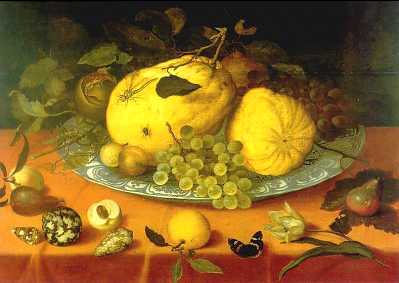
Balthasar van der Ast, Fruit with Shells, 1620
There is another way we fight, though. Remember how I said that fights are in the past tense? Remember how I said that they come because there is an affective state attached to a person before the incident that sparks the fight? Sometimes, people do not seek necessarily to get the other person to think the same things, but to feel the same things.

If you made me angry with what you did, I am angry. Now, when I call you into my office, I could explain your error and wring a confession out of you, show your error and teach the right way, ask for a narrative and see if you confess your error, or show the error and explain how that makes me look. I can pretty quickly get you to agree to never do it again, and you may do it again afterward or not, but it probably won't be lack of respect if you do.

Some people, when angry, do not want to have the other person see the right. In fact, the way the boss will explain things will demonstrate this. "So, Jane, tell me about typing up the assessment report."
"Well, I looked at the guidelines from the NEA and compared those to the SACS requirements and took the material we had submitted last year as well as this year's statistics, and I put the new data into the fields for instruments. I then changed the narrative for the learning objectives to match the updated statements, like you said to do. And. Um, that's... Oh! I called Renee to be sure that we were using the right form this time."
"And did you think about the Mission Statement?"
"The Mission Statement is listed."
"Oh really, Jane? Perhaps you can show it to me, then. Considering the fact that I distinctly remember telling you that the Mission Statement had to be at the top of every form, I'm at a loss to see where it is. I swear! First you don't put it in, and then you use the one from fifteen years ago!"
Many of us work for Executive Hardcase.
It goes on like this. (I apologize for any workplace flashbacks. I drew upon a real boss of mine for the above, where I was Jane.) Now the boss in this case is not looking to fix anything. The boss is not even being a sadist. The boss is, rather, fighting for the same objective, but a different value as other fights. He wants sympathy/remaking. In this case, he is angry, and he demands that the employee be made to feel the emotion that he was made to feel.

This is something that often separates masculine and feminine discourse in argument, as well. It is by no means always the case, but it is often the case that women will fight for an emotional sympathy. "You made me feel unhappy, and this fight is not over until you show that you feel as unhappy as you made me feel" is the dynamic of the argument. Is it fair? It's not any less fair than, "We won't stop until you agree with my logic" is. Both, in the end, are about achieving an overwriting of the other's state to show the power of the one, even as, paradoxically, they seem to be revenge. The person not letting go until fear is achieved is doing so because she or he felt powerless against the other inflicting that emotion.

The only reason I feel like sharing this guide to How We Fight is to bemoan a simple fact. The fight that depends on agreeing with propositions has a sort of annihilating draw option. There is a way to walk away in silence, with both parties thinking less of the other but peace achieved. In the instances where a person demands emotional pounds of tears, I know of no such thing. Perhaps skilled acting might work, with the cost only of integrity, but I don't know what to do with someone who wants anger from me, or sadness from me, because, honestly, that's asking for something that's not in the public sphere.


Monday, March 12, 2012

Ennervation Never Knows


"I can endure my own despair,
But not another's hope." -- William Walsh

The child skins its knee, and the pain is the worst of its life. It moans and keens with all of its mind at the unending and raging pain. The adult cuts itself with a knife while doing a routinely dangerous task, sucks air between its teeth, curses, sends reason to caution the primitive mind, invokes time's wisdom to know that all pains end, rushes to find unguents, wraps the wound, closes its eyes in mastery, and controls the impulse of pain. The older person's night time undressing reveals wounds along the legs, dried blood smears like comet tails from punctures on the forearm or thigh, and fear, a dull fear, comes up, and the older person asks itself when these damages happened, which enemies had struck during the night, and how unprotected it is against the environment, and then its reason and sense of time, stronger now than the senses of touch, say that such things are predictable and inconsequential.

The teenaged boy jostles its friends. They slam dance to socialize, because the little demons that inhabit them will not allow stillness, and looking one another in the eye would be faggy, and they rate women. The most imaginary flaw could cause emesis or impotence, they claim. Else nothing could stop their mighty virility from accomplishing its mission, but they would demand that the waif lose weight and the buxom woman get enhanced.
Their oppositely arrayed army mourn the imperfection of all the boys and perfection of all the imaginary men. Those who breathe are vile, and those who shimmer on screens or reflect from pages have every desire locked inside them. These here are immature -- a just complaint if ever there were one -- but those. . . those understand. Those are prettier, kinder, and listen.

The older person fails to notice. The mate, even the child, was a formula solved some time earlier. Since that time it has remained an integer of certain quantity and an attribute of certain quality. Only the things that are jarring, disagreeable, unsolved show up, and these as things that will not rest, will not allow the natural process to go its way. The woman cannot believe that the man isn't taking things seriously, as he is happy all the time, which means that he is indifferent, and the man cannot believe that the woman can never be satisfied, as things are not in crisis, and they have both formed conclusions. It is now just a matter of time between fights and resolution.

Ahem.
Sorry about that. Rather grand sounding, isn't it? After all, it is the way of us to be fresh and then grow stale, to lose connection to our sense of each thing as time goes on. People speak of the senses growing dull. Ears, eyes, tongue -- each has its own diminishing returns. However, there is also a simple process of ennervation, whereby the nerves running to these senses decrease and our ability to feel decreases. Ennervation is aging, and all of our awareness follows the pattern of the physical.
"I've got a wild man wizard, and he's hiding in me.
Illuminating my mind." -- Harry Chapin, "Taxi."
In youth, a fantasy strikes, and it fills up the horizon, fills in the holes of the heart left by disappointment in strength, attention, love, accomplishment. In youth, we can devote days to exploring our other selves: the knights, the shield maidens, the saviors of D-cup desperate women wearing thin their leather bikinis, the neglected beauty of the realm of power discovered by the lovely man, the radioactive scientist, the battle hardened soldier of either sex, the gang star, the respected woman who wins all she desires by her fire-hardened femininity and toughness, the cowboy, the Indian, and we can write it out in dreams -- visual, poetic, waking, sleeping, and prose.
"Julie Daydreaming," by Berthe Morisot
  As adults, we toy with our psychic familiars, pulling them from the closet in times of stress, embarrassed to be seen in public with them. Older still, we cannot capture even a half hour of what was once whole days of fascination, and we have no patience for reading or seeing another person's dreams realized. 'Oh, that fantasy book series is treacle for teenagers,' or 'That series on HBO is some middle aged guy's fantasy life; whoopee for him,' we say. The truth is that we feel guilty looking in at what we had.
I do not mean to complain of time's many gifts.
"Death and the Girl," Ego Schiele, 1915

 Our greatest desire, when young, and we do not know it, is to be free of the "insane and furious master" lashing us (Republic 329), lust. Our greatest desire as adults is to cease being the half-persons that everyone since Aristophanes has said is the way of sex (Aristophanes says, in Symposium that we were one ball, and we were trying to be gods, so Zeus split us in half, into male and female, and now we spend all our lives trying to reunite). In age, we can call on lust unreliably, but it's there, and the raging fire becomes a steady flame.

When young, a disappointment leaves us screaming our nights away as surely as the scraped knee left us howling as toddlers. Anger goes to destruction. We wish we could escape our own ability to feel so deeply. Time takes care of that, at least for a while.
By practice and discipline, we can tame the winds of youth. There is less to help us feel again when the nerves no longer connect. And, at last, when they reach no farther than the mind itself, there is no place for feeling to go but to the mind itself, and we go back again to our impulse, desire, and wish.

Monday, March 05, 2012

Once

I have found myself in the unenviable position of explaining punk rock to a generation that has no contact with it. It has heard the term, but the meaning of that term is at least doubly remote. It is remote in the sense that any musical movement is a fossil due to the destruction of radio, and it is remote in the sense that whatever this movement denoted, it simply is neither spoken of in a coherent manner nor played on whatever musical media as exist.
Photograph by Man Ray

"Well, like, um, The Clash?" crickets. "Ok, Blondie?" Nope. "Talking Heads? The Police? The Buzzcocks? Joy Division? The Ramones?" They have, some of them, heard of The Ramones, largely due to the habit of set decorators and costumers in Hollywood to put Ramones paraphernalia in television shows and movies. Now, a fair amount of what they have heard is punk at two removes, but the all stars of 1977 - 1985 are unknown to them.

Honestly, it is not germane to anything, and so I should not spend precious seconds mentioning any of this irrelevant history to college students, as both the free market and the shifting historical record that is culture have determined that what changed my world has been erased, but I have devoted perhaps five minutes, total, to this task, and I usually mention, as an example of the kind of punk I was, Talking Heads. I'll focus on what I think is the song they're most likely to have heard, "Once in a Lifetime." (Actually, "Burning Down the House" is more likely, I guess.) I tell them to imagine that they woke up one morning with complete amnesia. Imagine looking at their lives without any history at all. Just look at where they are and who they are at this exact moment. Cut a slice through time like a slide under a microscope and examine it. What conclusions would you draw?
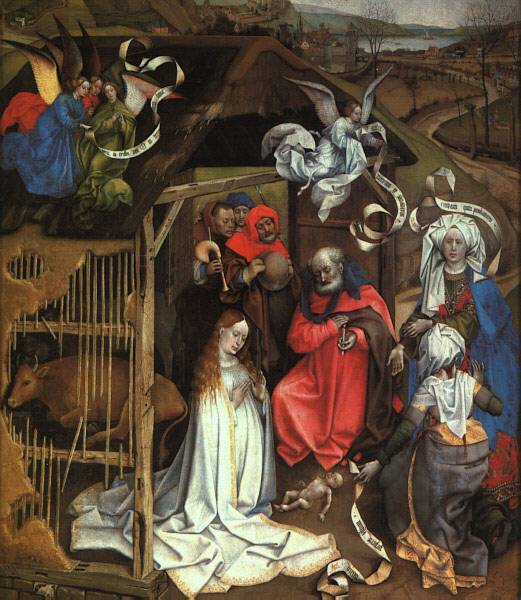
The Nativity, Robert Campin

"That's deep," they say. Yes, I say.

W. H. Auden squeezed a whole anthology entry out of Breugel, so I figure I can use the Master of Flemalle for a blog post. Auden was talking about suffering's banality as a corollary of the banality of evil, though. If the Nazi executioner might look like a businessman, then the martyr might look like a piece of paper crossing that businessman's desk.

What I try to tell kids, from David Byrne's artistic game, is about the nature of hierarchy in time, how sense-making depends on time and how lost emphasis is without priority. When I was a collegian, exploring everything, sticking my tongue into every crevice and trying to pry the lid off of every jar, Mr. Byrne was always the upper classman I admired. He was ahead of me intellectually and creatively. He had cooler friends, and he did the drugs I never would, but he and I were thinking along the same lines, but I was following.

Now, I have probably caught up with him intellectually. He still has some mighty cool friends, and money frees him to a courage that I will never have. Reading his journal, I have to say that he's awfully interesting and still more creative than I'll hope for, but he's no longer commanding spaces I haven't seen.

We were both interested in the idea of how the createdness of art altered its experience. We both wondered about how everyday utterance was shaped by ritual and how poetic cadences had roles in the group experience.

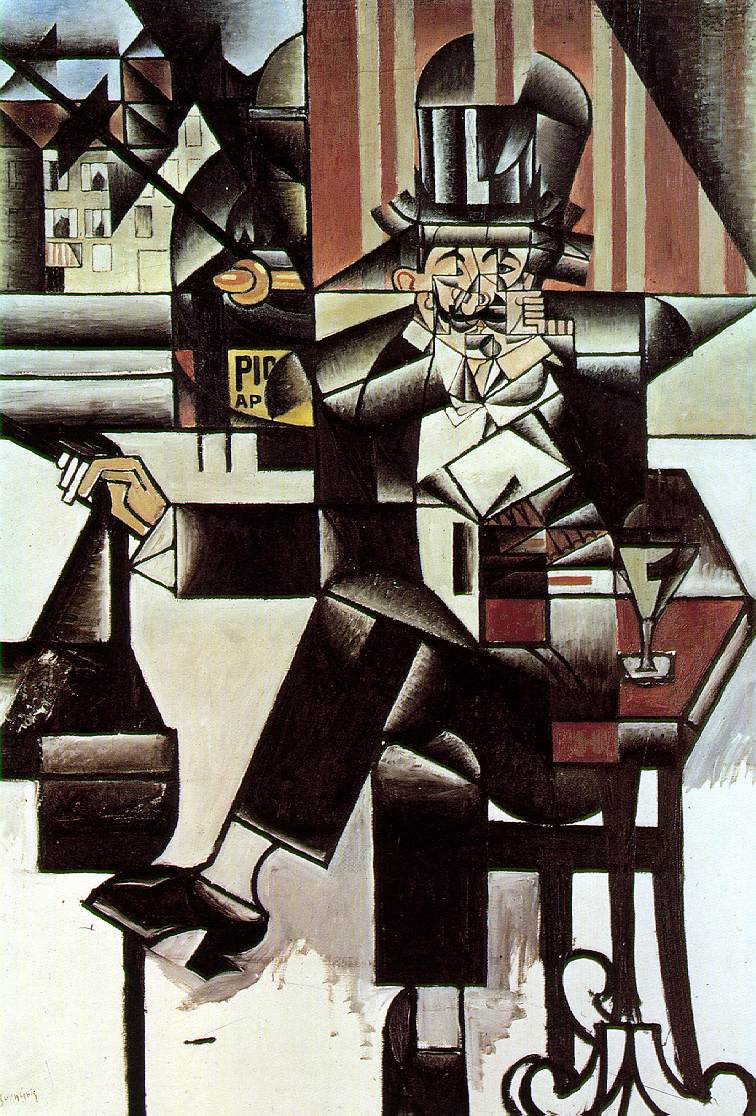
The Man at the Cafe, 1912, Juan Gris
What is the present moment?

In truth, not only do we fail to understand the slices of living and perceiving that together go into the narration that we call "our lives," but each individual moment is itself unperceived for the most part. Even without going to the radical Taoists and asking that we know all the sky, water, earth and that we lose our selves in the process, there is simply more of you than you will credit at a single time.

Your "now" is only the part of sensation and memory and desire that crosses into the organizing facility of the mind. If the ego is "the thing that knows what sort of person you are," then "now" is merely what the ego wishes to credit. There are a thousand things that a "person like you" or that "you, in particular" would not care about that are happening to and with you at this instance, and these are silent. They leave no impression on the tablet.

I do not know what is happening. I only know what I said happened.

One time is no time, after all, because we are continuous if we are at all.

Thursday, January 19, 2012

Why is the Gin Grinch saying these mean things?

I'm thrilled that Newt Gingrich is getting some of the negative attention that he has deserved for decades. He has enjoyed a Pat Buchanan like existence -- uttering troglodytic slogans, spitting poison, retreating to a cavern of stink, and always, always, always getting paid. Finally, though, his millionaires have met up with Romnoid's millionaires, and Newt's getting Newtered.

That said, he hasn't changed. There are three stages of a newt's life cycle. There is the newt in repose, when it gathers resentment and money, the newt campaigning, when it empties its bladder of all the stored resentment, and the newt sunning itself on the rock while in office, which is the time it picks on flies and claims to be defeating dragons.

However, Newt Gingrich, from Pennsylvania, found a niche in a defense contractor dominated area of Atlanta, and he migrated into that area and expanded to fill it completely. When he lost his position in Congress, he played dead, perhaps, but he is an old pro at playing possum. Once he was no longer Speaker of the House or minority or majority whip, what was the harm in putting him on Meet the Press FIFTY-THREE TIMES? After all, as an unelected, non-policy person, who could be more germane for a Sunday show?

I know that Mitt Romney is supposed to be the "perfectly lubricated weather vane," but Newt is self-lubricated. As for where he points, it is not where the voters push, but where they pull. Himself, he goes here and there, spinning as ego and carnal bliss may lead, but as a campaigner? He has one trick.


It seems tone deaf, if not suicidal, for Newt to go for the racial folderol, doesn't it? Even an audience that booed Jesus Christ applauded (lightly) when Juan Williams pointed out to Gingrich that his garbage about "Food Stamps" seemed racist. In 2008, the United States elected its first African American president, and it did so with a huge popular vote margin. Racism, qua racism, doesn't really win.

It's just that Newt is a salamander of habit.

We got our first taste of "strapping bucks" buying T-bone steaks with food stamps in 1980 from Ronald Reagan. It is possible that, in this age of more-lunatic-than-Reagan economic politics from the Republican Party, we have forgotten what Reagan Republicans looked like. It was Reagan who gave us "Welfare queen" and the "young buck" in 1976, and he kept the language going in Philadelphia, Mississippi. Newt liked. Newt learned.

Reagan Republicanism is misdirection at its most basic. Gingrich is caught. He has lost his ability to appear financially right wing, thanks to the bane of the far right wing corporate attack ads aimed at him. He has lost the ability to be the moral majoritarian, thanks to all the stained bedsheets being waved about. These are his winning issues! He has lost his stance as the smart guy by being exposed as silly, stupid, wrong, and extremely arrogant.

He has nothing, so he goes to the one thing that always works: the flashpot distraction of "lazy Black people are taking your money." It has always saved him in the past, and it's working for him now.


The most significant problem with Newt's flashbang grenade is that the room is too small.

You see, the diversion is working for him, among primary voters who boo Jesus Christ. This group wanted to be convinced only that there was a reason not to succumb to the inevitable Mittens. He has been able to interrupt everyone else by saying, "Don't you hate Welfare queens and gang bangers getting rich in their lazy 'hoods off of your money? Have you noticed that the President is a . . . guy who helps those people do that?" They were saying, "Gingrich has no economic plans as radical as ours, has no social policies as vicious as ours, and he has been free with his penis, unlike us," since the burden to pass for primary voters appears to be radicalism. He has succeeded only by saying, "Maybe, but I'm willing to say racist things in thinly disguised code without apologizing."

The most essential problem with Newt's turn is that it's a repeat. I don't mean by that, by the way, that racists have learned anything.

Have you noticed that Newt never campaigns on his Congressional accomplishments? Wouldn't you expect the legislative leader of the Republican Party in opposition to a Democratic president to campaign on successful legislation? Wouldn't you expect him to boast of his Contract On America? In 1994, Newt announced a takeover. He had a vision. He and his party were going to flat out dictate legislation.

You see, they succeeded. That's the thing. Newt should be campaigning on all he accomplished, because he got his way!

He SHUT DOWN THE GOVERNMENT to prove that "government isn't the solution to the problem. Government is the problem." The nation did not agree. You see, the truth, which is that the government is made up of the people, that our government is us, was made quite clear. Furthermore, he CLEARED THE WAY for corporate contributions to campaigns. He set in motion the destruction of Glass-Stegal that led to the banking collapse. He enabled the merger-mania that made Mitt Romney millions. He cut the capital gains tax so that Mitt Romney could draw ten million dollars a year and pay 15% in income taxes.

Why isn't Newt bragging about all that? Don't Republican voters like what they want?


More particularly, though, Newt's signal success was making good on his promise to get rid of all those lazy Welfare queens. The Welfare Reform Act of 1995 is Newtie's. (I vowed not to vote for Clinton's second term when he signed it.) You see, Newt Gingrich killed Welfare. It doesn't exist anymore.

Under the new thing, no one may receive aid for more than three years without being disabled. Therefore, it's three years and then starvation, so no "ten kids in a Cadillac." Foodstamps also ended. Both are now state programs. This has allowed vicious states to be vicious to the poor and humane states to be less vicious, but no one is being kind, or even reasonable.

In other words, Newt has to claim to have had no successes in order to campaign on lazy people on Welfare. He would rather present himself as a failure to repeat his 1980's campaigns than give up the dodge of racism. The campaign racism of the 1980's was bull to begin with, of course, because, when Welfare did exist, it went to Caucasians at a rate greater than demographic percentages would indicate, and Food Stamps are primarily to benefit dependent children. No one is a "buck" with a T-bone, but no one ever had been.

Never mind that, though: reality is not what Newt wants. It's not what he can afford.


Incidentally, this...

This is very funny and very well done, and don't even bother trying to tell me that it isn't, because there is "well constructed wit," and that's different from "I was in the mood to laugh."

Thursday, January 12, 2012

I Get Mitt

“I like being able to fire people.” – Mitt Romney, January 9, 2012.

People complain about Mitt Romney. They say that his followers are Romnulans. They say that he is a Romneybot. They say that he is a failed experiment by the Blue Fairy, who got bored of granting the wishes to suspiciously loved pediatric puppets and decided to see if she could turn a real boy into wood.2 But I get Mitt. Mitt's a regular guy, and his quote from the Chamber Com/Mers was proof of that.3

While candidates of questionable patriotism like John Huntsman might think the sentiment makes Mittens “unelectable,” I, and CBS Money Watch's Suzanne Lucas, know that Mitt was just being a regular guy!  It's probably going to win him votes among highly successful people.4

All Mittie meant, according to Ms. Lucas (and I'll bet she's really pretty!) is what Thomas Carlyle said earlier:
Whoever has sixpence is sovereign over all men – to the extent of the sixpence; commands cooks to feed him, philosophers to teach him, kings to mount guard over him – to the extent of sixpence. – Carlyle, Sartor Resartus 5
Now that Carlyle guy's character is poor, but the poor people get to fire people, too, and Mitt's unemployed! He doesn't even get a paycheck! So Mitt, just like every other regular guy, just means that he likes being able to say no to the people who fail to please him, and don't we all?

He's a regular Joe six-pack, complaining about the government. Those guys who make more money than he does and do an inferior job. It's the right -- nay, the pleasure -- of successful men to tell off inefficient and lousy workers as you demand better service.

A highly successful American man.


I remember, once, when I was in the small (I guess it's a town; "farm," "manorial estate," and "smear" all seem to miss the mark) of Dunwoody, Georgia. This town suffered from an infestation of money. There was an insidious rot of the stuff everywhere, but especially in the homes and cars, and I was in what was then its shiny new mall, called Perimeter Mall.6 I was in line at the McFood's, but I was unable to practice my love. A middle aged man was in front of me, and he was yelling at the counter help.

The beef patty in his bread sandwich was not warm upon reaching the plastic tray, and the condiments were applied unevenly. Furthermore, the pommes frites were tepid. He demanded . . . . Well, I wasn't entirely clear what it was that he demanded. He refused a coupon and a replacement. Instead, he was telling the counter boy that HE KNEW what it took, that HE had spent years in business, and YOU DON'T GET AHEAD by giving an inferior product.

The boy behind the counter looked as though his head were about to explode.7 Myself, I wanted to rabbit punch the business expert very much. I even formed a fist with one knuckle protruding, and I was examining his medulla oblogata.8 I thought it would be easier than asking him at what point he had gotten confused and believed that he had wandered into a three star restaurant or mistakenly assumed that he had paid for food of higher... well, food.

Now, though, I get it. That was Mitt. He was firing someone.


When depression strikes, and it strikes with a wet thud most of the time,9 some people hit the chocolate pie, some people regress, and a lot of people go for “retail therapy.” Taken to any kind of reliance or extreme, buying one's way out of a funk is a disease, but going down to the hobby store to buy a $1.29 Guillow Glider can be an enjoyable lift of the spirits. Put $25 in your pocket and go to the dollar store, and you can feel like king or queen of the world. Carlyle's quote comes true: you command the earth to the extent of that $25.

You become the Disney Princess, the Man of Largesse. Go to Krystal or White Castle, and you can purchase whole hamburgers for less than a dollar. This is that necessary, joyful illusion of prosperity and comfort and, most dear of all, power over one's tiny, crashing world, that we all have available to us to some small extent, if we have some employment.

Not everyone wants to be the Princess, though. Some people want to be the Queen.
”I don't want to get married. I just want to get divorced.” – Natasha (Jessica Harper) in “Love and Death”


Mittie's one of us, you see. He likes to lift his spirits by going out and, to the extent of two hundred and fifty million dollars, telling people that they're not good enough.10

You enjoy yelling at the mail man and paper boy, don't you? Well, so does Mitt. It's just a question of scale. If you have a problem with the difference in scale, it's not because Mitt's different, but because you're envious of him. It's true that he may have to buy up a company in order to demonstrate to it just how inferior it is, has to hire it in order to fire it, but that's again just a question of scale and envy on your part.

Some children go through the “fa-da” phase. (Ok, all children do, although I promise that I didn't. I only went through the fa so phase.) This is when they demand that Mommy give them a toy so that they can throw it on the ground and demand it again. It is great fun for the infant, because it proves that the infant has power. Some infants get stuck in a pleasure principle of gathering in, and others a destructive principle of tearing down11, and that's just how it goes -- but that's totally normal, just a regular guy kind of thing. The people who get into the love of accumulating can end up being addicted to things, I suppose, but, on the other hand, the ones who like to destroy make good human resources people.

So let's all give Mittie a break. He's a regular guy. He just likes to be able to fire people. Surely that bodes well for all of us as his employees, if he becomes president, doesn't it?
==Notes==
1.
    There is no first note.
2.
     I think it is entirely unfair to the conifer and angiosperm phyla to accuse Mitt Romney of bearing any relation to them. Furthermore, although the dream of a little boy born to a bachelor could be read rather, err, curiously today (just why did Giapetto want a boy he could control?), I think that it isnot true that those who call Romney wooden are trying to contrast the Mormon church's superfetation with the Roman Catholic Church's recent difficulties.
3.
     The connections between the Chambers of Commerce and SMERSH are well known. One has only to look at the video of Romney's remarks to spot several doubtful looking individuals.
4.
     Super effective people don't read books. They read summaries on the web that are based on summaries gotten from hornbooks.
5.
     If Carlyle had staid like he was when he wrote Sartor Resartus, more people would like him today. That book was sort of the last hurrah of the younger generation of Romantics, the last gasp of aestheticism (but no one told Aubrey Beardsley that). Unfortunately, he started making kissy faces at the boots of Great Men. . . and so did his wife, I think. . . and his historical view started getting pretty oily.
6.
     This mall was named for its proud stature of riding the "perimeter highway" of I-285, which is itself a strange thing, as "interstate" 285 goes around in a circle and therefore does not go inter state at all. It does, however, mark the state of "Atlanta, those people, it, what can't come out here" and "Us, normal folks, you know?, do I have to spell it out?, nice places." The demarcation was entirely economic, of course, and completely polite. Except in Stone Mountain. And Cuming.
7.
     This was not because he was going to holler back at the cretinous monster in his face, but rather due to the state of his acne.
8.
     Look at your dominant hand. Clench a fist. Now, stick your second finger knuckle out a bit by means of bedding the nail of that finger against your thumb. Be vewy vewy quiet as you approach the important business executive. Smile and stand behind him. When you hear, "Oh, sure, Obama wants to tax the top 2% of our income, but then it'll be 50%, and it's like Russia" or some other bit of insane certitude, bring your dominant hand back even with your ear, and strike quickly at the base of the offender's neck. Laughing hysterically or jumping up and down in glee is not necessary.
9.
     It can also fall like night, creep like a thief, strangle like a pillow, drown like a flood, massacre like a battallion of syphilitic cossacks, snipe like a myopic sharp shooter,  or overpower like a 1949 Oldsmobile sedan being swung on a pendulum from behind you.
10.
     Of course it's completely unfair to suggest that a highly successful businessman would spend his entire net worth on buying things in order to savage them. After all, his five boys have their ten million trusts, and he has operating capital. He probably operates on less than a tenth of that total worth -- $20,000,000.00 or so -- so it's hardly worth talking about. Chump change, really. Not enough room to maneuver, really, even when it's a buyer's and firer's market.
10.
     Bet you thought I was going to go for the anal retentive/anal expulsive thing, didn't you? Well, I'm not. I don't even know about that.

Thursday, January 05, 2012

Word of the Weeks: Babbittry

I will let you look up the word yourself, but you'll need a good dictionary. If you see a reference to Sinclair Lewis, you've got it.

Just as he was an Elk, a Booster, and a member of the Chamber of Commerce, just as the priests of the Presbyterian Church determined his every religious belief and the senators who controlled the Republican Party decided in little smoky rooms in Washington what he should think about disarmament, tariff, and Germany, so did the large national advertisers fix the surface of his life, fix what he believed to be his individuality. These standard advertised wares--toothpastes, socks, tires, cameras, instantaneous hot-water heaters--were his symbols and proofs of excellence; at first sight the signs, then the substitutes, for joy and passion and wisdom. -- Sinclair Lewis, Babbitt
Sinclair Lewis had the luck of getting to be a great, great cynic and being the first one across the tape when it comes to the stereotypes of America. He wrote bitterly about purchasing the American mind. From the agitated malcontents and racists and dreamers who looked for a frontier, we were losing scope. If there was no more a chance to go West to find gold, the gospel of getting rich hadn't changed: we just began to think the frontier was inside our borders. As the perspective grew narrower, we were selling our minds at wholesale prices. He got to be the first man to write Elmer Gantry. He wasn't the first one to write Main Street. He won the Nobel Prize.

He didn't win the fight, though. In Main Street, Arrowsmith, and Babbitt there is one consistent satirical target: the fatuous, jowl flapping, self-sure, raw faced dullard who nevertheless gets rich and bewildered in America, drunk on belief in platitudes. (That's what "babbittry" is. Pedantry won over writerly instinct, so I had to tell.)

It's a trap!

I will no longer bail water on the Titanic. I get it: the ship's sunk, the horse has fled and died, the party's over, she's gone home with someone else, the ship sailed, the train left the station, Elvis left the building, the sun's gone down, dawn has dawned on a new day, and there is no turning back now. (Is there ever "no turning back" except now? Was there no turning back then?) America belongs to . . . the golfers. America belongs to the Chamber of Commerce, and they don't even want it. It is the inheritance of the Republican Party, the quantifiers, and the people who have home-town spirit and the motivational posters to prove it. The people who think that global warming is "in dispute" because "those scientists" can't be trusted, that "both parties are the same," who believe that they're in the middle class and that they will get rich -- these are the rightful heirs of the land of natural resources, the natural rulers of the nation of the partly educated and lackadaisically free.

There is not a thing I can do about that. Even the "art of a well timed turd" is an useless plastic art when it comes to this tide. I am not young. Young folks shout themselves hoarse over these things and never realize that every generation does the same about the same things because "the bourgeoisie is rising" forever, and it is the nature of the thing to be dull witted and disappointing. Babbitt's SUV radio plays Rush Limbaugh complaining about how They are trying to take his wealth, and Babbitt thinks I'm a complainer.

I just want to help Babbitt be unhappy is all. After all, given the ratings of AM screaming radio, I presume that there are a good many people who want to be angry and unhappy. I'd like to get in on that. I picked up Sinclair Lewis's character because his theology is in improvement. In fact, Lewis wasn't just beating up idiotic rich men; he was satirizing the American religion of self-improvement, dieting, and technology, the belief every American has that he will be rich, that he will rise, that cautionary tales are fiction.

Babbitt himself has an iconography of gadgets. His children are the same. The world improves, as proven by the march of stuff, the never ending song of chrome finishes and carbon fibers and televisions in 3-D with surround sound. This is the empirical evidence of the divine grace of progress. We feel that challenged now, what with the crisis in the one fundamental value, land, but there is still a belief out there, despite all the actual evidence to the contrary, that "I" will make progress, that "people who know what they're doing" will flourish and that tomorrow will have better people in it, and a better surroundings.


Self-improvement is not a matter of faith, but of evidence, once you make one swap. If you agree to this exchange, you, too, can "do lunch" and worry about the size of your riding vaccuum cleaner; if you do not, you will never be comfortable. If empirical and material standards are the only real or knowable things, everything flows after.

How should an economy work? Should it provide maximum capital at the greatest efficiency or the greatest happiness for the greatest number? Is the law that binds society together one of moral obligation or of natural contracts for defense and exchange? What is the value of a man or woman to society? Is it the person's "honor" (marked by birth status and behavior in a code of ethics), or is it the material the person accumulates and contributes?

The questions I am posing are the basic questions that underpin materialist and empiricist value structures and essentialist and metaphysic value structures.

If anyone at all tells you that "capitalism" is the economic system of buying and selling at a profit, then that person is lying to you or completely uninformed. Capitalism is an economic system whereby all moral constraints on sales are removed, where wage and price reflect not cost, but cost and rental on capital. Furthermore, it emerged fitfully, not all at once, and in England for the most part.

People were trading in markets for as far back as we can find. A Phoenician cloth seller and a modern fabric shop operated in much the same way. Both bought their supply and sold with a markup. That's not capitalism. Capitalism, ideally, is a bunch of bankers deciding there ought to be a cloth shop, hiring a shop staff, and then demanding a cut of the profits every month, when their only "work" had been having money. Capitalism is also, though, being able to buy up all the cloth for a season and hold off selling until the price went up enough.

In the 18th century, when Adam Smith argued in favor of capitalism in The Wealth of Nations, what he was describing was already happening. He argued that it should happen more, mind you, and he had brilliant analysis, but he wasn't the king, and no one passed laws because of him. Smith thought that man had a "good nature." See, a lot of folks in the middle of the 18th century thought that was the case. They thought that humans, if schools and laws and churches didn't mess with us, were good. Further, Smith, like Hutcheson and a number of others, thought that we were born with morality in us. We had a "common sense" of what was good or bad. No one would starve a region to get rich! People aren't like that, and saying that they are is "superstition."

Smith also thought that what he was describing was a fact of nature. Leave people alone, without the interference of those nasty and corrupt kings and Popes, and people will operate a more efficient market.

That was it. That was the critical argument.
1. Capitalism is a natural state.
2. People are benign by nature.
3. The natural state is more efficient than any system designed by man.
4. It is best, therefore, to have limits on commerce removed.

Now, I'm sure #2 makes you shake your head. I do not know of too many times in history when intellectuals thought people were basically good other than the middle of the 18th century. However, the arguments against removing the limits on trade were coming from the aristocrats ("we're born with rights and obligations"), the church ("Christ demands that we give to the poor"), and the poor ("You owe us first"). None of these were as persuasive as the idea that man had gotten it wrong with kings and Popes and that "nature" and science would lead us to big money.

Never mind, though. No one did anything because of Smith's argument. They struck down Edward VI's corn laws because it made money for London and for the large land owners and for the corn factors who supported the members of Parliament. Let's be real. However, the argument stuck around. It was an argument that asked everyone to make a clear distinction, to pick a side: do you choose visible measures or moral ones?
It's apple time

Capitalism becomes self-validating.
When you do not have to give the poor first dibs at the wheat harvest, and when you can pre-sell your wheat to a dealer, then dealers ("corn factors") can move massive amounts of wheat from one region of the country to another. London can be fed. Hooray! Also, of course, England can export wheat to France during its revolutionary period. Hooray again! There is wealth 'created.' There is prosperity. The state has money for bigger navies and stuff.

Stuff is showing up.

Of course, during all of this, the poor have gone hungry. Prices have gone way up for the retail customer, but the aggregate customer, the large Market rather than that piddly little market town, is doing great guns. If you need proof of how naturally good it is, simply look at the money involved. If you need further proof, look at the STUFF! Pay no mind to the poor.

Once the real material *stuff* is your measure, improvement is always at hand, and progress is always going to occur. (Look, I'm not going to go into the whole "GDP must grow; capitalist nations are imperialist" and all that stuff. I don't need to.)

Even if an economy or epoch doesn't make any progress at all, an empiricist value system can tell the people that there is continual improvement because there is constant change. All you need to do is say, "Cymbalta is a new drug for treating pain," and you have a major bit of progress, don't you? (Hey, look at Snus!)

If you don't accept material as a sign of progress, then happiness proves elusive. If the .mp3 player that is also a marital aid, pasta maker, car battery starter, and TV remote isn't progress, then progress either vanishes or gets qualified into oblivion. Length of life is progress, but it gets qualified by new diseases. Literacy is progress, but unemployment obviates it. Clean water is very much progress, but it is only on offer for a minority -- the same minority who pretty much had it before.

So, playing golf and driving an SUV and wearing the right color tie or skirt? How about the TV-hat for watching one's iPhone? The rules that govern social ascent and verifiable happiness for the Babbitts are matters of faith, of religion. They worship the works of their own hands, the idols of their own making, and lose, in the process, morality.

Of course, in exchange, they get a sort of ennervated happiness.

Friday, December 30, 2011

Happy Independence Day!

The well known Christmas azaleas
Today is Independence Day. Congratulations to all of us.

In American Samoa, today is two days, as the islanders decided that the calendar should go from December 29th to December 31st, with no December 30th in between. They can do that, and they did. As the Christian Science Monitor put it, they "lost December 30, 2011 forever." That's right: it's gone, and it's NEVER COMING BACK! What's more, they lost Friday.


"The time present is seldom able to fill desire or imagination with immediate enjoyment, and we are forced to supply its deficiencies by recollection or anticipation." -- Samuel Johnson, The Rambler #203

We just had Christmas, of course, and I am sure you all enjoyed my constipated philosophical traction-pull on time and tide. Based on the number of comments I got, I would say that it managed to make a month at Mal-Wart shopping for Air Jordans seem like a healthy occupation. It's ok. At least I agree with you: it was boring. This time, I promise to only be repetitive.

Do you remember December 31st, 1999 or 2000? Did you feel a tingle when the clock switched from 11:59 to 12:00 AM? If so, were you touching an electrical wire or engaging in a sex act? When you woke up the next morning, did you find that all of your prior notions were subtly different? Did you find that your attitudes toward, say, cutting and pasting information in a business report or a scholarly study were softened? Did you notice that your memory was worse (permanently, I mean)? Did you say, "Hey! I'm not in the same country I went to bed in! I feel like the nation-state has lost its boundaries as a meaningful geopolitical unit?"

I ask this because, just as "by the year 2000, the #1 problem for Americans will be too much leisure time," so also "in the twenty-first century" everything has changed. You didn't notice? You thought that these things were slowly moving, some on a glacier and others on a surfboard? Well, that's because you weren't looking at the calendar the right way. You were being Samoan.

Call this the "Samoan version" of the same photo.
I don't blame you if you ignore the quotations I sometimes include in my essays. Johnsonian quotations in particular can sound so balanced as to be self-negating and nugatory. However, his quote this time is about the present and how we're not busy enough (by the year 1800, excess leisure will be the #1 problem for the English, someone surely predicted) to occupy our full attention, and so we either remember the past or dream of the future. For Sam the young man, that was a cue to wag a finger at the folly of vain imaginings and delusions. For me, though, it's something else.

I've made the point many times that you rarely or never see a map with "You Are Here" at the corner. That label is almost always in the center, because the sneaky truth is we make the maps, not nature. The terrain is as it is, but we organize it for our maps, and we make sure to spin the world's expanse out from our observing pens. The map is a reference in two senses -- we refer to it, but also it is a marker of a spot we occupied when we constructed it.

The calendar is a reference as well. Time is the thing we live in, through, and with. It courses through the blood firing out from the heart and fitfully returning. It allows all that metabolism to take place. It makes for growing and growing old. It says warm and cold. It doesn't care about our calendars. Instead, our calendars try desperately to match it.

He put away childish things

The New Year comes along, by the calendar, but nothing will change this time more than another time. Any given packet of time that we call by name is just an agreement -- a handshake whereby we agree on when to arrive and depart the party. However, we can use these names because we all learned them, all agreed to them. If the town clock were ten minutes fast, and every citizen set his watch by it, the clock would not be ten minutes fast until someone from another town came by.

Samoa has done what any one may do. They have decided which position in the calendar they will agree to. They had been in the United States's day, and now they wish to be in Australia's day. The BBC World Service has been interviewing people and expecting them to act the way that the British did when they updated their calendar by Act of Parliament. in 1752, when the British were supposed to have rioted and demanded their eleven days of life back. The Samoans seem to be "happy campers" with regard to the calendar change, and well they should be. They have made their own decision on where they are, and when.


Time as it goes through us, as nature makes it and as it pumps through the veins of the world, cannot be argued with. As I grow older, and as my charge has new complaints, I know that there is no arguing with biology, no prevailing on time. If the weather says that we will have water and sun enough for azaleas on Christmas, then so it will be, and if January 1 happens, the world does not know or care.

We are not twenty-first century women and men, nor twentieth century. Like calendar dates, those are references -- words meant only to themselves (the words) stick to one position while their subjects (time, nature, people) move on. You are free, reader! No Mayan, and no abacus clack of days, can master time as it flies, as it slows, as it endures, as it pulses and beats upon our broken shores, nor signal when we recollect or anticipate. We are free of dates, days, and time even as much as we are their subjects.

Wednesday, December 21, 2011

Advent


Let us make it clear: this is not about the Christmas spirit, or about the solstice, or about a Fox News personality's paranoid frisson. This is, first and foremost, about time. “Time and tide,” we say, when the words are synonyms in Old English. When it's “Eastertide” or “Christmastide,” the “tide” means “season” and “time.” This, then, is about Advent tide, and why that isn't Christmas.

I will acknowledge right off that I am peculiar. I am an anti-rationalist (which has nothing to do with irrationality, by the way) and a Christian humanist, and so I'm attracted to mysticism. I follow a long parade of better minds in this regard. From Kierkegaard to Wittgenstein, philosophers who have dealt with the insane limitations of enquiry have come to the conclusion that IF there is a Something Grander, reason won't go there.

However, liking mysticism is rather like being an inhabitant of Greenland. Someone lives there, you know, but they'd have a devil of a time getting you to visit.

Like Anglo-Saxon, Greek had more than one word for time. “Chronos” is the word used for time in general, and it's the customary word. However, the New Testament famously (ok, famously in the circles of people who read Greek) uses the other word, “kairos.” Even if you reject the tradition of Christian writing on the New Testament, the word “kairos” carried with it a sense of “right time” or “particular moment.” Therefore, a translator might say, “And at one particular time she was to be delivered,” but that can also mean, “She was due” or “When it was correct” (Luke 2:6).

W. H. Auden and Christopher Isherwood (or vice versa) have an essay in The Dyer's Hand about /kairos/, and I read it when I was young and impressionable. I didn't like it. I hated it. Consequently, it has informed my outlook ever since. Auden ties the breakthrough between supernatural reality and quotidian reality to separate cycles of time, whereby our natural, plodding time will assemble itself through myriad acts of free will and necessity into these few shocks of transcendent history, when God's history and our history converge in the “fullness of time.” (It turns out that I am a liar or a doddering fool, as I have searched electronic versions of The Dyer's Hand and found nothing, but I have found “For the Time Being” by the author. I have also discovered that Kierkegaard had quite a bit to say about “fullness of time.”)

Precision is impossible with these concepts because of how fluid they were. W. B. Yeats wanted to find history circling itself in “gyres,” where there would be moments of contact between the coils of the unwound spring. These contact points would be transcendent, as a single grand narrative played out over and over again. The French Symbolists, especially as they suffered revival by T. S. Eliot, saw a second world's signification lying beneath the scattered and broken objects of the war-ravaged landscape. While they silently held onto a priesthood of art by having the Poet be the one who could see the hidden, they also overtly secularized transcendence. It was supernatural, anti-rational, profound in the literal sense, and timeless.

By The Four Quartets, Eliot's mysticism was more classically Christian. He had, instead of a counter-narrative in life, the counter-narrative of humanity and, even below that, a rhyming, pulsing sense of spirit in time. I think Eliot would not have liked Kierkegaard, or anything that denied essence, but the two visions fit well.

The reason I am rambling through all of this is to show that this feeling, “like a splinter in your mind,” is hoary and persistent. Some of our more sensitive and thoughtful people have also found in it not a grand illusion, but a grand truth. For myself, I have to go back to the real before I can find anything super-real.

Metaphors of Life
How do we speak of life and time? We speak of the “circle of life” and the “river of time.” Sometimes we use a metaphor of a train, a journey, or growth for life, and the interconnected events of nature are sometimes phrased as a balance. The Magna Mater is kind of rare these days, but sometimes Mother Nature shows up, if only in advertisements for personal hygiene products.

The circle of life is both value neutral and nullified. It is purposeless, perpetual, and indifferent. We can only break it by caring or evading it. Further, it is a metaphor of biology and science, as it focuses upon eating and reproducing as the meaning of living. Since every time we speak the language, our language speaks us, this metaphor betrays our desires or infects them.

The “river” of time has been around for thousands of years. While Heraklitus might himself have meant to propose a stoical and mystical end, the metaphor is quietistic. It is fatal, as it suggests the particulate nature of the speaker, the hopelessness of understanding, much less commenting upon, the current, and the inevitability of events.

I was out in the managed wilderness yesterday, and I closed my eyes and listened. To listen, there must be sound instead of noise, and being far from a highway allowed me to hear things as they were without our intentionality splattered across them.
Digression for pastoralism
I apologize for being a self-indulgent jerk (it's ok: I forgive me), but this is what occurred to me while I was out there.
Most of all, the birds and the wind sound. The wind does not sigh, at least not here, not often. It swells a chorale, the chords shifting gracefully like curtains sweeping across the land, and the tree limbs and leaves, those freed corpses rolling about as tides of memnto mori until they bed in graves about the path, sing and shake rhythm and counter melody beside. And when the wind falls silent, it is only thinking of the next long syllable to play on the world. The lake's surface knows in its body what we cannot hear in our ears: there is always a breeze, for what else is the current?

The birds play tree specific notes. Sp! Sp! Is all the straw-blended sparrows say, until one says, Food. As each peeps and sings, the songs clash, but that mixture and burble is the hillside in winter. Besides, the loudest call, and most common, comes from the one who respects no season: the red tail hawk who is always complaining to no one in particular about the one that got away. When it is silent, it is only because it has no complaint.


The respiration of nature
Nature's order is each of the things we have said of it, but it is something more basic, too, something we carry in ourselves. It is wax and wane, ebb and surge. The natural world respirates, and respiration carries within it the cycle and the motion, for we never have the same breath twice.

When we humans set out order, we plan, and we will. We intend, and we let either a goal or a past event (history) set forth our intention, but the natural world accommodates by allowing any individual item to be whatever it is and still set the growth/release model.

Tide
The Anglo-Saxon tide is a period of time, a season, and an area of time when things are right. Like /kairos/, it is fullness, fitness, appropriateness. It can also be “area of time surrounding on a calendar,” but that is only true in a very limited sense. This is Christmas tide.

The Advent, for Christians, is not a time for simple meanings. The signal events in the Christian story are the ones most difficult, most ambivalent, calling for joy and grief simultaneously, for awareness of birth and death. I heard a young man pray in thanks for Christmas, because “Fathagod” it was “the time when you took all that sin on yourself.” For that young man and his dualist theology, he could only think of Advent as the birth of the crucifixion. The life of Jesus was hardly there at all.

The birth's meaning is far greater than his understanding, I think. As Auden and the others were saying, this is a moment, for Christians, when the three times intersect, when the natural order and the narrative order and the divine shatter. The moment of incarnation is parallel, proleptic, and also unique. Mary's response to Gabriel in the annunciation mirrors Jesus in the garden of Gethsemane, and the taking up of her flesh mirrors the words of institution at the last supper. (In other words, the flesh is important, in all its suffering.) At the same time, it is when the first sin, when Eve and Adam wanted to know what evil was and got their wish, is given the complex answer in the new humanity. All of that is involved, and so every sign repeats, leaps forward, calls to something from before, and evokes in such a way that any effort at pinning it down to “Happy baby” or “Whew, the cross is coming” or “He will ascend” is missing everything for trying at something.

No one knows when Jesus was born, not even the year. The traditional mass and feast for Jesus was set for December 25th in the west. For many Sundays prior, traditional lectionaries have readings to prepare for the feast, as this is not a question of Christmas, but of the Advent, nor of a day nor time, but of a tide.

Monday, December 19, 2011

First miracle/ First sin


"If the light is,
It is because God said, 'Let there be light'" - Dante Gabriel Rossetti, "At Sunrise"

A couple of posts ago, I mentioned that light is the first miracle, so my constant reader will not be surprised that my title refers to that. In fact, I don't care if my readers are pagans, Zoroastrians, or Raelians, (a church whose founder names himself after "The Lamb Lies Down on Broadway" and recruits via "go topless day" is something North America deserves), the Hebrew account of Genesis is an amazing organization. I personally do not view it as a scientific or historical organization, or at least not as we routinely use those words, but that is because the Hebrews were quite capable of writing science, quite willing and able of writing history, and they had these genres already (the question goes to 10th and 6th centuries, extant texts, and internal indications of generic conventions that would mark a structural history). They simply didn't need Genesis to be either of them in our sense. (As I said, this is a personal view and not one I want to push. It has nothing to do with the foolhardy "evolution" spat, either.)

It should be apparent by now that I'm attracted to mysticism, but mysticism is something like Greenland: you know that it's there, and some people love it, but it's really hard to convince anyone else to visit. The creation story in Genesis is logical, emphatic, and also reflecting some pretty deep mystical realities. In other words, what may be true in physical science and what is certainly true in perception, affect, and interpersonal communication are sometimes at odds, and, when that happens, it is better to know the latter than to insist on the former. People who insist on mathematical and physics-based realities when the hot confusion of the world throws dung at them tend to end up in a wooden shack in Montana. (That the Unibomber was a mathematician has more than some logic to it.) (Don't take this from me, by all means. Ask Sartre (both of those links were interesting) and read that nasty little Camus's tale of shooting innocent Arab men.)

In the case of the first miracle, though, we're in luck, because physicists shouldn't have too much of a fit if I say that light is a miracle. I am probably wrong (and we live in a probabilistic universe), but my understanding is that there is light and dark. The paradigm of "on/off" still applies. Light either is or is not, and it does not allow for "0.5 of light" or "potential light." There isn't a calculation with "0.2 photon applied to 2.4 roetgens."

June, 1998
We have to retreat, when we want light, to "let it be." We either have light, or we cry out for it. We either have relief from light in a time of true dark, or we suffer for the overload. Either way, light itself is too basic to be understood in any component part. All we may do is accept it as a whole and find attributes to it, like color, wavelength, and diffusion, but it is either there or not.

I said, above, that Genesis goes in emphatic order, and you probably thought that I meant it went from least to most important. In a sense, it did -- a moral sense -- but in another sense it is organized from most powerfully complex to least. Light out of the continuum of darkness, the land from the continuum of sea, the starry sky heavens from the terrestrial, then grasses before angiosperms, division of terrestrial time into its familiar seasons, days, nights, etc., fish and birds (and God told them to multiply that day, and by the next day they have populated the seas and skies and earth, which is kind of a clue that the readers of the story originally would not have thought of 24 hours), then we get cattle and insects, and then man in God's image. This order reflects the systems that require greatest interdependence, in many cases, to those that rely upon the prior. Man is the last and least in some sense -- the island creation, sitting atop the mass on the throne of the garden. (Genesis 2, you know, tells a different story.)

The order presented in the two accounts is harmonized. It is essential. In this creation, there is a dynamic order at work rather than a rigid one. Like light, like respiration, there is an order of wax and wane, growth and sustenance that needs no rule in order to reflect a very real rule.

As for the first sin, we all know what it was. It was the desire to understand, to create, to "be as gods, knowing good from evil" (Gen. 3:11). It wasn't any apple. the disobedience is in the acting on a desire to take on the responsibility God had of knowing what lies on the other side of creation. Inside the paradiso, mankind is part of creation, united with it in being innocent -- unable to create and murder, unable to create goodness because unaware of evil. The enemy offers them the chance to be creators, to take on the responsibility, to wear God's shoes, to find out about what one creates from and what parenting keeps at bay.

So we have an elaborate doctrine of original sin. (If you're dusty on why babies are damned, etc., then read that: it's the Roman Catholic doctrine summed up pretty well. This is not my view, but it's the view that all the other churches in the west are reacting against.)

There are a lot of things to say about the first sin. All I want to focus on, though, is the fact that we can't handle the truth.

Go, go, go, said the bird: human kind
Cannot bear very much reality. -- T.S. Eliot, "Burnt Norton"

We cannot handle very much, indeed, of that sort of reality, because we remain inside of the created universe, the physical universe, and if we ask questions about its nature, about the state of "not/is," we are asking ourselves to take on a perspective beyond that state. We cannot question God without being like unto gods, and we cannot be like unto gods so long as we are ourselves. We are imperfect. We do not know, any longer. We do not hear the song, rise and fall with the divine breath, see the light behind light.

Our fellows read Paul's epistles and fixate on the change of "nature" from "sin nature" to a heavenly one and miss entirely the fact that we still see as through a glass, darkly. We're still small vessels with cracks in them. Paul's epistles are like,
"...that wonderful piece de Interpretatione which has the faculty of teaching its readers to find out a meaning in everything but itself, like commentators on the Revelations who proceed prophets without understanding a syllable of the text.”  – Jonathan Swift, Tale of a Tub, Section II

In every thing that we do, we repeat our first sin. We now can create, but broken things. Our hands, hearts, and minds are incomplete, broken, and so we have the urge we asked for, the knowledge of both the chaos and the order, but we only make ourselves over and over again.

We strive for Eden and make dictatorships, because our orders never manage dynamism. Worse, we amplify ourselves in our creations. We magnify our desires with our assemblies, exaggerate our loneliness in our social networks, and testify loudly about the brittleness of our attainment when we claim to have found solutions.

I fear this has become a rant. I did not start out that way. I, too, will never overcome flaw.