Monday, July 23, 2012

Let's Talk About Chaos


"Ah! when the ghost begins to quicken,
Confusion of the deathbed over, is it sent
Out naked on the roads, as the books say, and stricken
By the injustice of the skies for punishment?" -- W. B. Yeats, "The Cold Heaven"

I remember that we grew very quiet, as a nation, the last time an ostensibly intelligent person turned killer, and we do so again today. As ever, we have to stipulate in advance that crazy people are crazy in mind as well as act, that murder is, by itself, proof of a disordered mind. And so, with our new H. H. Holmes, like our Unibomber, we have an insane person who gestures at a body of beliefs. We cannot blame the beliefs for the acts, nor can we think that the beliefs are more relevant or less because of the acts, but often these Crazy People show us silences that society should not have. They reveal repression.

Jonathan Nolan gave voice to the intellectual argument for anarchy in The Dark Knight, and our recent killer believes in it. Just as the Unabomber believed in the "Human Experience" Harvard class and what it taught about the lived life's degradation under the assault of technology and the sociological exchanges of modernism limiting our meaning, so this killer alledgedly believes in an intellectual core beneath chaos. What impressed critics about the argument that The Joker made in the movie was that it was somewhat coherent, if insane.


The Joker, you'll recall, argued that violence, by its nature, whether on the part of the state or against the state, was alike. Destruction was inherent, and all persons were guilty, and his job, he argued, was to make this guilt manifest at the same time that he encouraged the "joke" of destroying the toy-like rules of social control. Inside the new Batman fiction, it's a worthy idea, since the first film had been all about a group of social engineers who selectively reinforced or undermined cities and nations. 

There is no ready export of such a philosophy. In fact, it is itself an export of an older moral and philosophical realization. On the one hand, there is the psychological realization that all of us are sinful and guilty and that therefore the restraints carry only temporary force. We are animals held back by shock collars, and violence is all that prevents us from violence. The other offshoot of this is the idea that chaos, in the form of anarchy, is a method of freedom. In the movie, The Joker explores both possibilities. He puts two boats up, where the people are supposed to demonstrate their wickedness, but they fail to do so. This is in keeping, incidentally, with how people really are unless under duress. When his "game" fails, he simply shrugs, because he never really cared about making that point anyway, so long as there was chaos.

Suppose you believe in the social contract. In this, each person has the power to club the next but gives up the club in order to not be clubbed. Over time, some people think, more rules will creep in, and they will always favor the people who already have wealth or power. Eventually, all the clubs will be night sticks, and all the rules will apply to poor people. To "reset," there is a way only of getting back to the first state. From true chaos, private agreements and natural relationships of power might be formed.

Libertarians think this is swell, so long as there is money in gold and there are profits. Anarchists think that all the laws need to be smashed so that even a single law can be thought out without the prejudice of wealth or power.

Let's add in another group while we're here in the mob. Some people think that screaming, clawing, clubbing, sweating lawlessness is better than air conditioned apartment living because competition determines success and therefore virtue. They believe this is as true of people as bacteria, so we owe it to our children to ensure that they are only begotten by the "fit." Race you to the steroid stash.

If we do not talk about this, we leave people to think about it on their own, without input. They see The Joker, and they hear his side, and then they go on the Internet and read like-minded materials. They might fall in with "Black Bloc" Anarchists, or they might fall in with neo-Nazi's. In the end, it doesn't matter, because it is the failure to speak of chaos and law that has allowed for solitary voices to prevail. In the Batman movie, The Joker isn't proven right or entirely wrong, but the film is working from its own provocative, and intentionally discussion inducing, position of what a "super hero" is.

The old Reds recognized that they were hypocrites, at their best. Bertolt Brecht's "For Those Who Come After" points out that "We who wanted friendliness never could be friendly ourselves." They knew that they were not the workers they sought to liberate, and sometimes they even knew that they didn't especially like the workers. Their faith in the inevitability of a revolution drove them on because they thought it was right. Those who believe that chaos is either necessary or desirable, on the other hand, seem far less self-aware.

Knowing that the system we live in is corrupt and corrupting is not difficult. Knowing that the answer is violence is. Since these measures inevitably involve enforcing one's own philosophy upon others militarily and coercively, the "freeing" one is doing is often fatal and always unwanted. To believe that the laws need to be torn down is one thing, but to believe that they need to be torn down against the people within them is mad. It is fighting for peace. Similarly, concluding that laws diminish one's finances takes a mind of low wattage. Deciding that, because one's own finances have been diminished, the rest of the world must change to fit takes overweening pride.

Has the world run out of land or space for free communes and syndicates? If not, then Bo Gritz and the great Idaho anarchist experiment are always good ways of convincing the world of one's virtue. Deciding to fly a plane into the IRS building in Dallas is not.

In fact, these seem as if they are not intelligent or intellectual gestures at all. I would go so far as to say that such a person cannot be intellectually sound, because violence and the belief in violence in this case is an intensifier, a desire for redress and revenge. It has nothing to do with chaos as improvement. It has to do with being so upset with taxes or grades or dates that others must suffer. It is childish -- a tantrum with guns.


Sunday, July 15, 2012

The Joy of the Loveless

"I decided that if the
shaking of her breasts could be stopped, some of
the fragments of the afternoon might be collected,
and I concentrated my attention with careful
subtlety to this end." -- T. S. Eliot, "Hysteria," 1920
Your life, like most lives, is a tale of inappropriate loves that swerved one way or the other in the chaos of time by the impact of mismatched forces. Appropriate love, all the sober gray heads would agree, is of a living object better and bettering than the self; this definition may be behind our stumbles, but, like the naked mole rats we resemble, we feel our way by warmth on our pelts, blindly going "Warmer, warmer... colder, colder," falling this side or that of apathy's zero state.

And you thought Art History wasn't a good major!

 I was at the circus yesterday -- Mal-Wart, I mean -- and my absurd remnant of desire had me looking at women, girls, crones, and mothers, and then each would go from retina to a filter that may not be the same as other men's. I did not go to sexual attraction, but fitness of soul. A carriage, a posture of head, a relaxed face, would say that she was angry or worried or innocent, serious or vain. After that coarse speculation came nothing, really, but a reflected impulse, whereby I thought on time or life. Some women, more girls, did not inhabit their bodies, and others did not master them. Some were younger than their years, but more were older or matched.

I saw several who were in the last of their teens, but their world was older. They had become mothers or already learned to fear a ringing phone, and so their minds were not where their flesh was. Another was about twenty-five, but her eyes never held anything they touched, and her feet never reached the ground when she walked, and I realized, "She thinks seventeen." (There is not a word missing in that sentence.)

There may be more stages, more fixed points than the ones I know about, but it seems to me that there are ages we actually are. The "want to grow old" age is a mind that cannot have a number on it, because it is an age that, by its primary desire, tells itself that it is dependent, controlled, and inexperienced. Then, though, there is seventeen. Some thirteen year olds -- tough kid boys with older brothers who initiate them into beer and drugs early, girls who 'blossom' early and are stunned by the shockwave -- think seventeen, but it's usually the thinking of the triumph over puberty. It is having won against one's own body, feeling its contours as reliable and being relieved, at long last, of daily name calling, back stabbing, and fighting with same sex peers.

Some people are mistakenly under the impression that thinking seventeen is happiness. Ask someone who is seventeen, though. The next year is twenty-three. The graduating college person, the full of information person, the self-confident competent person who announces independence for the first time and competency for the first time and isn't awed by it -- this is the person who has the beer party, who goes to that strange restaurant with her friends, who organizes a potluck on her own. This is the person who writes the famously dense novel filled with every idea he or she ever had. (The genre of the novel of twenty-three could fill two graduate seminars.)

Then there's thinking thirty. Most of us past thirty think thirty. The thrills are gone. It's not neat to get mail in the mailbox. Parties are boring. Dating is dreaded. More money thought than creative thought goes on, and there is worry. One is at full power, but only to find that the world really has only a very, very small spot on the dance floor for each of us to move in.

I have just discovered that there is thinking fifty, too. This is the regretful and the "Oh, no" thinking, as well as the thinking of diminishment. It remains until the last thought -- being the person who is weak, and that, like the first, has no number associated with it. The first mind is one we flee as quickly as we are able, and the last is one we adopt only after we have no other choice.

The women I looked at fell into ages -- ages of mind. I also looked at their kindness, because to me that may be most needed. When I came back to the house, after that trip to the circus, I saw a man my age moving some heavy thing in a ditch. His wife was standing behind him with her arms crossed under her bra, her cropped hair a blond contrast to her red face. He placed the thing somewhere and looked eagerly under his arm behind him, and then bent back down. This is all I saw, but I was going 20 mph, so I saw that much. I also saw that she was a woman of a stunning figure at twenty, a heart of frustration lurking beneath it, and a mind of ways things must be done. (I have no praise for the man, but her stance was a cliche.)

Als das kind kind war
We think and are, at first, in love. Some people mistake this for joy. They are allowed to do so, because it can seem that way later, but it is, instead, trust. When one has no trust left, the thinking "when I grow up" seems idyllic, because it was a time of loving parents and teachers and police and aunts and uncles and the family dog. Even as it meant no self control, no power, it meant love. It was a false love, because it was a temporary one. All those things could be stronger, smarter, and wiser than the child, but not better -- as gummy eyed poets have said, and as Jesus made clear (it does occur to me, now, that, although Jesus in other places says that we must become children again and that the prophecy is fulfilled that the wise are made simple, the simple wise, the particular circumstance of this saying was of sick children and children suffering and having faith). After the completely thoughtless phases of grabbing whatever is wanted are gone, the aspiring young who think about their future are fine.

The next mind we inhabit is the one of self-aware division, where we fall victim to love's mating and lust's warfare, and we know it. I doubt there is a person who has gone through the mind and not been aware of some falseness to the driver. As for falling in love, I could point you at Shakespeare or other Elizabethans who have such precise words for it. ("This senior-junior, giant-dwarf, Dan Cupid; /Regent of love-rhymes,  lord of folded arms,/ The anointed sovereign of sighs and groans,/ Liege of all loiterers and malcontents." Marriage, the goal of earthly love, "’T is just like a summer bird-cage in a garden,—the birds that are without despair to get in, and the birds that are within despair and are in a consumption for fear they shall never get out.") Most of the Restoration wits saw love as a disease and lust as its fever, and they had elaborate metaphors for it -- what else but a disease could make a person behave in such a way, and what else but a fever could animate a person to such a degree?

Passing, or not passing, that, we join, or we join around the mind of twenty-three. I now advise teenagers to marry, and to do it quickly, because the false love of seventeen is negated by the false love of twenty-three. At seventeen's mind, it is union. The other person is better than you and has all the parts you lack, and two-in-one will solve the failure of isolation's deficits. Palm to palm and chest to chest, face to face, we have union -- a wonder enough to keep us forever and yet transient enough, mutable enough, to make us aware that it may be a shadow. She isn't better, and he isn't. She makes you a better person . . . somewhat, and he makes you stronger. . . when he isn't ruining everything. Union is so rarely complete, synchronized, and without tugging on the rope that we have a valid love, a good love, but still a misdirection.
Marry, children! Marry soon, or don't, because when you begin to live in the mind of twenty-three, you will fall in love with someone else. Around the age of nineteen, you will meet the most fascinating, compliant, coy, and agreeably cryptic and great person, ever: You.

From nineteen until thirty, you are the most interesting person you know. Why are you like ___? Why don't people like you more? Why aren't you wealthier? Why do you procrastinate? All these questions and more will come to you in time, and you'll answer them and others -- several times over. This is not a quality of the affluent only, either. The first flush of reflection, which occurs the moment the hormones take their claws off the gas pedal, leads to more.

The thirty mind can hit at twenty. It's just when you no longer think of yourself as a glorious subject, and instead think of yourself as a persecuted subject. The thirty year old mind is responsible, dutiful, over-stretched, under-appreciated, and busy. No one knows the beauty and sophistication of the great Self that the twenty-three year old was, and no one will see how wrong he is. Instead, whatever answers to the Big Mysteries of Me the person came up with, those stick, because now we are busy.

Imagine a man who marries at twenty-three -- a normal enough time. He might go into the wonder of self for a short time. That wonder lust wanderlust takes a person to blame first, then persecution, and then understanding, followed by repetition on a more accurate level. First up for most people is "Mom and Dad made me this way." That's the usual answer, but it doesn't usually last. However, if that man has his first child and is running his business the next year, he goes right from seventeen/nineteen to thirty, frozen at the introspective point until the next grand turn.

The love of the self's intricacies, its labyrinth of history and the pachinko game of the future, can better the self or worsen the self and probably does. However, it is not love of an object. The unexamined life is not worth living, Socrates said, but the examined life is not lived at all. The love affair of nineteen to twenty-three is necessary refining, but it's a false love. It precedes another false love: the battering of the body and will against other men and women and against capital to secure against time some light -- a profit, a trust, land, a home, generations, traditions. I don't think I need to argue with anyone very hard that this effort is rarely successful on its own terms and never a proper love. Love of children is great, but it isn't the spur.

Being fifty in mind means a panic, sure. It means knowing that the clock is running down, really. It's not the knowing, though: it's the inescapable, daily pain. Unlike an injury, age picks surprising joints and muscles to fire. So, we look back. We look ahead. We evaluate. The thirty age mind gets disgraced, often when the children are old enough to not need a custodial parent. The seventeen year old mind gets shouted at, often when the marriage mate is doing the same. The nineteen year old seems more attractive than even the seventeen year old: it's time to once again discover the self, to find out where things went wrong, to tap into potential, to talk to people of the opposite sex who are engaged in those quests.

Most of us are sane. We just wish, think, and grunt. We don't go nuts. Furthermore, that foolishness washes off, eventually, but we're left with the self, and then memory as its grist.

As for love affairs, I have no advice. I was rejected by eHarmony. But that love? Well, the soul is big enough to fold and open, and I can't see any love but one as sovereign.

Friday, June 08, 2012

In Which I Step in It

See, over here, you've got your sex, and over there, you've got your gender, and the two don't always meet.

I don't know whether or not to treat my readers like sophisticates of The Second Sex who all, themselves, know that there is a construction in society and by society of roles for sexes and that these roles are more or less dormant scripts. We call these "gender," and they are, as it were, the two halves of the Dramatis Personae of the play. Within each half, there are subtypes, but each is defined ahead of time by the corporate authorship of the audience and the other players.

"Why were we crucified into sex?
Why were we not left rounded off, and finished in ourselves?" -- D. H. Lawrence, "Tortoise Shout" (in magenta, no less!)

In addition, there is a social play going on, whereby one sex or gender gets to be the normative one and the foreground object to the organization and the other is the supporting role. This is an elaborately negotiated and continually adjustable script as well. Both of these together constitute gender.

Or should I treat my readers as people who believe that "gender" and "sex" are synonyms and that "masculine" is simply an adjective of "male?" I kind of need you guys to buy into the first set of assumptions, at least for what follows, because, even though it might sound airy fairy, it's actually the conservative position.

I know how the complaint that "the boys look like girls, and the girls want to be boys" goes back to the 1960's in the U.S., and then the 1760's, and then Juvenal's Satire II, where "Gracchus has presented to a cornet player-or perhaps it was a player on the straight horn-a dowry of four hundred thousand sesterces. The contract has been signed; the benedictions have been pronounced; a crowd of banqueters seated, the new made bride is reclining on the bosom of her husband. O ye nobles of Rome! is it a soothsayer that we need, or a Censor? Would you be more aghast, would you deem it a greater portent, if a woman gave birth to a calf, or a cow to a lamb? The man who is now arraying himself in the flounces and train and veil of a bride once carried the nodding shields[21] of Mars by the sacred thongs and sweated under the sacred burden!" (By the way, all you right wing flip-outs, the second satire is not about homosexuality. It's about hypocrisy and gluttony and the chasing of pleasure in neglect of duty while, at the same time, pretending to being a moral authority. Read with both of your eyes open.)

However, things have sped up thanks to our wonders of technology. Medicine -- the science, and art, of eliminating physical maladies, sought, caught, and targeted the very serious diseases that industrialization had made ubiquitous among women. Estrogen, progesterone, prolactin, and a host of hormones secreted in amounts previously undetectable are now known, pretty well understood, and reproducible from biological sources. Cancerous conditions and failures to survive infancy led to the laudable pursuit of testosterone's cousins and children, and all of the growth hormones and muscle mass factors, which the body orchestrates so subtly that it would take a fetal heart monitor in a concert hall to hear the notes, are comprehended, cataloged, and producible on demand. Plastic reconstructive surgery -- impelled by the viciousness of our military technologies and their own responses to medicine -- learned to make faces, shape cartilage, and craft features, and, because of cancer's ravages and Oncology's growing successes, how to mold soft tissue and bring sensation to it.

In short, boys can be girls. Girls... not entirely.  The spongy mass down below on men remains an unique signifier so far, but it will fall to persistence and desire.

I mentioned some time ago that I was posting essays at DailyKos. There are several recurrent themes to the essays there. One of them is job loss. One is death. One is, "I just got a vagina," or "I just bought my son her first bra," and I'm so proud. I was not shocked at this last. After all, at Wikipedia a shocking number of editors and chatterboxes were transsexual (compared to international norms). One was thirteen and undergoing transition from male to female.

Indeed, the wider world has largely been buffaloed into silence on the issue of transgender for good and bad reason. There is a lightning quick accusation of anyone with any question of any sexual reassignment of either homophobia or patriarchy or repression. A long list of stories of misery and repression will follow. The dire and genuine instances of grievous wrongs done are now serving to disable any consideration of any expression of reassignment. This is a mistake. The world cocked an eyebrow only when a pair of parents joyfully began sexual reassignment on their five year old boy who was or felt or wanted to be a girl.

If one knew of no real biographical case and only considered transgendered as a phenomenon of biology and brains (sex and the squirts of hormone), then we would expect it to be roughly evenly distributed between men and women, and yet male to female vastly outnumber female to male transsexuals. Given the potency of male hormone and the exquisite balance and perfect recipe of female sex hormones it requires to manifest in a brain/behavioral change, it would seem far easier, biologically, to err in female to male, not male to female.

Additionally, we would not expect to find sexual orientation and gender identification to be at odds at any great degree. In other words, there shouldn't be a great many male-to-female lesbians, and yet there are quite a few. Obviously, sexual orientation and sexual identity are not the same, and gay men are not really women any more than lesbians are pseudo-men.

Me? I'll be the one. I'll step in it. I'll say what no one will say. I'll say that no child should be given sexual reassignment therapy. Puberty and menopause/andropause are the two biggest biological revolutions we experience, shy of birth and death, and darn near everything can change. Puberty is also the time when gender is its worst, and where both sexes might wish devoutly to be the other.

Specifically, though, gender -- the code of behavior -- is freer for girls than boys, from a boy's perspective, but it is not freer for boys from a girl's perspective. The actual sex of female or male is equally awful and annoying or pleasant and liberating, but the gender...that's different.

What a male child sees is that girls get attention. They can act out and be the center of attention and be admired. Boys are not allowed to do that. Girls can also opt to stay home, can be retiring, and can be wounded, where boys must be vigorous, outward looking, and strong. They see the ability to appreciate art and giggle, where their own code demands that they ride skateboards and break their knees. The male adolescent sees feminine as being free to choose, as girls can be boyish or dandy and be acceptable, while their code tightens on them and demands muscular competition. They see feminine as offering, again, attention and the freedom to feel, while their world has only the category of "man enough" and "fag." Only the adult man sees feminine as no greater than what he has, because only the adult is free from (one hopes) being defined by others.

A female child sees boys being allowed to go out, when they must watch their clothes and looks. She sees that boys can go screaming at full voice into a muddy stream without a thought in their heads, and people applaud it, where they have to worry about every detail of how it will look to other people. They see masculine as being unlimited and free. The female adolescent sees masculine as powerful. Boys can ask for what they want, and no one will judge them for it. They can go out whenever, and they can say whatever they want, because no one is keeping score on them. Boys don't have to take an hour getting dressed so as to not be made fun of by the other girls for having some fashion that they can fault. Only a woman can see masculinity's restrictions and adjust her own degree of participation in the codes she passed through.

Now, if a boy child says he wants to be a princess, then no stinking wonder! If a male adolescent is miserable and thinks girls have it made, and he'd be such a dyke, if he were a girl... then that's just poppycock. We have found ways of making each other miserable and suicidal, of gouging out chunks of affection and memory from one another through gender, simply because we're all enslaved for five to ten years by a wild, flaming itch of desire.

Are environmental estrogens and endocrine blockers doing a number on the males of the United States? You bet your "Just Bitten" lip gloss they are! Are little boys ready for the joy of buying their first breast forms and picking out their vaginas? No. That's sexual reassignment, and sexuality isn't, I think, the issue, as much as gender.

By the way, below is a photo of your author holding The Ladder he built and described in the post below.


Monday, May 21, 2012

He haws, see saw?

When a man reaches an age, he looks about for ways to assert his continued masculinity. There are people who have money and use that for cigarette boats and happy hookers. Others take up golf, which is more consumptive of money and less productive than any prostitute. Me? I have discovered that there is yin and yang, but there is also haw and hee.


"All things are taken from us, and become
Portions and parcels of the dreadful past.
Let us alone." -- Alfred, Lord Tennyson, "The Lotos Eaters."

First, I discovered the pleasures of stomping in dog poo. I started shooting up "the clear," and it did absolutely nothing for my energy level or my libido, but it did enlarge my prostate and make me want to cut the grass. In fact, it made me sit inside and stare at the grass, cursing it for not growing taller so that I could cut it again.

Second, I changed my own oil, at least once. I haven't done it a second time yet, although that's coming up. This was in addition to starting to hack and slash at every growing thing I could get near that would not scream or bite back.

Now, though... now I have found it! At long last, my seminal moment: wood and power tools.

In case there was any doubt
 (Why is she holding an angle grinder? She's so thin, all that weight up top is going to make her ribs collapse. Let's all look away, before something terrible happens.)

DOODLING
I need to be careful here, because two things potentially cause offense. First, I spent a fair amount of time protesting that Southerners do not have stereotypical nicknames the way Hollywood says. I stand by that assertion. We don't all have silly names. However, I do, it seems, have an Uncle Doodle. I also have an Uncle Ram. I had a Grandmother Bill who was married to Deacon. Their daughter was Clyde. However, it's Doodle who concerns us here.
Doodle (short for "doodlebug") is an educated man. He went to Georgia Tech and got an engineering degree, and that is no mean feat. He was a real, professional engineer, I guess (no one knows what the older generation does for a living; my cousins didn't know) for the power company. However, Doodle also had, and perhaps has, a knack for comic demonstration's of Robert Burns's advice to a soon to die mouse: "The best-laid schemes o' mice an' men/ Gang aft aglee."

Doodle has enacted with his body what would otherwise be a Vaudeville act. When building a tree house for his boys, he decided that it would be properly made, and so he went up to the tree and laid down two floor joists. He then put down cross beams for support. After that, it was time for floor boards.
The clip art bears no resemblance to the man, as he hasn't nearly such a nose or chin, but I invite you to look at his position. Leaning over, he would nail down a floor board, take a step back, and nail down the next. He was doing this 8' off the ground, and his systematic approach was doing very well until the last step, which was into the void.

In 1969, it was a very hot summer in Atlanta, and Doodle got a window unit air conditioner for his and his wife's bedroom. They were living in a split level, and people were outside for the fourth of July. This left him time to install the unit. It was a large unit, and the top floor bedroom window did not like it. If you have ever installed a unit like that, then you have sympathy for what he was going through. With the bedroom in the 90's, himself in a tanker t-shirt and boxer shorts, and lifting an unbalanced behemoth, anyone would get angry, and Doodle had a way of getting angry that would put Homer Simpson to shame. It was not money that was at stake when the 200 lbs. of window until launched out of the window and the house, but pride, and Doodle was not going to have his pride -- his very integrity as a man -- lost, and so he held on.

The air conditioner landed in the neighbors' yard, with Doodle still attached, like a toddler with a kickboard at the swimming pool.
They were both fine and both worked afterward.

When we had a problem with a hornet's nest, the men folk huddled to decide on the course of action. Burning the hornets out seemed to be best, and so several went to go gather all the materials needed. Doodle favored a more direct route. He and his eldest went up to the tree and poured gasoline onto the hornet's nest. He then went to his shirt pocket for his butane lighter, which, of course, would not light. Once more, though, physical laws must work, and so he was going to stay in place, because the lighter must light. Hornets, one might add, must defend. As he kept rubbing the flint wheel, the hive came loose.

I was up hill at the house, and I saw the two of them running and screaming toward the house. The son was faster. Doodle was yelling and windmilling his arms. At one point, half way up the hill, he stopped windmilling and began running with one arm up, as if he were going to give the Black Power salute and run the 100.

We got them covered in towels and started pulling stingers. Doodle, it seemed, had windmilled a hornet into his arm pit, and that had caused the change in posture.
I Doodle
Doodle is an accomplished individual, but he just has this. . . knack.
I, on the other hand, am not so accomplished, and I regard mine as a tendency.
I wanted to get more in touch with my "haw." I needed to grunt and sweat and be manly and know that, even if my appendages were not being utilized nor utilizing me in the way that once they did/were, still I could celebrate muscle mass and a willingness to spurt blood.

I was going to be analytical about this. Not having paid attention (it was a frought situation) when I had the male role model around, I decided to go to the world wide web for plans.
Problem: Aluminum ladders are $80. I need to clean the gutters. My ladder is 6'.
Solution: Make a wooden ladder without frills or hinges or anything cute. No bonnets on the top, no filigree.

Well. Here you go, Doodle.

Ok, now it's time to think about it, assemble materials, think about it, and try to understand what you've read. Incidentally, I challenge YOU to understand what you've read, too.

Let's not rush into things.
Ok. Two saw horses -- least expensive -- from Lowes. "California has determined that touching this may cause birth defects or cancer. Wash your hands." Huh. I already have birth defects, and I don't want the cancer. Calf skin gloves on (Carhartt, union made). A chisel, hammer, a can of stain, sandpaper, a new circular saw what I ain't used since Shop my junior year in high school in 1978 or 1979, a pencil, a triangle square and tape measure, and three clamps.

Remember, this is for a 2 hour project.

The next day, I sand and stain the raw lumber, which is rather like fitting a teenager with a hearing aid. Then I clamp each piece of lumber to the saw horses individually, sort of kind of figure out how to get my saw to cut a half inch, and start measuring.

Side #1: measure 8" from the bottom, make a line. Go 16" from that, make a line, etc. I get four steps, plus the top. Side #2: repeat.
Get saw. Saw. Saw saw saw. The blade doesn't really line up where I want, and it's not actually on the lines, and I have to make a bunch of little cuts so I can then go in with a chisel to break out all the slices to get a notch.
Grab "bad" board and cut it into 16" steps.

Do you see the mistake I made? Neither did I. When I finally put the two side rails up against each other, it was pretty obvious.
--------|--------------|----------------|--------------|-------------------|--------
--------|----------------|---------------|----------------|--------------------|----
A very wee problem, there. If I put those steps in, it's going to be a slippy slidey trip.
Take a look at the directions again. "Clamp all four." Hmm.

!

Had I placed the two sides next to each other on the sawhorses and made a single cut, it wouldn't have mattered how bad my spacing was: they'd line up.
Consequences: First, I can hardly grip today. Second, my back and legs are busted. Third, my pride and integrity are both as uneven as those laterals. Fortunately, I had a "spare" lateral, so I can fix it.

Saturday, March 17, 2012

How We Fight

Pelham Bay, Bronx, NYC

"You give a head of canvas and oakum an expression of anger and leave it with it, with the convulsion, the tension enclosed once and for all, with a blind fury for which there is no outlet. The crowd laughs at the misery of imprisoned matter, of tortured matter which does not know what it is and why it is, nor where the gesture may lead that has been imposed on it for ever.” – Bruno Schulz, The Street of Crocodiles, “Treatise on Tailor's Dummies.”
The title "Why We Fight" was taken, twice, so I figured I'd look today at how we fight, presuming only to answer how we fight without our bodies and without our bodies' extensions -- weapons. Again, only because I can't stand the competition, and there is an enormous amount of competition on "how to fight" with and without weapons for Internet readers.

Sometimes we fight because of a proposal or a clash of viewpoints. It happens, but it happens very rarely. Present tense fights are dialogs that become a list of charge sheets, and the charges become battery.
"Dodd-Frank is more regulation, and it's killing the banking industry. In fact, that's why no one's getting a loan."
"That's crazy. Dodd-Frank hasn't even been funded, so how it can be killing anything is beyond me."
"I know a guy who is on the board of a bank, and they had to hire someone just to keep up with all the regulations and make sure that the bank could fill out all the new paperwork. That's 100% Dodd-Frank, and that's profit that should go to the bank instead of the government."
"What the? If they hired someone, then that's good, but the money from hiring that person isn't going to the government, and I'm sorry they didn't have their books in order, but..."
"Their books were fine! This is regulation killing the business."
"If they're doing fine, they're not getting killed...."
These two people are about to fight, if one of them doesn't find a way to Zen out.
 You see, the evidence to support the claim is anecdotal ("I know a guy") and the interpretation of the data is a non-sequitur on both sides (just because it isn't funded doesn't mean it can't have an effect; hiring a compliance officer doesn't mean the "government" is getting anything; supposing D-F required funds, which it doesn't, there would be no conclusion that this were harming, much less killing banks, which are showing high profits). The two are confirming a past position with new ones, probably. One began with an allegiance to what is today called "conservative," and the other at least didn't. This meant that the fight was like enemy troops discovering each other in thick woods: the fight that happens is bloody, sloppy, unwinnable in a conventional sense, and frequently the one that survived was the one most flexible, not the one most powerful.


We fight, actually fight, not in the present, but over the past tense. 


A huge, lysurgic photo to download. Call it GFDL.A crepe myrtle holding its empty seed pods.


Our memories are monologs. In fact, the problem with people who try to write fantasy novels or memoirs from memory is that those memories can't hold conversations, and those imaginations can't actually give dialog with blocking intent or separation from the speaking mind. Our memories, then, are what she said. They are what we said. 

If I offend you, right now, you object. It takes knowing me, having an architecture of hurt and malice, six cylinders of  unredressed grievance, to get the fight going, and then there has to be an objective. Given that we're talking about fighting and not arguing, there is only one real objective, and that is to make the other person into your own image to correct her or him. Barring that, the objective is obliteration of the other person.

Why you're fighting (dang it! I know -- it's because we are free and they put no value on life and we are defense contractors) is that the other person's differences (of opinion, of outlook, of value) are so great that your memory has an object in it that needs to be addressed. You have, in your past tense, a hurtfulness, unpleasantness, and disgust, and now, 
"Of course she got the job. She's black, isn't she."
Here it is. Oh, no, not again. You warned him (in your monolog in your mind) not to spout this racist crap again, and yet....

Because you need to get rid of the disgust, unpleasantness, and hurt, you have to get the other person to 1) agree with you, 2) agree with you enough to no longer elicit these feelings, 3) no longer elicit these feelings. Fights like this are idiotic, of course, because they can't be won. The most anyone ever gets is #3, and that by silence or evasion. How often have you had or heard a fight, a real fight, where one person says, "You're right. I didn't realize that I harbored such racist views. I'll be more careful from now on?"


Outside of marriage, where I doubt the sincerity or neutrality, I've never seen or heard of it.

Outside of marriage, what people get is behind Door #3. They get silent resentment. They get, "I'll never say nothing around her again" or "She's simply insane."  However, that works. It's functional. Civilization persists. The value of the two individuals has changed, as far as each is concerned. The one who thinks he won and the one who thinks he lost each knows that there was no victory, and each thinks that the other person is foul, and now the other person exists in memory as "Disagreeable jerk that I have to watch what I say around."


The first human who hurled an insult instead of a stone was the founder of civilization.  ~Sigmund Freud
 
 What I have described is what Freud was thinking of. It means that we reconceptualize each other, sure, but civilization continues. We stay out of each other's garden, wait for the next elevator, pretend to have cramps when there is a get together after work, and generally keep an averaged piece by fighting viciously until there is silence. Our objective had been to "correct" the other person by bringing the other person's rough edge into compliance with our own smooth side.

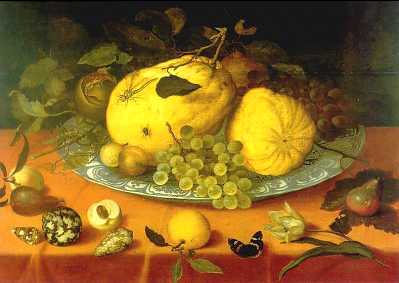
Balthasar van der Ast, Fruit with Shells, 1620
There is another way we fight, though. Remember how I said that fights are in the past tense? Remember how I said that they come because there is an affective state attached to a person before the incident that sparks the fight? Sometimes, people do not seek necessarily to get the other person to think the same things, but to feel the same things.

If you made me angry with what you did, I am angry. Now, when I call you into my office, I could explain your error and wring a confession out of you, show your error and teach the right way, ask for a narrative and see if you confess your error, or show the error and explain how that makes me look. I can pretty quickly get you to agree to never do it again, and you may do it again afterward or not, but it probably won't be lack of respect if you do.

Some people, when angry, do not want to have the other person see the right. In fact, the way the boss will explain things will demonstrate this. "So, Jane, tell me about typing up the assessment report."
"Well, I looked at the guidelines from the NEA and compared those to the SACS requirements and took the material we had submitted last year as well as this year's statistics, and I put the new data into the fields for instruments. I then changed the narrative for the learning objectives to match the updated statements, like you said to do. And. Um, that's... Oh! I called Renee to be sure that we were using the right form this time."
"And did you think about the Mission Statement?"
"The Mission Statement is listed."
"Oh really, Jane? Perhaps you can show it to me, then. Considering the fact that I distinctly remember telling you that the Mission Statement had to be at the top of every form, I'm at a loss to see where it is. I swear! First you don't put it in, and then you use the one from fifteen years ago!"
Many of us work for Executive Hardcase.
It goes on like this. (I apologize for any workplace flashbacks. I drew upon a real boss of mine for the above, where I was Jane.) Now the boss in this case is not looking to fix anything. The boss is not even being a sadist. The boss is, rather, fighting for the same objective, but a different value as other fights. He wants sympathy/remaking. In this case, he is angry, and he demands that the employee be made to feel the emotion that he was made to feel.

This is something that often separates masculine and feminine discourse in argument, as well. It is by no means always the case, but it is often the case that women will fight for an emotional sympathy. "You made me feel unhappy, and this fight is not over until you show that you feel as unhappy as you made me feel" is the dynamic of the argument. Is it fair? It's not any less fair than, "We won't stop until you agree with my logic" is. Both, in the end, are about achieving an overwriting of the other's state to show the power of the one, even as, paradoxically, they seem to be revenge. The person not letting go until fear is achieved is doing so because she or he felt powerless against the other inflicting that emotion.

The only reason I feel like sharing this guide to How We Fight is to bemoan a simple fact. The fight that depends on agreeing with propositions has a sort of annihilating draw option. There is a way to walk away in silence, with both parties thinking less of the other but peace achieved. In the instances where a person demands emotional pounds of tears, I know of no such thing. Perhaps skilled acting might work, with the cost only of integrity, but I don't know what to do with someone who wants anger from me, or sadness from me, because, honestly, that's asking for something that's not in the public sphere.

Monday, March 12, 2012

Ennervation Never Knows


"I can endure my own despair,
But not another's hope." -- William Walsh

The child skins its knee, and the pain is the worst of its life. It moans and keens with all of its mind at the unending and raging pain. The adult cuts itself with a knife while doing a routinely dangerous task, sucks air between its teeth, curses, sends reason to caution the primitive mind, invokes time's wisdom to know that all pains end, rushes to find unguents, wraps the wound, closes its eyes in mastery, and controls the impulse of pain. The older person's night time undressing reveals wounds along the legs, dried blood smears like comet tails from punctures on the forearm or thigh, and fear, a dull fear, comes up, and the older person asks itself when these damages happened, which enemies had struck during the night, and how unprotected it is against the environment, and then its reason and sense of time, stronger now than the senses of touch, say that such things are predictable and inconsequential.

The teenaged boy jostles its friends. They slam dance to socialize, because the little demons that inhabit them will not allow stillness, and looking one another in the eye would be faggy, and they rate women. The most imaginary flaw could cause emesis or impotence, they claim. Else nothing could stop their mighty virility from accomplishing its mission, but they would demand that the waif lose weight and the buxom woman get enhanced.
Their oppositely arrayed army mourn the imperfection of all the boys and perfection of all the imaginary men. Those who breathe are vile, and those who shimmer on screens or reflect from pages have every desire locked inside them. These here are immature -- a just complaint if ever there were one -- but those. . . those understand. Those are prettier, kinder, and listen.

The older person fails to notice. The mate, even the child, was a formula solved some time earlier. Since that time it has remained an integer of certain quantity and an attribute of certain quality. Only the things that are jarring, disagreeable, unsolved show up, and these as things that will not rest, will not allow the natural process to go its way. The woman cannot believe that the man isn't taking things seriously, as he is happy all the time, which means that he is indifferent, and the man cannot believe that the woman can never be satisfied, as things are not in crisis, and they have both formed conclusions. It is now just a matter of time between fights and resolution.

Ahem.
Sorry about that. Rather grand sounding, isn't it? After all, it is the way of us to be fresh and then grow stale, to lose connection to our sense of each thing as time goes on. People speak of the senses growing dull. Ears, eyes, tongue -- each has its own diminishing returns. However, there is also a simple process of ennervation, whereby the nerves running to these senses decrease and our ability to feel decreases. Ennervation is aging, and all of our awareness follows the pattern of the physical.
"I've got a wild man wizard, and he's hiding in me.
Illuminating my mind." -- Harry Chapin, "Taxi."
In youth, a fantasy strikes, and it fills up the horizon, fills in the holes of the heart left by disappointment in strength, attention, love, accomplishment. In youth, we can devote days to exploring our other selves: the knights, the shield maidens, the saviors of D-cup desperate women wearing thin their leather bikinis, the neglected beauty of the realm of power discovered by the lovely man, the radioactive scientist, the battle hardened soldier of either sex, the gang star, the respected woman who wins all she desires by her fire-hardened femininity and toughness, the cowboy, the Indian, and we can write it out in dreams -- visual, poetic, waking, sleeping, and prose.
"Julie Daydreaming," by Berthe Morisot
  As adults, we toy with our psychic familiars, pulling them from the closet in times of stress, embarrassed to be seen in public with them. Older still, we cannot capture even a half hour of what was once whole days of fascination, and we have no patience for reading or seeing another person's dreams realized. 'Oh, that fantasy book series is treacle for teenagers,' or 'That series on HBO is some middle aged guy's fantasy life; whoopee for him,' we say. The truth is that we feel guilty looking in at what we had.
I do not mean to complain of time's many gifts.
"Death and the Girl," Ego Schiele, 1915

 Our greatest desire, when young, and we do not know it, is to be free of the "insane and furious master" lashing us (Republic 329), lust. Our greatest desire as adults is to cease being the half-persons that everyone since Aristophanes has said is the way of sex (Aristophanes says, in Symposium that we were one ball, and we were trying to be gods, so Zeus split us in half, into male and female, and now we spend all our lives trying to reunite). In age, we can call on lust unreliably, but it's there, and the raging fire becomes a steady flame.

When young, a disappointment leaves us screaming our nights away as surely as the scraped knee left us howling as toddlers. Anger goes to destruction. We wish we could escape our own ability to feel so deeply. Time takes care of that, at least for a while.
By practice and discipline, we can tame the winds of youth. There is less to help us feel again when the nerves no longer connect. And, at last, when they reach no farther than the mind itself, there is no place for feeling to go but to the mind itself, and we go back again to our impulse, desire, and wish.

Monday, March 05, 2012

Once

I have found myself in the unenviable position of explaining punk rock to a generation that has no contact with it. It has heard the term, but the meaning of that term is at least doubly remote. It is remote in the sense that any musical movement is a fossil due to the destruction of radio, and it is remote in the sense that whatever this movement denoted, it simply is neither spoken of in a coherent manner nor played on whatever musical media as exist.
Photograph by Man Ray

"Well, like, um, The Clash?" crickets. "Ok, Blondie?" Nope. "Talking Heads? The Police? The Buzzcocks? Joy Division? The Ramones?" They have, some of them, heard of The Ramones, largely due to the habit of set decorators and costumers in Hollywood to put Ramones paraphernalia in television shows and movies. Now, a fair amount of what they have heard is punk at two removes, but the all stars of 1977 - 1985 are unknown to them.

Honestly, it is not germane to anything, and so I should not spend precious seconds mentioning any of this irrelevant history to college students, as both the free market and the shifting historical record that is culture have determined that what changed my world has been erased, but I have devoted perhaps five minutes, total, to this task, and I usually mention, as an example of the kind of punk I was, Talking Heads. I'll focus on what I think is the song they're most likely to have heard, "Once in a Lifetime." (Actually, "Burning Down the House" is more likely, I guess.) I tell them to imagine that they woke up one morning with complete amnesia. Imagine looking at their lives without any history at all. Just look at where they are and who they are at this exact moment. Cut a slice through time like a slide under a microscope and examine it. What conclusions would you draw?
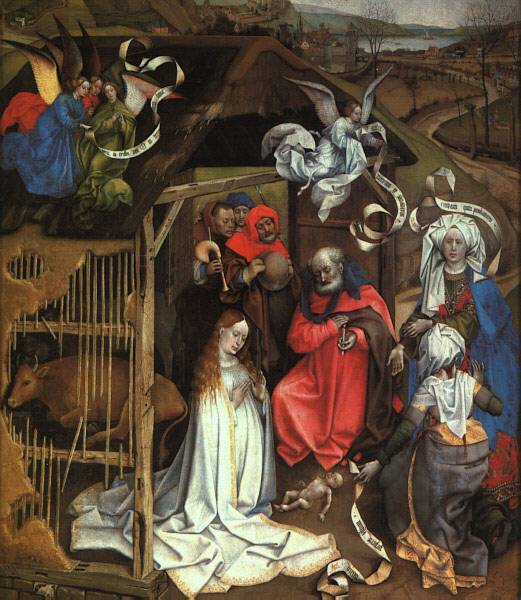
The Nativity, Robert Campin

"That's deep," they say. Yes, I say.

W. H. Auden squeezed a whole anthology entry out of Breugel, so I figure I can use the Master of Flemalle for a blog post. Auden was talking about suffering's banality as a corollary of the banality of evil, though. If the Nazi executioner might look like a businessman, then the martyr might look like a piece of paper crossing that businessman's desk.

What I try to tell kids, from David Byrne's artistic game, is about the nature of hierarchy in time, how sense-making depends on time and how lost emphasis is without priority. When I was a collegian, exploring everything, sticking my tongue into every crevice and trying to pry the lid off of every jar, Mr. Byrne was always the upper classman I admired. He was ahead of me intellectually and creatively. He had cooler friends, and he did the drugs I never would, but he and I were thinking along the same lines, but I was following.

Now, I have probably caught up with him intellectually. He still has some mighty cool friends, and money frees him to a courage that I will never have. Reading his journal, I have to say that he's awfully interesting and still more creative than I'll hope for, but he's no longer commanding spaces I haven't seen.

We were both interested in the idea of how the createdness of art altered its experience. We both wondered about how everyday utterance was shaped by ritual and how poetic cadences had roles in the group experience.

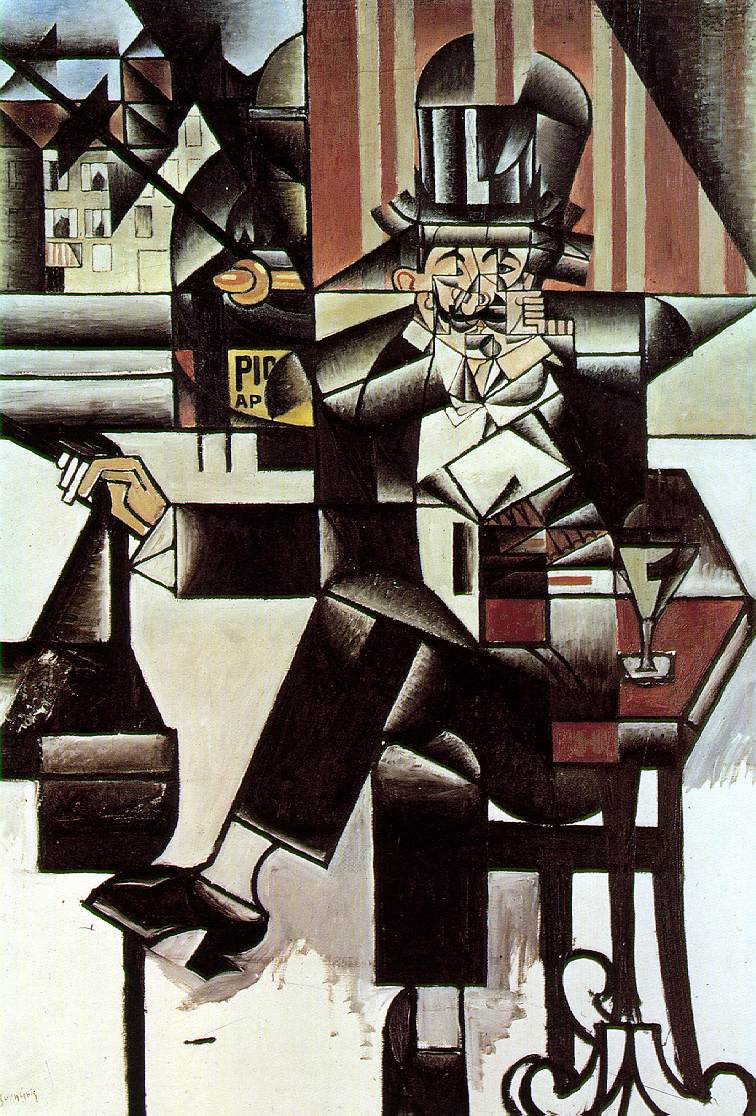
The Man at the Cafe, 1912, Juan Gris
What is the present moment?

In truth, not only do we fail to understand the slices of living and perceiving that together go into the narration that we call "our lives," but each individual moment is itself unperceived for the most part. Even without going to the radical Taoists and asking that we know all the sky, water, earth and that we lose our selves in the process, there is simply more of you than you will credit at a single time.

Your "now" is only the part of sensation and memory and desire that crosses into the organizing facility of the mind. If the ego is "the thing that knows what sort of person you are," then "now" is merely what the ego wishes to credit. There are a thousand things that a "person like you" or that "you, in particular" would not care about that are happening to and with you at this instance, and these are silent. They leave no impression on the tablet.

I do not know what is happening. I only know what I said happened.

One time is no time, after all, because we are continuous if we are at all.

Thursday, January 19, 2012

Why is the Gin Grinch saying these mean things?

I'm thrilled that Newt Gingrich is getting some of the negative attention that he has deserved for decades. He has enjoyed a Pat Buchanan like existence -- uttering troglodytic slogans, spitting poison, retreating to a cavern of stink, and always, always, always getting paid. Finally, though, his millionaires have met up with Romnoid's millionaires, and Newt's getting Newtered.

That said, he hasn't changed. There are three stages of a newt's life cycle. There is the newt in repose, when it gathers resentment and money, the newt campaigning, when it empties its bladder of all the stored resentment, and the newt sunning itself on the rock while in office, which is the time it picks on flies and claims to be defeating dragons.

However, Newt Gingrich, from Pennsylvania, found a niche in a defense contractor dominated area of Atlanta, and he migrated into that area and expanded to fill it completely. When he lost his position in Congress, he played dead, perhaps, but he is an old pro at playing possum. Once he was no longer Speaker of the House or minority or majority whip, what was the harm in putting him on Meet the Press FIFTY-THREE TIMES? After all, as an unelected, non-policy person, who could be more germane for a Sunday show?

I know that Mitt Romney is supposed to be the "perfectly lubricated weather vane," but Newt is self-lubricated. As for where he points, it is not where the voters push, but where they pull. Himself, he goes here and there, spinning as ego and carnal bliss may lead, but as a campaigner? He has one trick.


It seems tone deaf, if not suicidal, for Newt to go for the racial folderol, doesn't it? Even an audience that booed Jesus Christ applauded (lightly) when Juan Williams pointed out to Gingrich that his garbage about "Food Stamps" seemed racist. In 2008, the United States elected its first African American president, and it did so with a huge popular vote margin. Racism, qua racism, doesn't really win.

It's just that Newt is a salamander of habit.

We got our first taste of "strapping bucks" buying T-bone steaks with food stamps in 1980 from Ronald Reagan. It is possible that, in this age of more-lunatic-than-Reagan economic politics from the Republican Party, we have forgotten what Reagan Republicans looked like. It was Reagan who gave us "Welfare queen" and the "young buck" in 1976, and he kept the language going in Philadelphia, Mississippi. Newt liked. Newt learned.

Reagan Republicanism is misdirection at its most basic. Gingrich is caught. He has lost his ability to appear financially right wing, thanks to the bane of the far right wing corporate attack ads aimed at him. He has lost the ability to be the moral majoritarian, thanks to all the stained bedsheets being waved about. These are his winning issues! He has lost his stance as the smart guy by being exposed as silly, stupid, wrong, and extremely arrogant.

He has nothing, so he goes to the one thing that always works: the flashpot distraction of "lazy Black people are taking your money." It has always saved him in the past, and it's working for him now.


The most significant problem with Newt's flashbang grenade is that the room is too small.

You see, the diversion is working for him, among primary voters who boo Jesus Christ. This group wanted to be convinced only that there was a reason not to succumb to the inevitable Mittens. He has been able to interrupt everyone else by saying, "Don't you hate Welfare queens and gang bangers getting rich in their lazy 'hoods off of your money? Have you noticed that the President is a . . . guy who helps those people do that?" They were saying, "Gingrich has no economic plans as radical as ours, has no social policies as vicious as ours, and he has been free with his penis, unlike us," since the burden to pass for primary voters appears to be radicalism. He has succeeded only by saying, "Maybe, but I'm willing to say racist things in thinly disguised code without apologizing."

The most essential problem with Newt's turn is that it's a repeat. I don't mean by that, by the way, that racists have learned anything.

Have you noticed that Newt never campaigns on his Congressional accomplishments? Wouldn't you expect the legislative leader of the Republican Party in opposition to a Democratic president to campaign on successful legislation? Wouldn't you expect him to boast of his Contract On America? In 1994, Newt announced a takeover. He had a vision. He and his party were going to flat out dictate legislation.

You see, they succeeded. That's the thing. Newt should be campaigning on all he accomplished, because he got his way!

He SHUT DOWN THE GOVERNMENT to prove that "government isn't the solution to the problem. Government is the problem." The nation did not agree. You see, the truth, which is that the government is made up of the people, that our government is us, was made quite clear. Furthermore, he CLEARED THE WAY for corporate contributions to campaigns. He set in motion the destruction of Glass-Stegal that led to the banking collapse. He enabled the merger-mania that made Mitt Romney millions. He cut the capital gains tax so that Mitt Romney could draw ten million dollars a year and pay 15% in income taxes.

Why isn't Newt bragging about all that? Don't Republican voters like what they want?


More particularly, though, Newt's signal success was making good on his promise to get rid of all those lazy Welfare queens. The Welfare Reform Act of 1995 is Newtie's. (I vowed not to vote for Clinton's second term when he signed it.) You see, Newt Gingrich killed Welfare. It doesn't exist anymore.

Under the new thing, no one may receive aid for more than three years without being disabled. Therefore, it's three years and then starvation, so no "ten kids in a Cadillac." Foodstamps also ended. Both are now state programs. This has allowed vicious states to be vicious to the poor and humane states to be less vicious, but no one is being kind, or even reasonable.

In other words, Newt has to claim to have had no successes in order to campaign on lazy people on Welfare. He would rather present himself as a failure to repeat his 1980's campaigns than give up the dodge of racism. The campaign racism of the 1980's was bull to begin with, of course, because, when Welfare did exist, it went to Caucasians at a rate greater than demographic percentages would indicate, and Food Stamps are primarily to benefit dependent children. No one is a "buck" with a T-bone, but no one ever had been.

Never mind that, though: reality is not what Newt wants. It's not what he can afford.


Incidentally, this...

This is very funny and very well done, and don't even bother trying to tell me that it isn't, because there is "well constructed wit," and that's different from "I was in the mood to laugh."

Thursday, January 12, 2012

I Get Mitt

“I like being able to fire people.” – Mitt Romney, January 9, 2012.

People complain about Mitt Romney. They say that his followers are Romnulans. They say that he is a Romneybot. They say that he is a failed experiment by the Blue Fairy, who got bored of granting the wishes to suspiciously loved pediatric puppets and decided to see if she could turn a real boy into wood.2 But I get Mitt. Mitt's a regular guy, and his quote from the Chamber Com/Mers was proof of that.3

While candidates of questionable patriotism like John Huntsman might think the sentiment makes Mittens “unelectable,” I, and CBS Money Watch's Suzanne Lucas, know that Mitt was just being a regular guy!  It's probably going to win him votes among highly successful people.4

All Mittie meant, according to Ms. Lucas (and I'll bet she's really pretty!) is what Thomas Carlyle said earlier:
Whoever has sixpence is sovereign over all men – to the extent of the sixpence; commands cooks to feed him, philosophers to teach him, kings to mount guard over him – to the extent of sixpence. – Carlyle, Sartor Resartus 5
Now that Carlyle guy's character is poor, but the poor people get to fire people, too, and Mitt's unemployed! He doesn't even get a paycheck! So Mitt, just like every other regular guy, just means that he likes being able to say no to the people who fail to please him, and don't we all?

He's a regular Joe six-pack, complaining about the government. Those guys who make more money than he does and do an inferior job. It's the right -- nay, the pleasure -- of successful men to tell off inefficient and lousy workers as you demand better service.

A highly successful American man.


I remember, once, when I was in the small (I guess it's a town; "farm," "manorial estate," and "smear" all seem to miss the mark) of Dunwoody, Georgia. This town suffered from an infestation of money. There was an insidious rot of the stuff everywhere, but especially in the homes and cars, and I was in what was then its shiny new mall, called Perimeter Mall.6 I was in line at the McFood's, but I was unable to practice my love. A middle aged man was in front of me, and he was yelling at the counter help.

The beef patty in his bread sandwich was not warm upon reaching the plastic tray, and the condiments were applied unevenly. Furthermore, the pommes frites were tepid. He demanded . . . . Well, I wasn't entirely clear what it was that he demanded. He refused a coupon and a replacement. Instead, he was telling the counter boy that HE KNEW what it took, that HE had spent years in business, and YOU DON'T GET AHEAD by giving an inferior product.

The boy behind the counter looked as though his head were about to explode.7 Myself, I wanted to rabbit punch the business expert very much. I even formed a fist with one knuckle protruding, and I was examining his medulla oblogata.8 I thought it would be easier than asking him at what point he had gotten confused and believed that he had wandered into a three star restaurant or mistakenly assumed that he had paid for food of higher... well, food.

Now, though, I get it. That was Mitt. He was firing someone.


When depression strikes, and it strikes with a wet thud most of the time,9 some people hit the chocolate pie, some people regress, and a lot of people go for “retail therapy.” Taken to any kind of reliance or extreme, buying one's way out of a funk is a disease, but going down to the hobby store to buy a $1.29 Guillow Glider can be an enjoyable lift of the spirits. Put $25 in your pocket and go to the dollar store, and you can feel like king or queen of the world. Carlyle's quote comes true: you command the earth to the extent of that $25.

You become the Disney Princess, the Man of Largesse. Go to Krystal or White Castle, and you can purchase whole hamburgers for less than a dollar. This is that necessary, joyful illusion of prosperity and comfort and, most dear of all, power over one's tiny, crashing world, that we all have available to us to some small extent, if we have some employment.

Not everyone wants to be the Princess, though. Some people want to be the Queen.
”I don't want to get married. I just want to get divorced.” – Natasha (Jessica Harper) in “Love and Death”


Mittie's one of us, you see. He likes to lift his spirits by going out and, to the extent of two hundred and fifty million dollars, telling people that they're not good enough.10

You enjoy yelling at the mail man and paper boy, don't you? Well, so does Mitt. It's just a question of scale. If you have a problem with the difference in scale, it's not because Mitt's different, but because you're envious of him. It's true that he may have to buy up a company in order to demonstrate to it just how inferior it is, has to hire it in order to fire it, but that's again just a question of scale and envy on your part.

Some children go through the “fa-da” phase. (Ok, all children do, although I promise that I didn't. I only went through the fa so phase.) This is when they demand that Mommy give them a toy so that they can throw it on the ground and demand it again. It is great fun for the infant, because it proves that the infant has power. Some infants get stuck in a pleasure principle of gathering in, and others a destructive principle of tearing down11, and that's just how it goes -- but that's totally normal, just a regular guy kind of thing. The people who get into the love of accumulating can end up being addicted to things, I suppose, but, on the other hand, the ones who like to destroy make good human resources people.

So let's all give Mittie a break. He's a regular guy. He just likes to be able to fire people. Surely that bodes well for all of us as his employees, if he becomes president, doesn't it?
==Notes==
1.
    There is no first note.
2.
     I think it is entirely unfair to the conifer and angiosperm phyla to accuse Mitt Romney of bearing any relation to them. Furthermore, although the dream of a little boy born to a bachelor could be read rather, err, curiously today (just why did Giapetto want a boy he could control?), I think that it isnot true that those who call Romney wooden are trying to contrast the Mormon church's superfetation with the Roman Catholic Church's recent difficulties.
3.
     The connections between the Chambers of Commerce and SMERSH are well known. One has only to look at the video of Romney's remarks to spot several doubtful looking individuals.
4.
     Super effective people don't read books. They read summaries on the web that are based on summaries gotten from hornbooks.
5.
     If Carlyle had staid like he was when he wrote Sartor Resartus, more people would like him today. That book was sort of the last hurrah of the younger generation of Romantics, the last gasp of aestheticism (but no one told Aubrey Beardsley that). Unfortunately, he started making kissy faces at the boots of Great Men. . . and so did his wife, I think. . . and his historical view started getting pretty oily.
6.
     This mall was named for its proud stature of riding the "perimeter highway" of I-285, which is itself a strange thing, as "interstate" 285 goes around in a circle and therefore does not go inter state at all. It does, however, mark the state of "Atlanta, those people, it, what can't come out here" and "Us, normal folks, you know?, do I have to spell it out?, nice places." The demarcation was entirely economic, of course, and completely polite. Except in Stone Mountain. And Cuming.
7.
     This was not because he was going to holler back at the cretinous monster in his face, but rather due to the state of his acne.
8.
     Look at your dominant hand. Clench a fist. Now, stick your second finger knuckle out a bit by means of bedding the nail of that finger against your thumb. Be vewy vewy quiet as you approach the important business executive. Smile and stand behind him. When you hear, "Oh, sure, Obama wants to tax the top 2% of our income, but then it'll be 50%, and it's like Russia" or some other bit of insane certitude, bring your dominant hand back even with your ear, and strike quickly at the base of the offender's neck. Laughing hysterically or jumping up and down in glee is not necessary.
9.
     It can also fall like night, creep like a thief, strangle like a pillow, drown like a flood, massacre like a battallion of syphilitic cossacks, snipe like a myopic sharp shooter,  or overpower like a 1949 Oldsmobile sedan being swung on a pendulum from behind you.
10.
     Of course it's completely unfair to suggest that a highly successful businessman would spend his entire net worth on buying things in order to savage them. After all, his five boys have their ten million trusts, and he has operating capital. He probably operates on less than a tenth of that total worth -- $20,000,000.00 or so -- so it's hardly worth talking about. Chump change, really. Not enough room to maneuver, really, even when it's a buyer's and firer's market.
10.
     Bet you thought I was going to go for the anal retentive/anal expulsive thing, didn't you? Well, I'm not. I don't even know about that.